
 Worksheets
Environmental Management Review IGCSE
Total questions: 60
Worksheet time: 2hrs 40mins
1,0,1,5,6,3,4

12,10,10,10,13,12,11,13,10
5,11,2,12,4,2
4,2,7,4,3
2, 57, 38, 42, 6
5, 0, 9, 9, 3, 0, 5, 5, 4
28, 18, 19, 18, 17

TRUE about Minerals:
Inorganic
Naturally occuring
With chemical composition
All of the above
Refers to a mineral’s ability to scratch another mineral or be scratched by another mineral.
Luster
Hardness
Streak
Specific gravity
The basic building blocks of rocks:
Crystal
Acids
Magma
Minerals
As igneous rocks become more mafic,
the color becomes lighter
the color becomes darker
the density gets lighter
the texture becomes fine
Igneous rocks are also known as
Clastic
Bioclastic
Crystalline
Extrusive
Intrusive
Foliated
Non-foliated
Metallic
Nonmetallic
Clastic sedimentary rocks are also called
Crystalline
Bioclastic
Extrusive
Fragmental
Metamorphic Rocks are formed through the process of
Deposition and Burial
Heat and Pressure
Weathering and Erosion
Melting and Solidification
Minerals can be classified through
Composition
Texture
Crystal Size
Texture
Grain Size
Composition
Luster
Hardness
Streak
Luster
Color
Composition
Most igneous rocks are formed by which process
Erosion and Deposition
Heat and Pressure
Melting and Solidification
Compaction and Cementation
The best evidence for determining cooling rate of an igneous rock during its solidification is provided by
the mineral composition
the crystal size of its minerals
the index fossils
faults in the rock
The physical properties of minerals are determined by
their streak and color
their luster and hardness
the internal arrangement of their atoms
their composition

Energy is ______.
a force acting on an object.
electricity moving through a wire.
the ability to make a physical change in the universe
the power in a system.
Select all the renewable energy resources from the list below:
Oil
Wind
Gas
Solar
Geothermal
In general, what happens to the climate (of the Earth) if more greenhouse gases are released (through human activities and natural occurrences) into the atmosphere?
Average temperature goes up
Average temperature goes down
Average temperature remains the same
None of the above
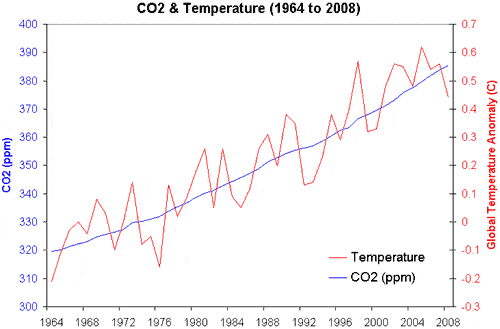
The graph below shows CO2 emissions and temperatures from 1909 to 1949. What conclusion is best supported by the graph?
There is no relationship between carbon dioxide concentrations and temperatures
As carbon dioxide concentrations increase, temperatures increase
As carbon dioxide concentrations increase, temperatures decrease
As carbon dioxide concentrations decrease, temperatures increase
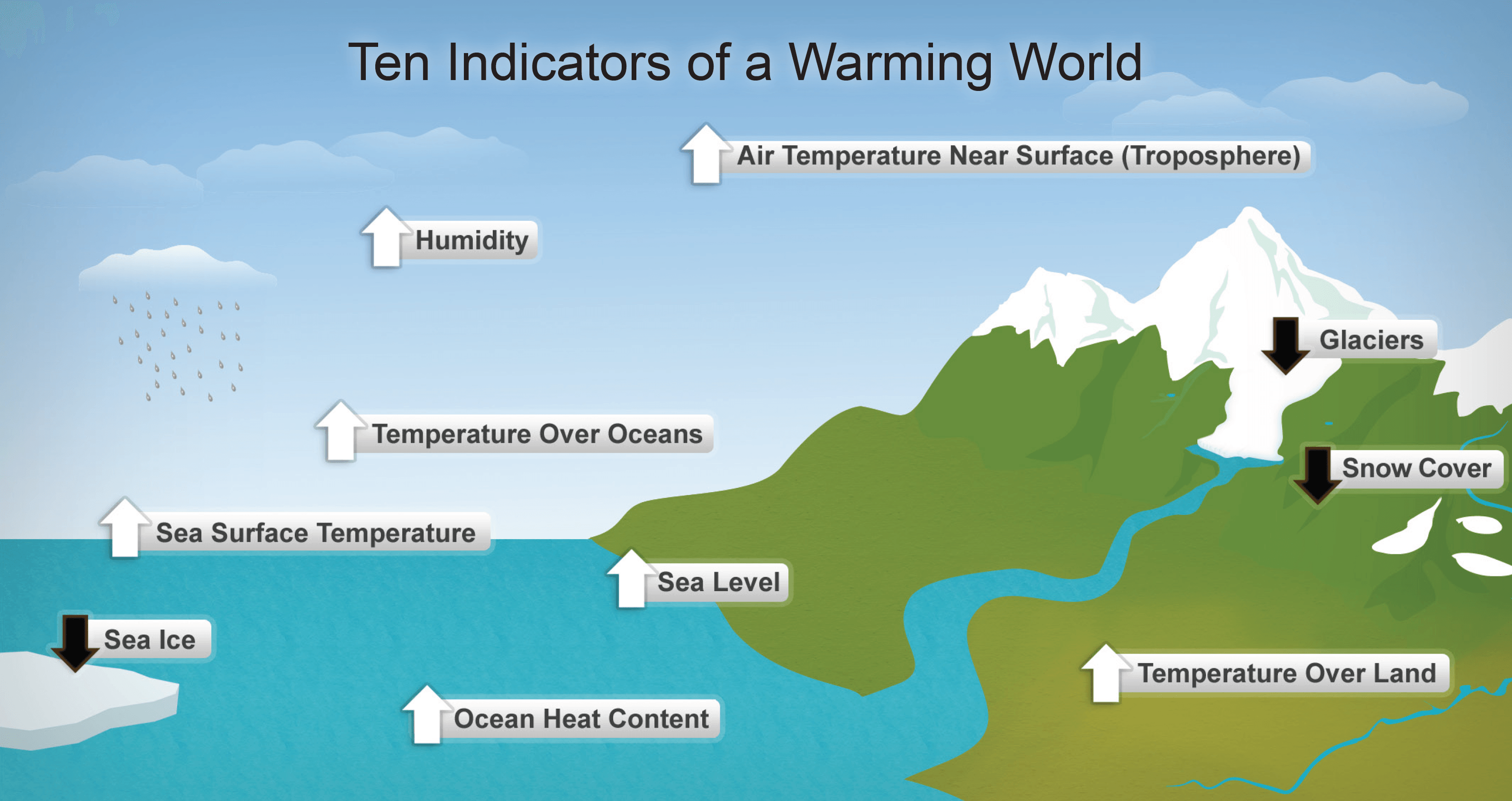
Without the Greenhouse Effect the Earth would be...
too warm for life
too cold for life
Why does the Earth heat up?
This happens when the amount of radiation emitted by the Earth is greater than the amount it absorbed.
This happens when the amount of radiation absorbed by the Earth is greater than the amount it emits.
This happens because the Sun gets bigger and emits more infrared radiation.
Which statement is true?
Climate change leads to the increase in greenhouse gases which leads to global warming.
Global warming leads to the increase in greenhouse gases which leads to climate change.
The increase in greenhouse gases leads to global warming which leads to climate change.
The approximate population of the world today is..
7.6 Million
6.7 Billion
6.7 Million
7.6 Billion
What is the world's most populous country?
India
China
U.S.
Mexico
Demography is:
The study of democracy.
The study of human populations.
The study of graphs.
The study of ecosystems.
Which of the following is NOT an example of a Density Dependent Factor?
Parasitism
Natural Disasters
Predation
Competition
A density-dependent limiting factor only becomes limiting if:
A population begins to decrease in size.
Random events occur in nature.
There are predator-prey interactions.
A population reaches its carrying capacity.
The movement of individuals into an area is known as:
Supplementation
Emigration
Immigration
Eradication
Typical population growth is described as:
Logarithmic growth
Logistic growth
Linear growth
Exponential growth
Which of the following is NOT a purpose of an age structure diagram?
Shows percentages of a population.
Describes why a population graph has a certain shape.
It tells us about the number of males and females.
Breaks down percentages of a population based on age group.
Emigration is:
When a population continues to increase.
When individuals move into an area.
When individuals move out of an area.
The study of human popuations.
Which of the following would cause a population to increase in size?
Emigration
Decreased Birthrate
Immigration
Increased Deathrate
In a given area, if the population of predators increases, the population of prey will _____________.
increase
decrease
remain about the same
go extinct
Which factor would contribute to an exponential growth rate in a given population?
higher death rates
less competition
less resources
lower birth rates
All of the following are density-independent factors except:
seasonal changes
hurricanes
less space
deforestation

The movement of tectonic plates is due to ____?
convection currents in the mantle
seafloor spreading

What is true about the Earth's plates?
The are made of solid rock that can never be seen.
They are made of solid rock that can be seen if not covered by soil, rock, or water.

As plates pull apart, what happens?
Loose rock material fills the empty space.
New plate material fills the empty space so there is no space left.

What is true about the Earth's plates?
They are separated by oceans.
They fit closely together with each plate touching all the others.

What happens when continental plates press together?
The edges of the plates will push upward and continue to move toward each other.
The edges of the plates will be pushed downward and continue to move toward each other.

Two of Earth's plates pressed together for millions of years. What happened?
The oceanic plate was pushed downward
The continental plate was pushed downward.

What kind of diagram would show how three of the Earth's plates fit together?
They would be next to each other and have a space between them.
They would be next to each other and have no space between them.

What is true about the layer (lower mantle) below the Earth's plates?
It is solid rock.
It is slightly softened rock like clay.
What is a natural hazard?
Burning yourself on the iron at home
A road traffic accident
A natural event which causes a threat to human activity or people
A natural event which involves a human causes hazard
Which of these are natural hazards?
Volcanic Eruptions
Earthquakes
Tsunami
Cave Arches Stacks and Stumps
What is a hazard risk?
Chance or probability of being affected by a natural event.
The risk of falling over
The chances of falling into a volcano
Chance or probability of being affected by a human event.
What are tectonic plates?
Extra large ceramic plates
Sections of the Earth's crust that are divided up, their margins create volcanoes and earthquakes
The Earth's crust
The top of the earth
Which one is the odd one out?
Crust
Inner Core
Outer Core
Mantle
Subduction Zone
What features are found at a destructive plate boundary?
Subduction Zone
Fold Mountains
Volcanoes
Magma Sinks

