
 Worksheets
Force and Motion POST-TEST
Total questions: 75
Worksheet time: 1hrs 20mins

What is the resultant of these two vectors?
+17 m
+3 m
-17 m
-3 m

What is the resultant vector of the two labeled vectors?
+2 km
+14 km
-2 km
-14 km
A vector includes ______ and ________.
direction, magnitude
magnitude, units
direction, units
scalars, scalars

How do you combine vectors if they are in opposite directions?
Add
Subtract
Draw Tip to Tail

How do you combine vectors if they are in the same direction?
Add
Subtract
Draw Tip to Tail

This chart represents the velocity of a motorcycle over time. Select the correct statement regarding the motorcycle's movement.
The motorcycle is speeding up.
The motorcycle has 0 acceleration.
The motorcycle is slowing down.
The motorcycle has constant acceleration.

If you traveled from Point A to Point B to Point C, what would your DISPLACEMENT be?
3 miles
4 miles
5 miles
7 miles

Velocity is different from speed because...
Velocity is distance/time. Speed is displacement/time.
Velocity is speed in a certain direction and can be positive or negative.
Speed is velocity in a certain direction. Both can only be positive.
Velocity is how much speed changes over time.

This chart represents the velocity of a bicycle over time. Select the correct statement regarding the bicycle's movement.
The bicycle has constant velocity.
The bicycle has constant speed.
The bicycle is accelerating.
The bicycle has 0 acceleration.

The image shows two cars with the same speed moving in different directions. What is true about the velocity of the cars?
Each car has the same velocity because the speeds are the same.
Each car has a different velocity because they are going in different directions.
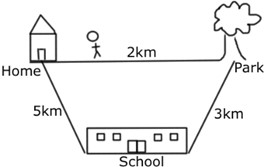
Jerry walked from home to school, then from the school to the park. What is his total distance?
2 km
5 km
8 km
10 km
Jerry walked from home to school, then from the school to the park. What is his total displacement?
2 km E
5 km N
8 km S
10 km W


What is the object's displacement from t=0s to t=6s?
6m
0m
14m
-14m

What is the object's distance traveled from t=0s to t=6s?
2m
14m
0m
-2m

What is the object's velocity from t=0s to t=2s?
2m/s
-2m/s
1m/s
-1m/s
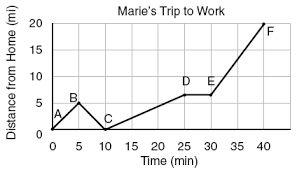
When was Marie driving the fastest?
C to D
D to E
E to F
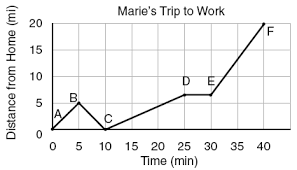
During what period of time was Marie stopped?
0-5 minutes
5-10 minutes
10-25 minutes
25-30 minutes
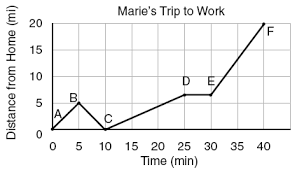
How does her speed at 3 minutes compare with her speed at 7 minutes?
She is driving faster at 3 minutes.
She is driving faster at 7 minutes
She is driving forward at 3 minutes and back at 7.
She is moving up at 3 minutes and down at 7 minutes
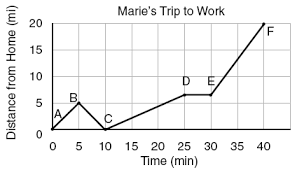
It usually takes Marie 30 minutes to get to work. Did her trip take...
The average amount of time.
Longer then average amount of time.
Shorter then average amount of time.
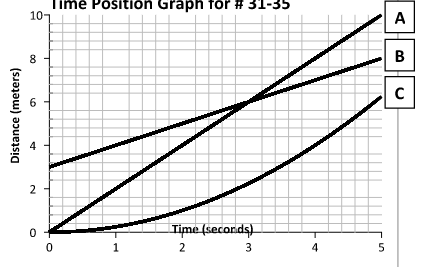


What is happening at E?
Stationary
Accelerating
Fast steady speed; moving away from the starting position
Steady speed; returning to start position


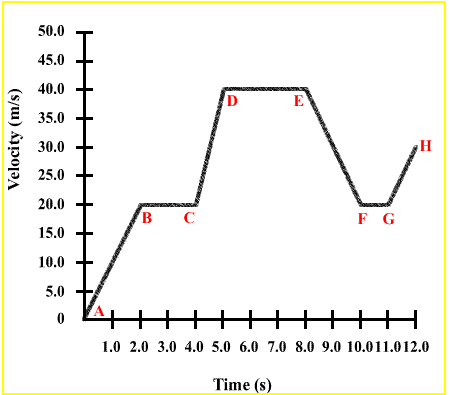
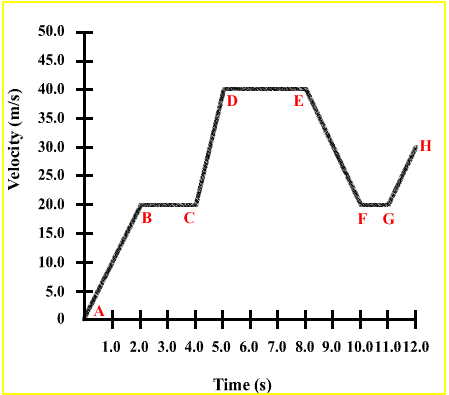


The object has constant velocity
The object is speeding up
The object is slowing down

The object has constant velocity
The object is speeding up
the object is slowing down

The velocity vs time graph below shows an object that is
speeding up
slowing down
moving at a constant velocity
not moving

Refer to the velocity - time graph of a fast moving car below. At what time did the car reverse direction?
at 2 seconds
at 4 seconds
at 6 seconds
at 7 seconds

Refer to the velocity - time graph of an ultra fast moving car below. In which segment is it not moving?
Segment B
Segment D
Segment F
A leftward force is applied to a crate to push it across the floor at a constant speed. Which is the correct force diagram?


A hockey puck glides to the right across the ice at a constant speed. Choose the right force diagram below.


A downward-moving skydiver who has just opened the parachute is slowing down. Which force diagram shows this sitation?


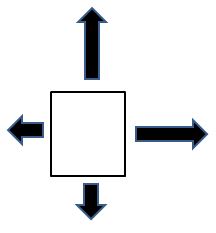
This object is being pushed on a surface. What direction would it be moving? (pick all that apply):
up
down
left
right
A leftward force is applied to a crate to push it across the floor at a constant speed. Which is the correct force diagram?

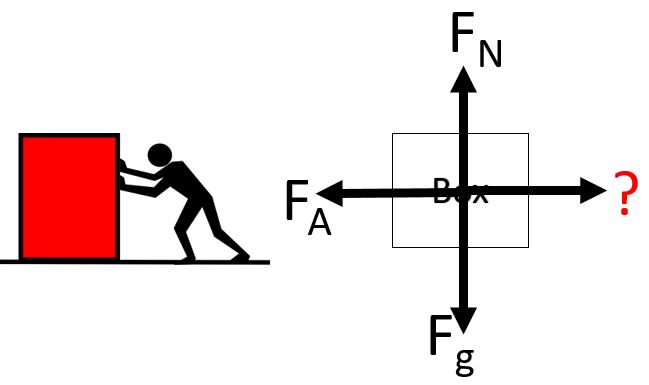


The support force exerted upon an object that is in contact with another stable object.
Gravity
Electrical Force
Normal Force
Which of the following is a balanced force?


The down-arrow in this diagram is most-likely:
gravity
normal
a push or pull
friction
The up-arrow in this diagram is most-likely:
gravity
normal
a push or pull
friction
If this object were moving right, the left-arrow in this diagram is most-likely:
gravity
normal
a push or pull
friction
Which diagram best shows person pushing a couch (accelerating) across the floor?


Newton's 1st Law is also called the Law of ...
Friction
Inertia
Unbalanced forces
Newtons
An object in motion tends to stay in motion, and an object at rest tends to stay at rest unless an ___ force acts on it.
unbalanced
balanced

Describe what will happen to the truck in this picture
Accelerate
Decelerate
Constant speed
Stationary

Describe what will happen to the truck in this picture
Accelerate
Decelerate
Constant speed
Stationary
A 20 kg bike accelerates at 10 m/s2. Calculate the force on the bike.
25 kg
20 N
200 N
10 m/s2
Jenny applies a 60 N force to a 20 Kg cart, what is the acceleration of the cart if friction can be neglected?
1200 m/s2
0.33 m/s2
20 m/s2
3 m/s2
An object accelerates 5 m/s2 when a force of 20 newtons is applied to it. What is the mass of the object?
4 kg
20 kg
0.5 kg
2 kg

According to Newton's second Law, which would take more force to slow down?
The silver car
The green car
They would both take the same force

Which of the following statements best describe Newton's 3rd law?
For every action, there is a reaction
When forces balance out, it is due to a reaction force
For every force acting on an object, there is an equal and opposite force acting on the object that caused the force.
Forces on a singular object balance out

The man pushes the car to the left. What is the reaction force?
The car pushes the man to the right.
The car accelerates to the left.
The car pushes the man to the left.
The car accelerates to the right.
A bicyclist with a mass of 100 kg collides with a truck with a mass of 2000 kg. The bicyclist experiences a force of 100 N to the left. What force does the truck experience?
100 N left
100 N right
2000 N left
2000 N right
A fireman turns on his hose and is knocked backwards is an example of...
Newton's 1st Law
Newton's 2nd Law
Newton's 3rd Law
Newton's 4rth Law

A ball bat hits aball with a force of 100 Newtons. What is the force and direction exerted by the ball on the bat?
100 Newtons, same direction
100 Newtons, opposite direction
200 Newtons, same direction
200 Newtons, opposite direction

The diagram shows a tug-of-war between team X and team Y. The arrows show the forces exerted by the teams on the rope.
What is the size of the resultant force on the rope and in which direction does the resultant force act?
size of resultant force = 75 N; direction of resultant force = to the left
size of resultant force = 75 N; direction of resultant force = to the right.
size of resultant force = 725 N; direction of resultant force = to the left
size of resultant force = 725 N; direction of resultant force = to the right.


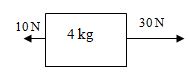
20 m/ s2
5 m/ s2
.2 m/ s2
80 m/ s2

8 m/ s2
1 m/ s2
.125 m/ s2
5 m/ s2



