wayground logo

Free Printable Worksheets

Font size

S
M
L
XL
Worksheets

Biology Spring Final Review

Total questions: 40

Worksheet time: 1hrs 21mins

Name
Class
Date
1.
1. What is the function of the mitochondria in eukaryotic cells?
a)

Photosynthesis

b)

Cellular respiration

c)

Protein synthesis

d)

DNA replication

2.
Which structure is responsible for transporting nutrients and oxygen throughout the body in animals?
a)
Mitochondria
b)
Nucleus
c)
Ribosomes
d)
Circulatory system
3.
Which type of cell division produces two identical daughter cells?
a)
Meiosis
b)
Mitosis
c)
Translation
d)
Transcription
4.
What is the difference between prokaryotic and eukaryotic cells?
a)
Prokaryotic cells have a nucleus while eukaryotic cells do not
b)
Eukaryotic cells are smaller than prokaryotic cells
c)
Prokaryotic cells have a cell wall while eukaryotic cells do not
d)
Eukaryotic cells have membrane-bound organelles while prokaryotic cells do not
5.
What is the function of the Golgi apparatus?
a)
Protein synthesis
b)
Lipid synthesis
c)
Cellular respiration
d)
Protein modification and packaging
6.
What is the primary function of the nervous system in animals?
a)

Transport nutrients

b)

Control movement

c)

Produce energy

d)

Regulate homeostasis

7.
Which scientist is credited with discovering the structure of DNA?
a)
James Watson
b)
Francis Crick
c)
Rosalind Franklin
d)
Linus Pauling
8.
What is the purpose of meiosis in sexual reproduction?
a)

To create genetically identical offspring

b)

To prevent offspring from inheriting genetic diseases

c)

To create genetic diversity among offspring

d)

To produce haploid cells

9.
What is the role of enzymes in biological processes?
a)
To transport nutrients
b)
To regulate gene expression
c)
To store energy
d)
To speed up chemical reactions
10.
What is the difference between aerobic and anaerobic respiration?
a)
Anaerobic respiration produces more ATP than aerobic respiration
b)
Aerobic respiration requires oxygen while anaerobic respiration does not
c)
Aerobic respiration takes place in the cytoplasm while anaerobic respiration takes place in the mitochondria
d)
Anaerobic respiration is only found in prokaryotic cells.
11.

True or False: DNA contains the genetic information for all living organisms including virus

a)

Fact

b)

Cap

12.

True or False: Mitosis is the process of cell division that creates four identical daughter cells.

a)

Fact

b)

Cap

13.
True or False: The mitochondria is the powerhouse of the cell and produces ATP.
a)

Fact

b)

Cap

14.
True or False: Enzymes are biological catalysts that speed up chemical reactions in cells
a)

Fact

b)

Cap

15.

True or False: Photosynthesis is the process by which plants convert sunlight into chemical energy in the form of C6 H12 O6C_{6\ }H_{12\ }O_6 .

a)

Fact

b)

Cap

16.
True or False: The Golgi apparatus is responsible for packaging and distributing proteins to be used in and out of the cell.
a)

Fact

b)

Cap

17.

True or False: The central dogma of molecular biology states that DNA is translated into RNA, which is then transcribed into proteins.

a)

Fact

b)

Cap

18.
True or False: Prokaryotic cells have a nucleus and other membrane-bound organelles.
a)

Fact

b)

Cap

19.
True or False: Meiosis is the process of cell division that creates haploid cells, such as sperm and eggs.
a)

Fact

b)

Cap

20.
True or False: Genetic drift describes the random fluctuations in allele frequencies that occur in small populations.
a)

Fact

b)

Cap

21.
Ecology is the study of
a)

Abiotic things and their environments'

b)

all living things

c)

living organisms, including humans, and their physical environments

22.
Name the correct order (hint: Mphase is Mitosis)
a)
G1, S, G2, Mphase
b)
Mphase, G1, G2, S
c)
S, G1, Mphase, G2
d)
G2, G1, S, Mphase
23.
Name the correct order for Mitosis.
a)
Prophase, Metaphase, Anaphase, Telophase
b)
Cytokinesis, Premetaphase, Anaphase, Metaphase, Telophase
c)
Metaphase, Anaphase, Prophase, Telophase
d)
Telophase, Anaphase, Metaphase, Prophase
24.
What factor controls cell specialization
a)
The size of the stem cell
b)
The non-stem cells nearby
c)
Gama Radiation (like the Hulk)
d)
Genes that are expressed
25.
When looking at a Phylogenetic tree what makes two animals closely related?
a)
The closer on the tree they are and the number of shared traits
b)
The further on the tree they are and the number of different traits
26.
Breeding animals is a form of...
a)

Natural selection

b)

Artificial selection

c)

Evolution

d)

Metamorphosis

27.
True or False: Natural selection is a mechanism of evolution.
a)
Fact
b)
Cap
28.

Name the correct order...

a)

Kingdom, Phylum, Class, Order, Family, Genus, Species, Domain

b)

Domain, Kingdom, Phylum, Class, Order, Family, Genus, Species

c)

Domain, Kingdom, Phylum, Class, Species, Family, Genus, Order

d)

Domain, Kingdom, Class, Phylum, Order, Family, Genus, Species

29.

What is Commensalism in symbiotic relationships

a)

symbiotic relationship in which one species benefits while the other species is not affected.

b)

symbiotic relationship in which both species benefit.

c)

symbiotic relationship in which one species (the parasite) benefits while the other species (the host) is harmed.

d)

symbiotic relationship in which one species is consumed

30.

A tick or a flea is a form of what type of relationship

a)

Mutualism

b)

Commensalism

c)

Parasitism

d)

Competition

31.

The eagle and bear both feed on the same limited supply of salmon. Describe the relationship between them:

a)

Commensalism

b)

Competition

c)

Parasitism

d)

Mutualism

32.

Select the best example of a community.

a)
b)
c)
d)
33.
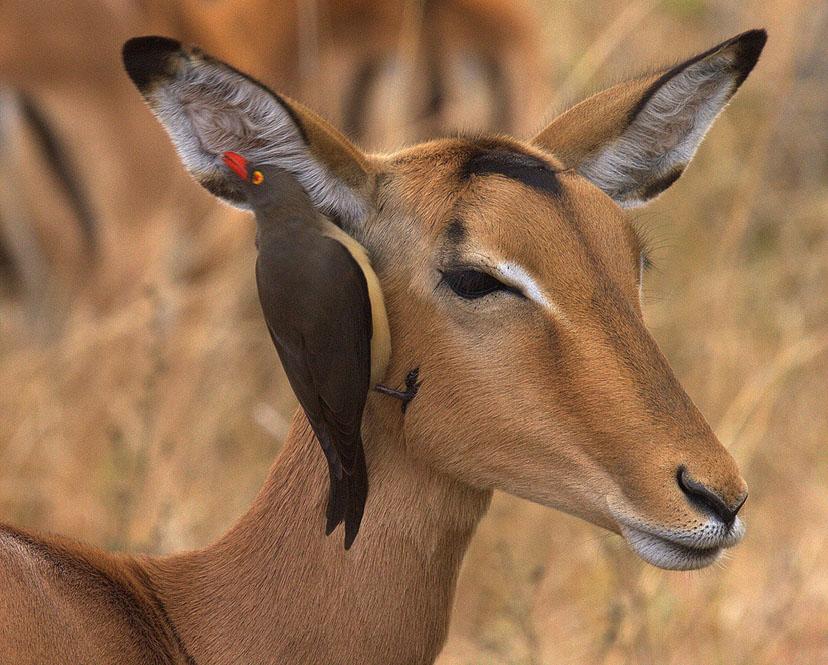
Red-billed oxpeckers are birds that often feed on parasites that infest impala.  This is an example of _______.
a)
commensalism
b)
mutualism
c)
neutralism
d)
competition
34.
What organ transports sugar throughout the plant
a)
Phloem
b)
Stomata
c)
Guard cells
d)
Cambium
35.
Which organ transports water throughout the plant
a)
Phloem
b)
Xylem
c)
Stomata
d)
Cambium
36.
Which organ contains small openings that allow for air exchange
a)
Xylem
b)
Phloem
c)
Cambium
d)
Stomata
37.

What part of the plant is responsible for making food?

a)

roots

b)

flower

c)

stem

d)

leaves

38.
Which of these plant structures supports a plant so it does not fall over?
a)
Seed
b)
Root
c)
Leave
d)
Flower
39.
Process by which green plants prepare their own food
a)
Germination
b)
Pollination
c)
Transpiration
d)
Photosynthesis
40.

1.       The diagram below shows a cross section of a flower.

What is the name of structure Y?

a)

  ovary

b)

  ovule

c)

style

d)

stigma