
 Worksheets
General Chemistry Second Semester Review
Total questions: 96
Worksheet time: 24hrs 0mins
In an acid & base neutralization reaction, what are the products of a reaction between an acid and a base?
Another acid and base
Carbon dioxide and a salt
Water and a salt
Either two acids or two bases
Which of the following is NOT an acid-base conjugate pair?
H20, OH-
NH4+, NH3
H2CO3, HCO3-
H2S, OH-
A 0.10 M solution of an electrolyte has a pH of 4.5. The electrolyte is:
a strong acid
a weak base
a weak acid
a strong base
Which solution below has the highest concentration of hydroxide ions?
pH = 7.00
pH = 3.21
pH = 10.12
pH = 12.49
Which of the following ions do all acids have in common?
H+
Na+
OH-
Ca2+
What is the conjugate acid for the base NH3?
NH4+
NH2-
NH52+
HCl
What is the H+ concentration of a solution with a pH of 2?
.01 moles/L
.1 moles/L
.0001 moles/L
.000001 moles/L
What is the pH of a solution with .0001 moles per L of H+?
4
3
10
13
What is the conjugate base of HCl?
Cl-
H2Cl+
HCl
H2O
sodium hydroxide (NaOH)
strong acid
weak acid
strong base
weak base
An organic substance that changes color as the pH of the solution changes is called a(n) ______________.
indicator
inhibitor
catalyst
salt

A student inflates a balloon with helium then places it in the freezer. The student should expect
the balloon's volume to increase
the balloon's volume to decrease
the balloon's moles to increase
the balloon's moles to decrease
If a hairspray can is heated, what can be expected of the pressure of the gas inside the can?
The pressure will increase
The pressure will decrease
The pressure will remain constant
The pressure will equalize
223.15
323.15
100.15
50.15
Match the following units to their names.
Volume
L
Temperature
K
Pressure
atm
Moles
mol
The average _______ energy of all the particles determines the temperature of the gas.
potential
kinetic
chemical
mechanical
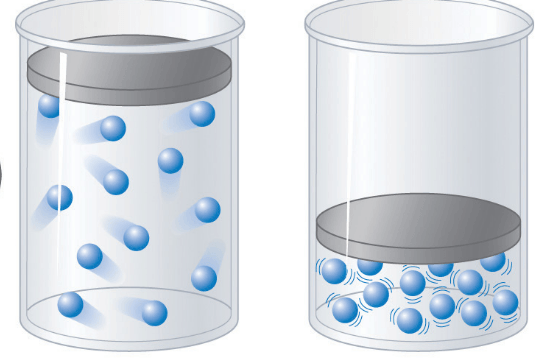
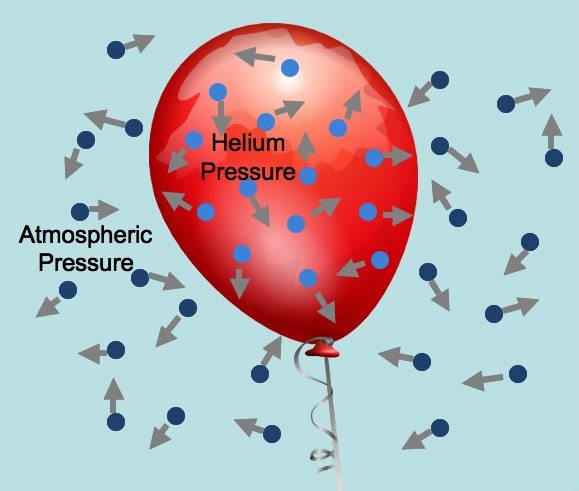

The following graph shows (a) relationship.

Oxidation is the _________ of electrons.
loss
gain
sharing
transfer
Reduction is the ___________ of electrons.
loss
gain
sharing
transfer
Gaining hydrogen is an example of...
oxidation
reduction
In a Galvanic cell, the electrons flow from the...
anode to the cathode
cathode to the anode
Which energy conversion shown below takes place in a battery/galvanic cell?
Electrical to chemical
Mechanical to chemical
Mechanical to electrical
Chemical to electrical
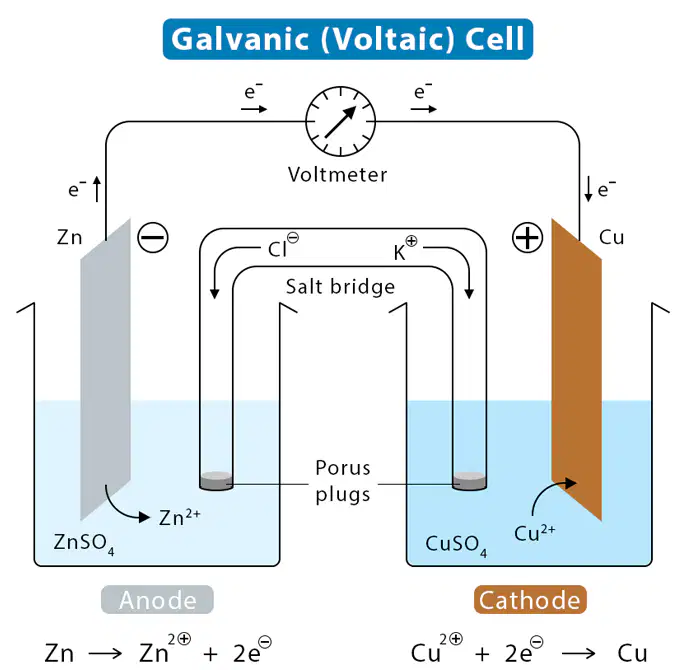
Reduction occurs at the...
Cathode
Anode
Salt Bridge
Voltmeter
Oxidation occurs at the...
Cathode
Anode
Salt Bridge
Voltmeter
What occurs in the anode beaker?
The anode is oxidized, giving up its two electrons
Zinc ions (Zn2+) are come off of the zinc metal
Zinc ions (Zn2+) will pair with chlorine ions (Cl-) from the salt bridge
All over the answers
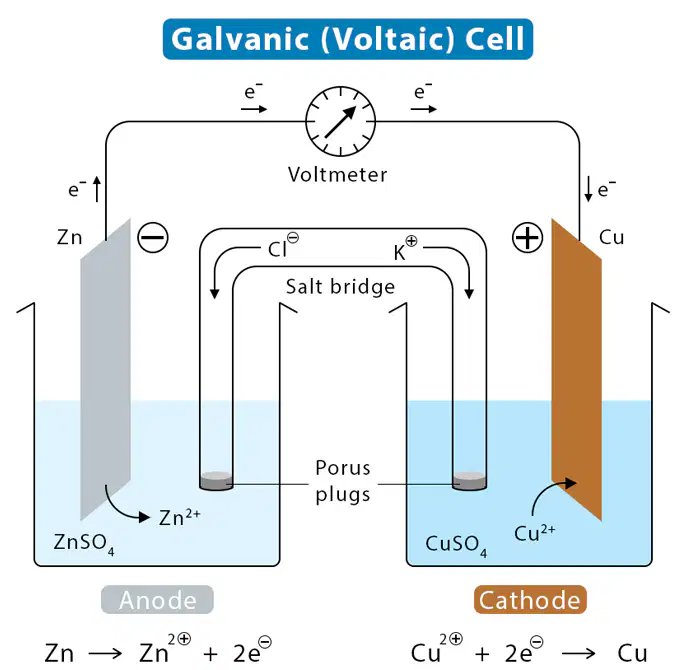
What is the role of the salt bridge in a voltaic cell?
To allow the movement of water molecules between the two half cells
To allow the movement of electrons between the half cells
To allow the movement of ions to maintain charge neutrality
A nuclear reaction where an atomic nucleus splits into two smaller nuclei is called:
Fission
Fusion
Gamma decay
Beta decay
The number of electrons always reduces to zero
Usually nothing happens, unless the atom is radioactive
The atomic nucleus breaks down and decays
It becomes a completely different atom, with different properties

This picture is an example of:
Fission reaction
Fusion reaction
Decomposition reaction
Combustion
This type of radiation has the highest penetrating power. Even several inches thick of lead or several meters of concrete cannot stop all of it:
Alpha
Beta
Gamma
Delta
This type of radiation has the lowest penetrating power. Can only penetrate 0.05 mm into the body and can be stopped by a piece of paper or clothing.
Alpha
Beta
Gamma
Delta
Inside a nuclear reactor, what object is able to absorb fast moving neutrons?
generator
moderator
control rods
sheilding
Where does nuclear fusion occur naturally?
Underwater
On the gaseous planets
In the radioactive waste
In the Sun
When a nucleus undergoes gamma decay, the atomic number of the element....
remains the same
decreases by one.
increases by one.
increases by two.
Which is a common isotope used in radioactive dating of organic matter?
Carbon-14
Uranium-235
Carbon-12
Iodine-43
Another term for an unstable atom would be:
Actinide
Electronegativity
Radioisotope
Halogen
Combustion
Chemical Reaction
Radioactive Decay
Isotopic shedding
What is the proper scientific name for radiation that can effect other atoms and damage cells?
ionizing radiation
toxic radiation
non ionizing radiation
radioisorade

What type of radiation is released from a microwave?
Ionizing Radiation
Non Ionizing Radiation
No Radiation is released
Gamma Radiation
After one ____________ of a radioactive element, half of the original radioactive material remains.
half-life
cycle
decay
Do molecules generally move faster at 45 C or 106 C?
45 C because molecules have more energy than in 106C
106 C because molecules have more energy than in 45C
106 C because molecules have less energy than in 45C
45C because molecules have less energy than in 106 C
DON'T RUSH, YOU HAVE TIME.
Water droplets condensing on the inside of a window on a cold day. Is this process exothermic or endothermic?
Gases condense to form liquids. Gases are moving faster than liquids, the air around the window has a higher temperature/kinetic energy. Releasing energy to get water droplets, which is is Exothermic
Gases condense to form liquids. Gases are moving faster than liquids, the air around the window has a higher temperature/kinetic energy. Releasing energy to get water droplets, which is is Endothermic
Gases condense to form liquids. Gases particles are moving slower than liquids. Releasing energy to get water droplets, which is is Endothermic
Gases condense to form liquids. Gases particles are moving slower than liquids. Releasing energy to get water droplets, which is is Exothermic

endothermic
exothermic
The 1st law of Thermodynamics
Energy can not be created or destroyed. It just changes forms.
Energy can only be created by the sun
Some energy is lost to the environment.
Define ΔH
Change in Specific Heat; Heat by one Degree Celsius
Change in Temperature; the energy we calculate; Degree Celsius
Change in Enthalpy; the energy/heat we calculate
Change in Time; time travel
Define Exothermic
Energy is released; ΔH is negative; Going from Gas to Liquid, Liquid to Solid
Energy is absorbed; ΔH is positive; Going from Gas to Liquid, Liquid to Solid
Energy is released; ΔH is positive; Going from Solid to Liquid, Liquid to Gas
Energy is absorbed; ΔH is negative; Going from Gas to Liquid, Liquid to Solid
Is this phase change representing an exothermic or endothermic reaction?
GAS to LIQUID
Exothermic
Endothermic
Is the phase change representing an exothermic or endothermic reaction?
SOLID to LIQUID
Endothermic
Exothermic
The force used to provide lift for the rocket is...
Weight
Control
Thrust
Inertia
In a sugar rocket, the sorbitol is the...
Fuel
Oxidizer
Additive
Reducing Agent
Provide the oxygen necessary to keep the combustion reaction occurring in a sugar rocket
Oxidizer
Fuel
Additive
Reducer
Combustion reactions always produce...
Oxygen Gas
Water
Carbon Dioxide
Organic Molecules

Single bonded carbons are called _________.
Alkanes
Alkynes
Alkenes
Arenes

Triple bonded carbons are called ________.
Alkanes
Alkenes
Alkynes
Arenes
Which of the following prefixes represents "7"?
prop-
but-
hept-
pent-

What is the common name given to this alkyl branch?
Propyl
Methyl
Isopropyl
Ethane
What is the prefix used when referring to ring structures?
Pyro-
Aro-
Cyclo-
None of the above

Name the polymer formed from this monomer
chloroethene
chloroethane
dichloroethene
dichloroethane
What functional group is -OH
Hydroxyl
Carboxyl
Amino
Carbonyl Ketone

What functional group is shown?
carboxyl
carbonyl
hydroxyl
amino

What functional group is shown?
carbonyl
hydroxyl
carboxyl
amino

sulfhydryl
hydroxyl
amino
phosphate

What functional group is shown?
carboxyl
phosphate
hydroxyl
amino
carbonyl group


carboxyl group


phosphate group


Dehydration
Hydrolysis
Reduction
Oxidation
What is the monomer of a carbohydrate?
fatty acid
amino acid
monosaccharide
nucleotide

Name this compound.
Butanol
Butene
Oxybutanol
Butanoic acid
Compounds that are composed of the same number and type of atoms but have them arranged in different ways are ___________.
isomers
isotopes
polymers
alkanes

Given a formula representing a compound.
Which formula represents an isomer of this compound?


What is the name of this compound?
Methylcyclopentane
Ethylcyclopentane
Ethylcyclopentene
Ethylcyclohexane

What is the name of the compound? And how many carbon atom of the compound?
Cyclononane, 9 carbon atom
Cyclohexane, 6 carbon atom
Cyclodecane, 10 carbon atom
Cyclobutane, 4 carbon atom
There are two main forms of isomerism, which are?
Constiutional isomers and Stereoisomers
Stereoisomers and Physical isomers
Chemical isomers and Stereoisomers
Structural isomers and Geometric Isomers

