
 Worksheets
Thermochemistry Review
Total questions: 47
Worksheet time: 1hrs 10mins
What are chemical reactions that absorb energy?
endothermic
fast
slow
exothermic
What does temperature measure?
heat
average kinetic energy
space
time

How much heat does an aluminum block absorb if 10.00 grams is heated from 25.0oC to 50.0oC? *Specific heat of aluminum is 0.900 J/goC
450 J
-450 J
225 J
-225 J

The specific heat of platinum is 0.133 J/g°C. How much heat is released when a 10 g piece of platinum cools from 100°C to 50°C?
66.5 J
665 J
0.0266 J
0.665 J

Releasing heat into the surroundings occurs during an ___________________ reaction.
Exothermic
Endothermic
Kinetic Energy
Thermal Energy
How does energy flow?
It goes from hot to cold
It goes from cold to hot
It transfers without any particular means
It doesn't flow
Does the total energy change in a reaction?
NEVER
Yes, it increases
Yes, it decreases
Yes, but some increases and some decreases

Which phase change represents a decrease in entropy?
solid to liquid
gas to liquid
liquid to gas
solid to gas
Entropy is a measure of
accuracy
precision
the disorder of a system
the attraction of a nucleus for an electron
In an endothermic reaction, heat is ...
taken in
given out
A student mixed two chemicals to allow them to react. The temperature before the reaction was 25 ° C. The temperature after the reaction was 18° C. Which of the following is true?
It is an exothermic reaction
It is an endothermic reaction

What type of reaction is this?
Exothermic
Endothermic
Kinetic
Potential
O2(g) + 2 H2 (g) → 2 H2O (g) + Energy
endothermic
exothermic
What is the Heat of Reaction ΔH for this reaction?
-200 KJ
200 KJ
400 KJ
-300 KJ

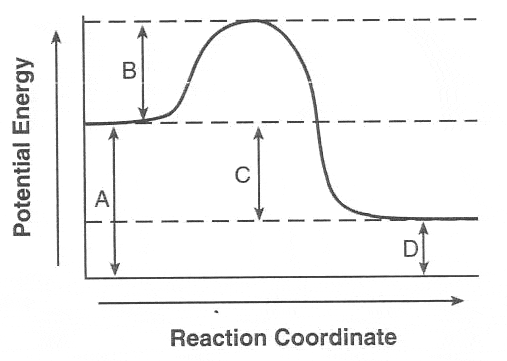
This energy curve is best described as an...
endothermic reaction
exothermic reaction
Which of the following is an endothermic phase change
vaporization
freezing
condensation
deposition
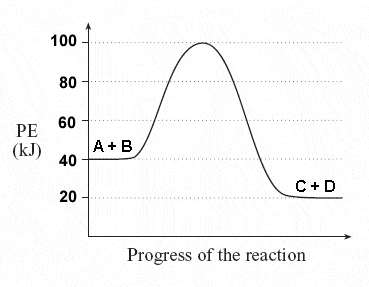
What is the change of the heat of the reaction (ΔH)?
-40 kJ
-20 kJ
100 kJ
60 kJ


What is the change of the heat of the reaction (ΔH)?
100 kJ
-175 kJ
-50 kJ
75 kJ
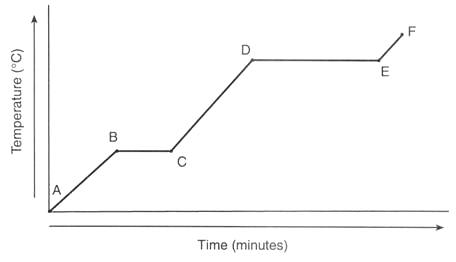

The melting point of the sample is
-60 ºC
-100 ºC
60 ºC
100 ºC

Given the heating curve of a solid being heated at a constant rate, what is the boiling point of this substance?
20°C
50°C
110°C
170°C


In a heating curve, diagonal lines indicate temperature is __________, while flat lines indicate temperature is __________.
Constant, changing
Changing, constant

Given the heating curve for water, during which line segment could I find water in both the solid and liquid phase at the same time?
AB
BC
CD
DE
EF
Thermal energy ALWAYS moves from _____ to _____.
cold to hot
hot to cold
A glass of water is placed in a freezer. Which way does energy flow?
Into the freezer
Into the glass of water
Energy does not flow

A metal cube at temperature of 70°C is immersed in water at temperature of 20°C.
The metal loses more heat than the water gains.
The metal loses less heat than the water gains.
The metal loses the same amount of heat that the water gains.
A metal cube with a mass of 55grams at temperature of 85°C is immersed in 150grams of water at temperature of 20°C. The metal and water then reach a final temperature of 23oC. How much heat does the metal lose?
-1881 J
-690 J
-14253 J
-38874 J
A metal cube with a mass of 55grams at temperature of 85°C is immersed in 150grams of water at temperature of 20°C. The metal and water then reach a final temperature of 23oC. What is the specific heat of the metal?
0.55 J/goC
2120 J/goC
11.4 J/goC
4.18 J/goC
0.75 J/goC

Which will heat up faster?
copper
granite
iron
basalt

Copper, Stainless Steel, Carbon Steel, and Zinc were all heated using 10,000 JOULES of thermal energy. Based on the chart, which material would have the SMALLEST change in temperature?
Copper
Carbon Steel
Zinc
Stainless Steel

Specific heat capacity is
heat energy needed to raise temp by 1C
heat energy needed to raise temp of 1g of substance by 1C
heat energy absorb to raise 1g of substance to higher temp
heat energy need to raise temp for 1g of substance
If 300 g of water at 20°C is mixed with 200 g of water at 80°C, what will be the final temperature of the mixture? (Assume no heat loss to the surroundings)
40°C
50°C
60°C
70°C

