
Font size
 Worksheets
Evolution Part 2 Adaptations and Speciation
Total questions: 50
Worksheet time: 59mins
Any inherited trait that gives an organism an advantage in its environment is called (a) .
(a) are mistakes in the DNA that cause variation within a species. Can be good, bad, or neutral
The differences among a species, like different bird beaks, are called (a)
Which of the following means "change over time" Lamarck used this term 1st and influenced Charles Darwin to study this topic further and come up with his own Theory.
natural selection
speciation
evolution
isolation


Whales have pelvic bones. What type of structure does this best represent?
Homologous structure
Analogous structure
Vestigial structure
None of the above
SELECT ALL THAT APPLY: Which of the following must be true in order for organisms to be considered the same species?
They must be able to mate
They must be able to produce viable offspring
They must have structural similaries
They must have the same bone structure


Members of a species can breed with other members of the same species.
True
False
Evolution is...
changes in inherited traits over time and the new specie cannot reproduce successfully with the old er species.
natural process that passes favorable traits
historical timeline of fossils
the process in which an animal dies out

The process by which different kinds of living organisms are thought to have developed and diversified from earlier forms during the history of the earth.
species
Darwin
evolution
taxonomy
Hummingbirds have a beak just the right length to reach the nectar in a cardinal flower and as they feed their foreheads bump into the pollen structure. Cardinal flowers are red which hummingbirds can see but bees can’t. Cardinal flower’s pollen structure is just the right length for the hummingbird to pick up pollen as it feeds
Convergent
Divergent
Coevolution
Bees don’t see red, but do see yellow, blue, and ultra-violet light. Thus, bee-pollinated flowers are mostly yellow or blue with UV nectar guides (landing patterns) to guide the bee. They usually have a small, narrow floral tube to fit the tongue-length of that species of bee.
Convergent Evolution
Divergent Evolution
Coevolution
Ants are the correct size and weight needed to open the flowers for the peony plant. The peony plant provides food for the ant and the ant fertilizes the peony’s flowers
Convergent
Divergent
Coevolution
Phylogeny is...
The study of classification of different species
The study of the evolutionary history of a species
The study of prehistoric life
The study of the distribution of different species
Cladograms show...
Evolutionary relationships between different species
How one species has evolved through time
Which species has evolved the most
Which species have evolved from other species

Based on the data given in the table, which two are most closely related?
Human & Gorilla
Gorilla & Orangutan
Human & Chimpanzee
Chimpanzee & Orangutan
Two organisms change in response to each other forming a specialized relationship.
Coevolution
Convergent Evolution
Gradualism
Extinction
Elimination of a species.
Extinction
Gradualism
Coevolution
Adaptive radiation

A shark's long gills, fins, and teeth make it a superior underwater predator. These are all examples of ___________ critical to the shark's survival.
coevolutions
adaptations
variations
characteristics
A flash flood carried a raft of Amazon ants away from their original population. There is enough distance between the two groups, that they will never meet in nature again. What type of isolation is this?
Behavioral isolation
Temporal isolation
Geographic isolation
If a population becomes isolated from other populations of the same species and then genetic differences start to occur, what happens?
Competition
Extinction
Speciation
Fossils form

Based on the image above, what type of Isolation is shown?
Geographic Isolation
Behavioral Isolation
Temporal Isolation
Fireflies make a pattern of flashes that attract mates of their own species. What type of isolation is this?
Geographic Isolation
Behavioral Isolation
Temporal Isolation
Two species of whales are divided by a physical barrier that connects two continents. What type of isolation is this?
Geographic Isolation
Behavioral Isolation
Temporal Isolation
One species of lizard breeds in the spring, one breeds in the summer. What type of isolation is this?
Geographic Isolation
Behavioral Isolation
Temporal Isolation

What are evolutionary trees called? (More than one answer)
Punctuated Equilibrium
Phylogenic Tree
Gradualism
Cladogram

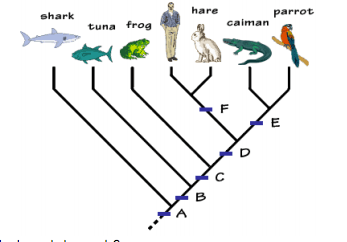
Which organism is most closely related to the cat?
Fish
Frog
Salamander
Goose
Human

camouflage
emitting smells
mimicry
panting
The arctic fox and snowshoe hare develop a white coat of fur during the winter months. What statement best describes this behavioral response?
The color of the fur will attract a mate
White fur allows the animals to reflect light and stay warm
Snow falls during the winter and the white fur will camouflage the animals
It becomes colder during the winter, so these animals need more fur to stay warm

Which adaptation is this organism using?
singing
feet
mimicry and camouflage
adaptations to hunt
What type of camouflage do zebras use to hide from their prey?
Disruptive Camouflage
Concealing Camouflage
Which animals use camouflage?
Arctic Fox
Zebra
Emperor Penguin
Walrus
Reindeer
Which animals use mimicry?
Butterfly Fish
Viceroy Butterfly
Leaf-Tailed Gecko
Sargassum Nudibranch
Zebra
Animals use camouflage...
to hunt or hide
for fun
to sleep
How do zebra stripes protect the zebra?
When zebras run as a herd,stripes help the predators pick out one zebra.
When zebras run as a herd,stripes help the zebras by not letting the predator pick out one zebra because they blend together and look like a blur of stripes.
The zebra stripes don't have a purpose.
Genome maps provide the DNA sequences of chromosomes. Some scientists have compared the genome maps of a hedgehog and a sloth. What do these genome maps allow the scientists to determine?
The color patterns of the offspring of each species
How much the size ranges of the two species differ
The methods of protein synthesis that each species uses
How closely related the two species are to each other.

The fact that both these mammals incubate their immature offspring in a pouch provides evidence that they-
Belong to the same species
Must range great distances to eat
Have very similar skeletal structures
Are descended from a common ancestor

Scientists can determine relatedness among organisms by comparing partial amino acid sequences. The table shows four partial amino acid sequences from four organisms. Which organism is the least related to the other three organisms?
organism 1
organism 2
organism 3
organism 4
Bactrian camels, dromedaries, llamas, and alpacas are all members of the same taxonomic family, Camelidae. Members of this family all have two toes, no hooves, true canine teeth, and a split upper lip. The family Camelidae originated in North America. The physical features of animals in this family and the family's geographical origin provide evidence that all these animals -
live in the same type of ecosystem
have slowly evolved to become herbivores
have a common ancestor
exchanged DNA at some point in the past

Three species of lizards of the genus Gallotia are found on the Canary Islands, a chain of seven volcanic islands off the wet coast of Africa. The easternmost island, Lanzarote, is the oldest, while the westernmost island, El Hierro, is the youngest. The distribution of lizard species is shown on the map. Which statement about the ancestry of the lizards from the genus Gallotia is best supported by this information?
The common ancestor of the lizards first colonized the island of El Hierro
The ancestors of each species came from different continents at different times
the common ancestor of the lizards probably came from Africa
The ancestors of each species evolved in Spain and were brought to the islands at the same time

