wayground logo

Free Printable Worksheets

Font size

S
M
L
XL
Worksheets

chem 2 review practice

Total questions: 85

Worksheet time: 47mins

Name
Class
Date
1.

What charge does an atom have when it GAINS electrons?

a)

Positive

b)

Negative

c)

Neutral

2.

What is a representation of an ion?

a)

Li

b)

Na-22

c)

O-2

3.

What is the mass number of bromine?

a)

35

b)

45

c)

80

d)

79.904

4.

How many neutrons does this bromine atom have?

a)

35

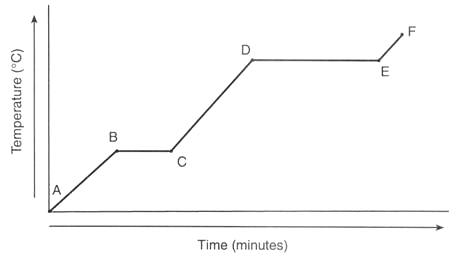
b)

45

c)

80

5.

What type of atom is this?

a)

Neutral atom

b)

Cation

c)

Anion

d)

Isotope

6.

What two particles determine the mass number?

a)

Protons and electrons

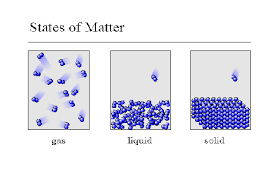
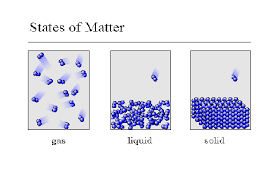
b)

Electrons and neutrons

c)

Protons and neutrons

7.

What type of atom is this?

a)

Normal Atom

b)

Cation

c)

Anion

d)

Isotope

8.

What is the mass number of this Neon atom?

a)

10

b)

11

c)

21

d)

20

9.

What does it change in an ion?

a)

The number of electrons

b)

The number of protons

c)

The number of neutrons

10.

How many neutrons does this Neon atom have?

a)

21

b)

11

c)

10

d)

12

11.

What does it happen to this atom?

a)

It LOSES electrons

b)

It GAINS electrons

c)

It GAINS protons

d)

It LOSES protons

12.

What is the atomic number of this element?

a)

12

b)

24

c)

23

13.

What type of atom is element C?

a)

Normal atom

b)

Ion

c)

Isotope

14.

What is the mass number of this element?

a)

12

b)

24

c)

23

d)

11

15.
Two atoms of different elements will definitely have different numbers_____
a)
Nuclei
b)
Protons
c)
Neutrons
d)
Electrons
16.
An ion forms when an atom gains or loses
a)
Protons
b)
Neutrons
c)
Electrons
17.
A neutral atom would become an ion that has a charge of 2+ by 
a)
Losing two protons
b)
Losing two neutrons
c)
Losing two electrons
18.
Isotopes are atoms that have different
a)
Mass numbers
b)
Element names
c)
Atomic Numbers
19.
A positively charged ion is formed when
a)
A neutron is lost
b)
An electron is lost
c)
A neutron is gained
d)
An electron is gained
20.
Two atoms that have different numbers of protons are 
a)
Different ions
b)
Different isotopes
c)
Different elements
21.
An ion that has a negative charge is formed when an atom 
a)
Loses neutrons
b)
Loses electrons
c)
Gains neutrons
d)
Gains electrons
22.
What information would allow you to determine whether two atoms are of the same or different elements
a)
The charge on each atom
b)
The number of neutrons each has
c)
The number of protons in their nuclei
d)
The location of the electrons in their electron clouds
23.
Is the element shown in this image an ion, isotope or normal atom?
a)
atom
b)
isotope
c)
cation (+ ion)
d)
anion (- ion)
24.
The atomic mass is equal to _.
a)
the number of protons only
b)
the number of neutrons only
c)
the total number of protons and neutrons
d)
the number of protons, neutrons, and electrons.
25.

What particles determine the mass number?

a)

Protons and electrons

b)

Electrons and neutrons

c)

Protons and neutrons

d)

Protons, neutrons, and electrons

26.

What is the mass number of bromine?

a)

35

b)

45

c)

80

d)

79.904

27.

The atomic number is equal to _.

a)

the number of protons

b)

the number of neutrons only

c)

the total number of protons and neutrons

d)

the number of protons, neutrons, and electrons

28.

How many neutrons does this bromine atom have?

a)

35

b)

45

c)

80

d)

115

29.

What is the mass number of this Neon atom?

a)

10

b)

11

c)

21

d)

20

30.

How many electrons does this magnesium ion have?

a)

24

b)

12

c)

10

d)

14

31.

What changes when an atom becomes an ion?

a)

The number of electrons

b)

The number of protons

c)

The number of neutrons

d)

Both the number of neutrons and electrons

32.

How many neutrons does this Neon atom have?

a)

21

b)

11

c)

10

d)

12

33.

What happened to this Magnesium atom to make it an ion?

a)

It LOST electrons

b)

It GAINED electrons

c)

It GAINED protons

d)

It LOST protons

34.

What is the atomic number of this element?

a)

12

b)

24

c)

23

d)

35

35.

Adding or subtracting neutrons makes the element change into

a)

an ion

b)

a mixture

c)

an isotope

d)

a neutral atom

36.

What is the charge on a lithium atom that loses 1 electron?

a)

+1

b)

0

c)

-1

d)

-2

37.
The atomic mass is equal to _.
a)
the number of protons only
b)
the number of neutrons only
c)
the total number of protons and neutrons
d)
the number of protons, neutrons, and electrons.
38.

What is the atomic number of Fe? (click to see image)

a)

26

b)

55.845

c)

56

d)

30

39.
How many neutrons does B (Boron) contain?
a)
5
b)
11
c)
6
d)
10.811
40.

Rubidium has two common isotopes, 85Rb and 87Rb. If the abundance of 85Rb is 72.2% and the abundance of 87Rb is 27.8%, what is the average atomic mass of rubidium?

a)

85.468 amu

b)

37 amu

c)

85.6 amu

d)

86.4 amu

41.

There are two primary isotopes found in any sample of copper: copper-63 and copper-65. The isotope 65Cu composes 69.2% of the sample and 63Cu comprises the other 30.8%. Based on this data, what is the atomic mass of copper?

a)

29 amu

b)

63.546 amu

c)

64.4 amu

d)

63.6 amu

42.
An isotope has three forms.  30% have a mass of 4 amu, 20% have a mass of 5 amu and 50% have a mass of 3 amu.  Average atomic mass will be closest to
a)
2 amu
b)
3 amu
c)
4 amu
d)
5 amu
43.
Calculate the average atomic mass of silver.
a)
106.38649amu
b)
111.91896amu
c)
107.8677amu
d)
121
44.
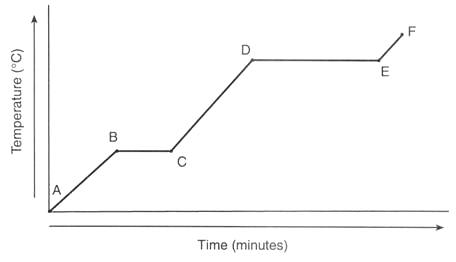
Between what two points is the most energy being added to the system
a)
A -B
b)
B-C
c)
C-D
d)
D-E
45.
Which line segment demonstrates vaporization occurring?
a)
B-C
b)
C-D
c)
D-E
d)
E-F
46.
What phase change is occurring at line segment B-C if the graph is exothermic?
a)
melting
b)
freezing
c)
boiling
d)
condensation
47.
As substance goes from D to E what happens to the distance between the particles?
a)
particles get closer together
b)
particles disappear
c)
particles get far apart
48.
At what temperature is this substance melting?
a)
50C
b)
100C
c)
0C
49.
At point temperature does this substance finish melting?
a)
B
b)
C
c)
D
d)
E
50.
The temperature at which a substance in the liquid state freezes is the same as the temperature at which the substance_________- 
a)
melts
b)
sublimes
c)
boils
d)
condenses
51.
How long does it take this substance to change from a liquid to a gas?
a)
1 minute
b)
2 minutes
c)
10 minutes
d)
15 minutes
52.

The change of one state of matter to another is called

a)

Osmosis

b)

Phase Change

c)

Matter

d)

Energy

53.

A phase change is a chemical or physical change?

a)

Physical

b)

Chemical

54.

Transition from a solid to a liquid

a)

Condensation

b)

Melting

c)

Freezing

d)

Evaporation

55.

Transition from a liquid to a gas

a)

Condensation

b)

Freezing

c)

Evaporation

d)

Melting

56.

Transition from a liquid to a solid

a)

Freezing

b)

Sublimation

c)

Melting

d)

Evaporation

57.

Gas condenses to a liquid

a)

Evaporation

b)

Melting

c)

Freezing

d)

Condensation

58.

Change of a solid directly into a gas

a)

Deposition

b)

Melting

c)

Sublimation

d)

Freezing

59.

Change of a gas directly into a solid

a)

Sublimation

b)

Condensation

c)

Evaporation

d)

Deposition

60.

When an object undergoes phase change, its mass

a)

increases

b)

stays the same

c)

decreases

61.
At higher temperatures
a)
particles in an object have less energy
b)
particles in an object move faster
c)
a gas contracts
62.
A gas
a)
has a definite shape but no definite volume
b)
has a definite volume but no definite shape
c)
has fast-moving particles
63.

Freezing

a)

Solid to gas

b)

Liquid to solid

c)

Gas to solid

64.

Boiling

a)

liquid to gas

b)

gas to solid

c)

gas to liquid

65.
Which state of matter has a definite shape?
a)
solid
b)
liquid
c)
gas
66.

What is happening when my ice cream changes from a solid to a liquid?

a)

freezing

b)

melting

c)

burning

67.

The state of matter that has no definite size or shape is

a)

Solid

b)

Liquid

c)

Gas

68.

Particles in a ______________________ move quickly and are far apart.

a)

gas

b)

solid

c)

liquid

69.

Particles of a liquid

a)

are tightly packed together and stay in a fixed position.

b)

are free to move around one another but still touch.

70.

Solid to Gas

a)

Deposition

b)

Sublimation

c)

Evaporation

71.

What is condensation?

a)

gas to solid

b)

gas to liquid

c)

liquid to solid

72.

The slower the particles in a substance move,

a)

the colder it is.

b)

the warmer it is.

c)

the more energy it has.

73.

Is this a picture of something hot or cold?

a)

Hot

b)

Cold

74.

Is this a picture of something hot or cold?

a)

Hot

b)

Cold

75.
The temperature of a substance increases as___.
a)
the substance expands
b)
the average kinetic energy of its particles increases
c)
the substance's volume increases
d)
the substance's mass increases
76.

Definite shape and definite volume

a)

Solid

b)

Liquid

c)

Gas

77.

Has a definite volume but not a definite shape

a)

Solid

b)

Liquid

c)

Gas

78.

Liquid to Gas

a)

Condensation

b)

Evaporation

c)

Sublimation

79.

What state/phase is the object likely from points C to D ?

a)

Solid

b)

Liquid

c)

Gas

d)

Plasma

80.

What state/phase is the object likely from points D to E ?

a)

Solid

b)

Liquid

c)

Gas

d)

Plasma

81.
The graph shows a cooling curve for an unknown substance.  What is happening during segment DE?
a)
boiling
b)
condensation
c)
freezing
d)
melting
82.
Between which points is the temperature of the substance remaining constant?
a)
A-B only. 
b)
A-B, C-D, E-F
c)
B-C only. 
d)
B-C, D-E
83.

Is the substance gaining or losing energy?

a)

Gaining

b)

Losing

84.

Where on the graph are phase changes taking place?

a)

1

b)

2

c)

3

d)

4

e)

5

85.

Is the substance gaining or losing energy?

a)

Gaining

b)

Losing