Worksheets
AP Test Review Quiz
Total questions: 92
Worksheet time: 2hrs 11mins


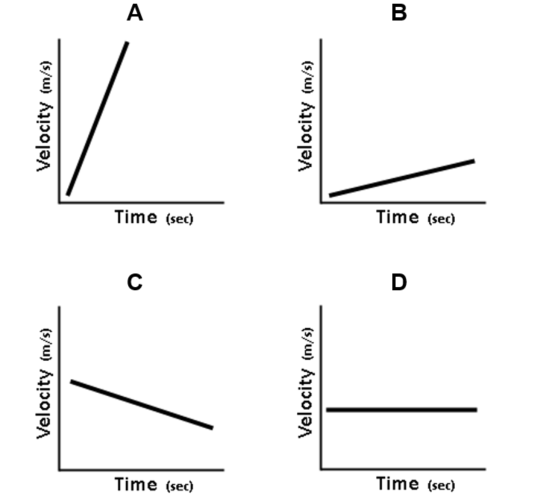


A person walking along a straight line moves such that her velocity as a function of time can be represented by the graph above. At what time does the person have the same position as she had at time t = 0?
At t = 5 s
During the interval 5 s < t < 8 s
At t = 8 s
During the interval t > 8 s


How much time does it take for the rock to hit the ground?

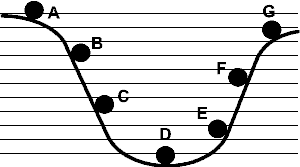
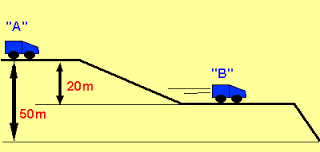
Between which adjacent pairs is the gain in kinetic energy the greatest?
i. The vector sum of the three forces must equal zero.
ii. The magnitude of the three forces must be equal.
iii. All three forces must be parallel.
At what rate does a child do work on the box?
You do work against gravity when you walk up some stairs.
True
False
The area under a force vs. displacement graph tells you the
mass of the object
momentum of the object
work done on the object
impulse of the object

A person throws a marble straight up into the air, releasing it a short height above the ground and catching it at that same height. If air resistance is negligible, which of the following graphs of position y versus time t is correct for the motion of the marble as it goes up and then comes down?


A person is running on a track. Which of the following forces propels the runner forward?
The normal force exerted by the ground on the person
The normal force exerted by the person on the ground
The force of friction exerted by the ground on the person
The force of friction exerted by the person on the ground

A rock attached to a string swings in a vertical circle, as shown above, with negligible air resistance. Which of the following diagrams could correctly show all the forces on the rock when the string is in the position above?


Which of the following is constant for an object in uniform circular motion?
Velocity
Acceleration
Displacement
Kinetic Energy
Ball X of mass 1.0 kg and ball Y of mass 0.5 kg travel toward each other on a horizontal surface. Both balls travel with a constant speed of 5 m/s until they collide. During the collision, ball Y exerts an average force with a magnitude of 40 N for ⅙ second on ball X. Which of the following best predicts ball Y's momentum after the collision?
Ball Y will travel at a speed less than 5 m/s in the same direction of travel as before the collision.
Ball Y will travel at a speed less than 5 m/s in the opposite direction of travel as before the collision.
Ball Y will travel at a speed greater than 5 m/s in the opposite direction of travel as before the collision.
Ball Y's motion cannot be predicted because the impulse on it is not known.
An object of mass m attached to a spring with constant k oscillates with amplitude A. Assuming air resistance and the mass of the spring to be negligible, which of the following changes alone would cause the period of this oscillation to increase?
I. Increasing m
II. Increasing A
III. Using a spring with greater k
I only
II only
III only
I or III
II or III

An object begins at position x = 0 and moves one-dimensionally along the x-axis with a velocity v expressed as a function of time t according to the graph above. At what time does the object pass through x = 0 again?
Between 10 s and 20 s
Between 20 s and 30 s
At exactly 30 s
Between 30 s and 40 s
Two blocks of masses 1.0 kg and 2.0 kg, respectively, are pushed by a constant applied force F across a horizontal frictionless table with constant acceleration such that the blocks remain in contact with each other, as shown above. The 1.0 kg block pushes the 2.0 kg block with a force of 2.0 N. The acceleration of the two blocks is (a) .
A 2-kg object is a distance of 10,000,000 meters away from the center of Earth, which has a mass of nearly 6 × 1024 kg. What is the approximate gravitational field strength of Earth’s gravitational field at the location of the 10-kg object?
2 N/kg
4 N/kg
10 N/kg
The gravitational field strength is negligible and, therefore, approximately zero.

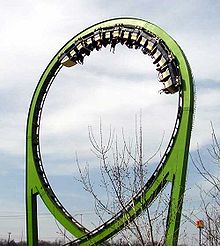
A cart is going around a circular loop, as shown in the figure. The cart moves with the smallest speed necessary to stay in contact with the loop to complete a circular path at point 1. What is the speed of the cart at point 2?
zero
gR
3gR
5gR
A spacecraft of mass 4000 kg is traveling in a straight line in the positive direction. Engines can be fired so that the force exerted on the spacecraft is in the positive or negative direction. The graph above shows data for the force during one interval. Which of the following is the best estimate of the net change in the speed of the spacecraft from time t = 0 to time t = 4 s?
+ 0.4 m/s
+ 0.1 m/s
- 0.1 m/s
- 0.4 m/s

In an experiment, one end of a string is attached to an object of mass M, and the other end of the string is secured so that the object is at rest as it hangs from the string. When the object is raised to a height above its lowest point, the object undergoes simple harmonic motion. Data collected from the experiment is graphed and linearized, as shown. What information from the graph can be used to determine the acceleration due to gravity for an object that is released from rest near Earth’s surface and allowed to fall to the ground?


The graph cannot be used to determine the acceleration due to gravity for an object that is released from rest and allowed to fall to the ground.

The diagram above shows a top view of a child of mass M on a circular platform of mass 5M that is rotating counterclockwise. Assume the platform rotates without friction. Which of the following describes an action by the child that will result in an increase in the total angular momentum of the child-platform system?
The child moves toward the center of the platform.
The child moves away from the center of the platform.
The child moves along a circle concentric with the platform (dashed line shown) opposite the direction of the platform’s rotation.
None of the actions described will change the total angular momentum of the child-platform system.
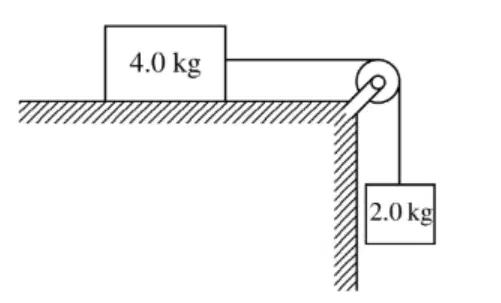
The system shown above is released from rest. If friction is negligible, the acceleration of the 4.0 kg block sliding on the table shown above is most nearly (a) .

A planet moves in an elliptical orbit around a star, as shown in the diagram. Which of the following is true as the planet moves from position 1 to position 2?
The planet loses kinetic energy due to negative gravitational work; thus, the total energy in the planet-star system decreases.
The planet’s kinetic energy increases due to positive gravitational work; thus, the total energy in the planet-star system increases.
Kinetic energy decreases and gravitational potential energy increases, but the total energy in the planet-star system stays constant.
Potential energy decreases and kinetic energy increases, but the total energy in the planet-star system stays constant.

A cart of known mass moves with known speed along a level, frictionless track, as shown in the figure above. The cart hits a force sensor and rebounds. The force sensor measures the force exerted on the cart as a function of time and as a function of the position of the cart. The results will be graphed on the axes shown. Which of the two graphs can be used to determine the cart’s speed after it rebounds?
Only graph 1; graph 2 will have no information useful for finding the speed.
Only graph 2; graph 1 will have no information useful for finding the speed.
Either graph 1 or graph 2 can be used.
Neither graph alone is sufficient; both graph 1 and graph 2 are needed.
A massless rigid rod of length 3d is pivoted at a fixed point W, and two forces each of magnitude F are applied vertically upward as shown above. A third vertical force of magnitude F may be applied, either upward or downward, at one of the labeled points. With the proper choice of direction at each point, the rod can be in equilibrium if the third force of magnitude F is applied at point (a) .

Three identical rocks are launched with identical speeds from the top of a platform of height 0 h. The rocks are launched in the directions indicated above. Which of the following correctly relates the magnitude vy of the vertical component of the velocity of each rock immediately before it hits the ground?
(vy1=vy2)>vy3
vy1>vy3>vy2
vy2>vy3>vy1
vy1=vy2=vy3
A block moving to the right on a level surface with friction is pulled by an increasing horizontal force also directed to the right. As the applied force increases, which of the following is true of the normal force and the frictional force on the block?


The student wishes to determine the spring constant of the spring using the measurements of the period of oscillation. Which of the following pieces of equipment would provide another measured quantity that is sufficient information to complete the determination of the spring constant?
Meter stick
Motion sensor
Balance
Photogate
In which of the following situations is the kinetic energy of the object decreasing?
A sphere is dropped from a building.
A satellite is moving in a circular orbit around the earth.
A baseball is heading upward after thrown at an angle.
An elevator is moving upward at a constant velocity.


Shown in a top view are six uniform rods that vary in mass M and Length L. Also shown are circles representing vertical axis around which the rods are going to be rotated in a horizontal plane and arrows representing forces acting to rotate the rods. The forces change direction in order to always act perpendicular to the rods. Rank these rods, from greatest to least, on the magnitude of the their angular acceleration. The moment of inertia formula for rod about end I = (1/3)ML^2.
F,B,D,E,A,C
E,D,B,F,C,A
A,E,C,D,B,F
C,E,A=D,B,F
C,A,E,D,B,F


What is the average velocity of the object between 0 and 10 seconds?
6.0 m/s
1.5 m/s
-4 m/s
0 m/s
A body is thrown with speed 20m/s vertically upward , It will return to thrower’s hand after a time of:(assume g=10m/s2)
2 s
4 s
20 s
never
A body is traveling in a circle at a constant speed.
has a constant velocity
has no acceleration
has an inward acceleration
has an outward radial acceleration

Given the FBD, which of the following must be true?
The frictional force must be accelerating the system to the left.
The box must be accelerating to the right.
The box must be moving to the right.
The FBD is incorrectly drawn. This situation isn't possible

Which of the following statements is true about the image above?
The accelerations of the blocks will vary according to their mass
The net force acting on each block is the same
The blocks will experience the same acceleration
The 3m box will eat the 2m and the m boxes

If there is no friction, then the acceleration would be equal to
mg
sin(θ)mg
g
sin(θ)g
A student is asked to determine the work done on a block of wood when the block is pulled horizontally using an attached string. The student is supplied with a spring scale, a stopwatch, and a meterstick. Which of the following graphical analysis techniques will allow the student to determine the work done on the block by the string?
Graphing the force as a function of time and calculating the slope
Graphing the force as a function of time and calculating the area under the curve
Graphing the force as a function of distance and calculating the slope
Graphing the force as a function of distance and calculating the area under the curve


Which of the following are characteristics of simple harmonic motion? Select two answers.
The acceleration is constant
The restoring force is proportional to the displacement
The frequency is independent of the amplitude
The period is dependent upon the amplitude
A student measures the maximum speed of a block undergoing simple harmonic oscillations of amplitude A on the end of an ideal spring. If the block is replaced by one with twice its mass but the amplitude of its oscillations remains the same, then the maximum speed of the block will
decrease by a factor of 4
decrease by a factor of 2
decrease by a factor of 2
increase by a factor of 2
A block with a mass of 4 kg is attached to a spring on the wall that oscillates back and forth with a frequency of 4 Hz and an amplitude of 3 m. What would the frequency be if the block were replaced by one with one-fourth the mass and the amplitude of the block is increased to 9 m?
4 Hz
8 Hz
12 Hz
24 Hz