wayground logo

Free Printable Worksheets

Font size

S
M
L
XL
Worksheets

AP Review Quiz 3

Total questions: 79

Worksheet time: 2hrs 31mins

Name
Class
Date
1.

A wave of amplitude A is traveling through a rope that is fixed on both ends. Which of the following represents the wave upon return?

a)
b)
c)
d)
2.

Two waves of amplitude A are initially traveling in the same direction through a rope that is fixed at both ends. When the two waves meet, the resultant wave will have an amplitude of:

a)

A

b)

A2

c)

2A

d)

0

3.

A wave with amplitude A is traveling through a rope. If the rope is fixed on the left but not on the right, then which of the following represents the wave as it returns?

a)
b)
c)
d)
4.

Two waves of amplitude A travel to the right that is fixed on the left but not on the right. When the two waves meet, the resultant wave will have amplitude:

a)

0

b)

2A

c)

A

d)

A2

5.

A water wave has a period of 0.25 seconds and a wavelength of 0.6 meters. What is the speed of the wave?

a)

2.4 m/s

b)

0.15 m/s

c)

0.85 m/s

d)

2.1 m/s

6.

Which of the following is true about the speed of sound through different mediums?

a)

V(gas) > V(liquid) > V(solid)

b)

V(liquid) > V(gas) > V(solid)

c)

V(solid) > V(liquid) > V(gas)

d)

V(solid) > V(gas) > V(liquid)

7.

The length of a pipe organ is 2.4 meters. If the pipe is opened at both ends and the speed of sound in air is 343 m/s, then what is the fundamental frequency of the sound wave?

a)

214.5 Hz

b)

823.2 Hz

c)

143 Hz

d)

71.5 Hz

8.

A guitar string−fixed at both ends−has a frequency of 247 Hz. If the velocity of the wave is 296.4 m/s, then what is the length of the guitar string?

a)

0.6 meters

b)

1.2 meters

c)

1.8 meters

d)

0.3 meters

9.

Which of the following does not change when a sound wave moves from one medium to another?

a)

Velocity

b)

Frequency

c)

Temperature

d)

Wavelength

10.

A train moving at 20 m/s sounds it's whistle while passing a stationary observer. The apparent frequency of the observer can be seen on the graph. If the speed of sound for that day is 338 m/s, then what is the frequency of the whistle?

a)

555 Hz

b)

625 Hz

c)

358 Hz

d)

478 Hz

11.

A stationary horn broadcasts an emergency distress signal at a constant frequency f. A stationary observer hears the signal then begins to walk away from the source. The observer will perceive a frequency that is:

a)

constantly the same as f.

b)

Initially the same as f, with the frequency decreasing.

c)

always greater than f.

d)

Initially the same as f, with the frequency increasing.

12.

The speed of sound in water is about 1,482 m/s. If the frequency of the wave is 20 Hz, then what is the wavelength?

a)

148.2 meters

b)

74.1 meters

c)

102.1 meters

d)

98.6 meters

13.

Which of the following is equivalent to a Hz?

a)

meters/second

b)

1/meters

c)

1/seconds

d)

seconds/meter

14.

By what factor will the kinetic energy of an object increase if the velocity of the object is tripled?

a)

The kinetic energy will stay the same.

b)

3

c)

6

d)

9

15.

An 8-kg object is raised by a crane to the top of a building 20-meters in height. If it takes 50 seconds for the object to get to the top of the building, then how much power was needed?

a)

1600 watts

b)

3.2 watts

c)

32 watts

d)

200 watts

16.

The area under a force-time curve represents:

a)

Change in potential energy

b)

Change in momentum

c)

Change in force

d)

Change in torque

17.
What is the coefficient of static friction if it takes 44 N of force to move a box that weighs 86 N? 
a)
0.78
b)
0.51
c)
0.78 N
d)
0.58 N
18.
"An object in motion (or at rest) will to stay in motion (or at rest) until an outside force acts upon it."
a)
Newton's 1st Law
b)
Newton's 2nd Law
c)
Newton's 3rd Law
d)
Newton's 4th Law
19.
Force = Mass x Acceleration
a)
Newton's 1st Law
b)
Newton's 2nd Law
c)
Newton's 3rd Law
d)
Newton's 4th Law
20.
"For every action, there is an equal and opposite reaction."
a)
Newton's 1st Law
b)
Newton's 2nd Law
c)
Newton's 3rd Law
d)
Newton's 4th Law
21.

A 31-kg mass is accelerated by a net force of 81 N. What is the acceleration of the mass?

a)

2.6 m/s2

b)

10 m/s2

c)

0.39 m/s2

d)

0.25 m/s2

e)

4 m/s2

22.
Which of the following is true about the system shown?
a)
The system is not accelerating.
b)
The tension between m2 and m1 is less than the tension between m2 and m3
c)
The acceleration of the system only depends on m3
d)
None of the other answers are true
23.

What is an example of a non-mechanical energy?

a)

Heat Caused by Friction

b)

Gravitational Potential Energy

c)

Spring Potential Energy

d)

Kinetic Energy

24.

Truck 1 is a 500-kg object traveling at a velocity of 35 m/s, and truck 2, is a 400-kg object traveling at a velocity of 40 m/s. Which object has a larger kinetic energy?

a)

Truck 1

b)

Truck 2

c)

The two trucks have the same kinetic energy

d)

Not enough info is provided

25.

A truck has 2 times the mass of yet another truck, and is moving at the same velocity. If K1 and K2 refer to the two trucks respectively, it is correct to say that

a)

K1=4K2

b)

K1=3K2

c)

K1=2K2

d)

K1=K2

26.

What is the equation for spring potential energy?

a)

Us= (k)(x)2

b)

Us= (k)(x)

c)

Us= 1/2(k)(m)

d)

Us= 1/2(k)(x)2

27.

A stone is held at a height h above the ground. A second stone with six times the mass of the first stone is also held at height h. the gravitational potential energy of the second stone stone compared to the first one is...

a)

One-fourth as much

b)

Twice as much

c)

Three times as much

d)

Six times as much

28.

The unit for energy and work is

a)

J

b)

N

c)

m/s

d)

m/s2

29.

A pendulum is released from point C. Which statement is correct as it swings from C to A?

a)

The PE increases and KE decreases

b)

The KE increases and PE decreases.

c)

The PE is maximum at A.

d)

The KE is maximum at C and B.

30.

When my velocity triples, my kinetic energy increases by

a)

9 times

b)

2 times

c)

5 times

d)

0.5 times

31.
If you throw a baseball straight up, what is its velocity at the highest point?
a)
9.8 m/s2
b)
9.8 m/s
c)
0 m/s2
d)
0 m/s
32.
If you throw a baseball straight up, what is its acceleration at the highest point?
a)
9.8 m/s2
b)
9.8 m/s
c)
0 m/s2
d)
0 m/s
33.
What is the horizontal acceleration of a projectile?
a)
0 m/s2
b)
9.8 m/s2
34.
What is the vertical acceleration of a projectile?
a)
0 m/s2
b)
9.8 m/s2
35.
An object is projected horizontally from a cliff.  The time it takes to hit the ground is
a)
more than if it was just dropped
b)
less than if it was just dropped
c)
the same amount of time than if it was just dropped
d)
impossible to determine
36.
When a ball is projected horizontally, what is its initial vertical velocity?
a)
10
b)
0
c)
not enough information given
37.
Two objects - one with mass m and the other with mass 2m - are released from rest at the same height. Which object hits the ground first?
a)
mass m
b)
mass 2m
c)
both objects hit the ground at the same time
d)
unable to determine with information given
38.
A student weighing 700 N climbs at a constant speed to the top of an 8m verticle rope in 10 s.  The average power expended by the student to overcome gravity is most nearly
a)
1.1 W
b)
87.5 W
c)
560W
d)
875 W
39.
A spring with a spring constant of 3 N/m is compressed by 4 cm. How much potential energy is stored in the spring?
a)
0.0024 J
b)
0.024 J
c)
2.4 J
d)
24 J
40.

If you are pushing a dresser across the room, which direction is the force of friction?

a)

The opposite direction of your applied force.

b)

The direction of your applied force.

c)

To the left of your applied force.

d)

To the right of your applied force.

41.

What is the net force?

a)

0 N

b)

5 N

c)

10 N

d)

15 N

42.
How much work is done in holding a 15 N sack of potatoes while waiting in line at the grocery store for 3 minutes?
a)
15 J
b)
45 J
c)
0 J
d)
5 J
43.
What unit do we use for measuring power?
a)
Watts 
b)
Joules 
c)
Newtons 
d)
ft/lbs
44.

The area under a force vs. displacement graph tells you the

a)

mass of the object

b)

momentum of the object

c)

work done on the object

d)

impulse of the object

45.
The graph respresents
a)
no motion
b)
constant velocity
c)
increasing velocity
d)
decreasing velocity
46.
At what time did runner A pass runner B?
a)
0 seconds
b)
1 second
c)
2 seconds
d)
3 seconds
47.
Calculate the acceleration for segment A.
a)
2 m/s2
b)
2 m/s
c)
-2 m/s2
d)
0 m/s2
48.
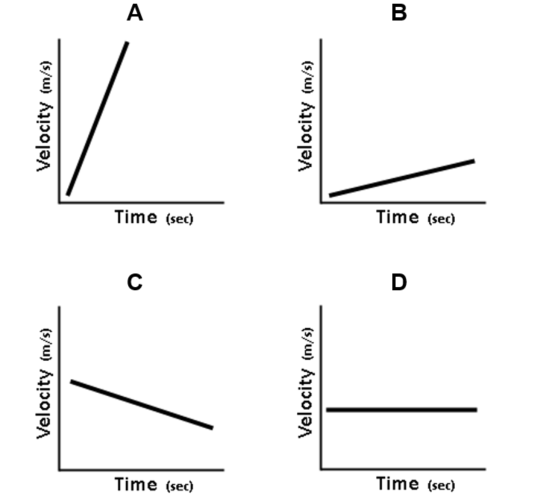
Which graph represents zero acceleration (constant velocity)?
a)
A
b)
B
c)
C
d)
D
49.
What is happening between 3 seconds and 4 seconds?
a)
The object is moving in a negative direction.
b)
The object is returning to its starting position.
c)
The object is slowing to a stop.
d)
The object is changing direction.
50.
As the angle of the incline increases, what happens to the normal force?
a)
The normal force increases
b)
The normal force decreases
c)
The normal force is not affected by the incline
d)
The normal force is only dependent on the force due to gravity
51.
The acceleration of an object is proportional to ...
a)
the net force acting upon it
b)
its position
c)
its velocity
d)
its mass
52.
Raymond is hover boarding down they hall at a constant velocity. Assuming there is friction, which of the following must be true?
a)
The force applied by the board must be greater than the frictional force
b)
The frictional force must equal the force applied by the board
c)
The force applied must equal zero
d)
There is not enough information
53.
If you throw a baseball straight up, what is its velocity at the highest point?
a)
9.8 m/s2
b)
9.8 m/s
c)
0 m/s
d)
4.9 m/s
54.
A 5 kg ball is lifted 12 m above the ground. It's gravitational potential energy is
a)
60 J
b)
600 J
c)
17 J
d)
2.4 J
55.
On a graph showing distance versus time, a horizontal line represents an object that is
a)
moving at constant speed
b)
decreasing its speed
c)
increasing its speed
d)
not moving
56.
A person has a mass of 24 kg on Earth. What is the persons mass on the Moon (1/6 of Earth's gravity)?
a)
24 kg
b)
144 kg
c)
6 kg
d)
4 kg
57.
What is the horizontal acceleration of a projectile?
a)
0 m/s2
b)
9.8 m/s2
c)
4.9 m/s2
d)
-9.8 m/s2
58.
What determines the strength of gravitational attraction between two objects?
a)
mass and distance
b)
size and mass
c)
density and mass
d)
density and size
59.
Which of the following objects has the most kinetic energy?
a)
A 20 kg toddler running at 5 m/s
b)
A 50 kg toddler running at  30 m/s
c)
A 90 kg toddler running at 30 m/s
d)
A 100 kg  toddler running at 2 m/s
60.
is it possible for forces to act on an object and still have a net force of zero?
a)
yes
b)
no
c)
depends on the type of force
61.
What happens to the velocity of a ball as it is dropped off a cliff? 
a)
It decreases at a uniform rate 
b)
It increases at a uniform rate 
c)
It is constant 
d)
It increases at a non-uniform rate
62.
How do you find a resultant if there are components at a right angle to each other, and you know two sides?
a)
Multiply
b)
Divide
c)
Pythagorean Theorem
d)
sins or cosine
63.
What is the correct equation to solve for x?
a)
tan (45) = x/13
b)
cos (45) = x/13
c)
sin (45) = 13/x
d)
sin (45) = x/13
64.
Find x
a)
20
b)
5.9
c)
33
d)
42
65.
Find the length of side w.
a)
21.4 cm
b)
18.0 cm
c)
36.5 cm
d)
43.6 cm
66.
A solid  metal bar is at rest on a horizontal frictionless surface. It is free to rotate about a vertical axis at the left end. The figures show forces of different magnitudes that are exerted on the bar at different locations. In which case does the bar's angular speed about the axis increase at the fastest rate?
a)
A
b)
B
c)
C
d)
D
67.
A roller coaster car is poised at the top of the first hill on its track. What type of energy is the car's total energy stored as?
a)
Kinetic
b)
Thermal
c)
Potential
d)
Mechanical
68.

A roller coaster car moves down the hill. Assuming that the track is frictionless, which option represents the transfer of energy?

a)

Potential to Kinetic

b)

Kinetic to Potential

c)

Mechanical to Thermal

d)

Mechanical to Potential

69.
A spring with a spring constant of 3 N/m is compressed by 4 cm. How much potential energy is stored in the spring?
a)
0.0024 J
b)
0.024 J
c)
2.4 J
d)
24 J
70.

The unit for energy and work is

a)

J

b)

N

c)

m/s

d)

m/s/s

71.
If you exert a force of 20 N to push a desk 10 m, how much work did you do to the desk?
a)
20 N
b)
200 N
c)
200 J
d)
2 J
72.
The law of conservation states that
a)
every action has an equal and opposite reaction
b)
all matter has thermal energy
c)
energy cannot be created or destroyed, only changes form
d)
heat moves from an object of higher temperature to an object of lower temperature
73.
The ability to do work is called
a)
energy
b)
thermal
c)
kinetic
d)
potential
74.
Mechanical energy can be either potential or ________.
a)
Motion
b)
Kinetic
c)
Chemical
d)
Light
75.

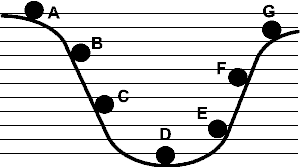
Which position has the most kinetic energy? Assume the ball is rolling down the halfpipe from left to right.

a)

A

b)

G

c)

D

d)

B

76.

Which position has the most potential energy? Assume the ball is rolling down the halfpipe from left to right.

a)

A

b)

G

c)

C

d)

D

77.

Which of the following is the best example of work being done?

a)

You lift a heavy box off the floor

b)

You stand still holding a heavy box

c)

Work is being done in both lifting and holding a heavy box

d)

No work is being done for either lifting nor holding a heavy box

78.

Energy stored in a compressed spring is

a)

kx

b)

kx2

c)

1/2 kx2

d)

mgh

79.
An object with a mass of 2000 kg at rest has what momentum?
a)
2000 kg m/sec
b)
0 kg m/sec
c)
2000 kg
d)
2000 m/sec