wayground logo

Free Printable Worksheets

Font size

S
M
L
XL
Worksheets

Physical Science Revew

Total questions: 89

Worksheet time: 2hrs 31mins

Name
Class
Date
1.
Which of the following is a unit of mass?
a)
kilogram
b)
liter
c)
meter
d)
pound
2.
The mass of an object ___________________________.
a)
changes, depending on where it is located
b)
changes randomly
c)
changes, depending on temperature
d)
does not change
3.

A squirrel has a weight of 4.9 N. What is his Mass if he is running on the Ground?

a)

4.9 kg

b)

9.8 N/kg

c)

0.5 kg

d)

5.0 kg

4.

______ is explained as a push or pull motion

a)

Force

b)

Friction

c)

Gravity

d)

Weight

5.

______ is the attractive force between any two objects that depends on the objects mass and distance to each other.

a)

Weight

b)

Gravity

c)

Net Force

d)

Rolling Friction

6.

What are the units for Weight?

a)

Kg

b)

N

c)

N/kg

d)

Joules

7.

What is the weight of a 0.456 kg object?

a)

456g

b)

0.456kg

c)

4.56N

d)

456N

8.

Find the weight of a 20g object

a)

200N

b)

20g

c)

0.2N

d)

0.02kg

9.

What statement is true?

a)

Mass never changes. Weight does.

b)

Weight never changes. Mass does.

c)

Both mass and weight change because they are affected by gravity.

d)

Neither mass nor weight change. They are always the same.

10.
Acceleration occurs when an object changes its speed or ______.
a)
direction
b)
force
c)
inertia
d)
mass
11.

During which interval is the object speeding up?

a)

A to B

b)

B to C

c)

D to E

d)

E to F

12.
Acceleration occurs when an object changes its speed or ______.
a)
direction
b)
force
c)
inertia
d)
mass
13.
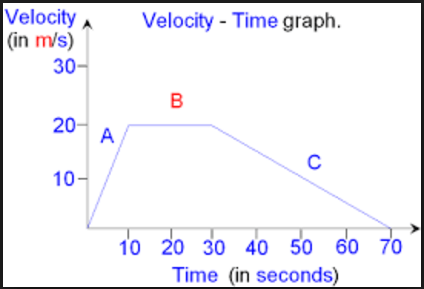
This is a velocity-time graph.  What is the object doing in segment C?
a)
Positive acceleration
b)
Negative acceleration
c)
Constant Velocity
d)
Not moving
14.
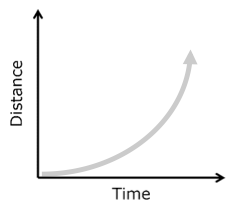
This graph demonstrates an object that is -
a)
Increasing speed
b)
At a constant speed
c)
Decreasing speed
d)
Stationary
15.
This graph demonstrates an object that is -
a)
Increasing speed
b)
At a constant speed
c)
Decreasing speed
d)
Stationary
16.
Which line represents an object moving at a faster speed?
a)
A
b)
B
17.
Velocity is
a)
speed and acceleration
b)
constant speed
c)
a frame of reference
d)
speed in a given direction
18.
Acceleration is
a)
increasing speed
b)
decreasing speed
c)
changing direction
d)
all of the above
19.

State of matter that takes the shape of it's container and has a definite volume.

a)

Solid state

b)

Liquid state

c)

Gas state

d)

Plasma state

20.

State of matter that can fill containers with no fixed shape or volume.

a)

Solid state

b)

Liquid state

c)

Gas state

d)

Plasma state

21.

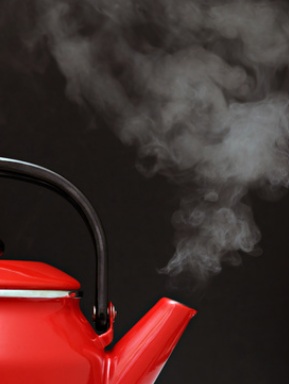
What change of state is taking place in this photograph?

a)

Condensation

b)

Freezing

c)

Vaporization

d)

Melting

22.

What change of state is taking place in this photograph?

a)

Condensation

b)

Freezing

c)

Vaporization

d)

Melting

23.

The diagram shows the way the particles of a solid occupy space. Select the property of a solid that is consistent with this micro-view.

a)

No define shape

b)

Cannot be compressed

c)

No definite volume

24.

Which of the following states is correct?

a)

Gases cannot be compressed.

b)

Solids are easily compressed.

c)

Gases are easier to compress than solids.

d)

Liquids cannot be compressed or expanded.

25.

How would you classify the matter in the picture above?

a)

Element

b)

Compound

c)

Homogeneous Mixture

d)

Heterogeneous Mixture

26.

How would you classify the matter in the picture above?

a)

Element

b)

Compound

c)

Homogeneous Mixture

d)

Heterogeneous Mixture

27.

How would you classify the matter in the picture above?

a)

Element

b)

Compound

c)

Homogeneous Mixture

d)

Heterogeneous Mixture

28.

How would you classify the matter in the picture above?

a)

Element

b)

Compound

c)

Homogeneous Mixture

d)

Heterogeneous Mixture

29.

How would you classify the matter in the picture above?

a)

Element

b)

Compound

c)

Homogeneous Mixture

d)

Heterogeneous Mixture

30.

How would you classify the matter in the picture above?

a)

Element

b)

Compound

c)

Homogeneous Mixture

d)

Heterogeneous Mixture

31.

What is the name of group number 1?

a)

halogens

b)

noble gases

c)

alkali metals

d)

alkaline earth metals

32.

What is the name of group number 2?

a)

transition metals

b)

halogens

c)

metaloids

d)

alkaline earth metals

33.

where are the metaloids found

a)

far left, vertical

b)

stair step/diagonal

c)

far right horizontal

d)

at the bottom

34.

What group number are the halogens found?

a)

18 (8A)

b)

1

c)

2

d)

17 (7A)

35.
How many "valance electrons" are in chlorine?
a)
7
b)
2
c)
17
d)
8
36.
Carbon-12, Carbon-13, and Carbon-14 are...
a)
ions
b)
isotopes
c)
electronegative
d)
radioactive
37.
How many Protons does Bromine have?
a)
45
b)
79.904
c)
80
d)
35
38.
How many Neutrons does Bromine have?
a)
35
b)
80
c)
45
d)
79.905
39.
A particle with a negative charge inside of an element is called
a)
isotope
b)
neutron
c)
proton
d)
electron
40.
An isotope has...
a)
the same number of protons but different number of electrons
b)
same number of protons but different number of neutrons
c)
same number of electrons and neutrons
d)
same number of electrons, protons, and neutrons
41.
Is this Lewis Dot Structure correct
a)
Yes
b)
No, chlorine has 6 valence
c)
No, chlorine has 8 valence
d)
No, chlorine has 17 electrons
42.
What is titanium's atomic mass?
a)
47.867
b)
22
c)
26
d)
49
43.

A substance is found to have the following characteristics:


Very bitter taste

Feels slippery to the touch

Produces OH- ions when dissolved in water


In what category would the substance be classified?

a)

acid

b)

base

c)

enzyme

d)

fatty acid

44.

HNO2

a)

a base

b)

a salt

c)

an acid

d)

an ionic compound

45.

KOH is ...

a)

an acid

b)

a base

c)

a salt

d)

an ionic compound

46.

On the pH scale, an acid is a compound that produces a solution with a pH (a)   7.

47.

On the pH scale, a base is a compound that produces a solution with a pH (a)   7.

48.

What pH does a neutral substance have?

a)

5

b)

6

c)

7

d)

8

49.

Which of the following is the weakest acid?

a)

bananas (pH 5)

b)

tomatoes (pH 4)

c)

cheese (pH 6)

d)

orange juice (pH 3)

50.
A(n) ______ is a substance with a pH less than 7
a)
Acid
b)
Alkaline
c)
Base
d)
Buffer
51.
A(n) _______ is a substance with a pH greater than 7.
a)
Base
b)
Acid
c)
Buffer
d)
Water
52.
The pH scale is a range from:
a)
1-7
b)
0-14
c)
1-14
d)
1-20
53.

The 3 types of chemical bonds are ________, ________, and ______. (Choose 3)

a)

ionic

b)

valence

c)

covalent

d)

metallic

e)

atomic

54.
If an atom gains two electrons what charge will it have?
a)
-2
b)
-1
c)
+1
d)
+2
55.

A bond between two nonmetal atoms is a __________ bond.

a)

ionic

b)

nuclear

c)

metallic

d)

covalent

56.
Covalent bonds are between...
a)
two or more nonmetals
b)
sodium and chlorine
c)
metals and metals
d)
metals and nonmetals
57.

Ionic bonds form between ---

a)

nonmetals.

b)

metals and nonmetals.

58.
What is the name for an ion with a negative charge?
a)
cation
b)
anion
c)
onion
d)
union
59.
The following is what type of reaction:
PbCl2 + AgNO3 → Pb(NO3)2 + AgCl
a)
Synthesis
b)
Decomposition
c)
Single Replacement
d)
Double Replacement
60.
The following is what type of reaction:
NH3 + HCl  → NH4Cl
a)
Synthesis
b)
Decomposition
c)
Single Replacement Replacement
d)
Double Replacement Replacement
61.
What type of chemical reaction is this?
Al(OH)3 → Al2O3  + H2O
a)
Decomposition
b)
Combustion
c)
Synthesis
d)
Single Replacement 
62.
3Ca + 2AlCl3 --> 3CaCl2 + 2Al
a)
Synthesis
b)
Decomposition
c)
Single Displacement
d)
Double Displacement
63.
Which side of a chemical equation is the reactant side?
a)
Left (before the yields sign)
b)
Right (after the yields sign)
64.
Which side of a chemical equation os the product side?
a)
Left (before the yields sign)
b)
Right (after the yields sign)
65.
Balance this equation.
_SnO+_H2-->_Sn +_H2O
a)
1,1,2,1
b)
1,2,1,1
c)
1,2,1,2
d)
1,2,2,1
66.

Water freezes at 320 on which temperature scale?

a)

Fahrenheit

b)

Celsius

c)

Kelvin

d)

Absolute Zero

67.

Absolute zero is shown as 0 on which scale?

a)

Fahrenheit

b)

Celsius

c)

Kelvin

d)

Centigrade

68.
Has a mass of 4 and a charge of +2
a)
Alpha
b)
Beta
c)
Gamma
69.
Has the symbol
a)
Alpha
b)
Beta 
c)
Gamma
70.
Takes two small nuclei and combines them into a larger nucleus
a)
fission
b)
fusion
71.
The splitting of a nucleus into smaller nuclei is
a)
fusion
b)
fission
c)
half-life
d)
gamma radiation
72.
The specific heat of aluminum is 0.21 cal/g°C.  How much heat(Q) is released when a 10 g piece of aluminum foil is taken out of the oven and cools from 100° to 50°?
a)
105 J
b)
10.5 J
c)
1.05 J
73.
20 g of water. specific heat of water is 4.18 J/x°C.  temperature changes from 25° C to 20° Chow much heat energy (Q) moves from the water to the surroundings?
a)
418 Joules
b)
209 J
c)
83 J
d)
4.18 J
74.

In which region(s) does temperature increase?

a)

Region C only

b)

Regions B and D

c)

Regions A, C, and E

d)

Regions A and B

75.

In which region(s) of the heating curve would water be a liquid and a gas at the same time?

a)

A

b)

B

c)

C

d)

D

e)

E

76.

The energy transferred between objects that are at different temperatures is called

a)

Heat

b)

Temperature

c)

Energy

d)

Friction

77.
The sum of all forces acting on an object and direction
a)
Contact Force
b)
Balanced Force
c)
Unbalanced Force
d)
Net Force
78.
Forces have both _________ and direction.
a)
Magnitude
b)
Gravity
c)
Speed
d)
Height
79.

A push/pull exerted on an object is called

a)

Force

b)

Momentum

c)

Speed

d)

Net force

80.

This diagram can be used to indicate which of the following? (TWO correct answers)

a)

An object at rest

b)

An object accelerating

c)

An object decelerating

d)

an object moving at a constant velocity (speed)

e)

(Trick question -- there is only one correct answer)

81.

Which of the following is true about this free-body diagram?

a)

the forces are balanced

b)

the object is moving upward

c)

the object is free-falling

d)

the forces are unbalanced

82.

Which of the following would be considered a physical change?

a)

Cutting paper

b)

pH test

c)

Burning marshmellow

d)

Roasting a Turkey

83.

Which of the following would be considered a physical property?

a)

Colour

b)

Flammability

c)

pH

d)

Reactivity

84.

Is this a physical or chemical change?

a)

Physical

b)

Chemical

85.

Bubbles form when water boils. Is this evidence of chemical change?

a)

Yes, because water is changing.

b)

Yes, because the water is reacting.

c)

No, because the vapor is still water.

d)

No, because water doesn't react with anything.

86.

Every chemical change involves a transfer of ______.

a)

mass

b)

volume

c)

density

d)

energy

87.
Work divided by time equals...
a)
energy
b)
power
88.
The unit of work is the ...
a)
joule
b)
force
89.
The unit of power is the...
a)
work
b)
watt