wayground logo

Free Printable Worksheets

Font size

S
M
L
XL
Worksheets

Exam Review

Total questions: 210

Worksheet time: 5hrs 26mins

Name
Class
Date
1.
What is a solute?
a)
The substance that does the dissolving in a solution.
b)
The substance that is dissolved into the solution.
c)
The mixing of different substances.
d)
The process in which neutral molecules lose or gain electrons
2.
What is a solvent?
a)
The substance that does the dissolving in a solution.
b)
The substance that is being dissolved in a solution.
c)
The mixing of different substances.
d)
The process in which neutral molecules lose or gain electrons
3.

Molality (m) = moles of solute / _________________________.

a)

kilogram of solvent

b)

kiloliter of solvent

c)

kilometer of solvent

d)

ounces of solvent

4.

molality is defined as ________________________

a)

the moles of solute per kilogram of solvent

b)

moles of solute per liter of solution

c)

mass of solute/ mass of solution

d)

mass of solute/ mass of solvent X 100

5.
Which sweet tea would you expect to taste the sweetest?
a)
1M
b)
3M
c)
3.1M
d)
2.5M
6.

Molarity is measured in _____.

a)

moles per g.

b)

mols per L.

c)

moles per mm.

d)

moles per mL.

7.

A solution that is considered unsaturated would _____.

a)

be dark in color.

b)

have a strong scent.

c)

have a large amount of solute.

d)

have a small amount of solute.

8.

What do molarity and molality have in common?

a)

Both have "moles solute" in the numerator

b)

Both have "kg solvent" in the denominator

c)

Both have "L solution" in the denominator

d)

Both have "moles solution" in the denominator

9.

What are the units of molarity?

a)

M

b)

m

c)

Ml

d)

Mr

10.

When the solution equilibrium point is reached and no more solute will dissolve, the solution is said to be _________.

a)

unsaturated

b)

saturated

c)

supersaturated

11.

What do you call a solution that contains less than the maximum amount of solute that is capable of being dissolved?

a)

unsaturated solution

b)

saturated solution

c)

supersaturated solution

d)

insoluble solution

12.

Which of the following best describes a supersaturated solution?

a)

a solution that contains the maximum amount of solute that is capable of being dissolved

b)

a solution that contains less than the maximum amount of solute that is capable of being dissolved.

c)

a solution that contains more than the maximum amount of solute that is capable of being dissolved.

d)

none of the above

13.

The term molar which is used to describe a solution's concentration, is written as?

a)

M

b)

mol

c)

g

d)

g/L

14.
What is the molarity of a solution made by diluting 26.5 mL of 6.00M HNO3 to a volume of 250 mL?
a)
15.9 M
b)
0.636 M
c)
0.642 M
d)
1.59 M
15.
What is the molarity of a solution made by adding 1.565 moles of PbNO3 to 500 mL?
a)
300. M
b)
31.3 M
c)
3.13 M
d)
1.56 M
16.

Identify Cesium Nitrate

a)
CsNO3
b)
Cs2(NO3)3
c)
Cs2NO3
d)
Cs3NO3
17.
What is the name of K3PO4?
a)
Tripotassium Phosphate
b)
Tripotassium Phosphite
c)
Potassium phosphide
d)
Potassium phosphate
18.
What is the name of Mg(OH)2?
a)
Magnesium Hydride
b)
Magnesium Dihydride
c)
Magnesium Dihydroxide
d)
Magnesium Hydroxide
19.
Ions are: 
a)
atoms with a positive or negative charge
b)
atoms with no charge
c)
atoms with ONLY a positive charge
d)
atoms with ONLY a negative charge
20.

What is the correct name for this polyatomic ion: ClO

a)

hypochlorite

b)

chlorite

c)

chlorate

d)

perchlorate

21.

What is the correct name for this polyatomic ion: OH

a)

hydrogen carbonate

b)

oxonium

c)

hydroxide

d)

acetate

22.

What is the correct name for this polyatomic ion: NO3

a)

carbonate

b)

hydroxide

c)

nitrite

d)

nitrate

23.

What is a cation's charge?

a)

positive

b)

negative

c)

neutral

d)

depends on the element

24.

What is an anion's charge?

a)

positive

b)

negative

c)

neutral

d)

depends on the element's charge

25.

Is potassium a cation or an anion?

a)

cation

b)

anion

26.

What is the charge of iron (III)?

a)

+3

b)

+2

c)

+6

d)

+4

27.

What is the charge of phosphate?

a)

-3

b)

-2

c)

-1

d)

-4

28.

Is the ion ammonium a cation or an anion?

a)

cation

b)

anion

29.

Identify the compound if hydrogen and chlorine are chemically combined.

a)

HCl

b)

HCl7

c)

H1Cl1

d)

H1Cl7

30.

What is the cation charge of chromium (VI)?

a)

+6

b)

-6

c)

+24

d)

-24

31.
C2H3O2-
a)
acetate
b)
carbon hydroxide
32.
NH4+
a)
nitrogen hydride
b)
ammonium
33.
Which of the following describes an ionic bond?
a)
does not conduct electricity
b)
has a low melting point
c)
between nonmetals
d)
between metals and non-metals
34.
The limiting reactant . . .
a)
slows the reaction down.
b)
is used up first.
c)
is the reactant that is left over.
d)
controls the speed of the reaction.
35.
Identify the limiting reagent when 6.00 moles HCl combines with 5.00 moles Mg to form MgCl2.
 
1 Mg +  2 HCl --> 1 MgCl2  +  1 H2   
 
a)
Mg
b)
H2
c)
MgCl2
d)
HCl
36.
Use the equation 2 Al + 3 Cl2 ---> 2 AlCl3.  If 2 moles of aluminum and 2 moles of chlorine are reacted, identify the limiting reactant.
a)
AlCl3
b)
Cl2
c)
Al
d)
None
37.
When does a chemical reaction stop?
a)
When the lab is finished.
b)
When the excess reactant is used. up
c)
When the limiting reactant is used up.
d)
Chemical reactions never stop.
38.
When 12 moles of O2 reacts with 6 moles of C10H8, what is the limiting reactant?  
1 C10H8 + 12 O2 --> 10 CO2 + 4 H2O
a)
Oxygen
b)
C10H8
c)
Water
d)
Carbon Dioxide
39.

Theoretical yield = 73g

Actual yield = 62g

Calculate the percent yield.

a)

116%

b)

85%

c)

1.16%

d)

76%

40.
3. The reactant that is not completely used up in a chemical reaction is called the __________ .
a)
spectator reagent
b)
limiting reagent
c)
excess reagent
d)
catalyst
41.
4. If the quantities of reactants are given in units other than moles, what is the first step for determining the amount of product?
a)
Determine the amount of product from the given amount of limiting reagent.
b)
Convert each given quantity of reactant to moles.
c)
Identify the limiting reagent.
42.

Identify the limiting reagent when 6.00 g HCl combines with 5.00 g Mg to form MgCl2.

Mg + 2HCl --> MgCl2 + H2

a)

Mg

b)

H2

c)

MgCl2

d)

HCl

43.
When you use a balanced chemical equation to calculate the amount of a product on paper it is referred to as the 
a)
experimental value
b)
theoretical value
c)
true amount
d)
percent yield
44.
A reaction was predicted to produce 32.4 grams of a compound. When the product was measured, there were only 26.1 grams made. What is the percent yield?
a)
80.6%
b)
6.3%
c)
24.1%
d)
58.5%
45.

Cl2 + 2 KBr → Br2 + 2 KCl

How many grams of potassium chloride can be produced from 356 g of Cl2 and 356 g of potassium bromide?

a)

749 g

b)

223 g

c)

479 g

d)

814 g

46.
Silver nitrate and sodium phosphate are reacted in equal amounts of 200 g each. How many grams of silver phosphate are produced? 
3AgNO3  + Na3(PO4)  --->  Ag3(PO4)  + 3NaNO3
a)
164 g
b)
64 g
c)
146 g
d)
164 moles
47.
4NH+ 5O--> 4NO + 6H2O
How many grams of NO are formed if 6.30g of ammonia react with 1.80g of oxygen? 
a)
0.37g
b)
0.045g
c)
1.35g
d)
11.1g
48.
P+ 6Cl--> 4PCl
The reaction of 75.0g P4 with excess chlorine gas produces 110g PClin lab. Find the theoretical yield and calculate percent yield for the reaction. 
a)
78%
b)
64%
c)
27%
d)
33%
49.

Why is it important to identify the limiting reagent?

a)

The limiting reagent speeds up the reaction.

b)

The limiting reagent controls the amount of product formed.

c)

If there is no limiting reagent, the reaction will not occur.

d)

No stoichiometry calculations can be done without a limiting reagent.

50.

0.667 g of Al reacts with 2.53 g of CuCl2. How many grams of Al are left over after the reaction is complete?

a)

0.328 g Al

b)

0.338 g Al

c)

0.667 g Al

d)

4.98 g Al

51.

If 0.667 g Al reacts with 2.53 g CuCl2, what is the theoretical yield of Cu?

a)

3.21 g Cu

b)

0.338 g Cu

c)

1.20 g Cu

d)

2.35 g Cu

52.

If 0.666 g Al reacts with 2.53 g CuCl2, and 1.01 g Cu are formed in the lab, what is the percent yield of Cu?

a)

15.8 %

b)

84.2 %

c)

98.4 %

d)

100.0 %

53.
What does Boyle's law relate to?
a)
Temperature and Volume
b)
Volume and Pressure
c)
Temperature and Pressure
54.
When the temperature of matter increases the particles...
a)
speed up and move closer
b)
speed up and move farther apart
c)
slow down and move closer together
d)
slow down and move farther apart
55.
In Charles' Law the pressure remains constant.
a)
True
b)
False
56.
What type of relationship is Charles' Law?
a)
Inverse
b)
Direct
c)
Not enough information
d)
#goals
57.
True or False: Gases can be compressed. 
a)
True
b)
False
58.
What is the formula for Boyle's Law?
a)
P1V1=P2V2
b)
P1V1/P2V2
c)
P1V2=P2V1
d)
P1/V1=P2/V2
59.
When Pressure increases then the Volume must...
a)
Increase
b)
decrease
60.
When Volume increases then Pressure must...
a)
Increase
b)
Decrease
61.
What type of relationship to pressure and volume have?
a)
direct
b)
inverse
c)
no relationship
d)
I don't know
62.
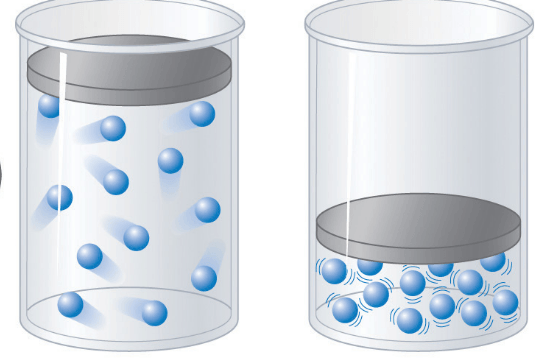
Which container will have a lower pressure?
a)
left
b)
right
c)
they both have the same pressure
d)
I don't know
63.
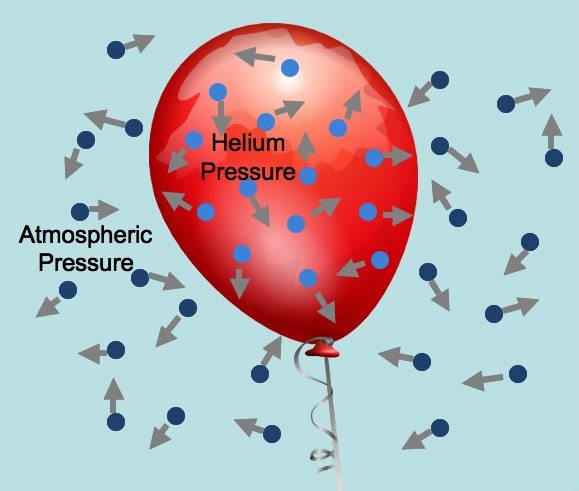
What causes pressure?
a)
The walls of the container
b)
The vacuum in the container
c)
The collisions of the particles
d)
Atmospheric pressure acting on the outside walls
64.
The relationship of which two variables are compared in Boyle's Law?
a)
pressure & volume
b)
volume & temperature
c)
temperature & pressure
d)
volume & moles (amount of gas)
65.
Boyle's law : When _______ is held constant, the pressure and volume of a gas are ________  proportional
a)
temperature,  equally
b)
mass, inversely
c)
temperature, inversely
d)
mass, equally
66.
What type of relationship is Charles' Law?
a)
Inverse
b)
Direct
c)
Not enough information
d)
#goals
67.
What is the formula Charles' Law?
a)
V = T
b)
VT = VT
c)
T1 / V1 = T2 / V2
d)
V1 / T1 = V2 / T2
68.

Fill in the blank. (Copper has a charge of +2)

Cu+ AgNO3--> Ag + _____

a)

Cu(NO3)2

b)

CuNO3

c)

CuAg

d)

Cu

69.

Predict the products for this equation.

(Zn with a charge of +2)

Zn + H2SO4 -->

a)

Zn(SO4)2 + H

b)

ZnSO4 + H2

c)

ZnSO4 + H4

70.

Complete the balanced equation for this Double Replacement reaction.

3 NaOH + Fe(NO3)3 -->

a)

NaFe + OH(NO3)3

b)

2NaNO3

c)

3 NaNO3 + Fe(OH)3

71.

Predict the products for the this Single Replacement reaction:

K + HCl -->

a)

KCl + H2

b)

KHCl

c)

KH + Cl2

72.

Predict the products for the this Single Replacement reaction:

Mg + CuCl2 -->

a)

MgCl2 + Cu

b)

Mg + Cu

c)

MgCu + Cl2

73.

Predict the products for the this Double Replacement reaction:

AgNO3 + KCl -->

a)

AgCl + KNO3

b)

AgK + ClNO3

c)

KAg + NO3Cl

74.

If an element is diatomic it should have a subscript of___

a)

1, always

b)

2, only when it is by itself

c)

it shouldn't have a subscript, it should have a coefficent

75.

What is the charge of Iron in this compound. (Hint: think criss cross method):

Fe3(PO4)2

a)

+3

b)

+2

c)

+1

76.

What is the correct way of representing hydrogen gas alone, in a reaction?

a)

2H

b)

H

c)

H2

77.

What are the products of this Single Replacement reaction?

Zn(s) + H2SO4(aq) -->

a)

ZnH2SO4

b)

ZnSO4 + H2

c)

No reaction

78.

To predict if a single replacement reaction will take place you should use the____________ __________

a)

Activity series

b)

Solubility Chart

c)

Periodic Table

79.

When predicting a double replacement reaction we use the__________ ________ to help us determine if a solid is produced or not

a)

Activity series

b)

Solubility Chart

c)

Periodic Table

80.

What is the name for the solid formed during a reaction?

a)

Precipitate

b)

Rocks

c)

Aqueous

81.

The symbol for a substance dissolved in solution is ______

a)

(s)

b)

(l)

c)

(aq)

82.

Is the following substance soluble or insoluble?

NaNO3

a)

Soluble

b)

Insoluble

83.

Is the following substance Soluble or insoluble?

AlPO4

a)

Soluble

b)

insoluble

84.
Combining substances to form a new substance
a)
Displacement
b)
Synthesis
c)
Decomposition
d)
Oxidation
85.
Breaking down a substance into simpler substances
a)
Displacement
b)
Synthesis
c)
Decomposition
d)
Oxidation
86.
Cu + 2Ag(NO3) → 2Ag + Cu(NO3)
a)
Synthesis Reaction
b)
Decomposition Reaction
c)
Single Displacement Reaction
d)
Double Displacement Reaction
87.

Ca3(PO4)2 + 3 H2SO4 → 3 CaSO4 + 2 H3(PO4)

a)
Synthesis Reaction
b)
Decomposition Reaction
c)
Single Displacement Reaction
d)
Double Displacement Reaction
88.
Consider the equation 4 Fe+3 O2 → 2 Fe2O3 . In this equation, 3 O2 is a
a)
product
b)
reactant
c)
compound
89.
Which of the following examples shows that a chemical reaction has occurred? 
a)
A rock breaks into smaller pieces when it is struck with a hammer.
b)
Rust forms on a hammer that has been left outside to long. 
c)
A cup of water turns pink when a few drops of red food coloring are added. 
d)
A solid is formed when heat is removed from a sample of water. 
90.
Balance this equation
_N+ _H--> _NH3
a)
1,2,3
b)
1,3,2
c)
1,1,2
d)
2,1,1
91.
What does the Law of Conservation of Mass state?
a)
Matter cannot be gained or lost in a chemical reaction.
b)
Matter can only be lost in a chemical reaction.
c)
Matter can only be gained in a chemical reaction.
d)
Matter can be gained and lost in a chemical reaction. 
92.
What is the right ratio of chemicals for the BCE (Balanced Chemical Equation)?__Al + __O2--> __Al2O3
a)
4,1 --> 2
b)
4,3 --> 4
c)
3,4 --> 1
d)
4,3 --> 2
93.

What is the right ratio of chemicals for the BCE (Balanced Chemical Equation)?

__CH4 + __O2 --> __CO2+ __H2O

a)
2,1 --> 2,1
b)
1,2 --> 1,1
c)
1,2 --> 1,2
d)
1,2 --> 2,1
94.

What type of reaction is Fe + Cl2 → FeCl3

a)

Synthesis

b)

Decomposition

c)

Single Replacement

d)

Combustion

e)

None of these

95.

What type of reaction is C2H2 + O2 → CO2 + H2O

a)

Synthesis

b)

Decomposition

c)

Single Replacement

d)

Combustion

e)

None of these

96.

What type of reaction is BF3 + Li2SO3 → B2(SO3)3 + LiF

a)

Synthesis

b)

Decomposition

c)

Single Replacement

d)

Combustion

e)

None of these

97.

What type of reaction is Ag2O → Ag + O2

a)

Synthesis

b)

Decomposition

c)

Single Replacement

d)

Combustion

e)

None of these

98.

What type of reaction is C5H10 + O2 → CO2 + H2O

a)

Synthesis

b)

Decomposition

c)

Single Replacement

d)

Combustion

e)

None of these

99.

What type of reaction is Zn + HCl → H2 + ZnCl2

a)

Synthesis

b)

Decomposition

c)

Single Replacement

d)

Combustion

e)

None of these

100.

What type of reaction is H2 + N2 → NH3

a)

Synthesis

b)

Decomposition

c)

Single Replacement

d)

Combustion

e)

None of these

101.

What type of reaction is (NH2)3PO4 + Pb(NO3)4 → NH4NO3 + Pb3(PO4)4

a)

Synthesis

b)

Decomposition

c)

Single Replacement

d)

Combustion

e)

None of these

102.

What type of reaction is FeBr3 + H2SO4 → HBr + Fe2(SO4)3

a)

Synthesis

b)

Decomposition

c)

Single Replacement

d)

Combustion

e)

None of these

103.

What type of reaction is Fe + H2SO4 → H2 + FeSO4

a)

Synthesis

b)

Decomposition

c)

Single Replacement

d)

Combustion

e)

None of these

104.

What type of reaction is Mg + Br2 → MgBr2

a)

Synthesis

b)

Decomposition

c)

Single Replacement

d)

Combustion

e)

None of these

105.

What type of reaction is KClO3 → KCl + O2

a)

Synthesis

b)

Decomposition

c)

Single Replacement

d)

Combustion

e)

None of these

106.

What type of reaction is K2CO3 → K2O + CO2

a)

Synthesis

b)

Decomposition

c)

Single Replacement

d)

Combustion

e)

None of these

107.

What type of reaction is CH4 + O2 → CO2 + H2O

a)

Synthesis

b)

Decomposition

c)

Single Replacement

d)

Combustion

e)

None of these

108.

What type of reaction is NaOH + HCl → H2O + NaCl

a)

Synthesis

b)

Decomposition

c)

Single Replacement

d)

Combustion

e)

None of these

109.

What type of reaction is SeCl6 + O2 → SeO2 + Cl2

a)

Synthesis

b)

Decomposition

c)

Single Replacement

d)

Combustion

e)

None of these

110.
The pH of a solution is tested, and it is found to be a basic solution. Of the following choices, what could the pH have been?
a)
3
b)
9
c)
7
d)
5
111.
Pure water has a pH of 7. Pure water _______.
a)
is a base
b)
is a neutral substance
c)
could be either an acid or a base
d)
is an acid
112.
Tastes bitter.
a)
Acids
b)
Bases
c)
Salts
d)
All
113.
Ammonia has a pH of 12.  Ammonia is __________.
a)
an acid
b)
a base
c)
an element
d)
a metal
114.
Soap is a weak base.  What is true about the taste of bases?
a)
they taste sour
b)
they taste sweet
c)
they taste bitter
d)
they taste salty
115.
When dissolved in water, bases produce:
a)
acids
b)
salts
c)
hydrogen ions
d)
hydroxide ions
116.
Which of these solutions is an acid?
a)
Dish Soap: pH of 12
b)
Tomato Soup: pH of 4
c)
Baking Soda: pH of 9
d)
Drain Cleaner: pH of 14
117.
Litmus paper can tell you if a solution is acidic, neutral or basic by changing color when placed in a solution.  If you test a base with litmus paper, it will turn ____________.
a)
purple
b)
red
c)
blue
d)
pink
118.
When dissolved in water, acids produce:
a)
bases
b)
salts
c)
hydrogen ions
d)
hydroxide ions
119.
Which has a slippery texture?
a)
Acid
b)
Base
120.
Turns litmus red
a)
Acids
b)
Bases
c)
All
121.

What is the colour of methyl orange an acid ?

a)

Red

b)

Yellow

c)

Pink

d)

Colourless

122.

What is the colour of phenolphthalein an acid?

a)

Pink

b)

Yellow

c)

Orange

d)

Colourless

123.

What is the colour of phenolphthalein in a base ?

a)

Pink

b)

Blue

c)

Red

d)

Colourless

124.

What is the colour of methyl orange in a base ?

a)

Pink

b)

Blue

c)

Yellow

d)

Colourless

125.

According to Arrhenius, what is the definition of an ACID?

a)

a substance that contains hydroxide and ionizes to produce OH-

b)

a substance that contains hydrogen and ionizes to produce H+

c)

a substance that contains hydrogen and ionizes to produce OH-

d)

a substance that contains hydroxide and ionizes to produce H+

126.

According to Bronsted-Lowry, what is the definition of an BASE?

a)

a substance that donates a hydrogen (H+) ion

b)

a substance that donates a hydroxide (OH-) ion

c)

a substance that accepts a hydrogen (H+) ion

d)

a substance that accepts a hydroxide (OH-) ion

127.

What is being donated/accepted between conjugate acid-base pairs?

a)

a hydrogen (H+) ion

b)

a hydroxide (OH-) ion

c)

water

d)

a neutron

128.

What is the conjugate base in the following reaction?

a)

HCO3-

b)

HCl

c)

H2CO3

d)

Cl-

129.
What is the conjugate acid in the following equation?
a)
PO43- 
b)
HNO3 
c)
NO3- 
d)
HPO42-
130.
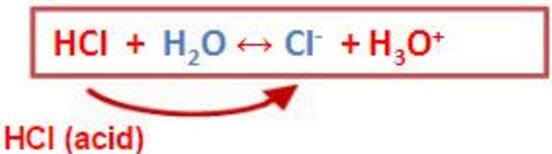
Which of the following shows the correct conjugate acid base pair?
a)
HCI (acid) / H3O+ (conjugate base)
b)
HCI (acid) / CI- (conjugate base)
c)
HCI (base) / CI- (conjugate acid)
d)
HCI (base) / H3O+ (conjugate acid)
131.

An arrhenius acid

a)

produces hydroxide ions in a solution

b)

is a proton donor

c)

produces hydrogen ions in a solution

d)

is a proton acceptor

132.

An arrhenius base

a)

produces hydroxide ions in a solution

b)

is a proton donor

c)

produces hydrogen ions in a solution

d)

is a proton acceptor

133.

Acid-base conjugate pairs differ by a single

a)

Electron

b)

Proton

c)

Neutron

d)

Oxygen

134.

For a solution, pH + pOH =

a)

7

b)

14

c)

1.0 x 10⁻¹⁴

d)

-log (1.0 x 10 -14)

135.

If the pH of a solution is 4.0, what is the pOH?

a)

4.0

b)

10.0

c)

1.0 x 10 -4

d)

cannot be determined from the information

136.

If the [H3O+] of a solution is 1 x 10⁻³ M, the pH is

a)

11

b)

-3

c)

3

d)

1

137.

What is the pH of a solution that has a [H+] of 2.5 x 10⁻⁵?

a)

4.60

b)

2.5

c)

5.0

d)

7

138.

What is the [H+] if the pH is 4.0?

a)

1.0 x 10⁻¹⁰ M

b)

1.0 x 10⁻¹⁴ M

c)

1.0 x 10⁻⁴ M

d)

1.0 x 10⁻⁷ M

139.

Acids have a ______ pH and a _________ pOH

a)

low, high

b)

high, low

c)

An acid will not have a pOH

140.

Find the pH of a solution with [OH-] = 8.41 x 10⁻⁴.

a)

3.08

b)

10.92

c)

9.88

d)

11.23

141.

If the [H3O+] of a solution is 9.3 x 10⁻³ M, the pOH of the solution will be

a)

2.03

b)

1.02

c)

11.97

d)

12.98

142.
The hydroxide ion concentration in a soft drink is 5.00 x 10⁻¹² M.  Find the pH.
a)
0.002
b)
2.7
c)
11.3
d)
14
143.
The [H+] is orange juice is
0.00020 M.  FInd the pH of orange juice.
a)
1
b)
3.7
c)
10.3
d)
13
144.
What is the conjugate acid in the following equation?
a)
PO43- 
b)
HNO3 
c)
NO3- 
d)
HPO42-
145.
What is the conjugate base in the following reaction?
a)
HCO3- 
b)
HCl
c)
 H2CO3 
d)
Cl-
146.

Which of the following correctly identifies an Acid-Base Pair?

a)

HH4+ , OH-

b)

H2O , OH-

c)

CaCO3 ,CaCl2

d)

HNO3 , H2SO4

147.

Given the reaction above, which compound is the bronsted-Lowry Acid?

a)

NH3

b)

HCl

c)

NH4+

d)

Cl-

148.

Given the reaction above, which compound is the bronsted-Lowry Conjugate base, if HCl is the acid?

a)

NH3

b)

NH4+

c)

Cl-

149.

Given the information from the previous three questions, what is NH4+ classified as?

a)

Acid

b)

Base

c)

Conjugate Acid

d)

Conjugate Base

150.
Which of the following word pairs correctly completes the sentence below?
_______ are corrosive substances characterized as having a strong smell, a sour taste, and a _______.
a)
Acids; pH less than 7
b)
Acids; pH greater than 7
c)
Bases; pH greater than 7
d)
Bases; pH less than 7
151.
A substance that remains when a base has accepted an H+ ion is
a)
An acid
b)
A Base
c)
A Conjugate Acid
d)
A Conjugate Base
152.
The conjugate acid of HCO3is ___ and the conjugate base of HCO3- is ___.  (remember that Hion? well, follow it!!)
a)
H2CO3; CO3-2
b)
CO3-2; CO3-2
c)
H2CO3; H2O
d)
H2O; H2CO3
153.
Which reactant in the following equation is a Bronsted acid?
a)
ammonium
b)
ammonia
c)
hydroxide
d)
water
154.

Which compound is the conjugate base?

HCO3- + HCl ==> H2CO3 + Cl-

a)

HCO3-

b)

HCl

c)

H2CO3

d)

Cl-

155.

NH3 + H2O --> NH4+ + OH-

What is H2O in this reaction?

a)

acid

b)

base

c)

conjugate acid

d)

conjugate base

156.

In the reaction below, H2O is a(n):

H2SO3 + H2O --> H3O+ + HSO3-

a)

base

b)

acid

c)

conjugate acid

d)

conjugate base

157.
In the reaction HCl + H2O --> H3O+ + Cl-, what is the conjugate acid?
a)
HCl
b)
H2O
c)
H3O+
d)
Cl-
158.

Given the equation:

H2SO4 + H2O ↔ H3O+ + HSO4- 1

What is the conjugate acid?

a)

H2SO4

b)

H2O

c)

H3O+

d)

HSO4- 1

159.

Which of the following is a neutralization reaction?

a)

2Na + Cl2 → 2NaCl

b)

CH4 + 2O2 → CO2 + 2H2O

c)

HCl + KOH → KCl + H2O

d)

CaCO3 → CO2 + CaO

160.
Acid + Metal --> ?
a)
Salt + Water
b)
Salt + Hydrogen
c)
Salt
d)
Hydrogen
161.
Iron + Hydrochloric acid --> ?
a)
iron sulfate + water
b)
iron + hydrogen
c)
iron chloride + hydrogen
d)
iron chloride + water
162.
Zinc + nitric acid --> ?
a)
zinc sulfate + water
b)
zinc sulfate + hydrogen
c)
zinc nitrate + hydrogen
d)
zinc chloride + water
163.
What gas is produced when a metal reacts with an acid?
a)
Water vapour
b)
Acidic gas
c)
Hydrogen
d)
Nitrogen
164.
Which salt will be produced if magnesium react with hydrochloric acid?
a)
Magnesium oxide
b)
Magnesium sulfate
c)
Magnesium sulfide
d)
Magnesium chloride
165.
An acid reacts with a metal carbonate to produce 
a)
Salt, water and hydrogen gas
b)
Salt, water and carbon dioxide
c)
Limewater
d)
Salt and water 
166.
A neutralisation reaction produces 
a)
An acid 
b)
A neutral substance 
c)
Only water 
d)
Salt and water 
167.
What type of reaction is the following: 
HCl  + Zn --> ZnCl2 + H2
a)
Neutralisation
b)
Acid and a metal 
c)
Acid and a carbonate 
d)
Ionic 
168.
Complete the following reaction:
Sulphuric acid + sodium carbonate
--> 
a)
Carbon dioxide + water 
b)
calcium carbonate + water + carbon dioxide 
c)
Sodium sulphate + water + carbon dioxide 
d)
Sodium chloride + water + carbon dioxide 
169.
Complete the following reaction:
Hydrochloric acid + magnesium hydroxide --> 
a)
Magnesium chloride + water 
b)
Magnesium + water
c)
Magnesium chloride + hydrogen gas 
d)
Magnesium chloride + water + carbon dioxide 
170.
What are the formulas for the following?
--sulfuric acid--
--nitric acid--
a)
H2SO, HNO
b)
H2SO3, HNO3
c)
H2S, H3N
d)
H2SO4, HNO3
171.
Name the following in order:
HClO4, HClO3
a)
chlorous acid, hypochlorous acid
b)
perchloric acid, chloric acid
c)
chloric acid, perchloric acid
d)
hypochlorous acid, chlorous acid
172.
Strong acids and bases...
a)

do not break apart into ions (non-electrolyte)

b)

partially break apart into ions (weak electrolyte)

c)

completely break apart into ions (strong electrolyte)

d)

None of these

173.
What are the formulas for the following?
--hydrochloric acid--
--hydrobromic acid--
--hydroiodic acid--
a)
HClO3, HBrO3, HIO3
b)
HCl, HBr, HI
c)
HClO4, HBrO4, HIO4
d)
HClO, HBrO, HIO
174.

Which of the following is NOT a strong acid

a)

Sulfuric acid

b)

Hydrochloric acid

c)

Perchloric acid

d)

Hydrofluoric acid

175.

Which of the following is a weak acid

a)

HClO3HClO_3

b)

H2SH_2S

c)

HNO3HNO_3

d)

HBr

176.

Which of the following is a weak base

a)

Sodium hydroxide

b)

Rubidium hydroxide

c)

Magnesium hydroxide

d)

Strontium hydroxide

177.

Which of the following is NOT a strong base

a)

Be(OH)2Be\left(OH\right)_2

b)

CsOHCsOH

c)

KOH

d)

NaOH

178.

Any substance that has mass and occupies space is called____________________

a)

atom

b)

matter

c)

volume

179.
Milk is a _____. It can take the shape of any container that it is in.
a)
Solid
b)
Liquid
c)
Gas
180.
What is the missing word? When water is...., it starts to change from a liquid to a solid.
a)
Cooled
b)
Heated
c)
Boiled
181.

Which state of matter has a definite shape and volume?

a)

solid

b)

liquid

c)

gas

182.
Gases __________.
a)
have a fixed shape
b)
are easily compressed
c)
have particles that do not flow easily
d)
have a definite volume
183.

Molecules in _______________are very loosely packed.

a)

solids

b)

liquids

c)

gases

184.

The air you breathe is in which state?

a)

gas

b)

liquid

c)

solid

185.

These particles are representing which state of matter?

a)

gas

b)

solid

c)

liquid

186.

These particles are representing which state of matter?

a)

liquid

b)

solid

c)

gas

187.

Matter exist in _________________states.

a)

Two

b)

Three

c)

Four

d)

Five

188.

What is energy?

a)

Something you get from sleeping

b)

The ability to do work or supply heat

c)

A stadium in Houston

d)

A magical power

189.

What is thermochemistry?

a)

study of heat changes that occur during a chemical reaction & physical changes of state

b)

the study of heat and chemistry

c)

the study of heat

d)

the study of chemistry

190.

What is chemical potential energy?

a)

Energy from chemicals

b)

Energy to make chemicals

c)

Energy stored in chemical bonds

d)

Energy from the sky

191.

Which one is temperature change NOT dependent on

a)

amount of heat added

b)

Humidity levels

c)

mass of the substances

d)

composition of the substance (specific heat)

192.

Specific heat of water is...

a)

4180 J/g*C

b)

41.80 J/g*C

c)

4.184 J/g*C

d)

0.4184 J/g*C

193.

Match the following

a)

Jg C or calg C\frac{J}{g\ \circ C}\ or\ \frac{cal}{g\ \circ C}

1.

c

b)

g or kg

2.

m

c)

ΔT\Delta T

3.

C or K

d)

c

4.

J or cal, kJ or Kcal

194.

How much heat, in calories, is needed to raise the temperature of 125.0 g of lead (c lead= 0.130 J/g°C) from 17.5°C to 41.1°C?

a)

91.7 cal

b)

9.17 cal

c)

917 cal

d)

917.0 cal

195.
Is the combustion of gasoline endothermic or exothermic?
a)
Endothermic
b)
Exothermic
196.
What is the symbol for heat?
a)
q
b)
H
c)
J
d)
∘C
197.

What are chemical reactions that absorb energy?

a)

endothermic

b)

fast

c)

slow

d)

exothermic

198.

What is the formula for calculating heat?

a)

q = mcΔT

b)

H = ΔH x moles

c)

H = ΔH x grams

d)

products - reactants

199.

What are the two main types of energy?

a)

endothermic and exothermic

b)

spontaneous and nonspontaneous

c)

potential and kinetic

d)

entropy and enthalpy

200.
The heat required to raise the temperature of a SUBSTANCE by 1∘C
a)
calorie
b)
joule
c)
specific heat
d)
4.184 J
201.

What does temperature measure?

a)

heat

b)

average kinetic energy

c)

space

d)

time

202.

How much heat does an aluminum block absorb if 10.00 grams is heated from 25.0oC to 50.0oC? *Specific heat of aluminum is 0.900 J/goC

a)

450 J

b)

-450 J

c)

225 J

d)

-225 J

203.

A 24.0 gram sample of copper was heated from 25.0oC to 500.0oC, 4378 J of heat were absorbed, what is the specific heat of copper?

a)

0.384 J/g°C

b)

49909200 J/g°C

c)

2.60 J/g°C

d)

8.77 J/g°C

204.

Releasing heat into the surroundings occurs during an ___________________ reaction.

a)

Exothermic

b)

Endothermic

c)

Kinetic Energy

d)

Thermal Energy

205.

Which law states that energy cannot be created nor destroyed, but it can be transformed or transferred?

a)

Dalton's Law

b)

law of conservation of energy

c)

Hess's Law

d)

E=mc^2

206.

A gas has ________ kinetic energy than a liquid.

a)

more

b)

less

207.

When water evaporates, the process is...

a)

endothermic

b)

exothermic

208.

When wood is burned in a campfire, the process is...

a)

endothermic

b)

exothermic

209.

For an exothermic reaction, ΔH\Delta H  is...

a)

negative

b)

positive

210.

For an endothermic reaction, ΔH\Delta H  is...

a)

negative

b)

positive