wayground logo

Free Printable Worksheets

Font size

S
M
L
XL
Worksheets

Earth Spheres

Total questions: 60

Worksheet time: 57mins

Name
Class
Date
1.
What is the process of breaking down rocks or other material into smaller pieces?
a)
erosion
b)
weathering
c)
compaction
d)
cementation
2.
A plate boundary at which two plate move parallel to each other in opposite directions
a)
convergent plate boundary
b)
divergent plate boundary
c)
transform plate boundary
d)
subduction
3.
one tectonic plate moves under another
a)
convergent plate boundary
b)
divergent plate boundary
c)
transform plate boundary
d)
subduction
4.
a boundary at which two plate move toward each other
a)
convergent plate boundary
b)
divergent plate boundary
c)
transform plate boundary
d)
subduction
5.
What type of boundary is in this image?
a)
convergent plate boundary
b)
divergent plate boundary
c)
transform plate boundary
d)
subduction
6.
The Himalayas in South Asia are an example of what type of plate boundary?
a)
continental-oceanic convergent
b)
continental-continental convergent
c)
oceanic-oceanic convergent
d)
continental-continental divergent
7.
The formation of the Hawaiian Islands is associated with ____.
a)
a transform boundary
b)
hot spots
c)
convergent boundaries
d)
divergent boundaries
8.

An active volcanic area on earth is found at_______.

a)

Diverging Boundaries

b)

Converging Boundaries

c)

Hot Spots

d)

All of the above

9.

What is the active volcano area around the Pacific Rim called?

a)

Hot Spots

b)

Pacific Ocean

c)

Ring of Fire

d)

Hawaii

10.
Where do volcanoes come from?
a)
Places where plates move apart
b)
Places where plates are moving together
c)
Hot Spots
d)
All of these options
11.
What is the shaking and trembling that results from movement of rock beneath Earth's surface?
a)
Volcanoes
b)
Earthquakes
c)
Plate tectonics
12.

Where an oceanic crust converges with a continental or oceanic a very deep feature is made called a

a)

Ridge

b)

Trench

c)

crater

d)

oceanic dip

13.
Which of the following causes Earth's tectonic plates to move?
a)
Energy from the Sun
b)
Magnetic Pole Reversal
c)
Convection currents in the mantle
d)
Faults in Mountain Ranges
14.

Where does the heat come from that drives the convection current in the mantle? 

a)

The sun

b)

The crust

c)

the mantle

d)

the core

15.
What are the two types of crust
a)
continental and oceanic
b)
ocean and upper
c)
lower and upper
d)
pizza and subway
16.
Which of these is an example of erosion
a)
Light Shinning onto a mountain
b)
Rain breaking down rock 
c)
Wind blowing away sediment
d)
All of the above
17.
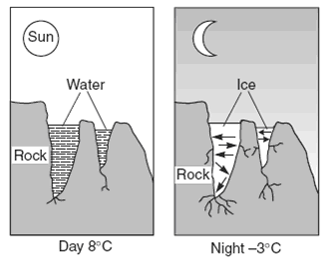
The diagrams  shows a natural process that weathers rock.
 Which statement best explains why this process results in weathering?
a)
frozen water acts as a solute
b)
water expands when it freezes
c)
the mass of water increases when it freezes
d)
frozen water dissolves most types of rock
18.
How does vegetation in the soil affect the rate of erosion?
a)
It doesn't affect erosion.
b)
It decreases erosion.
c)
It increases erosion.
19.
What is an enormous mass of ice moving over land?
a)
Ice wedging
b)
Glacier
c)
Iceberg
d)
Dune
20.
The ability of a material to transmit water through interconnected pores is called
a)
capacity
b)
competence
c)
permeability
d)
porosity
21.
Where does most fresh water exist?
a)
ice caps, lakes, and streams
b)
glaciers, rivers, and oceans
c)
aquifers, ice caps, and glaciers
22.
The change of water from a liquid to a gas.
a)
evaporation
b)
precipitation
c)
condensation
d)
transpiration
23.
How much of the earth's water is freshwater?
a)
50 %
b)
3 %
c)
97 %
d)
93 %
24.
Ocean's cover what percent of the Earth's surface?
a)
70 %
b)
60 %
c)
10 %
d)
none of the above
25.
What part of the water cycle does this picture show?
a)
condensation
b)
precipitation
c)
evaporation
26.
Snow, sleet, hail, and rain are all examples of  ________________. 
a)
evaporation
b)
condensation
c)
accumulation
d)
precipitation
27.
After the rain falls down onto Earth's surface, what most likely happens? What is it called?
a)
1. The remains of the water is soaked into the ground.
2.Groundwater
b)
1. Groundwater
2. The remains of the water is soaked into the ground.
c)
1. Groundwater
2. Transpiration happens to the plants.
d)
1. The liquid turns into an gas or an water vapor
2. Evaporation
28.
What is the water cycle?
a)
the 3 forms of water
b)
the movement of water on, above, or below the surface of the Earth
c)
when water melts
d)
when clouds form
29.
Marshes are a type of wetland...
a)
that can have either fresh or salt water.
b)
that will have cypress trees.
c)
that has no animals in it, only plants.
d)
that only filter water, but provide no flood protection.
30.
A land area that is covered with water for part of the year is called:
a)
lake
b)
wetland
c)
river
d)
wasted land
31.
The air in the troposphere has a greater density than the air in any other layer of the atmosphere,
a)
True
b)
False
32.
Temperature in the stratosphere warms as altitude increases.
a)
True
b)
False
33.
What is the percentage of oxygen in Earth's atmosphere?
a)
1%
b)
21%
c)
78%
d)
90%
34.
What is the percentage of nitrogen in Earth's atmosphere?
a)
1%
b)
21%
c)
78%
d)
90%
35.
Which layer of the atmosphere contains the greatest amount of water vapor?
a)
Thermosphere
b)
Troposphere
c)
Mesosphere
d)
Stratosphere
36.
In which layer of the atmosphere does weather occur?
a)
Mesosphere
b)
Thermosphere
c)
Stratosphere
d)
Troposphere
37.
What causes the temperature to increase in the stratosphere?
a)
Nitrogen
b)
Ozone
c)
Water Vapor
d)
carbon dioxide
38.
What decreases as you go up in the atmosphere?
a)
Altitude
b)
Atmosphere
c)
Meteors
d)
Air Pressure
39.
James plans to climb to the top of Mount Everest.  Which of the following statements about his climb will be the most accurate?
a)
Air pressure will rise and the temperature on a thermometer will increase.
b)
Air pressure will fall and the temperature on a thermometer will decrease.
c)
Air pressure will rise and the temperature on a thermometer will decrease.
d)
Air pressure and thermometer will not change.
40.
Which of the following is NOT a reason why the atmosphere is important?
a)
It is made of many layers.
b)
It provides gases living things need.
c)
It provides warm temperatures.
d)
It protects us from UV rays and meteors.
41.
Describe how the ozone layer protects the earth.
a)
Absorbs solar radiation, Protects Earth from UV Rays,  and emits heat
b)
Ozone in the lower atmosphere is a pollutant
42.
The warming of the atmosphere by the trapping of heat being radiated to space is called
a)
evaporation
b)
condensation
c)
the greenhouse effect
d)
radiation
43.

Which of the following statements about the movement of Earth's atmosphere is correct?

a)

A column of cool, dense air produces low pressure at the Earth's surface.

b)

The movement of air within the atmospheric convection cells generates the wind belts.

c)

Cold air is less dense than cool air so it tends to sink toward the Earth's surface.

d)

A column of warm, less dense air produces high pressure at the Earth's surface.

e)

Warm air is denser than cool air so it tends to sink toward the Earth's surface.

44.

The Sun is the ultimate energy source for all other objects in the Solar System. Which process transfers energy from the Sun through space to all other objects in the Solar System?

a)

conduction

b)

convection

c)

radiation

d)

reflection

45.

As snow and ice are deposited in arctic environments, layers build up over time. Because air is trapped during the formation of each new layer, scientists can take a cross section of ice and analyze it to determine how the atmosphere has changed over time. These samples are called ice cores. An example of ice core data is shown below. Which conclusion is best supported by this data?

a)

Carbon no longer leaves the atmosphere.

b)

The total amount of carbon on Earth has increased over time.

c)

The more recently the air was deposited, the more carbon it can store.

d)

The amount of carbon in the atmosphere was stable for a period of time.

46.

The principal greenhouse gases in our present atmosphere are:

a)

water vapor and carbon dioxide.

b)

hydrogen sulfide and carbon disulfide.

c)

hydrogen and helium.

d)

methane and ammonia.

e)

sulfuric acid vapor and carbon dioxide.

47.

The relative size of the atmosphere layer as compared to the solid part of Earth is most similar to:

a)

the meat of a peach as compared to the pit of the peach.

b)

the skin of a grape as compared to the meat of the grape.

c)

the peel of an orange as compared to the meat of the orange.

d)

the meat of a cherry as compared to the pit of the cherry.

e)

the rind of a watermelon as compared to the meat of the watermelon.

48.

Which form of electromagnetic radiation is absorbed by carbon dioxide and water vapor in our atmosphere?

a)

infrared

b)

radio

c)

visible light

d)

ultraviolet

e)

gamma rays

49.

Which of the following is the earth's largest reservoir of carbon dioxide?

a)

atmosphere

b)

icebergs

c)

oceans

d)

soil

50.

How do currents such as the Gulf Stream affect regional climates?

a)

Currents absorb heat as they move from low latitudes to high latitudes.

b)

Currents distribute heat from offshore regions to coastal regions.

c)

Currents distribute heat from the equator to higher latitudes.

d)

Currents remove heat from higher latitudes and distribute it at the equator.

51.

Data collected from ice cores have been compared in the diagrams illustrated below taken from a research station in Antarctica. What climate relationship can most likely be concluded from the information shown in these two graphs?

a)

Higher ice CO2 levels are the result of higher temperatures.

b)

Lower ice CO2 levels are the result of higher temperatures.

c)

Higher atmospheric CO2 levels leads to higher temperatures.

d)

Lower atmospheric CO2 levels leads to higher temperatures.

52.

The map shows the location of a category 3 hurricane. The black line shows the limits of where the hurricane may be located over the next several days. Why does the area inside the black lines get larger as each day passes?

a)

The hurricane is forecast to grow in size.

b)

Winds in the hurricane are expected to become stronger.

c)

The hurricane is forecast to begin to move faster as each day passes.

d)

It is difficult to predict the exact track of a hurricane for more than a day.

53.

The weather forecast map predicts rain and thunderstorms for central Florida. Rain misses the area. The map is shown below. Which is the most likely cause for the incorrect forecast?

a)

Ocean evaporation, which affects temperature and humidity, was not considered.

b)

Many conditions in the atmosphere can interact in unexpected ways.

c)

Computer models failed to calculate the interactions in the atmosphere.

d)

Too few weather stations were used to measure atmospheric and oceanic conditions.

54.

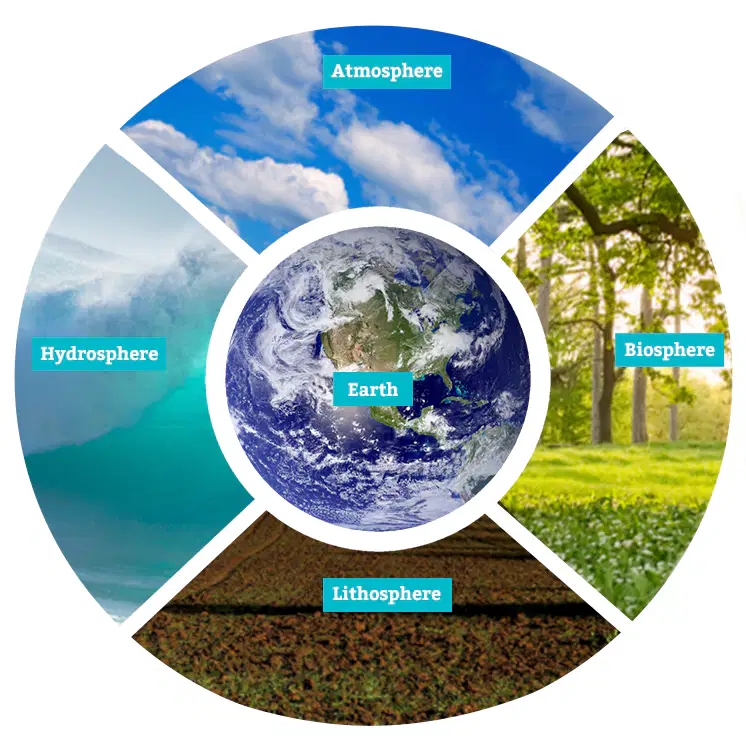
Which spheres of the earth are in this photo? (Select all that are present)

a)

Biosphere

b)

Hydrosphere

c)

Stratoshphere

d)

Lithosphere

e)

Atmosphere

55.

The Spheres of Earth

a)

are all connected

b)

have nothing to do with one another

c)

exist on Venus and Mars

d)

don't affect human life

56.

How do the biosphere and the hydrosphere interact?

a)

Air contains water.

b)

Volcanic ash can enter the atmosphere.

c)

Living things need water to survive.

d)

These two spheres do not interact.

57.

What is the main sphere represented in this picture?

a)

Hydorsphere

b)

Atmosphere

c)

Lithosphere

d)

Biosphere

58.

What sphere is represented here?

a)

Atmosphere

b)

Biosphere

c)

Lithosphere

d)

Hydrosphere

59.

Which two spheres are interacting?

a)

Atmosphere

b)

Biosphere

c)

Lithosphere

d)

Hydrosphere

60.
Question Image

Match root-word to the meaning

a)

Atmos

1.

Gas

b)

Bio

2.

Life

c)

Litho

3.

Stone

d)

Hydro

4.

Water

e)

Cryo

5.

Cold