wayground logo

Free Printable Worksheets

NEW

Font size

S
M
L
XL
Worksheets

Chem review

Total questions: 70

Worksheet time: 1hrs 5mins

Name
Class
Date
1.
Which of the following elements has the smallest radius?
a)
Mg
b)
Al
c)
Si
d)
K
2.

Which element in Period 2 has the greatest atomic radius?

a)

Be

b)

C

c)

Na

d)

Li

3.

Of the halogens (group 7A), which has the smallest radius?

a)

F

b)

Br

c)

He

d)

At

4.
As you move across the periodic table from left to right, the atomic radius decreases.  This is because - 
a)
the number of protons increases, so attraction to electrons increases
b)
the number of energy levels increases
c)
the number of electrons increases
d)
the atomic mass increases
5.
Ionization energy is...
a)
the energy required to add an electron to a specific atom
b)
how much energy it takes to remove an electron from an atom
c)
the energy required to shield the outer electrons from the nucleus
d)
a measure of the ability of an atom to attract electrons
6.

Electronegativity __________ from left to right within a period and __________ from top to bottom within a group.

a)

decreases, increases

b)

increases, increases

c)

increases, decreases

d)

stays the same, increases

7.

The vertical (up and down) columns in the Periodic Table are called

a)

groups

b)

towers

c)

periods

d)

atomic numbers

8.

The atom with the largest atomic radius in Group 8A is -

a)

Ar

b)

He

c)

Kr

d)

Rn

9.
Francium (Fr) has the lowest ionization energy in Group 1 because - 
a)
it has the smallest number of valence electrons
b)
it has the greatest atomic mass
c)
it has the greatest number of protons, so it attracts its electrons the strongest
d)
its 1 valence electron is very far from the nucleus, so little energy is needed to remove it
10.
Which has the greater EN: 
H or F?
a)
H
b)
F
11.
Which has the greater EN: 
N or C?
a)
C
b)
N
12.

How many valence electrons does Carbon have?

a)

4

b)

5

c)

6

d)

8

13.
Atoms that have a high electronegativity, _______________.
a)
give up their electrons more easily.
b)
hold on to their electrons more tightly.
c)
have more electron shells.
14.
Which of the following sequences corresponds to a correct trend in ionization energy?
a)
Cl > S > P > Al
b)
Sr > Ca > Mg > Be
c)
Rb > K > Na > Li
d)
Rb > Sr > I > Xe
15.

The ability of an atom to attract electrons in a bond is called

a)

Ionization energy

b)

electronegativity

c)

atomic radius

d)

proton affinity

16.
As you move down a group, atomic radius increases because - 
a)
you add more and more neutrons
b)
you add more and more protons
c)
you add more and more shells (energy levels)
d)
you add more atomic mass
17.
The element with the smallest ionization energy in Period 6 is - 
a)
Rn
b)
Cs
c)
Os
d)
Tm
18.

Which of the following will have a lower ionization energy than Scandium (Sc)?

a)

Helium (He)

b)

Titanium (Ti)

c)

Calcium (Ca)

d)

Magnesium (Mg)

19.

Which of the following will have a higher electronegativity than arsenic (As)?

a)

Carbon (C)

b)

Neon (Ne)

c)

Antimony (Sb)

d)

Germanium (Ge)

20.

As you move left to right across a period, ionization energy

a)

increases

b)

decreases

c)

says the same

21.
What is the study of the composition, structure, and properties of MATTER?
a)
Chemistry
b)
Biology
c)
Geology
d)
Physics
22.
Anything that takes up space and has mass is known as _______________.
a)
Matter
b)
Molecules
c)
Compounds
d)
Stuff
23.
What are the building blocks of MATTER?
a)
Atoms
b)
Cells
c)
Protons
d)
Neutrons
24.
What are the positively charged particles in an atom?
a)
Protons
b)
Neutrons
c)
Electrons
25.
Electrons have what charge?
a)
Negative
b)
Positive
c)
Neutral
 (No Charge)
26.
Neutrons have what charge?
a)
Negative
b)
Positive
c)
Neutral
 (No Charge)
27.
The nucleus of an atom is made up of...
a)
Protons and Neutrons
b)
Neutrons and Electrons
c)
Protons and Electrons
28.
The image shows the periodic grid for POTASSIUM. What is Potassium's atomic number?
a)
19
b)
39
c)
20
d)
Impossible to tell
29.
The image shows the periodic grid for POTASSIUM. What is Potassium's atomic mass?
a)
19
b)
39
c)
20
d)
Impossible to tell
30.
The image shows the periodic grid for POTASSIUM. How many PROTONS are found in a potassium atom?
a)
19
b)
39
c)
20
d)
Impossible to tell
31.
The image shows the periodic grid for POTASSIUM. How many ELECTRONS are found in a potassium atom?
a)
19
b)
39
c)
20
d)
Impossible to tell
32.
The image shows the periodic grid for POTASSIUM. How many NEUTRONS are found in a potassium atom?
a)
19
b)
39
c)
20
d)
Impossible to tell
33.
A(n) ____________________ is a pure substance made of a single type of atom and cannot be broken down.
a)
Element
b)
Compound
c)
Molecule
d)
Mixture
34.
What does the ATOMIC MASS tell us about an atom?
a)
Protons + Neutrons
b)
Protons + Electrons
c)
Neutrons + Electrons
35.
What holds atoms, molecules, and compounds together?
a)
Chemical Bonds
b)
Electromagnetism
c)
Magnetism
d)
Electricity
36.
A molecule is formed when two or more ____________ chemically join together.
a)
Atoms
b)
Compounds
c)
Mixtures
d)
Solutions
37.
Which science examines the structure of living organisms at the atomic level?
a)
Biochemistry
b)
Geology
c)
Zoology
d)
Cytology
38.

When an atom gains a valence electron, it becomes a(n) _____________ ion.

a)

positive

b)

negative

c)

neutral

39.

When an atom loses a valence electron, it becomes a(n) _____________ ion.

a)

positive

b)

negative

c)

neutral

40.
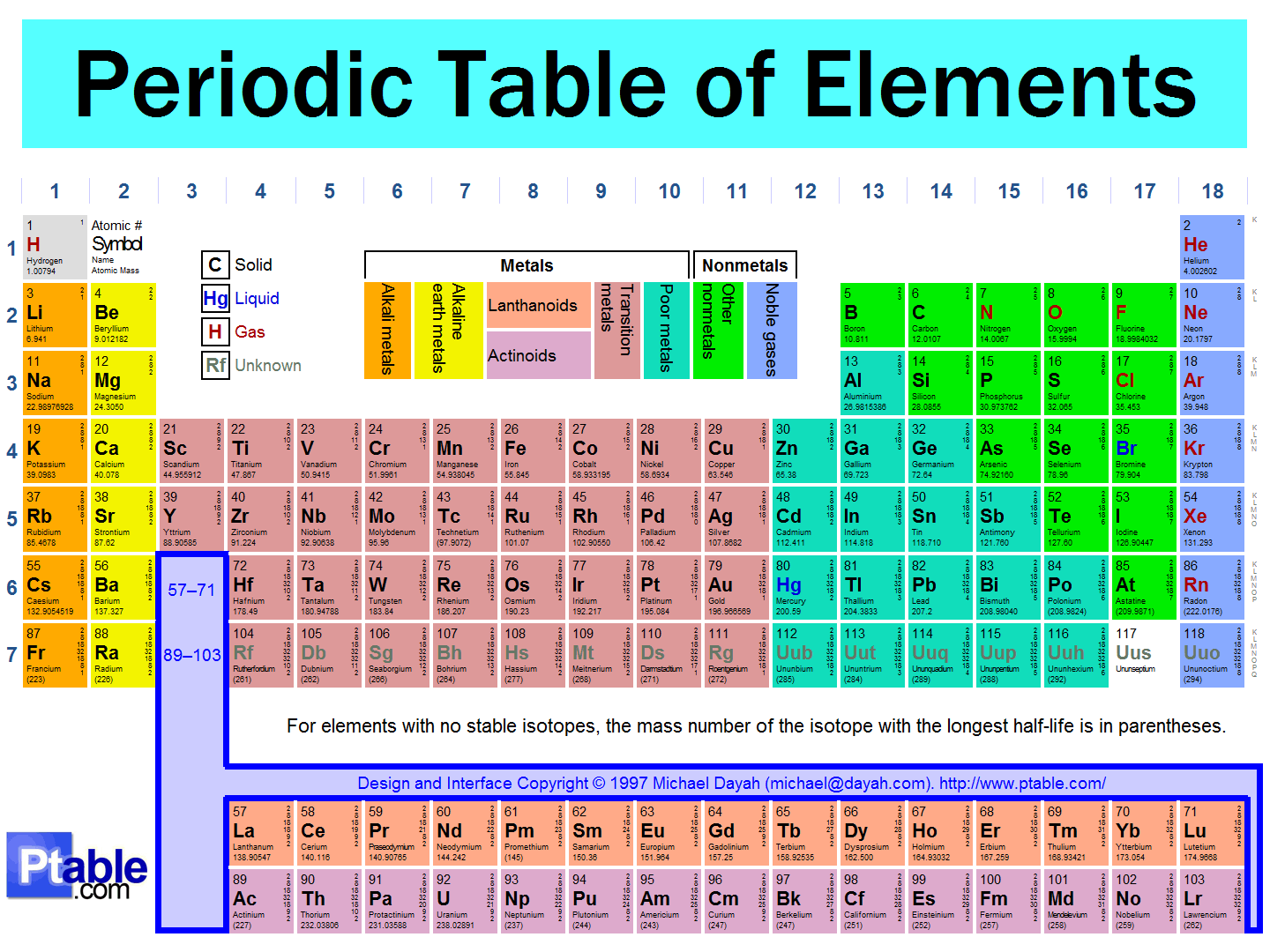
Where are metals located on the periodic table?
a)
Blue
b)
Green
c)
Red
41.
Where are the nonmetals located on the periodic table? 
a)
Blue
b)
Red
c)
Green
42.
What charge will an Oxygen ion have? 
a)
+1
b)
-1
c)
+2
d)
-2
43.
If an element has 3 valence electrons, what charge will likely form on its ion ?
a)
+3
b)
+5
c)
-3
d)
-5
44.

What is the charge of a sodium ion?

a)

+2

b)

+1

c)

-1

d)

-2

45.
Which of the following has a -3 charge?
a)
Boron
b)
Fluorine
c)
Nitrogen
d)
Neon
46.
charge of lithium ion
a)
-2
b)
-1
c)
+1
d)
+2
47.
charge of beryllium ion
a)
-2
b)
-1
c)
+1
d)
+2
48.
Anions are...
a)
Positive
b)
Negative
c)
Neutral
d)
Crying
49.
What is the ionic symbol for a Gold ion?
a)
Au+
b)
Au-
c)
Au+2
d)
Au-2
50.
What is the ionic symbol for Krypton?
a)
Kr
b)
Kr+
c)
Kr-
d)
Kr-2
51.
What Periodic Table family is represented by the Lewis dot diagram?
a)
Halogens
b)
Alkali Metals
c)
Transition Metals
d)
Noble Gases
52.
Which of the following is the atomic number of an alkali metal?
a)
31
b)
20
c)
18
d)
19
53.
Which properties are characteristic of the Group 1 metals?
a)
high reactivity and the formation of unstable compounds
b)
low reactivity and the formation of unstable compounds
c)
high reactivity and the formation of stable compounds
d)
low reactivity and the formation of stable compounds
54.
What group on the Periodic Table contains the elements of the alkaline earth family?
a)
1
b)
2
c)
17
d)
18
55.

The elements in this family are soft, silvery, and very reactive with water.

a)

Alkaline Earth Metals

b)

Alkali Metals

c)

Transition Metals

d)

Lanthanides

56.

What group is the family found? These halides are very reactive and almost have full outer energy level/shell.

a)

1

b)

2

c)

16

d)

17

57.
Gold (Au)
a)
Transition Metal
b)
Alkali Metal
c)
Alkaline Earth Metal
d)
Heavy Metal
58.
Which element is not in the Alkali metal family?
a)
Li
b)
H
c)
Fr
d)
Cs 
59.
Argon (Ar)
a)
alkali metal
b)
alkaline earth metal
c)
halogen
d)
noble gas
60.
Which of the following is the most reactive group of non-metals? 
a)
Alkali
b)
Alkali Earth
c)
Halogen
d)
Noble Gas
61.
How many valence electrons does an alkaline earth metal have? 
a)
1
b)
2
c)
7
d)
8
62.
How many valence electrons does a halogen have? 
a)
1
b)
2
c)
7
d)
8
63.
An atom that has the electron configuration of 1s22s22p63s23p64s23d5 is classified as
a)
A transition element
b)
a noble gas
c)
an alkali metal
d)
an alkaline earth metal
64.
Which of the following in not a diatomic element?
a)
hydrogen
b)
carbon
c)
nitrogen
d)
oxygen
65.

The is family has properties of both metals and nonmetals.

a)

Alkali

b)

Halogens

c)

Nonmetals

d)

Metalloids

66.

This type of element is dull, brittle solids and gases, insulators, poor conductors of heat and electricity, as well as having low melting points.

a)

metals

b)

metalloids

c)

nonmetals

67.

Sulfur is a...

a)

metal

b)

nonmetal

c)

metalloid

68.
Which is a metal?
a)
Rhodium (Rh)
b)
Arsenic (As)
c)
Hydrogen
d)
Argon (Ar)
69.
Which is an alkaline earth metal?
a)
Calcium
b)
Rubidium
c)
Carbon
d)
Iodine
70.
Radium (Ra)
a)
alkali metal
b)
alkaline earth metal
c)
halogen
d)
noble gas