
 Worksheets
SOAL MARCO SHOPOZ
Total questions: 130
Worksheet time: 3hrs 30mins
The unit of weight is....
kg
kg/m2
kg m/s2
gram
What do you use to measure the mass of an object?


The astronaut floats in international space station. It proves that...
His weight is less in space
His mass is less in space
His weight does not change
His mass is more in space
If an object mass =30 kg on the Earth, what would be it's weight on Earth?
30 N
300 kg
3000N
300 N

What is the name of this tool?
spring balance / force meter
scale
measuring cylinder
thermometer
What is weight?
the pulling force of gravity on an object
the time it takes to get on a ride
the amount of matter in an object
the size of an object
My weight on the Earth's surface is 500 N. What is my mass?
500 kg
500 g
50 kg
50 g
What statement is true?
Mass never changes. Weight does.
Weight never changes. Mass does.
Both mass and weight change because they are affected by gravity.
Neither mass nor weight change. They are always the same.
The device of measuring weight is ....
spring scale
balance scale
one -arm scale
two -arms scale
The weight of a person in a flying ballon is ......... that on the earth's surface
smaller than
larger than
equal to
no answer
The object's mass 2kg, so its weight on the earth is equal .......
2Newton
20 Newton
200 Newton
0.2 Newton


Which statement is correct about the mass of the chair on the earth and moon?
mass is greater on the moon
mass is less on the moon but not equals to zero
mass is zero on the moon
mass is the same on the moon



What is the speed of a cheetah that travels 112.0 m in 4.0 s?
0.0357 m/s
30 m/s
0.036 m/s
28.0 m/s


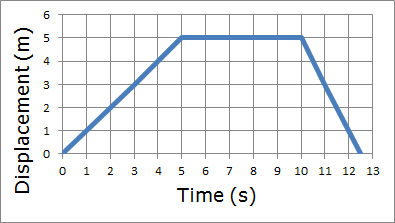
The distance from the picture below are...
9 m
25 m
55 m
59 m

The displacement from the picture below are ...
8 m
10 m
12 m
22 m

The displacement from the picture below are ...
3 m
4 m
12 m
15 m
Distance is ...
the change in position of an object in motion.
the total length of the path travelled by an object in motion.
the rate of change in a body’s position
the line an object moves along from a particular starting point
Displacement is ...
the rate of change in a body’s position
the total length of the path travelled by an object in motion.
the line an object moves along from a particular starting point
the change in position of an object in motion.
Which statement describes a scalar?
direction
The students are arguing over the differences between speed and velocity. One student says, “Speed is a vector because it describes how fast an object traveling. Velocity is a scalar because it tells how fast and what direction an object is traveling.” Which of the following statements is correct?
The students' understanding of all four terms (speed, velocity, scalar, and vector) is correct.
The students' understanding of all four terms (speed, velocity, scalar, and vector) is incorrect.
The students' understanding of speed and velocity is incorrect but their
understanding of scalar and vector is correct.
The students’ understanding of speed and velocity is correct but their understanding of scalar and vector is incorrect.
7. For winter, a duck flies 10 m/s due to south against a gust of wind with a speed 2.5 m/s. What is the resultant velocity of the duck?
7.5 m/s, north
12.5 m/s, south
7.5 m/s, south
12.5 m/s, north

What is the resultant force?
40 N left
0 N Balalnced
400 N right
40 N right

What is the resultant force?
17 N, Left
6N, Right
None of the above
11N, Left
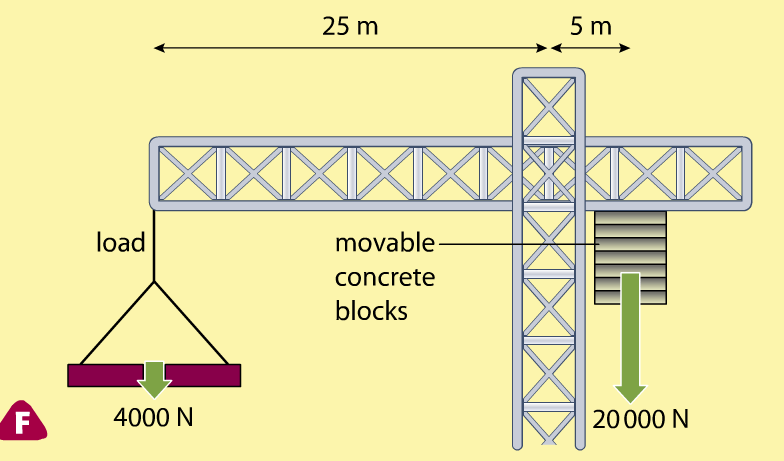
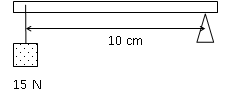
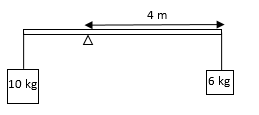
Two masses of mass 10.0 and 6.0 kg are hung from massless strings at the end of a light rod. The rod is virtually weightless. A pivot (fulcrum) is placed off center and the system is free to rotate. If the 6.0 kg mass is 4.0 m away from the pivot, how far away is the 10.0 kg mass if the system is not rotating?
0.42 m
2.4 m
4.8 m
4.2 m
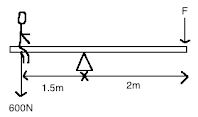
A boy of weight 600N sits on the see-saw as shown at a distance of 1.5m from the pivot. What is the force F required at the other end to balance the see-saw?
450 N
350 N
4.5 N
200 N
Moment (Nm) =
Force (N) x distance (m)
Angular Force (N°) x distance (m)
Work done (J)
Force (N) x distance (s)
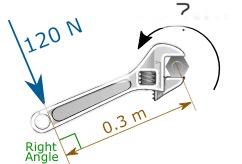
What is the size of the moment shown by the black arrow?
30 Nm
36 Nm
40 Nm
60 Nm
State the principle of moments.
When a system is in equilibrium, the sum of the total clockwise moment is equal to the sum of the total anti-clockwise moment about the same pivot.
When a system is in equilibrium, the sum of the total clockwise moment is greater the sum of the total anti-clockwise moment about the same pivot.
When a system is in equilibrium, the sum of the total clockwise moment is less than the sum of the total anti-clockwise moment about the same pivot.
When a system is in equilibrium, the sum of the total clockwise moment is equal to the sum of the total anti-clockwise moment about the different pivot.
36 km/h is equal to....
10 m/s
13 m/s
60 m/s
72 m/s

What is the distance travelled by a student from the dormitory to the university, if each side of the square represents 100 m?
(600 i + 800 j) m
(600i - 800 j) m
1000 m
1200 m
Which picture doesn’t show motion?


How does the mass of an object affect the motion of an object?
The greater the mass the less effect a force will have
The greater the mass the greater the effect a force will have
The less the mass the less effect a force will have
It has no effect


If 150 Joules of work is needed to move a box 10 meters, what force was used?
1500 N
15 N
1.5 N
150 N
Renatta Gass is out with her friends. Misfortune occurs and Renatta and her friends find themselves getting a workout. They apply a cumulative force of 1080 N to push the car 218 m to the nearest fuel station. Determine the work done on the car.
2.35 x 10⁵ J
2.05 x 10⁵ J
1.35 x 10⁵ J
3.25 x 10⁵ J
Lamar Gant, U.S. powerlifting star, became the first man to deadlift five times his own body weight in 1985. Deadlifting involves raising a loaded barbell from the floor to a position above the head with outstretched arms. Determine the work done by Lamar in deadlifting 300 kg to a height of 0.90 m above the ground.
2.6 x 10³ J
4.8 x 10³ J
1.5 x 10³ J
3.7 x 10³ J
A new conveyor system at the local packaging plan will utilize a motor-powered mechanical arm to exert an average force of 890 N to push large crates a distance of 12 meters in 22 seconds. Determine the power output required of such a motor.
490 Watts
40. Watts
11 x 103 Watts
0.55 Watts
What is the kinetic energy of a 4kg shotput thrown with a velocity of 13m/s
676 J
52 J
17J
338 J


A cheetah can run briefly with a speed of 31.0 m/s. Suppose a cheetah with a mass of 47.0 kg runs at this speed. What is the cheetah’s kinetic energy?
1457 Joules
22,584 Joules
15 Joules
45,167Joules


Steve, Mary, Annie, and James hit four identical tennis balls with a racket. The diagram below shows the top speed at which each tennis ball moved when it was hit.
Based on the diagram, which of the following is true about the tennis balls when they were at their top speed?
James's ball had the most kinetic energy.
Steve's ball had the most kinetic energy.
Mary's ball had the most kinetic energy.
Annie's ball had the most kinetic energy.

Juniper and her cousins are racing model cars they have built. Based on the table below, whose car has the most kinetic energy as it rolls down the road?
Kylie
Craig
Sheldon
Juniper

Two cars that are identical except for their color are traveling on the same road.
The red car is traveling at a speed of 78 km/hr, and the blue car is traveling at a speed of 106 km/hr. Which of the following statements is true?
Neither car has any kinetic energy.
The red car has more kinetic energy than the blue car.
The blue car has more kinetic energy than the red car.
The cars have the same kinetic energy.

A tidal power station is made by building a barrage across the mouth of a river. At high tide the
sea water is trapped behind the barrage.
At low tide the water is allowed to flow back into the sea through a turbine.
What is the useful energy change in a tidal power station?
electrical energy → energy of position (potential)
electrical energy → energy of motion (kinetic)
energy of motion (kinetic) → energy of position (potential)
energy of position (potential) → electrical energy
Which action would most likely reduce concerns about how strip mining can harm the environment?
Restrict mining operations to rural areas
Reclaim the ecosystem after mining
Increase the usage of the products being mined
Decrease the amount of labor needed in the mines
The Law of Conservation of Energy states:
Energy can created or destroyed but not transformed
Energy cannot be created or destroyed, it can only transformed
Energy can't be created, destroyed or transformed
Energy cannot be created or destroyed.
A kettle uses 100J of electrical energy to produce 7J of sound energy and 93J of thermal energy. How efficient is the kettle?
100%
7%
93%
95%

Total energy = 200J
Useful energy = 20J
Workout the efficiency of this lightbulb.
efficiency = total energy inuseful enegy ×100
100%
80%
40%
10%
The Law of Conservation of Energy states:
Energy can created or destroyed but not transformed
Energy cannot be created or destroyed, it can only transformed
Energy can't be created, destroyed or transformed
Energy cannot be created or destroyed.

Diagram shows a phenomenon occurs when the spotlight is directed onto a mirror surface. What is the principle of light shown in the situation?
Light travels in a straight line
Refraction of light
Reflection of light
Light travels in parallel
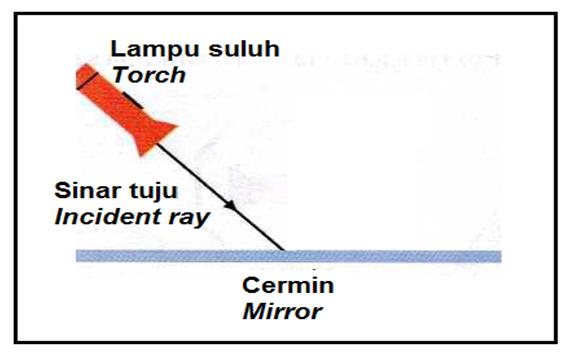
The following diagram shows the ray diagram when a torch light is torched towards a mirror. Which of the following is the correct reflected ray?
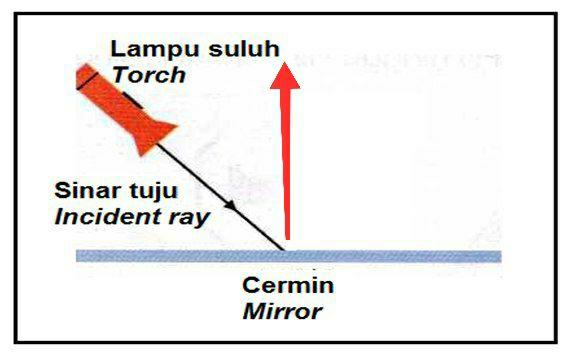
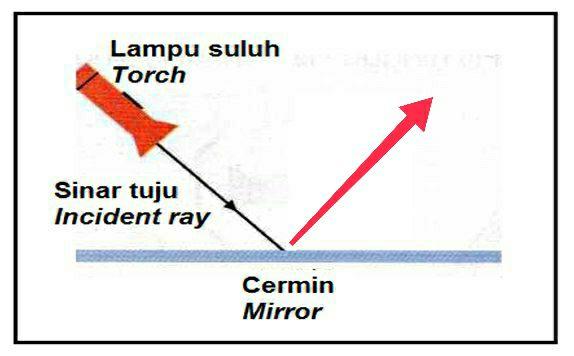
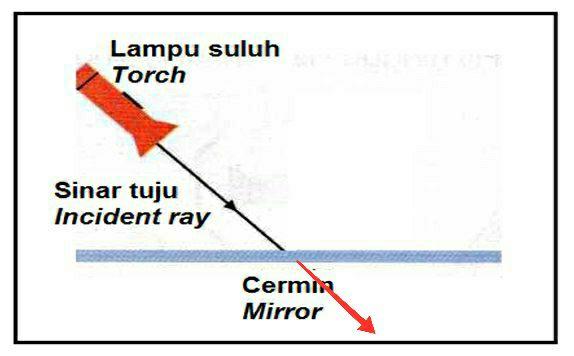
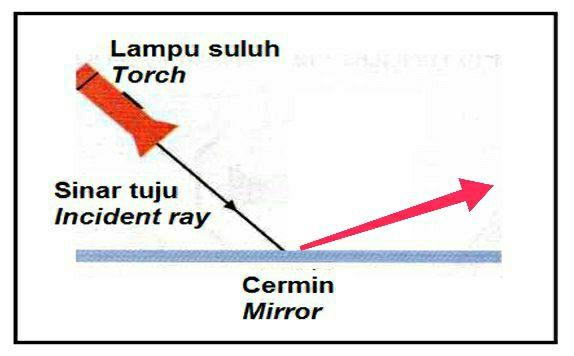

Diagram shows the condition of a spoon in a glass of water.
What can be observed about the spoon?
The spoon looks bent.
The water is clearer.
The water level rises.
Light is refracted.
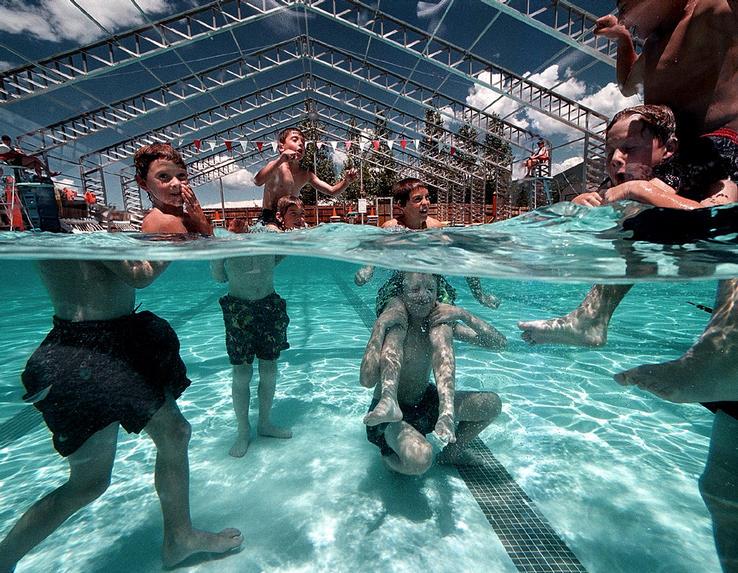

What is the angle of reflection (θr) in the image?
56o
90o
124o
34o

From the diagram shown, what is the angle of incidence?
40o
50o
80o
90o

From the diagram shown, what is the angle of reflection?
20o
40o
70o
90o

An incident ray strikes a plane mirror at an angle of incidence of 40o. What is the decrease in the angle of reflection if the incidence ray moves to an angle of incidence of 30o?
10o
20o
30o
40o

From these graphs, determine the speed of the wave
3 cm/s
3 m/s
6 m/s
-2 cm/s

Find the speed of the wave
20 cm/s
52.5 cm/s
62.5 cm/s
80 cm/s

Ray, Spherical WaveFront, Plane Wavefront
Spherical WaveFront, Ray, Plane Wavefront
Amplitude, Ray, Wavefront
Ray, Amplitude, Wavefront
Unpolarized light in air is reflected from a liquid surface in such a way that it is completely polarized. The angle of incidence is 43°. What is the angle of refraction in the liquid?
53o
51o
47o
43o

What is the reflected wave of the incident wave below?


Water waves below travels from deep region to shallow region. What is the refracted waves of the water waves?


What is a?
Incident Ray
Reflected Ray
Incident Angle
Reflected Angle
What is b?
Incident Ray
Reflected Ray
Incident Angle
Wavefront
What is f?
Normal Line
Reflected Angle
Incident Angle
Wavelength
An object is placed 30 cm in front of a plane mirror.
Which statement describes the image of the object?
The image is the same size and 30 cm from the object
The image is the same size and 60 cm from the object
The image is smaller and 30 cm from the object
The image is smaller and 60 cm from the object

Radio waves are received at a house at the bottom of a hill. The waves reach the house because the hill has caused them to be
diffracted
radiated
reflected
refracted
What is the number of wavefronts per second that pass a fixed point?
the amplitude of the wave
the frequency of the wave
the speed of the wave
the wavelength of the wave

The diagram shows a side view of a water wave at a particular time. The diagram is drawn full size. Which statement about the wave is correct?
The wave is longitudinal and the frequency can be measured from the diagram.
The wave is longitudinal and the wavelength can be measured from the diagram.
The wave is transverse and the frequency can be measured from the diagram.
The wave is transverse and the wavelength can be measured from the diagram.

The diagram represents a water wave. Which row shows the amplitude and the wavelength of the wave?
amplitude (1m), wavelength (2m)
amplitude (1m), wavelength (4m)
amplitude (2m), wavelength (2m)
amplitude (2m), wavelength (4m)
A boy throws a small stone into a pond. Waves spread out from where the stone hits the water and travel to the side of the pond. The boy notices that eight waves reach the side of the pond in a time of 5.0s. What is the frequency of the waves?
0.20 Hz
0.63 Hz
1.6 Hz
40 Hz
Sound waves of frequency 2.0kHz travel through a substance at a speed of 800m/ s. What is the wavelength of the waves?
0.40 m
2.5 m
400 m
1600 m
What type of energy is transmitted from the sun to earth through space?
potential energy
kinetic energy
electromagnetic
electrical
What makes the waves in the EM spectrum different from each other?
amplitudes
wavelength and frequency
colors
speed
How high the wave is is its
frequency
pitch
amplitude
crest


Wavelength Not Frequency

Wavelength Not Frequency

Wavelength Not Frequency
An electromagnetic wave in a vacuum has a wavelength of 0.07m. What is its frequency?
f= 3.0x 10^8 m/s
f= 3.0x 10^9Hz
f=4.3x 10^9Hz
f=4.3x 10^8m/s

The correct pairs of instrument and how they are played are shown by numbers …
1 and 3
2 and 4
2 and 3
1 and 4

The animals that can hear ultrasonic sound are numbers …
1 and 3
2 and 4
1 and 2
2 and 3

Based on the table, the air inside of the music instrument on numbers … vibrates when they produce sound.
1 and 2
2 and 4
1 and 3
3 and 4

Based on the picture above, the type of sound that uses to capture live images from the inside of our body is … .
audiosonic
infrasonic
ultrasonic
videosonic
The following below that is not a requirement to hear the sound is ...
there are good ears
there are things vibrate
there are medium to deliver the sound
it can travel in a vacuum
Echo is ...
sound reflection that is heard before the end of the
original sound.
sound reflection that is heard after the end of the original
sound.
the number of vibrations per second
the maximum distance taken by a particle of medium

Based on the picture above, sound can travels through …
solid
liquid
gas
vacuum
Sound travels through solids, liquids, and gaseous objects. The speed of sound is the time taken for the sound to travel a certain distance. The fastest speed in sound of these pictures is … .


The loudness of a sound is directly related to the wave's _____.
wavelength
frequecy
rest position
amplitude
The unit Hertz is used to measure the waves _______.
frequency
wavelength
loudness
amplitude

When a man with low pitch sound screaming, what would the sound wave looks like?
There are a lot of waves, the waves are tall
There are a little waves, the waves are tall
There are a lot of waves, the waves are short
There are a little waves, the waves are short

In this picture which wave property is different ? (Notice that the number of waves is the same for each)
frequency
amplitude
Doppler Effect
diffraction

