
 Worksheets
Unit 5 Work & Machines
Total questions: 131
Worksheet time: 11hrs 55mins
What is needed to calculate work?
time and distance
speed and distance
force and direction
acceleration and velocity

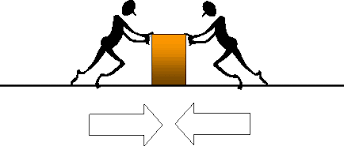
Is this an example of work?
Yes
No
What is the unit of measurement for work?
meters
newtons
m/s
Joules
You have to push with 15 N of force to move it 10 meters. How much work do you do?
15 Joules
150 Joules
1.5 Joules
.67 Joules
500 J of work is done by a person who uses a force of 50N to move a box, how far does it go?
10 m
0.1 m
25,000 m
10 J
Newtons are the unit for _____________.
Work
Distance
Acceleration
Force
A push or a pull
Work
Force
Acceleration
Speed
For work to be done on an object, the direction and force have to be going the same direction.
True
False
Picking up a box is an example of____________
Work
Not Work
Pushing a box across the floor is an example of
Work
Not Work
You exert 200 J of work by pulling on an object with 20 N of force. What distance is the object moved?
.01 m
10 m
10 J
4,000 m
The unit for energy and work is
meters
joules
newtons
watts
Energy is
stored work
is destroyed when used
can not be changed into another form of energy
measured in newtons
_____________ is the rate of doing work.
Conservation of energy
Joules
Energy
Power
Power is measured in ___________.
meters
joules
newtons
watts
You do 40 Joules of work in 8 seconds. How much power did you exert?
0.2 watts
320 watts
5 watts
The law of Conservation of Energy says________
energy is constantly created
energy can not be created or destroyed instead it changes from one form to another
energy can not change forms
If the object does not move then what is happening
nothing
work
power
no work is being done on the object
Two factors that determine work are...
Force
Mass
Velocity
Distance
The ( ) the force the ( ) work is done
less, more
smaller, more
bigger, more
bigger, less
Fred kicks a ball with a force of 20N to George, who is 5M away.
How much work was done to the ball?
25 J
100 J
4 J
75 J
If you push a cart with a force of 60 N for 2 m... how much work have you done?
120 J
30 J
120 N
30 N
Person A and Person B are both using the same amount of work to lift something. Person A takes half as much time to do it. Who has greater power.
Person A
Person B

A force of 4.6 N moves a 2.7 kg box a distance of 3.3 m in 6.8 s. How much power is exerted?
2.23 W
6.03 W
17.4 W
278.7 W


We can calculate the work done by using the formula
Force × Energy
Force × Distance

Energy is the ability to do work.
True
False
what is the formula needed to solve for work?
W=F Δ x
W=F/undefined x
F=Wundefined x
if you push a cart with a force of 60 N for 2 m... how much work have you done
120 J
30 J
120 N
30 N
If 40N of force is applied to Rollo Koster's 10 kg cart over a distance of 50 meters, how much work is done?
8000J
8000N
4000J
2000J

Ahmed is out with his friends. Misfortune occurs and Ahmed and his friends find themselves getting a workout. They apply a cumulative force of 1000 N to push the car 200 m out of the sand. Determine the work done on the car.
2 x 10⁵ J
2.70 x 10⁴ J
3.2 x 10⁻⁴ J
3.54 x 10⁵ J
Two people push on a wall with 100 N. The wall doesn’t move. How much work is done?
100J
100N
0J
0N

A student lifts 100 N of books 1 m to his shoulder. He walks forward 10 m to the stairs and goes up 3 m. He walks 20 m forwards to class. How much work has been done to the books?
No work is done
100J
300J
400J
An airplane passenger carries a 215-N suitcase up the stairs , a displacement of 4.20 m vertically and 4.60 m horizontally. How much work does the passenger do on the suitcase.
903 J
989 J
976 J
945 J
A mover loads a 185-kg refrigerator into a moving van by pushing it at a constant speed up a 10.0 m , friction free ramp at an angle of inclination of 11 degrees. How much work is done by the mover on the refrigerator?
1.86 x 10³ J
3.45 x 10² J
3.46 x 10³ J
1.78 x 10⁴ J
What is mechanical advantage?
The advantage a machine has over a bicycle
A measure of how much a simple machine reduces work
A measure of when is the best time to use a simple machine
A measure of the input force is multiplied using a simple machine
What is an advantage of using a simple machine?
less work in more time
less work in less time
more work less time
same work less time

Which action is considered to having no work done?
A forklift lifting boxes
Pushing a wheelchair up a ramp
A snowplow moving snow
A hockey puck being hit on ice

Two factors that determine work are...
Force
Mass
Velocity
Distance
If you push a cart with a force of 60 N for 2 m... how much work have you done?
120 J
30 J
120 N
30 N
Fred kicks a ball with a force of 20N to George, who is 5M away.
How much work was done to the ball?
25 J
100 J
4 J
75 J
If 40N of force is applied to Rollo Koster's 10 kg cart over a distance of 50 meters, how much work is done?
8000 J
8000 N
4000 J
2000 J

If the mystery machine moves 100 meters how much work is done?
130,000,000 J
70,000 J
100,000 J
30,000 J

If Jay Loppy pushes his van 20 meters how much work is done?
2,000 J
40,000 J
10,000 J
800,000 J
What does the prefix 'kilo' mean?
[E.g. the 'k' in km]
10
100
1000
1,000,000 (million)
1,000,000,000 (billion)
What does the prefix 'Mega' mean?
[E.g. the 'M' in MJ]
10
100
1000
1,000,000 (million)
1,000,000,000 (billion)
What does the prefix 'Giga' mean?
[E.g. the 'G' in GJ]
10
100
1000
1,000,000 (million)
1,000,000,000 (billion)
What does the prefix 'centi' mean?
[E.g. the 'c' in cm]
1/10
1/100
1/1000
What does the prefix 'milli' mean?
[E.g. the first 'm' in mm]
1/10
1/100
1/1000
What does the prefix 'deci' mean?
[E.g. the 'd' in dm]
1/10
1/100
1/1000
1m = _______cm
[1m contains how many cm?]
10
100
1000
1,000,000
1km = _______m
10
100
1000
1,000,000
1min = _______seconds
10
60
100
3600
1hour = _______seconds
10
60
100
3600

(1 cm = 10 mm)

( 1 cm = 10 mm)

(1 cm is 10 mm)

(1 kg is 1000 g)

(1 m = 100 cm)


(1 kg = 1000 g

Which one of Newton's laws is shown
3rd law
2nd law
1st law

Which one of Newton's laws are displayed
2nd law
1st law
3rd law

Which of Newton's laws is shown
1st law
3rd law
2nd law
An object in motion will stay in motion and an object at rest will stay at rest unless acted upon by an outside force. Which law does this describe
2nd law
1st law
3rd law
What force slows objects down and keeps them from moving?
Acceleration
Gravity
Friction
Net Force


Suppose that an astronaut throws a baseball in outer space at a location far from significant influences of gravity and air resistance. One would expect that the baseball would ____.
eventually stop since all objects ultimately "lose their steam"
eventually stop as its inertia slowly becomes used up
continue in motion with the same speed and direction
either a, b, or c -- depending on whether the astronaut continues to push it
All objects have inertia
True
False
Inertia depends on ______
Velocity
Speed
Distance
Mass
A skateboard rolls down a hill, reaches the level surface and eventually comes to a stop. The fact that the skateboard ultimately stops is best explained by ____.
an unbalanced force would be required to keep the sled moving forward at constant speed
the presence of an unbalanced force (e.g., friction) can cause a moving object to stop
the presence of inertia causes it to stop
the natural tendency of any object is to ultimately stop
the tendency of an object to resist a change in its motion
acceleration
inertia
mass
frame of reference

Velocity is speed with __________________________.
a unicycle helmet
direction
fight


Which of the following is the correct equation for calculating an object's gravitational potential energy?
PE = mgh
PE = mg / h
PE = mg + h
PE = gh

Rank in order, from largest to smallest, the gravitational potential energies of the balls.
1 > 2 = 4 > 3
1 > 2 > 3 > 4
3 > 2 = 4 > 1
3 > 2 > 4 > 1

A cheetah can run briefly with a speed of 31.0 m/s. Suppose a cheetah with a mass of 47.0 kg runs at this speed. What is the cheetah’s kinetic energy?
1457 Joules
22,584 Joules
15 Joules
45,167Joules

How much gravitational potential energy does a 100kg (220lb.) skydiver have if they jump from 4000 meters?
3920000 J
294 J
180000 J
1225 J

A 6kg cat misjudges a jump and falls 5 meters. How much gravitational potential energy does the cat have? (The cat is fine by the way.)
294 J
180000 J
1225 J
3920000 J

What is the kinetic energy of a 1,600kg Mustang travelling at 15 m/s (33mph)
180000 J
294 J
1225 J
3920000 J

A 50kg (100lb) person is running at 7m/s (about 16 mph). How much kinetic energy do they have?
1225 J
180000 J
294 J
3920000 J

What is the unit for mass?
kilogram (kg)
meter (m)
Newton (N)
Joule (J)

A 2kg television falls from 1 meter. How much energy does it have?
19.6 J
196 J
2 J
9.8J
W=5000 Joules
t=???
Two workers use 100 N of force to move a sofa 2 meters in 2 seconds. How much power is required?
100 watts
400 watts
104 watts
50 watts

