
 Worksheets
APES Unit 3: Ecology
Total questions: 133
Worksheet time: 4hrs 0mins
What is formed during primary succession that doesn't need to be formed during secondary succession?
pioneer species
soil
climax community
Intermediate Species


What is evolution?
When animals move to warmer climates in the winter
How organisms change across many generations
The migration of different species through the seasons
Ancient rock layers and the fossils they contain
The LESS genetically diverse a population is, the better it can respond to environmental stressors
True
False
The relative abundance of individuals within each species refers to the
Species Richness
Genetic Diversity
Species Evenness
Ecological Diversity
The study of rates of colonization and extinction of species on islands or other isolated areas is known as
The study of Islandology
Genetic drift
Demographic bottleneck
Island biogeography
While taking a walk in the southern states, you notice that there is an old abandoned car covered with a vine. You notice the house, next to it, is covered in this same vine. The vine seems to be growing out of control and beginning to take over the area. You would suspect that you are seeing a(n)...
Native species
Invasive species
Bullying species
Another name that can be used for an EXOTIC species is
Native species
Invasive species
Outcast species
I: Extinction
II: Introduced species
III: Habitat loss & degradation
IV: Direct Exploitation
The three types of biodiversity are:
Species
Genetic
Ecosystem
Mythical

Which of these has a higher biodiversity?
Community A
Community B
If a trait on one extreme is favored, what kind of selection will you have?
Directional
Stabilizing
Disruptive
Sexual
If the most common trait is favored, what kind of selection will you have?
Directional
Stabilizing
Disruptive
Sexual
If both extremes of a trait are favored over the most common, what kind of selection will you have?
Directional
Stabilizing
Disruptive
Sexual
Female widowbirds prefer males with longer tail feathers. This is an example of _______________ selection.
Sexual
Artificial
Stabilizing
Disruptive
(Without human impacts) Species richness generally ____________ over time.
Increases
decreases
stays the same
war... war never changes
Microevolution
can happen over short periods of time
are small changes to adapt to the environment
usually happens over long periods of time
changes one species into another
Macroevolution
can happen over short periods of time
are small changes to adapt to the environment
usually happens over long periods of time
changes one species into another
Island biogeography states that species richness ___________ as islands are closer to the mainland and ____________ as islands increase in size.
increases, increases
increases, decreases
decreases, increases
decreases, decreases
Animals with high ecological tolerance can survive in:
Extreme environments
A wider range of environments
A smaller range of environments
Only very specific environments
Indicator species have a _______ ecological tolerance.
Low
Medium
High
Very high
Ecological resistance is
Ability to recover after a disaster
How much they are affected by a disaster
Ability to avoid disasters
Number of animals in an area
Ecological resiliance is
Ability to recover after a disaster
How much they are affected by a disaster
Ability to avoid disasters
Number of animals in an area
Intermediate disturbance hypothesis states that what increases diversity?
Frequent, major disturbance
Infrequent, minor disturbance
Frequent, minor disturbance
Infrequent, major disturbance
The predictable replacement of one group of spcies by another over time is called____________.
Succession
Resiliance
Resistance
Biodiversity
What grows first during secondary succession?
Lichen
Moss
Grass
Shrubs
Species of least concern have
Abundant, widespread populations
Limited, isolated populations
Rapidly declining populations
No living individuals
Endangered species have
Abundant, widespread populations
Limited, isolated populations
Rapidly declining populations
No living individuals
Invasive species
Are not native to an area
Are native to an area
Have no predators
Have predators
A flagship species is best when it is:
Charismatic
Sensitive to environmental change
A generalist species
An insect
Edge habitat
Is good for sensitive species
Increases high-quality habitat
Decreases high-quality habitat
Increases with habitat fragmentation
The best solution for habitat fragmentation is
Corridors to connect fragments
Moving species between fragments
Genetic engineering of species
Doing nothing
A keystone species has what role In an environment?
The role of a top predator
A smaller role than expected
The role of a producer
A larger role than expected
A trophic cascade is when there are _________ affects in an ecosystem.
Top down
Bottom up
Side to side
Bring it back now y'all.
If one species benefits from a relationship and the other is not harmed, this is what kind of relationship?
Mutualism
Symbiosis
Parasitism
Commensalism
Dogs living with humans is what kind of relationship?
Mutualism
Symbiosis
Parasitism
Commensalism
If a bird lays its eggs in another birds nest and forces it to raise its baby, this is a form of
Mutualism
Symbiosis
Parasitism
Commensalism
What is the term for a long term relationship in which one or more species benefits?
Mutualism
Symbiosis
Parasitism
Commensalism
Competition reduces
Stress
Access to resources
Disease
Fun

Which term best explains what is going on in this graph?
Competitive exclusion principle
Trophic cascades
Predator prey relationship
Resource Partitioning
Terror Birds, a 10 foot tall flightless bird, was the top predator of the modern day Americas back in the Cenozoic Era. Some scientists think their extinction was caused by being outcompeted by the better suited Saber Tooth cats who filled the same niche. The scientific principle that would apply to this hypothesis is the:
Exclusive niche principle
Trophic Cascades
Competitive exclusion principle
Rule of 10s
Competition is a _______ relationship
- , -
+ , +
+ , -
+ , 0
In one predator prey cycle, you would expect to see: (click all that apply)
Prey population increase
Prey population decrease
Predator population increase
Predator population decrease
Which of these is an intraspecific interaction?
A hawk killing a wren
Ants living in an Acacia
Snakes fighting over a mate
Lichen dissolving a rock
Box turtles usually spend most of their lives living within a mile or two from where they were born. This area would be considered the individual box turtle's
Niche
Ecosystem
Habitat
Community
Coatimundis root around in leaf litter and eat fruit, insects, andizards they find on the forest floor. They also hang out in trees. These would be best described as the coati's
Habitat
Adaptations
Niche
Ecosystem
Autotrophs
Always do photosynthesis
Produce their own energy
Eat other organisms for energy
Eat plants
Heterotrophs
Consume organisms for energy.
Make their own energy.
Are producers
Only eat plants
Food chains show
As many relationships as it can between species in an ecosystem
One pathway energy or matter could take through an ecosystem.
Which predators eat which prey species in an ecosystem.
The amount of energy available at each trophic level.
The edge effect is severely increased as you have more:
Disruption
Habitat Fragmentation
Habitat Size
Species in the same niche
Wildlife Corridors are best used to help against
The Edge Effect
The competitive exclusion principle
Habitat fragmentation
Poaching
What is the correct equation for respiration.
CO2 + H20 + Energy = C6H1206 + O2
O2 + C6H12O6 = Energy + Water + CO2
CO2 + C6H12O6 = Energy + Water + O2
O2 + H20 + Energy = C02 + C6H12O6
A community is:
A group of organisms with interspecific interactions.
A group of organisms with intraspecific interactions.
A group of organisms with interspecific and abiotic interactions
A group of organisms with interspecific and abiotic interactions.
If GPP is 10 and respiration is 3, NPP is
13
7
10
30
If NPP is 30 and GPP is 50, respiration is
15
5
45
20
Which of these are measures of energy?
Kcal/m2/year
g/m2/year
Joule/m2/year
watt/m2/year
Most energy on Earth comes from the
Core
Sun
Moon
Plants
Energy is lost as you go up each trophic level. It is turned into
CO2
O2
Heat
Minerals
Earth is an _______ system in regards to energy.
Open
Closed
A marmot is an herbivore in the Rocky Mountains. What is their trophic level?
1st
2nd
3rd
4th
The 10% rule states that:
10% of energy is lost as you go up each trophic level.
Only about 10% of energy moves up the trophic level.
The maximum amount of energy at the top of a trophic pyramid is 10%
10% of organisms die at each trophic level.
Food chains show
As many relationships as it can between species in an ecosystem
One pathway energy or matter could take through an ecosystem.
Which predators eat which prey species in an ecosystem.
The amount of energy available at each trophic level.
Energy pyramids show
The amount of mass at each of the trophic levels.
The number of organisms at each trophic level.
The importance of species at each trophic level.
The amount of energy at each trophic level
Heterotrophs
Consume organisms for energy.
Make their own energy.
Are producers
Only eat plants
Autotrophs
Always do photosynthesis
Produce their own energy
Eat other organisms for energy
Eat plants
Coatimundis root around in leaf litter and eat fruit, insects, andizards they find on the forest floor. They also hang out in trees. These would be best described as the coati's
Habitat
Adaptations
Niche
Ecosystem
Box turtles usually spend most of their lives living within a mile or two from where they were born. This area would be considered the individual box turtle's
Niche
Ecosystem
Habitat
Community
Which of these is an intraspecific interaction?
A hawk killing a wren
Ants living in an Acacia
Snakes fighting over a mate
Lichen dissolving a rock
In one predator prey cycle, you would expect to see: (click all that apply)
Prey population increase
Prey population decrease
Predator population increase
Predator population decrease
Competition is a _______ relationship
- , -
+ , +
+ , -
+ , 0
Terror Birds, a 10 foot tall flightless bird, was the top predator of the modern day Americas back in the Cenozoic Era. Some scientists think their extinction was caused by being outcompeted by the better suited Saber Tooth cats who filled the same niche. The scientific principle that would apply to this hypothesis is the:
Exclusive niche principle
Trophic Cascades
Competitive exclusion principle
Rule of 10s
Which term best explains what is going on in this graph?
Competitive exclusion principle
Trophic cascades
Predator prey relationship
Resource Partitioning
Competition reduces
Stress
Access to resources
Disease
Fun
What is the term for a long term relationship in which one or more species benefits?
Mutualism
Symbiosis
Parasitism
Commensalism
If a bird lays its eggs in another birds nest and forces it to raise its baby, this is a form of
Mutualism
Symbiosis
Parasitism
Commensalism
Dogs living with humans is what kind of relationship?
Mutualism
Symbiosis
Parasitism
Commensalism
If one species benefits from a relationship and the other is not harmed, this is what kind of relationship?
Mutualism
Symbiosis
Parasitism
Commensalism
A trophic cascade is when there are _________ affects in an ecosystem.
Top down
Bottom up
Side to side
Bring it back now y'all.
A keystone species has what role In an environment?
The role of a top predator
A smaller role than expected
The role of a producer
A larger role than expected
Using the rule of 70, a population growing at 10% would double in
7 years
10 years
17 years
15 years
not enough information to tell
What factor describes when populations decrease because animals are moving out of a population?
Emigration
Limiting Factors
Immigration
Exponential Growth


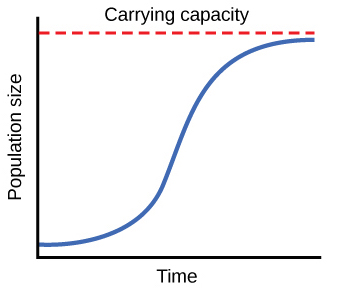
What point on the graph represents the carrying capacity?
A
B
C
D
A population is...
All members of one species in one area
All members of all species that live in one area
All of the living and nonliving things in an area
None of these

What is happening at the 'A' on the graph?
the population overshoots above the carrying capacity
the population stops growing
growth begins to slow down due to limited resources
growth is speeding up due to an abundance of resources
Two male Giraffes are fighting over the last green leaf of a tree that is dying.
Intraspecific Competition
Mutualsim
Predation
Commensalism
Interspecific Competition

What is a group of organisms of one species that lives in the same area at the same time.
community
group
population
habitat
What is the maximum number of individuals of one species that the environment can support?
overload capacity
top capacity
population
carrying capacity
The part of the environment that keeps a population's size at a level below its full potential
limiting factor
stopping factor
carrying factor


When a population grows past the ecosystem's carrying capacity, what happens to the population?
Continues to grow
The population starts to die off to return below carrying capacity
The population will go extinct due to lack of resources
Which one shows the relation between population and square kilometres?
Natural increase
Life expectancy
Population density
What is the dispersion pattern of herding animals, birds that flock together, and fish that form schools?
clumped
random
uniform
unpredictable
Which factor would be considered density independent?
an intestinal parasite
a fatal virus
a severe drought
severe overcrowding
Which factor would be considered density dependent?
competition
drought
water quality
pH of the soil

What is the horizontal line on the graph called?
exponential growth
geometric growth
carrying capacity
straight-line growth
If angel fish produce hundreds of young several times a year, which statement below is true?
Angelfish have a k-strategy reproductive pattern
Angelfish have an r-strategy reproductive pattern
Angelfish probably have a low mortality rate
Angelfish provide a lot of care for their young

Type III survivorship is characterized by
extremely high juvenile mortality
mortality that is not age dependent
most mortality occurring among the elderly
most juveniles surviving to a critical age
I. They produce many offspring in a short period of time.
II. They have very low survivorship early in life.
III. They take a long time to reach reproductive maturity.

Which curve best describes an organism that invests a lot of energy in parenting?
What is the correct equation for photosynthesis.
CO2 + H20 + Energy = C6H1206 + O2
O2 + C6H12O6 = Energy + Water + CO2
CO2 + C6H12O6 = Energy + Water + O2
O2 + H20 + Energy = C02 + C6H12O6

