
 Worksheets
Physics Fall Semester Final Review
Total questions: 127
Worksheet time: 3hrs 20mins

What two measurements are necessary for calculating speed?
Mass and time
Temperature and mass
Mass and distance
Distance and time

Can be measured in seconds (s)
Distance
Time
Speed
Acceleration

A measurement of how fast an object is moving
Velocity
Speed
Vector
Acceleration

A description of the speed and direction of an object's motion
Velocity
Speed
Acceleration
Vector

What is the speed of an object that travels 60 meters in 4 seconds?
240 m/s
15 m/s
0.067 m/s
15 mph

If you run around the football field (which is 2 miles) 3 times, what is your distance?
0 miles
3 miles
6 miles
9 miles

What is the speed of an object that travels 20 meters in 4 seconds?
80 m/s
0.2 m/s
5 m/s
24 m/s

An old lady rolls down a hill at 3 meters/second. The hill is 36 meters long. How many seconds does it take the old lady to reach the bottom of the hill?
39 seconds
12 seconds
15 seconds
33 seconds

You walk 10 meters to math class in 20 seconds. Your average speed is
2 m/s
0.5 m/s
200 m/s
5 m/s

It took Shawn 6 hours to walk to Susan's house at 2 km/hr. How far is it between Shawn's house and Susan's house?
12 km
3 km
12 hours
3 hours
How long will it take to go 150,000 m traveling at 50 km/hr?
3000 hours
3000 sec
3 hours
3 sec
Jose wandered 4 km at 2 km/hr. How long did Jose wander?
2 hours
8 hours
0.5 hours
2 km

Two people walk across a parking lot. Their paths are shown in the image. Who traveled with a larger displacement?
Person A
Person B
They both had the same displacement.
Two people walk across a parking lot. Their paths are shown in the image. Who traveled with a larger displacement?
Person A
Person B
They both had the same displacement.
Billy runs 400 meters to Andy's house, turns around, and runs 400 meters back home. What is Billy's distance?
0 meters
400 meters
800 meters
1600 meters
Billy runs 400 meters to Andy's house, turns around, and runs 400 meters back home. What is Billy's displacement?
0 meters
400 meters
800 meters
1600 meters
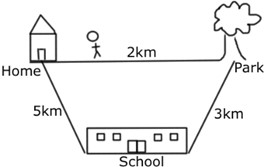
Jerry walked from home to school, then from the school to the park. What is his total displacement?
2 km
5 km
8 km
10 km
Jerry walked from home to school, then from the school to the park. What is his total distance?
2 km
5 km
8 km
10 km

From the figure, what is the displacement?
20 meters
25 meters
15 meters
25 meters NE
The change in an objects position from the final position to initial position.
displacement
distance
motion
reference point

What are you calculating when you divide the distance an object travelled by the amount of time it took for that object to travel that distance?
velocity
slope
motion
speed
Distance ÷ Time =
velocity
speed
acceleration
direction
The SI unit for speed is_______.
meters per second
miles per hour
miles per second
meters per hour
speed in a given direction
velocity
average speed
instantaneous speed
speed
Vector or Scalar?
Wind blowing at 20 mph.
Vector or Scalar?
A deer running 15 meters per second due west.
Another word for "size" is...
magnification
magnetism
magnitude
magnanimity
A runner races in the 100 meter dash. It takes her 10 seconds to finish. What is her average speed?
10 m/s
1000 m/s
100 seconds
10 seconds
A vehicle travels 2345 m in 315 s toward the evening sun. What is its speed?
7.44 m/s
0.13 m/s
738,675 m/s
7.44m
A runner runs 2 laps around a track with a circumference of 400 m. What is their total displacement?
800 m
0
400 m
400 m North
35 m/s would describe
distance
displacement
speed
velocity
5 m/s west would describe
distance
displacement
speed
velocity
seconds is a unit for
distance
time
speed
acceleration
meter is a unit for
distance
time
speed
acceleration
What is the speed of an object that travels 60 meters in 4 seconds?
240 m/s
0.067 s
15 m/s
15 mph

Joe rides his bike from point A to point B and then on to point C. What is the total distance traveled?
12 m
43 m
7 m
12 m


In a projectile motion we always have...
1 component (x)
3 components (x,y, and z)
2 components (x and y)
0 components
What is the direction of the acceleration for any projectile?
The direction the projectile is traveling.
Down
Up
Sideways

A ball is thrown and follows the parabolic path shown above. Air friction is negligible. Point Q is the highest point on the path. Points P and R are the same height above the ground. How do the speeds of the ball at the three points compare?
vP < vQ < vR
vR < vQ < vP
vQ < vR < vP
vQ < vR = vP
vP = vQ < vR
A ball is thrown and follows the parabolic path shown above. Air friction is negligible. Point Q is the highest point on the path. Points P and R are the same height above the ground. Which of the following diagrams best shows the direction of the acceleration of the ball at point P?


If a ball thrown straight up into the air takes 4 seconds to reach the top (peak), how long will it take to travel from the peak back to the original position?
0s
1s
3s
4s
The fact that an apple and a watermelon, dropped simultaneously from the same height, would hit the ground at the same time indicates that
you don't like apples or watermelons.
greater masses have greater acceleration.
lesser masses have greater acceleration.
acceleration is independent of mass.
The initial horizontal velocity of a projectile is ____ its final horizontal velocity.
less than
equal to
greater than
What is the velocity of an object launched straight up at its highest point?
zero
equal to its vx
½ its maximum value
equal to gravity
The path followed by a projectile is also known as its
trajectory
range
height
vertical displacement
Once a projectile is launched, what is the only force that affects its motion?
mass
friction
inertia
gravity

At what point is vy= 0 m/s?
A
B
C
D
None of these points
At what point is vx= 0 m/s?
A
B
C
D
None of these points

A force is a _______ or _______ on an object.
pull
touch
push
motion
Two equal forces acting in opposite directions on an object
Inertia
Balanced Force
Push
Unbalanced Force
Forces are measured in:
Inertia
Grams
Tons
Newtons
An unequal push/pull on an object that causes a change in motion:
Unbalanced Force
Push
Balanced Force
Inertia
The sum (total) of all forces acting on an object:
Unbalanced Force
Balanced Force
Newtons
Net Force
The greater the mass of an object, the more force it will take to accelerate the object.
Newton's 1st Law of Motion
Newton's 2nd Law of Motion
Newton's 3rd Law of Motion
An object in motion will stay in motion until acted on by an unbalanced force. An object at rest will stay at rest until acted on by an unbalanced force.
Newton's 1st Law of Motion
Newton's 2nd Law of Motion
Newton's 3rd Law of Motion
For every action, there is an equal and opposite reaction
Newton's 1st Law of Motion
Newton's 2nd Law of Motion
Newton's 3rd Law of Motion
A lamp sitting on a table is demonstrating Newton's ___ Law.
1st
2nd
3rd
4th
A rollercoaster heading down a hill is _____________.
at rest
slowing down
accelerating
velocity
According to Newton’s second law of motion, force is equal to mass times ______________________.
inertia
weight
acceleration
direction

The picture is an example of Newton's...
1st Law
2nd Law
3rd Law
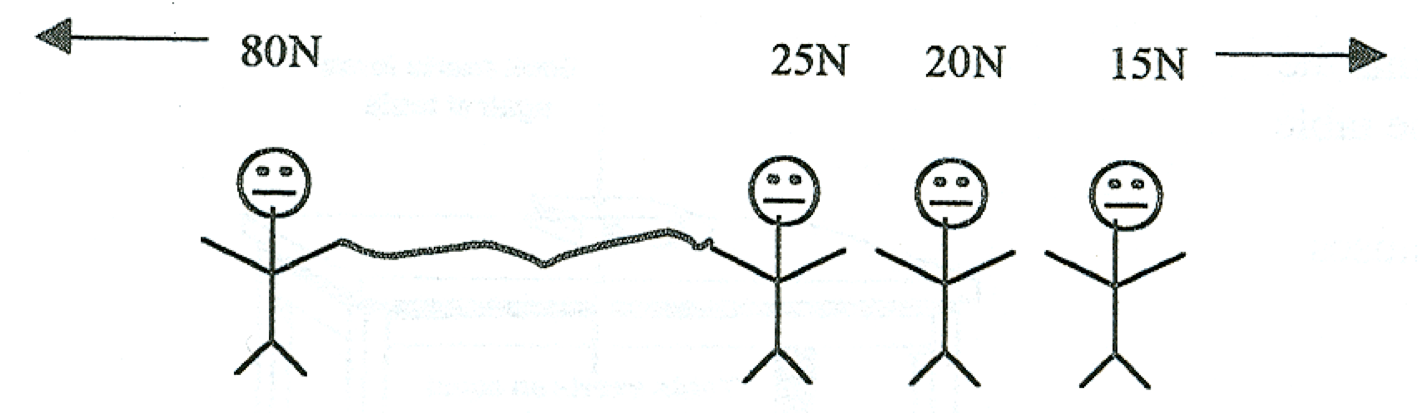
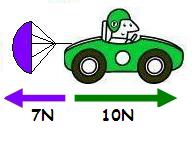
What is the net force?
3 N
3 N, right
17 N, right
3 N, left

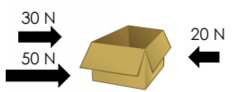


Kinetic energy is associated with ---.
speed
position
direction
temperature
Potential energy is associated with ---.
speed
position
direction
temperature

How will you describe the energy at Point A?
mostly potential energy
mostly kinetic energy
losing PE, gaining KE
losing KE, gaining PE
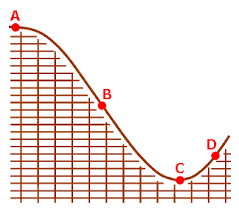
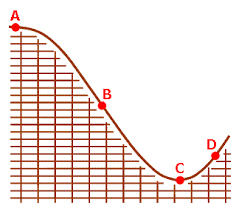

What is the energy possessed by the cart?
potential energy
kinetic energy
mostly potential
mostly kinetic

If the mass of the cart is 15kg, how much is the potential energy of the cart?
0J
1.2J
6J
58.8J

If the mass of the cart is 8.12kg, what is the kinetic energy of the cart?
0J
1.2J
6J
58.8J
How high up is a 3200-kg plane if it has 960000 J of potential energy?
10 m
30 m
307200000 m
300 m
If a 1300-kg car has been lifted so it has 19500 J of potential energy, it was lifted up ---.
1.5 m
150 m
15 m
0.67 m
A 40-kg person is climbing 3 m up a flight of stairs in 6 seconds. How much work did they do climbing the stairs?
400 J
1200 J
200 J
120 J

A crane lifts an 8-m long steel girder weighing 2600 N up 15 m off the ground. The crane did ___ of work.
0 J
39000 J
20800 J
2600 J
A 40-kg person is climbing 3 m up a flight of stairs in 6 seconds. How much power did they exert climbing the stairs?
400 W
1200 W
200 W
120 W
The momentum of an object depends upon the object's ___________&_____________.
size and shape
mass and speed
mass and veloctiy
mass and energy
Which one of the following units represents the standard metric units of momentum
Newtons * meter / second
Kilograms * meter / second2
meter / second
Kilograms * meter / second
Which one of the following units represents the standard metric units of impulse
Kilograms * meter / second2
Newton * meter
meter / second2
Newton * second
An object that has momentum can be described as _________
a) changing its velocity
b) moving fast
c) resisting changes in its state of motion
d) having its mass in motion
e) encountering a net force
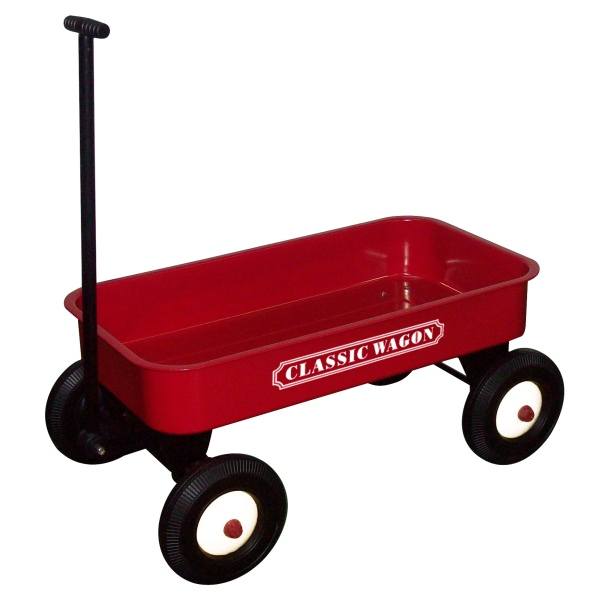
Which one of these objects has the greater amount of momentum?
A turtle that slowly crosses a road
A parked car
A stop sign
When a cannon fires a cannon ball, it recoils backwards. This occurs because of...
Energy in the system is conserved
Energy in the system is increased
Momentum in the system is conserved
Energy in the system is not conserved
An egg landing on a soft surface will remain intact. The surface increases the _____ and decreases the _____ during the impact
impulse, time
impulse, force
force, time
time, force
Padded dashboards in cars are safer in accidents than non padded ones because the passenger hitting the dash has...
a) Increased time of impact
b) decreased impulse
c) decreased impact force
d) a and b
e) a and c
A freight car of mass 20,000kg moves along a track at 15 m/s. What is the momentum of the car?
30,000 kg*m/s
3,000 kg*m/s
300,000 kg*m/s
3,000,000 kg*m/s
A 5 N force is applied to a 3 kg ball to slow it down from 9 m/s to 3 m/s. What is the impulse on the ball?
-2.5 N⋅s
-10 N⋅s
-18 N⋅s
-45 N⋅s

