wayground logo

Free Printable Worksheets

Font size

S
M
L
XL
Worksheets

Biology SOL Review

Total questions: 136

Worksheet time: 2hrs 16mins

Name
Class
Date
1.
This variable in an experiment is the one being changed by the scientist. 
a)
dependent variable
b)
independent variable
c)
data
d)
control group
2.
An experiment is performed on plants to see how different liquids affect plant growth. Each plant in the experiment is given a different liquid; water, apple juice, or milk. Each plant has the same amount of soil, sunlight, and listens to the same music. In this investigation, the independent variable is ...
a)
The type of plant
b)
The amount of sunlight
c)
The type of music
d)
The type of liquid
3.
Dependent variable means
a)
the scientist controls what to test
b)
educated guess
c)
ask a question
d)
what is being measured
4.
If you increase the amount of spinach you eat, then you will increase the iron in your blood. 
What's the dependent variable?
a)
increase the amount of iron in your blood
b)
spinach you eat
5.
This part of the experiment serves as a basis of comparison; the one variable being tested has been omitted. 
a)
experimental group
b)
control group
c)
data
d)
variables
6.
An experiment is performed on plants to see how different liquids affect plant growth. Each plant in the experiment is given a different liquid; water, apple juice, or milk. Each plant has the same amount of soil, sunlight, and listens to the same music. In this investigation, what are the controlled variables?
a)
Type of plant, amount of music, and sunlight
b)
Water, apple juice, milk
c)
Plant growth
7.

The constants in an experiment are

a)

all of the items in the experiment that stay the same

b)

the variable that is manipulated

c)

the mistake that occurs in the experiement

d)

used for comparison

8.
Francesco Redi performed an experiment in 1668. In the experiment, he placed rotting meat in two jars. The first jar was left open. After a few days, fly larvae were found on the decaying meat inside. The mouth of the second jar was covered with gauze. After a few days, the decaying meat inside was free of fly larvae, but larvae were found on the gauze. This experiment supports the hypothesis that — 
a)
decaying meat produces fly larvae
b)
fly larvae prefer fresh meat
c)
adult flies are not attracted to decaying meat
d)
fly larvae only come from adult flies
9.
Harvester ants often strip a bush of all of its leaves. Some people believe this helps the plant grow thicker, healthier stems. In an experiment, a student stripped off all the leaves from a set of plants. In a second set of identical plants, the student allowed ants to strip off the plants’ leaves. In order to improve this experimental design, it is most important to add a set of plants —
a)
that are dormant
b)
of a different species
c)
exposed to a different ant species
d)
with its leaves left intact
10.
 Which data point on the graph is probably invalid?
a)
1
b)
2
c)
3
d)
4
11.
Jan consistently read the volume of liquids as shown. How would this practice impact her work?
a)
Her measurements would be too low for less dense liquids.
b)
Her measurements would be too high.
c)
Her measurements would be very accurate.
d)
Her measurements would lack precision.
12.
Which variable appears to control leaf production in these plants?
a)
the temperature
b)
the relative humidity
c)
the amount of water
d)
the number of daylight hours
13.
Orchids were studied to determine if the amount of humidity affected the flowering of these plants. Which of these was the independent variable in this study?
a)
the amount watered
b)
the percentage of humidity
c)
the number of flowers on each plant
d)
the length of time required for flowering
14.
The data show the growth of two bean plants over several weeks using four different fertilizers. The experimental data would be more valid if which of the following variables was included in the experiment?
a)
The plants were grown at variable temperatures.
b)
A fifth fertilizer was tested.
c)
A control without fertilizer was included for each plant.
d)
Only one plant was tested.
15.
What does a food web represent?
a)
All connections of energy flow throughout all organisms in a habitat.
b)
The specific ways that mutualism is carried out.
c)
A single pathway or energy flow between organisms. 
d)
How carnivores get their food. 
16.
The amount of energy that usually transfers from one trophic level to the next...
a)
10%
b)
20%
c)
80%
d)
50%
17.
All of the living and nonliving things in an area that interact with each other are called a/an ______.
a)
community
b)
habitat
c)
population
d)
ecosystem
18.
largest number of individuals of a population that the environment can support  
a)
carrying capacity
b)
primary succession 
c)
denitrification
d)
mutualism
19.
What type of growth model is this?
a)
exponential growth model
b)
logistic growth model
c)
Type I curve
d)
Type III curve
20.
Name this symbiosis:
a)
Mutualism
b)
Commensalism
c)
Parasitism
d)
Predation
21.
The largest group of organisms found in a food web would be:
a)
Primary Consumers
b)
Producers
c)
Decomposers
d)
Tertiary Consumers
22.
The rabbit in this food web would be considered a:
a)
Decomposer
b)
Producer
c)
Secondary Consumer
d)
Primary Consumer
23.
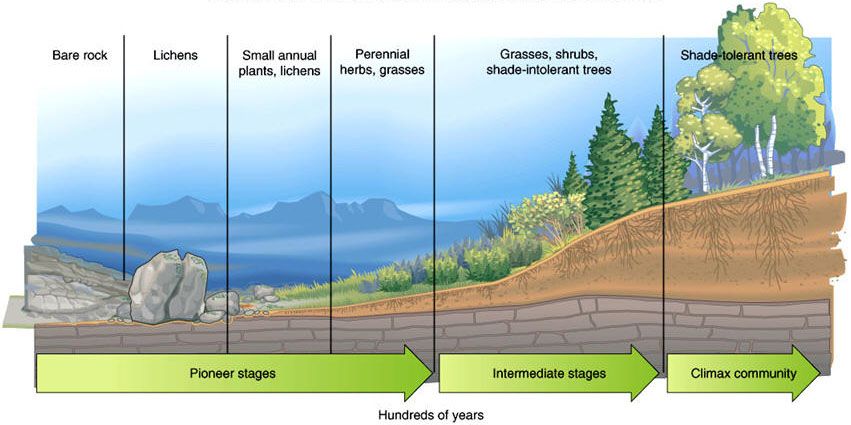
The picture shows what type of succession?
a)
primary
b)
secondary
c)
tertiary
d)
quadanary
24.
The first organisms that appear in an ecological community
a)
ecological succession 
b)
primary succession 
c)
secondary succession
d)
pioneer speciles
25.
How would the biodiversity of this ecosystem be affected if the lantern fish disappeared?
a)
The ocean sunfish population would increase.
b)
The large shark population would die out.
c)
The squid would die out.
d)
There would be no change.
26.
What is the order of succession shown in this figure?
a)
A, B, C, D
b)
B, A, D, C
c)
C, D, A, B
d)
D, A, B, C
27.
Where in the cell does cell respiration occur?
a)
chloroplast 
b)
central vacuole 
c)
mitochondria
d)
cell membrane
28.
This organic molecule is the main component of biological membranes.....
a)
carbohydrates
b)
lipids 
c)
proteins 
d)
nucleic acids
29.
Which main type of cell is large and complex with membrane bound organelles?
a)
prokaryote
b)
eukaryote
c)
plant
d)
animal
30.
If you place a freshwater cell in a salt water solution, what happens to the cell?
a)
nothing
b)
stays the same
c)
swells
d)
shrinks
31.
Which direction does water move in a hypotonic solution?
a)
water moves out of the cell
b)
solutions moves into the cell
c)
water moves into the cell
d)
solution moves out of the cell
32.
Active transport requires the cell to move materials against the concentration gradient, what molecule is required for this to occur?
a)
ADP
b)
ATP
c)
carbohydrates
d)
lipids
33.
Where in the cell does photosynthesis occur?
a)
chloroplast 
b)
mitochondria 
c)
plasma membrane
d)
none of these 
34.
This type of nutrition occurs when organisms make their own food...
a)
heterotroph
b)
autotroph
c)
consumer
d)
primary consumer
35.
Which process generates the most amount of ATP?
a)
aerobic respiration
b)
anaerobic respiration
36.
This molecule stores and transmits our genetic information and remains in the nucleus 
a)
rRNA
b)
trna 
c)
DNA
d)
mRNA
37.
Which of the following is an example of a homozygous dominant genotype?
a)
BB
b)
Bb
c)
bB
d)
bb
38.
A change in DNA is called a __________________.
a)
Nucleotide
b)
Mutation
c)
Radiation
d)
Transcription
39.
If a homozygous dominant (AA) individual is crossed to a homozygous recessive (aa) individual, what will the genotypes be of the offspring?
a)
50% AA, 50% aa
b)
25% AA, 50% Aa, 25% aa
c)
100% Aa
d)
50% AA, 50% Aa
40.
The human body has 23 homologous pairs of chromosomes.  How many chromosomes does a somatic cell have?
a)
12
b)
23
c)
46
d)
92
41.
How do molecules move during facilitated diffusion?
a)
With the concentration gradient, using energy
b)
Against the concentration gradient, without using energy
c)
With the concentration gradient, without using energy
d)
Against the concentration gradient, using energy
42.
In a water molecule, which atom(s) has/have a partial negative charge?
a)
Oxygen
b)
Hydrogen
c)
None of the atoms
d)
All of the atoms
43.
What is the property of water that allows it to stick to other surfaces?
a)
Surface tension
b)
Cohesion
c)
Adhesion
d)
Solubility
44.
Enyzmes are a very important type of protein used to
a)
Build bones in skeleton
b)
Send hormonal signals throughout body
c)
Speed up chemical reactions
d)
Photosynthesize glucose in plants
45.
What is the monomer of proteins?
a)
amino acids
b)
polypeptides
c)
nucleotides
d)
monosaccharides
46.

How do enzymes speed up chemical reaction?

a)

Increasing activation energy

b)

Decreasing activation energy

c)

Increasing deactivation energy

d)

Decreasing deactivation energy

47.
Which of the following statements is not part of the cell theory?
a)
Cells are the basic unit of structure and function in all living things.
b)
All cells are produced from other cells.
c)
Only animal cells are composed of cells.
d)
All living things are composed of cells.
48.

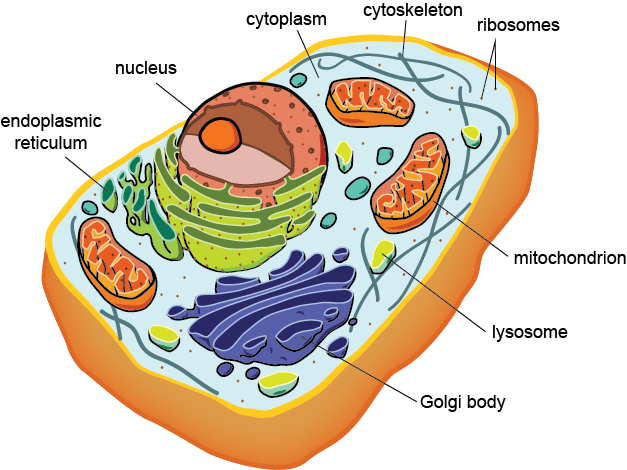
What type of cell is this?

a)

Plant

b)

Animal

c)

Eukaryote

d)

Prokaryote

49.
The cell structure that converts the energy in food into usable energy for the cell is the?
a)
mitochondrion
b)
cell wall
c)
chloroplast
d)
nucleus
50.
I make proteins for the cell. What am I?
a)
ribosome
b)
mitochondria
c)
chloroplast
d)
lysosome
51.
Osmosis is the diffusion of _____ across a membrane
a)
glucose
b)
NaCl
c)
proteins
d)
water
52.
What does semi-permeable mean?
a)
Only some things can move through membrane
b)
Nothing can move through membrane
c)
Reagan can move through membrane
d)
Membrane connot be moved through
53.
When particles move from areas of high concentration to areas less concentrated, this has taken place.
a)
diffusion
b)
mitosis
c)
endocytosis
d)
photosynthesis
54.
The raw materials or reactants of photosynthesis are
a)
sugar and water.
b)
sugar and oxygen.
c)
carbon dioxide and water.
d)
carbon dioxide and oxygen.
55.
Which of the following is the correct equation for PHOTOSYNTHESIS?
a)
6CO2 + 6H2O --> 6O+ C6H12O6
b)
6CO+ C6H12O6 + 6H2O --> O
c)
6O2 + 6H2O --> 6CO+ C6H12O6
d)
C6H12O6 + 6O2 ---> 6H2O + 6CO2 
56.
Which sequence of DNA bases would pair with this partial strand
ATG TGA CAG
a)
ATG TGA CAG
b)
TAC ACT GTC
c)
GTA AGT GAC
d)
CAT TCA CTG
57.
Guanine bonds with ______________.
a)
Adenine
b)
Guanine
c)
Cytosine
d)
Thymine
58.
Which process is used to make mRNA from the DNA in the nucleus?
a)
transcription
b)
translation
c)
replication 
59.
Which phrase best describes translation?
a)
converts mRNA into a polypeptide
b)
catalyzes bonds between amino acids
c)
produces RNA from DNA molecules
d)
recycles tRNA molecules for reuse
60.
Name the phase:
a)
Anaphase
b)
Telophase
c)
Metaphase
d)
Prophase
61.
What is the next phase of mitosis?
a)
Prophase
b)
Metaphase
c)
Anaphase
d)
Telophase
62.
I have cell walls
I am an autotroph
I am multicellular
What am I?
a)
Plant
b)
Animal
c)
Eubacteria
d)
Unicorn
63.
I am unicellular
I am prokaryotic
I am found in extreme ecosystems
What kingdom do I belong to?
a)
The Candy Kingdom
b)
Kingdom Plantae
c)
Kingdom Animalia
d)
Kingdom Archaebacteria
64.
All fungi have cell walls made of _.
a)
cellulose
b)
glucose
c)
chitin
d)
sucrose
65.
The hind leg bones in a whale (which have no apparent function) are examples of
a)
homologous structures
b)
analogous structures
c)
fossils
d)
vestigal structures
66.
The model that predicts evolution occurs at a slow, steady rate is called...
a)
gradualism
b)
punctuated equilibrium
c)
adaptive radiation
d)
convergent evolution 
67.
when members of a population are separated from each other by a physical barrier, causing new species to develop.
a)
migration
b)
mutation
c)
reproductive isolation
d)
geographic isolation
68.
Which layer is the oldest?
a)
1
b)
2
c)
3
d)
4
69.
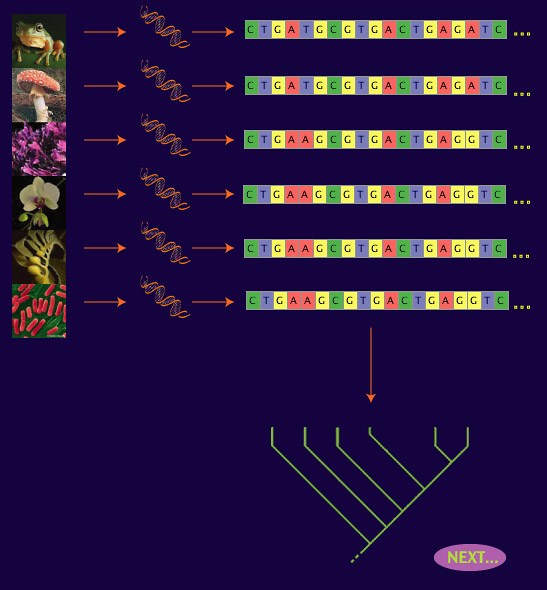
Two organisms that are closely related would have
a)
very similar DNA sequence
b)
exactly the same DNA sequences
c)
no proteins in common
d)
completely different DNA sequence
70.
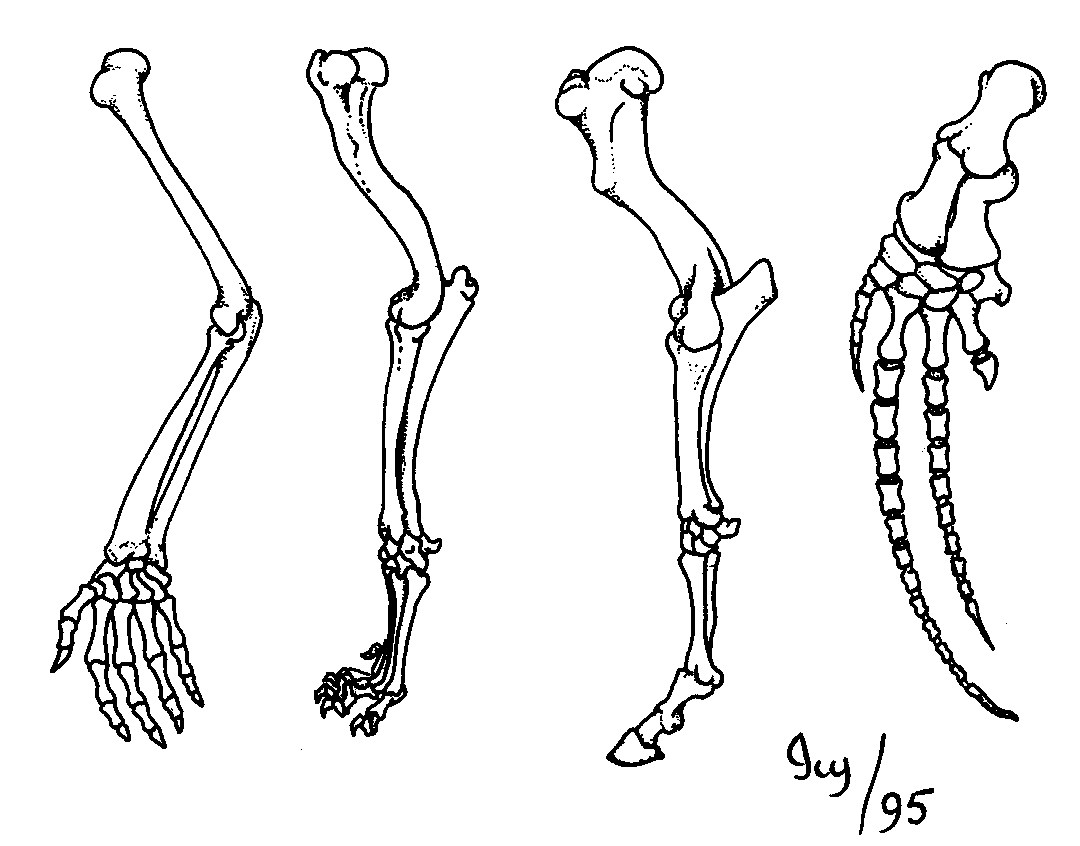
Structures with the same parts have different functions; suggests that organisms share a common ancestry
a)
vestigial structures
b)
homologous structures
c)
adaptive radiation
d)
fossil
71.
Controls what enters/leaves a cell
a)
cell membrane
b)
Nuclear membrane
c)
cell wall
d)
cytoplasm
72.

Phospholipids and transport proteins work in conjunction to control -

a)

cellular functions such as digestion

b)

what enters and exits through the cell membrane

c)

how often proteins are produced by the ribosomes

d)

the energy needs of each of the cell parts

73.

The cell membrane's function is to maintain ______, or balance levels of pH / water / etc. to ensure that the cell functions properly.

a)

solubility

b)

improper surface area

c)

extracellular conditions

d)

homeostasis

74.

This image shows molecules passing through a transport protein from low to high concentration, which requires energy, in a process called -

a)

active transport

b)

osmosis

c)

dissolving

d)

respiration

75.

In order to maintain a proper surface area to volume ratio, cells must routinely undergo -

a)

osmosis

b)

meiosis

c)

cell division

d)

active transport

76.

The urinary and excretory systems in your body work to -

a)

regulate your temperature

b)

circulate your blood

c)

remove unwanted waste

d)

bring in oxygen

77.
Which organic compounds are the building blocks of proteins?
a)
fatty acids
b)
amino acids
c)
monosaccarides
d)
peptides
78.

The weak bonds between the nitrogenous bases are

a)

peptide bonds

b)

hydrogen bonds

c)

covalent bonds

d)

sulfur bonds

79.

a nucleotide consists of what 3 parts

a)

rna,dna,phosphate

b)

5 carbon sugar,phosphate,nitrogenous base

c)

6 carbon sugar, phosphate, nitrogenous base

d)

carbon, sugar, oxygen

80.

prokaryotic cells do not have

a)

ribosomes

b)

defined nucleus

c)

cell membrane

d)

cytoplasm

81.
The discovery that chromosomes are involved in inheritance was made possible by the invention of the —
a)
computer
b)
microgram scale
c)
mercury thermometer
d)
microscope
82.
What is the total magnification used to view these onion cells through this microscope setup?
a)
400
b)
50
c)
40
d)
10
83.
An organism that causes infections in plants and animals, but cannot be seen with a light microscope similar to that used in a high school biology course, is most likely a —
a)
protozoan
b)
bacterium
c)
fungus
d)
virus
84.
Richard was observing black swallowtail butterflies in the field. Which one of these is an observation he made about a black swallowtail butterfly?
a)
The black swallowtail laid its eggs on a parsley plant.
b)
The black swallowtail is closely related to the spicebush swallowtail
c)
The black swallowtail likes to fly more than anything else.
d)
The black swallowtail belongs to the class Insecta.
85.
Which of the following scientific achievements best represents a collaborative effort among scientists?
a)
Robert Koch studied infectious diseases, and Louis Pasteur demonstrated that life only comes from life.
b)
Francis Crick and James Watson worked together to design the double-helix model of DNA.
c)
Anton van Leeuwenhoek invented the microscope in the 1600s, which was later used by others to study cells.
d)
Gregor Mendel’s study of pea plants enabled Thomas Morgan to become the first to locate a gene on a chromosome in Drosophila.
86.
The picture shows a coverslip correctly being lowered onto a slide. This method is used because it —
a)
reduces the possibility of air bubbles on the slide
b)
prevents the escape of microorganisms found in the water
c)
prevents the coverslip from moving
d)
allows microorganisms to move freely in the water
87.
Early classification systems consisted of two kingdoms; Plantae and Animalia. What scientific development allowed taxonomists to establish the Monera and Protista kingdoms?
a)
creation of electrophoresis
b)
discovery of DNA
c)
invention of the electron microscope
d)
development of Koch's postulates
88.
Suppose two organisms, each heterozygous for eye color, reproduced and had offspring. How likely are the two organisms to have heterozygous offspring?
a)
25%
b)
50%
c)
75%
d)
100%
89.
Gametes are formed and the chromosome number is reduced in this type of cell division
a)
Mitosis
b)
Meiosis
c)
Cytokenesis
d)
Translation
90.
One codon for STOP is?
a)
AAA
b)
UUA
c)
UAA
BB/bb
d)
AAG
White fur
91.
Which of the following provides an accurate example of a genotype?
a)
Brown Fur
b)
BB
c)
Blue Flowers
d)
Round seeds
92.
Which of the following cell organelles are related to movement?
a)
Ribosomes and lysosomes
b)
Flagella and Cilia
c)
Nucleus and cell membrane
d)
Golgi and ER
93.
Chromosomes that make up a pair (one chromosome from each parent) are called _________ chromosomes.
a)
Heterozygous
b)
Homozygous
c)
Homologous
d)
Tetrad
94.
Bacteria adapt more quickly than elephants to environmental changes. Which best explains this difference?
a)
Bacteria reproduce more rapidly
b)
Bacteria populations are more isolated
c)
Individual bacteria have more genes
d)
Bacteria grow more steadily
95.
What do phototropism and geotropism enable plants to do?
a)
Allow bacteria to invade cells
b)
Allow cell division to take place
c)
Prevent cell division
Develop resistance toward DNA
d)
Grow toward needed resources
96.
Escherichia coli is the scientific name of a bacterium. What category of classification is Escherichia?
a)
Order
b)
Phylum
c)
Genus 
d)
Species
97.
Tissue samples taken from the heart and stomach of a grasshopper would be expected to have the same:
a)
Cell Size
b)
Metabolic Rate
c)
DNA
d)
Cell Shape
Cell shape
98.
An ecosystem has a stable population of white-tailed deer. What is the most likely outcome if a new species of deer that competed for the same resources were introduced?
a)
The white tailed deer population would increase
b)
The producer population would decrease
c)
The deer will not be affected
d)
The predator population would decrease
99.
During the process of protein synthesis, a section of DNA molecule is copied into which other molecule?
a)
DNA
b)
r-RNA
c)
m-RNA
d)
t-RNA
100.
According to the graph the enzyme Amylase will
a)
Slow down the digestion rate
b)
Speed up the digestion rate
c)
Denature the starch
d)
Take in excessive heat
101.
According to this graph the carrying capacity of these deer is?
a)
20
b)
40
c)
70
d)
80
102.
When a group of foxes moves to a new environment, a change in which of the following is least likely to be a selective pressure on the foxes?
a)
Temperature
b)
Food Resources
c)
Decomposers
d)
Precators
103.

What is happening to the temperature in New York City?

a)

It is remaining about the same.

b)

It is mostly decreasing.

c)

It is mostly increasing.

d)

There is a pattern of increasing and decreasing.

104.
The dependent variable in this experiment is - 
a)
Number of Bacteria
b)
Time of Incubation
c)
Culture Number
d)
Type of Bacteria
105.
What can you infer about the temperature for E.coli bacterial growth?
a)
E. coli does not grow well at low and high temperatures.
b)
E coli will continue to grow at very high temperatures.
c)
E.coli grows best at very low temperatures
d)
E.coli grows best at very high temperatures.
106.
What percent of Iodine is left after 24 days?
a)
50%
b)
6.25%
c)
12.5%
d)
3.13%
107.

Which of the following is NOT a requirement to be considered living?

a)

Capable of reproducing

b)

Made up of one or more cells

c)

Eat food in order to survive

d)

Can respond to changes in the environment

108.

Which type of air pollutant is the most abundant?

a)

carbon monoxide

b)

particulate matter

c)

nitrogen oxides

d)

sulfur oxides

109.
What are disease causing agents like bacteria or viruses called?
a)
antibodies
b)
pathogens
c)
proteins
d)
vitamins
110.
Shingles is a disease that appears in the elderly. Someone may be infected with shingles but only show symptoms dozens of years after infection. What type of virus causes shingles?
a)
A lytic cycle virus
b)
A lysogenic cycle virus
c)
A bacteriophage
d)
A bacteria
111.
How do viruses reproduce?
a)
Binary Fission
b)
Using a host cell and the lytic cycle.
c)
Through cell mitosis.
d)
By using nuclear fission.
112.
What is a capsid?
a)
viral reproduction
b)
type of nucleic acid
c)
prokaryotic cell
d)
protein coat that protects a virus
113.
I'm unicellular, autotrophic. What kingdom do I belong to?
a)
Animalia
b)
Archaebacteria
c)
Protista
d)
Plantae
114.
Antibiotics are used for ____.
a)
bacteria
b)
viruses
115.
95% of all animals
a)
sponges
b)
worms
c)
invertebrates
d)
vertebrates
116.
Which of the following is an example of a nonvascular plant?
a)
Grass
b)
Fern
c)
Apple Tree
d)
Moss
117.
The plant cell wall is made up of
a)
chitin
b)
peptidoglycan
c)
cellulose
d)
glycogen
118.
Evaluate the cladogram above. What should letter A be labeled? 
a)
Pollen and Seeds
b)
Fruits and Seeds
c)
Vascular Tissue
d)
Flowers
119.
Evaluate the cladogram above. What should letter B be labeled? 
a)
Seeds
b)
Fruits and Seeds
c)
Vascular Tissue
d)
Flowers
120.
The picture shows what type of succession?
a)
primary
b)
secondary
c)
tertiary
d)
quadanary
121.
What property of water makes it the 'universal solvent'?
a)
it is a polar molecule
b)
it is an ionic compound
c)
it contains hydrogen bonds
d)
it steals electrons from other atoms
122.
Carbohydrates are made of... 
a)
C H O
b)
C H O N
c)
C H O N P
d)
C H O N S
123.
Which group of organic molecules serve as long-term energy storage and waterproof coverings?
a)
proteins
b)
carbohydrates
c)
lipids
d)
nucleic acids
124.
Attractions between water molecules are called
a)
Covalent bonds
b)
Ionic bonds
c)
Polar bonds
d)
Hydrogen bonds
125.
Unlike mitosis, meiosis in male mammals results in the formation of
a)
one haploid gamete
b)
three diploid gametes
c)
four diploid gametes
d)
four haploid gametes
126.
When an area of a chromatid is exchanged with the matching area on a chromatid of its homologous chromosome, _________________ occurs
a)
crossing over
b)
mutagenesis
c)
hybridization
d)
fertilization
127.
In certain rats, black fur is dominant over white fur. If two rats, both heterozygous for fur color are mated, their offspring would be expected to have 
a)
four different genotypes and two different colors
b)
two different genotypes and three different colors
c)
three different genotypes and two different colors
d)
three different genotypes and three different colors
128.
Which of the following genotypes is homozygous recessive?
a)
RR
b)
Rr
c)
rr
d)
None of the Above
129.
Tt is-
a)
homozygous dominant
b)
homozygous recessive
c)
heterozygous
d)
none of these
130.
T15. The hypothesis that evolution of a species occurs in periods of rapid change separated by periods of little or no change is called
a)
divergence
b)
gradualism
c)
punctuated equilibrium
d)
isolation
131.
Charles Darwin’s observation that finches of different species on the Galápagos Islands have many similar physical characteristics supports the hypothesis that these finches 
 
a)
have the ability to interbreed.

b)
acquired traits through use and disuse.
c)
all eat the same type of food.
d)
descended from a common ancestor.
132.
What is required for evolution?
a)
overproduction (too many organisms)
b)
competition
c)
variation
d)
all of these
133.
To classify an organism a scientist finds in the field, which of these will the scientist first compare to other known organisms?
a)
dietary habits
b)
ecological niche
c)
physical structure
d)
reproductive method
134.
What did Rosalind Franklin contribute to the understanding of DNA molecules?
a)
An image indicating the shape of a DNA molecule
b)
An analysis of the chemical makeup of a DNA molecule
c)
A though that DNA carries genetic information
d)
A theory about how DNA conveys genetic information
135.
The weakness of hydrogen bonds between the bases of DNA allows-
a)
rearrangement of the sequence of bases to take place
b)
base pairs to separate during transcription and replication
c)
new bases to be incorporated into the DNA molecule
d)
conversion of bases to amino acids in the event of cell starvation
136.
Why are most enzymes destroyed by high temperature? 
a)
Changes their shape 
b)
Changes their pH 
c)
Changes their amino acid sequence 
d)
Causes them to break into pieces