
 Worksheets
Chem 2-24
Total questions: 105
Worksheet time: 3hrs 49mins

22688Ra = ___ + 42He

In order of most to least penetrating radiation we have
Alpha , Beta, Gamma
Beta , Gamma , Alpha
Gamma, Beta, Alpha
Gamma, Alpha, Beta


The energy producing nuclear reaction that takes place between hydrogen atoms in the sun is an example of
gamma decay
alpha decay
fusion
fission

The vertical (up and down) columns in the Periodic Table are called
groups
towers
periods
atomic numbers
Elements that occur in vertical columns on the periodic table.
periods
metalloids (semimetals)
groups
Proton
USE THE PERIODIC TABLE
How many valence electrons does sodium have?
1
2
3
4
USE THE PERIODIC TABLE
How many valence electrons does Phosphorus have?
31
5
15
4
How does a group 1 metal atom form an ion?
lose 1 electron
lose 2 electrons
gain 1 electron
gain 2 electrons
What is the charge of a group 1 metal ion?
1+
2+
1-
2-
If a potassium atom lost one electron, what would be the symbol for that ion?


What is the oxidation number (charge) of Li?
1+
1-
2+
2-
What is the oxidation number (charge) of P?
3+
3-
5+
5-
Magnesium has 12 electrons. In how many energy levels are the electrons of magnesium?
1 energy leve
2 energy levels
3 energy levels
4 energy levels
How many electrons would fluorine need to gain in order to have a stable outer energy level?
1 electron
2 electrons
3 electrons
4 electrons
What is an electron dot diagram?
symbol of element with dots representing the electrons in the outer shell
vertical column of elements on the periodic table
row of elements on periodic table
arrangement of the elements by increasing atomic numbers
The rows or periods on a periodic table represent?
The number of protons
The number of energy levels
The number of atoms in an energy level
The number of electrons and mass number
What is the atomic radius?
The distance from the nucleus to outermost electron
The distance from one side of an atom to the other side
The distance around the atom
The distance between atoms in the gas phase
The distance between atoms in the solid phase

As you look from left to right across a period, electronegativity
increases
decreases
Electronegativity trends are the same as:
Atomic radius trends
Ionization energy trends
Both of these
None of these
What does electronegativity do as you go across a period?
decrease
no pattern
stay the same
increase

1s22s22p63s23p64s23d10

Sodium is an element with atoms with 11 protons. For it to be stable, does it lose or gain electrons?
Lose
Gain
Elements tend to react to acquire the stable electron structure of a(n)
ion
halogen
metal
noble gas
How do molecules of gas behave?
They vibrate in place.
They bounce around randomly.
They are locked in place by chemical bonds.
They clump together.

Which diagram represents a gas?
A
B
C
None of the Above
I have a
definite, fixed volume. What could I be?
solid or liquid
liquid only
gas only
solid only
liquid or gas
Which phase of matter is compressible with lots of free space between particles?
Liquid
Gas
Solid
A student measures the pressure and volume of an empty water bottle to be 1.4 atm and 2.3 L. She then decreases the pressure to 0.65 atm. What is the new volume?
2.1 L
5.0 L
8.2 L
3.9 L
What is the pressure of a car tire that had an initial pressure of 1.8 atm but was heated from 38°C to 123°C?
0.9 atm
2 atm
1.6 atm
3.4 atm

You have a gas that has a pressure of 2 ATM and a volume of 10L. What would be the new volume if the pressure was changed to 1 ATM?
P1⋅V1=P2⋅V25 L
20 L
It would stay at 10L
1 L
If 10L of O2 at 273K and 1 atm is compressed to a 7L container at 250K, what is the new pressure?
P2= P1V1T2/V2T1
1.31 atm
9.16 atm
0.76 atm
6.0 atm
PV=nRT what are the units for T?
L
K
mL
Celcius
PV=nRT what is n?
atm or torr
K
mL
mole
PV=nRT
A substance moves from a solid to a liquid, what must occur?
the substance must undergo an endothermic reaction and release energy
the substance must undergo an exothermic reaction and release energy
the substance must undergo an endothermic reaction and absorb energy
the substance must undergo an exothermic reaction and absorb energy.

1. Kinetic refers to _______________
Force
Energy
Motion
Acceleration
Gas pressure is caused by ______.
gravity.
gas molecules colliding with each other.
gas molecules colliding with surfaces of the container.
gas molecules reacting with each other.
A mixture of H, Ne, & O has a pressure of 12.4 atm. If Hydrogen measures 5.6 atm and Oxygen measures 2.0 atm, what is the pressure of Neon?
7.6 L
4.8 L
5.4 L
12.0 L
Which of the following states of matter has the LOWEST level of energy?
Solid
Liquid
Gas
Plasma

What happens to the average kinetic energy of matter when it is heated?
It increases
It stays the same
It decreases
It cannot be determined

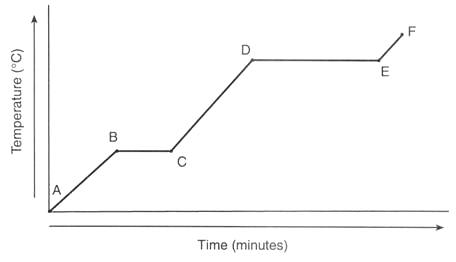
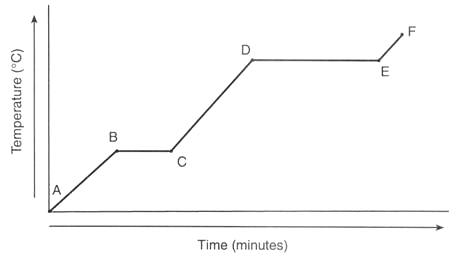
Which area represents liquid water temperature rising ?
A-B
B-C
C-D
D-E
Liquid to Gas
deposition
vaporization
condensation
sublimation

Segment D-E represents the...
Melting Point
Boiling Point
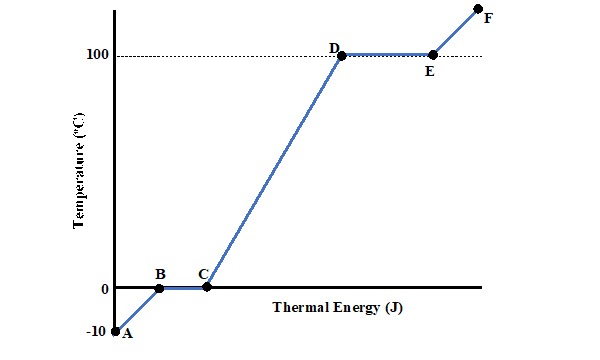
Between which two points is Heat of Fusion?
A <----> B
B <----> C
C <----> D
D <----> E
E <----> F
The amount of energy required to raise the temperature 1ºC for every gram is called____?
Thermal Energy
Specific Heat
Temperature
Kinetic Energy
The amount of energy required for a liquid at its boiling point to become a gas is _____________.
heat of fusion
heat of vaporization
transpiration
freezing point
The amount of energy needed to change a substance from the solid phase to the liquid phase is the substance's
heat of vaporization
heat of transformation
melting point
heat of fusion
2Na + Cl2 → 2NaCl + 25kJ energy
Br2 + Cl2 + 30.0 J of energy → 2BrCl
The amount of thermal energy stored in an object depends on:
the mass of the object.
the temperature of the object.
the amount of energy that the particular material stores per degree of temperature.
All of the above
The specific heat of platinum is 0.133 J/g°C. How much heat(Q) is absorbed when a 10 g piece of platinum warms from 100°C to 150°C?
66.5 J
665 J
0.0266 J
0.665 J
A 15.75-g piece of iron absorbs 1086.75 joules of heat energy, and its temperature changes from 25°C to 175°C. Calculate the specific heat capacity of iron.
0.46 J/goC
1.654 J/goC
2,567,446.875 J/goC
What is a compound?
2 or more elements separated
2 or more atoms of the same element
2 or more elements combined in a fixed ratio
A bunch of elements grouped together
The substances in this mixture have been mixed together so well that the different parts will not separate on their own.
Homogeneous mixture
Heterogeneous mixture
Pure substance
Suspension
Solution
Solutions are ___________ mixtures.
Solid
Homogenous
Heterogeneous
Gas
When you dissolve sugar cubes in tea, the sugar cube is the __________.
solute
solvent
When you dissolve sugar cubes in tea, the tea is the ____________.
solvent
solute

What is the solubility of KNO3 at 50°C?
Approximately 85 g
Approximately 100 g
Approximately 50 g
Approximately 15 g
How does stirring influence the rate of dissolving?
Increases the rate of dissolving
Decreases the rate of dissolving
Does not influence the rate of dissolving
How does temperature generally influence the rate of dissolving?
Increase in temperature generally increases the rate of dissolving
Decrease the temperature generally increases the rate of dissolving
Temperature does not influence the rate of dissolving
These are all ways to make a solution dissolve FASTER. Choose all that apply.
Stirring
Use cold water
Use small particles
Shaking

How many grams of K2Cr2O7, are soluble in 100 g of water at 95 ºC?
83 grams
75 grams
40 grams
12 grams


When 42 grams of potassium chloride ( KCl), is dissolved in 100 grams of water at 50 ºC, the solution can be correctly described as:
supersaturated
saturated
unsaturated
What is the molarity of a 0.5L sample of a solution that contains 60.0 g of sodium hydroxide (NaOH)
0.8 M
1.5M
3.0M
6.0M
Calorimetry Question:
A piece of metal with a mass of 32.8 g is heated to 100.5°C and dropped into 138.2 g of water at 20.0°C. The final temperature of the system is 30.2°C. What is the specific heat capacity of the metal? (Specific heat of water is 4.18 J/g⋅°C)
2.56 J/g⋅°C
0.391 J/g⋅°C
5.29 J/g⋅°C
3.50 J/g⋅°C

