Worksheets
Physical Science Sem.2 Final 2023
Total questions: 73
Worksheet time: 2hrs 44mins
Check all examples that are heterogeneous mixtures.
Saltwater
Pepperoni pizza
Chopped salad
Air
Check all examples that are homogeneous mixtures.
Milk
Tea
Chicken noodle soup
Air
Which of these is not an element?
Water (H2O)
Copper (Cu)
Carbon (C)
Iron (Fe)
What is the smallest unit of an element that retains the chemical properties of that element?
Electron
Neutron
Molecule
Atom

Which of these samples shown best represents an mixture?
A
B
C
D
Which of these samples shown best represents an element?
A
B
C
D
Which of these samples shown best represents a compound?
A
B
C
D

Volume of solid
definite
Movement of Solid
vibrates
Shape of solid
definite shape

Shape of Liquid
same as container
Volume of Liquid
definite
Movement of Liquid
slow

Shape of gas
same as container
volume of gas
not definite
movement of gas
fast

What is boiling point (write the number)?
(a)

Match the letter in the picture with the word
A
all solid
B
melting/
freezing
C
all liquid
D
boiling/
condensing
E
all gas

Look at the picture and match the following:
Density 1.25g/ml
C
Density
0.89 g/ml
A
Density
1.05g/ml
B

Which of the following belongs in the heterogeneous mixture group:
tea
hot fudge sundae
milk
Identify the parts of a mixture made from 1cm of salt mixed with 1000 ML of water.
salt
solute
water
solvent
saltwater
solution
The vertical (up and down) columns in the Periodic Table are called
groups
towers
periods
atomic numbers
Which group of the periodic table is composed of inert (not reactive) gases?
answer choices
alkali metals
alkaline earth metals
halogens
noble gases


Elements in the same group have : (2 correct answers)
Similar chemical properties
Similar names
Same number of outer (valence) electrons)
The same number of protons

The blue elements (left side) are called
The yellow elements (right side) are called

Losing electrons makes an atom more
of a loser
positively charged
forgetful
than enough
Which two elements would NOT form an ionic bond?
calcium and lithium
calcium and oxygen
lithium and oxygen
calcium and carbon
Cr3+ O2-
2

Identify the reaction type:
C2H6 + O2 --> CO2 + H2O
Double displacement
Synthesis
Acid base
Combustion
Identify the reaction type for the following equation:
K + F2 --> KF
Double displacement
Single Replacement
Synthesis
Decomposition
Identify the type of reaction:
ZnCl2 + Mg --> Zn + MgCl2
Precipitate
Single Replacement
Double Displacement
Decomposition
Identify the reaction type:
NaCl + KOH --> KCl + NaOH
Double displacement
Combustion
Redox
Precipitate
Identify the reaction type:
H2O2 --> H2O + O2
Decomposition
Synthesis
Combustion
Acid Base
What are reactants?
The chemicals that start the reaction.
The chemicals that the reaction produced.
The chemicals that are on the right side of the arrow.
What are products?
The chemicals that start the reaction.
The chemicals that the reaction produced.
The chemicals that are on the left side of the arrow.
What is the number before a chemical formula called?
Example: 2H2 + O2 ---> 2H2O
Coefficient
Atom
Subscript
Equation
What is the total number of atoms present in 5Na3PO4?
5
55
40
8
Mg + __HCl ---> MgCl2 + H2
What coefficients are needed to balance the equation?
___Al + ___ O2 ---> 2Al2O3
3,2
3,4
4 , 3
4,2
Identify the solvent
A mixture with more solute dissolved in the solvent than is usually soluble is called:
concentrated
supersaturated
saturated
unsaturated
When you have added as much solute as can dissolve in the solvent, the solution is called:
concentrated
supersaturated
saturated
unsaturated
The following substances can NOT conduct electricity in water:
Soluble ionic compounds
Acids
Bases
Covalent Compounds
In general, how could you increase the solubility of a solid in a liquid?
Increase the pressure.
Decrease the pressure.
Increase the temperature.
Decrease the temperature.
I am an Alkaline Earth Metal in Period 6. Who am I?
Tungsten
Calcium
Barium
Caesium
I have 1 more proton than lead and am found in Pepto Bismo.
arsenic
thallium
bismuth
xenon
Period 4 and 1 valence electron. My symbol does not match my name
Potassium
Lithium
Sodium
Calcium
The only metalloid in period 3
Silicon
Boron
Germanium
Arsenic
I am the element with five valence electron with the second heaviest atomic mass in my group. I also glow very bright when exposed to oxygen.
phosphorus
oxygen
beryllium
rubidium
Select the correct order of waves on the EM Spectrum from low to high energy
Radio, Micro, Infra, Visible, Ultra, X-ray, Gamma
Gamma, X-ray, Ultra, Vis, Infra, Micro, Radio
Vis, Micro, Infra, Ultra, X-ray, Gamma, Radio
Micro, Radio, Vis, Infra, Ultra, X-ray, Gamma
How are Electromagnetic waves different from Mechanical waves?
EM waves have very short wavelengths
EM waves transmit energy instead of matter
EM waves can travel through the vacuum of space (without particles)
EM waves can change direction by reflection
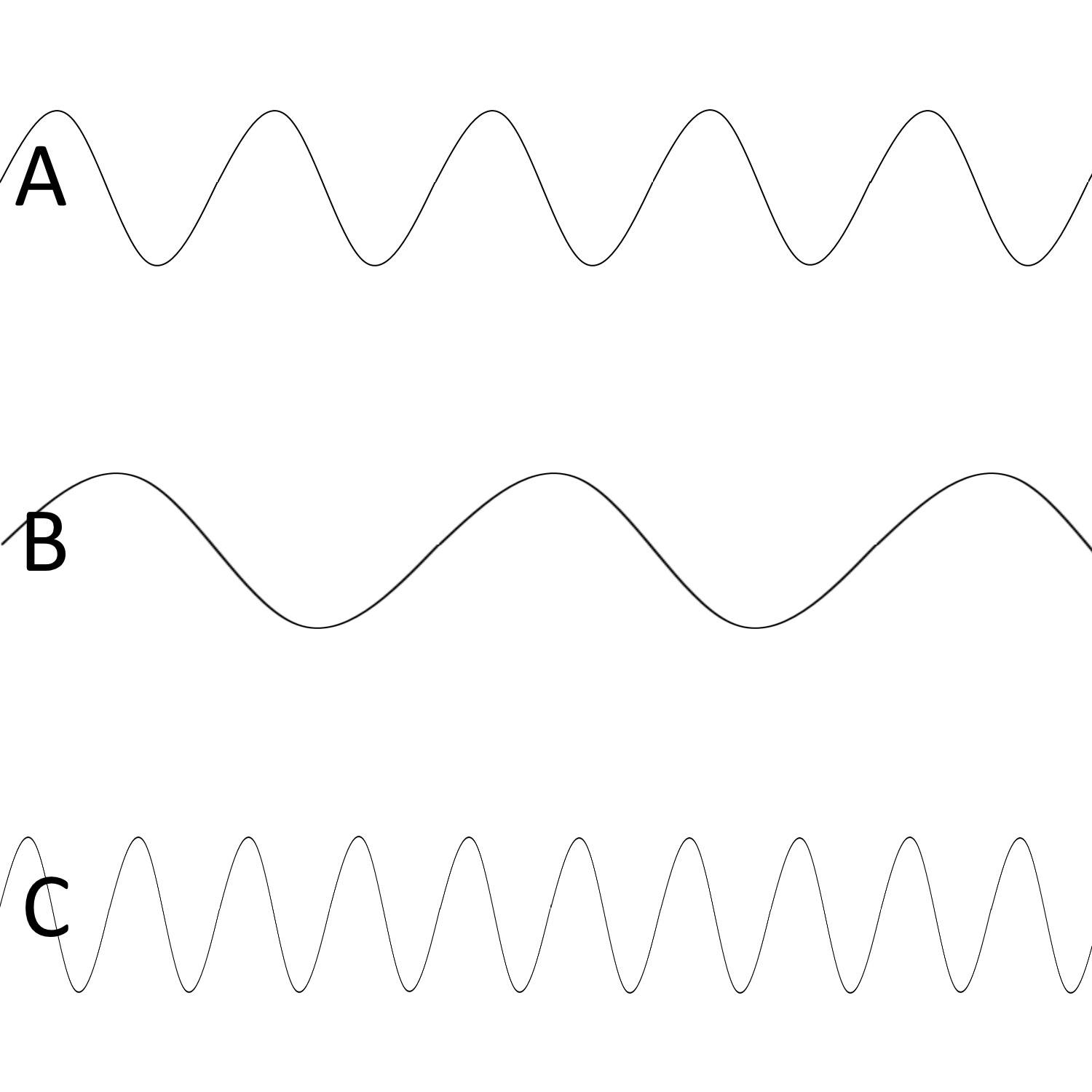

Which letter indicates X-rays?
A.
B.
C.
D.
Which letter indicates infrared rays?
A.
B.
C.
D.
Which of the following occurs as a light wave bends when it passes from on medium to another?
constructive interference
refraction
reflection
destructive interference