
 Worksheets
M+S23FR
Total questions: 44
Worksheet time: 11hrs 0mins
_____ are underlying constructs that are not directly observable and cannot be measured by one single thing.
Observable variables
Factor variables
Latent variables
Multi variables
Which of the following statements is NOT true regarding confirmatory factor analysis (CFA)?
CFA requires you to predetermine the number of factors.
CFA is best used in situation where you have no expectations of what the outcome of your analysis would be.
CFA requires you to predetermine which observable variables are related to each factor.
CFA requires you to predetermine a specific hypothesis.
Which of the following statements regarding exploratory factor analysis (EFA) is NOT correct?
EFA involves a specific hypothesis based on previous research or theory.
EFA identifies the factor structure.
EFA can explain a maximum variance amount.
EFA does not require you to predetermine the number of factors or the relationship between the factors and the observed variables.
Which of the following is NOT one of the primary goals of factor analysis?
Determine how many factors underlie a set of observable variables.
Provide a method of explaining variance among observable variables by using fewer, newly created factors.
Define the meaning or content of the observable variables.
Reduce data by allowing us to extract a small set of factors from a larger set of observable variables.
What is factor analysis?
A statistical method that is used to determine whether a group of observable variables are related to a smaller group of underlying factors.
A statistical method used to calculate the correlations between underlying factors.
A statistical method used to determine whether there are differences between observable variables.
None of these answers are correct.
T/F: Chi-Square looks to see if two categorical variables are related.
True
False
T/F: Sampling error is any error that is due to variance in your sampled group of people.
False
True
T/F: Type 2 error is the possibility of rejecting the null hypothesis when the null is actually true.
False
True
T/F: Type 1 error is the possibility of rejecting the null hypothesis when the null is actually true.
True
False
T/F: Type 2 error is the possibility of failing to reject the null hypothesis.
True
False
T/F: Effect size helps readers understand the magnitude of differences found, whereas statistical significance examines whether the findings are likely to be due to chance
True
False
T/F: Statistical significance is the final determinant of an effective treatment
True
False
Which of the following statements is NOT true regarding Cohen's d?
Assess the strength of the relationship between variables or the impact of an intervention
Tells us how large the difference between two groups is, taking into account the variability within each group
Helps us understand the practical significance or the real-world importance of the observed difference
All statements are true
T/F: the t test rescales the difference between the means into standard error units, while Cohen’s d rescales the same difference between the means into standard deviation units.
True
False
T/F: Advantage of scaling over standard deviation in Cohen’s d is that the standard deviation is not materially affected by sample size.
True
False
T/F: advantage of scaling over standard error term in t test is that the standard error term is not materially affected by sample size.
True
False
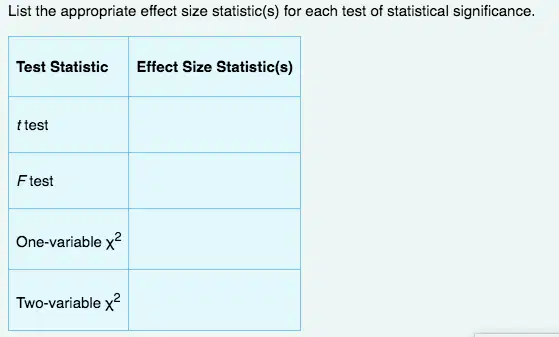
Cohen’s d; eta; r; phi
eta; Cohen’s d; r; phi
Cohen’s d; eta; phi; r
eta; Cohen’s d; phi; r
The results from a rigorous study must meet three requirements. What are the three requirements?
statistical significance
Practical significance or effect size
reproducibility and replicability
All of the above
T/F: Increasing Type I error means accepting a greater chance of making a Type I error.
True
False
Wolverine wants to know if his new multivitamins work for humans. He samples 20 participants before giving them his WolveVits and re-evaluates them 4 weeks after the treatment. What type of research design should you use?
One-way within-subjects ANOVA or Dependent sample t test
One-way between-subjects ANOVA or independent samples t test
Normal deviate z test
None of the above
Professor P wanted to know if the color of paper had an effect on test scores. On test day, he randomly handed out the tests printed on white paper or blue paper to his students. What research design should you use?
One sample t-test
One-way within-subjects ANOVA or Dependent sample t test
One-way between-subjects ANOVA or independent samples t test
MANCOVA or multivariate multiple regression with dummy coding
I want to know if the colors in my M&Ms bag match the average colors of M&Ms as stated on their website (e.g., 3 red, 4 blue, etc.). What type of research design should you use?
Regression
One sample t-test
A 2x2 chi square test of independence
Chi square goodness of fit
A botanist wants to determine whether there are any differences in the nesting bird species among avocado trees that were grown using different propagation methods. More specifically, she wants to know if more crows than blue jays prefer making nests in trees that were propagated from leaf cuttings than trees that were propagated from simple layering. What type of research design should you use?
Pearson r, Correlation
A 2x2 chi square test of independence
Chi square goodness of fit
None of the above
Dr. Y's previous studies suggests that people’s love for animals can predict how likely they are to become vegetarian. However, their research group thinks that the relationship can be explained by how much people love cows. What type of research design should you use?
Mediation linear regression
Moderation linear regression
MANCOVA or multivariate multiple regression with dummy coding
2x2 within-subjects ANOVA
The average weight for a Pembroke Welsh Corgi living in America is 26 pounds. A concerned citizen wants to weigh a random sample of Corgis to ensure that pet owners are not under-feeding or over-feeding their dogs. What type of research design should you use?
One-way within-subjects ANOVA or Dependent sample t test
One-way between-subjects ANOVA or independent samples t test
One sample t-test
None of the above
Dr. James is studying nerac (a categorical variable with 2 levels) and neutronium file (a continuous variable) to see how they predict alkali megadestabilazation (a continous variable) and mean-spirited sociality ( a continous variable). What type of research design should you use?
A 2x2 within-subjects ANOVA
MANCOVA or multivariate multiple regression with dummy coding
Moderation with a 3x2 ANOVA
Moderation regression
Researchers wanted to know if the amount of ice cream consumed and the time of consumption could improve stress levels. Participants were randomly assigned to eat either 1 scoop, 2 scoops, or none every day for a week. Some were told to eat their ice cream in the morning and others at night. What type of research design should you use?
Moderation with a 3x2 ANOVA
A 2x2 within-subjects ANOVA
Correlation; simple linear regression
A 3x2 between-subjects ANOVA
This analysis tells you if there is a relationship between 2 variables while this analysis between 2 variables tells you if one can predict the other
Mediation regression
Correlation; simple linear regression
Moderation regression
Analysis of Variance
A study was done to see if financial status could affect the relationship between happiness and life satisfaction. What analysis is this example?
Multiple linear regression
Moderation regression
Mediation regression
Correlation
This is a test I should use if I only have categorical data.
Chi Square
Correlation
Analysis of Variance
None of the above
This is a test I should use if I only have continuous data.
Correlation
Analysis of Variance
Regression
Chi-Square
A study done with first year college students want to know if the time they take class and the gender of the professors can impact end of the year grades. Participants were randomly assigned to have classes in the afternoon or in the morning, and if the professors is a female or a male in the first semester. During the second semester participants had their classes in the other time or with opposite gender.
Moderation with a 3x2 ANOVA
A 2x2 within-subjects ANOVA
A mixed factorial 2x2 ANOVA
Regression
Dr. X conducted a study on a fraternity house to measure the effects of literature read and dinner type on residents satisfaction. Participants were assigned to read a romance or horror book in the first day, and read the opposite book in day two. Participants were also assigned to eat either Italian or Mexican food for both days. Residents satisfaction was measure using a Likert scale.
A mixed factorial 2x2 ANOVA
A 2x2 within-subjects ANOVA
Moderation with a 3x2 ANOVA
A 3x2 between-subjects ANOVA
An experimenter shows a video to participants about the dangers of SeaWorld. Participants either see Steve Irwin, Jane Goodall, or no celebrity in the video. Afterwards, their willingness to sign a petition is measured. The experimenter wants to know which campaign works best (which produces the highest average willingness to sign the petition)? Or does one campaign work better for females, another for males?
A 3x2 between-subjects ANOVA
A 2x2 within-subjects ANOVA
Mediation with a 3x2 ANOVA
Moderation with a 3x2 ANOVA
T/F: Analysis of Variance is what ANOVA stands for
True
False
A basketball player only scored 10 points in his game last week. However, this week, he scored closer to his usual performance, around 30 points. This is the name of the statistical phenomenon being described.
Chi Square
Regression to the mean
General linear model
None of the above
T/F: Confounds and artifacts threaten these internal and external validity, respectively
False
True
T/F: Regression, ANOVA, t-test, correlation, ANCOVA, and MANOVA all fall under the General linear model
True
False
When we increase sample size, power _________, p value _________, and effect size _______.
increase, decrease, does change
increase, decrease, doesn’t necessarily change.
decrease, increase, does change
decrease, increase, doesn't necessarily change
This is the minumum number of articles I need in order to run a meta-analysis
1
3
2
4
In FA, this is the name of the plot I should examine to see how many factors I have
Linear plot
Scatter plot
Scree Plot
None
T/F: Eigenvalue is the name of the value I look for to see if it is greater than 1 (indicating a separate factor)
False
True
T/F: When comparing models, Delta R2 (change in R2) value specifically tells me if Model 2 is a better fitting model than Model 1
True
False
Which is NOT a part of the process of doing a meta-analysis?
Combining data from all reports to make a single report
Graphing data from randomized studies to determine whether the intervention had an effect
Graphing data from all included studies to determine whether the intervention had an effect
Choosing studies that are appropriate

