
 Worksheets
Chemistry Semester 2 Review
Total questions: 73
Worksheet time: 6hrs 5mins
What does the number 3 represent in 4NH3?
Subscript
Superscript
Coefficient
What does the number 4 represent in 4NH3?
Subscript
Superscript
Coefficient

In the equation shown, what are the reactant(s)?
N2 + H2
NH3
In the equation shown, what are the product(s)?
N2 + H2
NH3

Is this equation balanced?
Yes
No

Is this equation balanced?
Yes
No

To balance an equation you should:
ONLY change subscripts.
ONLY change coefficients.
Change BOTH subscripts and coefficients.
N2+O2--> _NO
What law governs the balancing of chemical equations?
Law of Energy
Law of Conservation of Matter/Mass
Law of Gravity
Law of Matter Movement
Balance this equation
_Al +_HCl --> _H2 +_AlCl3
2,6,3,2
it's already balanced
4,12,3,4
2,1,4,5
NH3 + HCl → NH4Cl
PbCl2 + AgNO3 → Pb(NO3)2 + AgCl
Al(OH)3 → Al2O3 + H2O
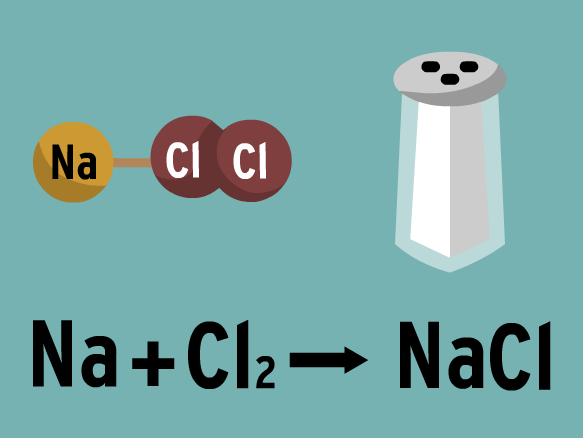
In a chemical reaction, 4 grams of sodium must combine with how many grams of chlorine to produce 10 grams of table salt?
4 grams
6 grams
8 grams
10 grams
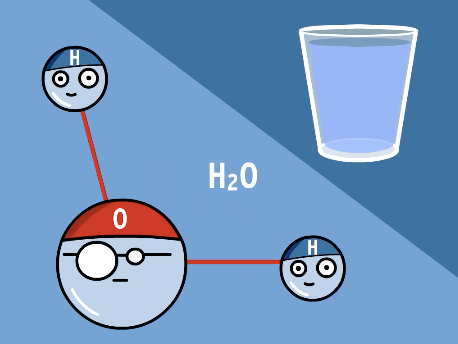
4 grams of hydrogen and 32 grams of oxygen will combine to form:
36 grams of water
28 grams of hydroxide
32 grams of oxygen
36 grams of deuterium
Predict the products of this DR reaction: NaCl + CaO ----->
Na2O + CaCl2
NaCa + OCl2
This reaction will not occur
NaO + CaCl
What are the products of this reaction: Na(NO3) + CaF2 --->
This reaction will not occur
NaF + Ca(NO3)2
NaF2 + Ca(NO3)
NaCa + F(NO3)
Mg + I2 -->
Predict the products for the following reactants. Na + O2 -->
NaO
NaO2
ONa
Na2O
[1 mole Ga = 70g Ga]
N2 + 3H2 --> 2NH3
What is the total number of moles of NH3 produced when 10 moles of H2 reacts completely with N2?
6.7
2.0
3.0
15.0
N2 + 3H2 --> 2NH3
How many moles of N2 is needed to react with 6 moles of H2?
6.7
3.0
2.0
15.0

covalent bond
London forces
hydrogen bond
dipole-dipole attraction
The weaker the intermolecular forces of a substance the _____________ the boiling point
higher
lower
Which substance has the weakest intermolecular forces?
Substance A, boiling point of 75 °C
Substance B, boiling point of 105 °C
Substance C, boiling point of 25 °C
Substance d, boiling point of 45 °C

How many grams of K2Cr2O7, are soluble in 100 g of water at 95 ºC?
83 grams
75 grams
40 grams
12 grams


In a solution, the part of the mixture in which other substance are dissolved
Strainer
Solvent
Solute
Magnetism

What is the molarity of a 0.5L sample of a solution that contains 60.0 g of sodium hydroxide (NaOH)
0.8 M
1.5M
3.0M
6.0M
Which of the following is the correct formula for calculating molarity?
moles/liters of solution
moles/kg of solvent
# particles/Avogadro's #
theoretical yield/actual yield
If water is a polar molecule, then which of the following must be nonpolar
sugar
salt
oil
juice
Since "like dissolves like", water and oil will not mix because
both of them are polar
both of them are nonpolar
oil is polar and water is nonpolar
oil is nonpolar and water is polar
As we dilute a solution.....
The volume increases and the molarity (M) increases
The volume increases and the molarity (M) decreases
The volume decreases and the molarity (M) increases
The volume decreases and the molarity (M) decreases
If you have 34 mL of a 0.5 M NaBr solution, what will the concentration be if 56 mL of water is added to it?
.188 M
3.78 M
.389 M
1.76 M

B represents
Potential Energy of Products
Potential Energy of Reactants
Change in Enthalpy
Activation Energy
A represents
Potential Energy of Products
Potential Energy of Reactants
Change in Enthalpy
Activation Energy
D represents
Potential Energy of Products
Potential Energy of Reactants
Change in Enthalpy
Activation Energy

Which component of collision theory is represented in the image?
Correct orientation of molecules
molecules collide with sufficient energy
Products become reactants
Molecules form an activated complex

Is the following reaction endothermic or exothermic
endothermic
exothermic

Is the following reaction endothermic or exothermic
endothermic
exothermic

Which energy diagram line represents the catalyzed reaction?
The black line
The red line
It can not be determined
AgNO3 + NaCl → AgCl + NaNO3
What would you expect to happen if we decrease the temperature of this reaction container?
The energy of the reactants would decrease.
The would be more product produced.
The number of particles of
AgNO3 and NaCl would decrease.
The number of collisions in the reactants would increase.
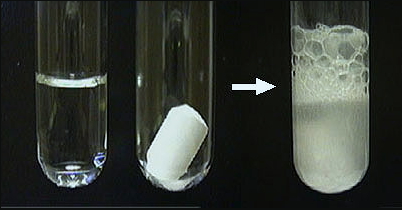
How could we make this reaction happen more quickly?
Decrease the concentration of the acid
crush the chalk to increase the surface area
Put the test tube in an ice bath
How do you calculate Enthalpy of a reaction?
ΔH = ΔHproducts - ΔHreactants
ΔT = q / mC
ΔG = ΔH -TΔS
E = mc2

How much activation energy is needed for this reaction?
300 KJ
500 KJ
400 KJ
100 KJ
What is the Heat of Reaction ΔH for this reaction?
-200 KJ
200 KJ
400 KJ
-300 KJ
What is the Keq expression for this reaction?
2 NO(g) + O2(g) ↔ 2 NO2(g)
Keq = [NO2]2 / [NO]2 [O2]
Keq = [NO]2 [O2] / [NO2]2
Keq = [NO]2 [O2] [NO2]2
Keq = [NO2]2 / [NO]2 + [O2]
What is the correct equilibrium expression for the following reaction:
2H2O2 (aq) ↔ 2H2O (l) + O2 (g)
[H2O]2[O2] / [H2O2]2
[H2O2]2 / [H2O]2[O2]
[O2] / [H2O2]2
[H2O]2 / [H2O2]2
How is the reaction quotient used to determine whether a system is at equilibrium?
At equilibrium, the reaction quotient is undefined.
The reaction is at equilibrium when Q < K.
The reaction is at equilibrium when Q > K.
The reaction is at equilibrium when Q = K.
If the reaction quotient Q has a smaller value than the related equilibrium constant, K, _________
the reaction is at equilibrium
the reaction is not at equilibrium, and will make more products at the expense of the reactants
the reaction is not at equilibrium, and will make more reactants at the expense of the products
the value of K will not increase until it is equal to Q
If the reaction quotient Q has a value larger than the related equilibrium constant, K _________
the reaction is at equilibrium
the reaction is not at equilibrium, and will make more products at the expense of reactants
the reaction is not at equilibrium, and will make more reactants at the expense of products
the value of K will increase until it is equal to Q
Increasing the concentration of the reactants will ___.
shift the reaction to the left, making more reactants
shift the equilibrium to the right, making more products
have no effect on the equilibrium position
decrease the value of the equilibrium constant
If the volume of the container is decreased at constant temperature, this will ____.
2NO2 (g) ⇌ N2O4 (g)
cause a shift to the left
cause a shift to the right
have no effect on the equilibrium position
change the value of the equilibrium constant
For the reaction at equilibrium:
4H2(g) + CS2(g) ⇌ CH4(g) + 2H2S(g)
If some CH4 is removed, what will happen to the concentration of H2S in order to re-establish equilibrium?
The H2S concentration will increase
The H2S concentration will decrease
There will be no change to the H2S concentration.
Consider the reaction at equilibrium:
heat + A2(g) + 3 B2(g) ⇌ 2 AB3(g)
Which of the following stresses would cause a shift to the right?
(Select all that apply)
increase the temperature
decrease the temperature
add more B2(g)
add more AB3(g)
remove some A2(g)

