
 Worksheets
AQA CS - Physics -P3 - Matter
Total questions: 40
Worksheet time: 20mins
What is specific heat capacity?
The power needed to raise the temperature of 1 kg of a substance by 1oC.
The energy needed to raise the temperature of 1 kg of a substance by 1oC.
The temperature increase of 1 kg of a substance when it is heated for 1 minute.
The mass of a substance whose temperature will increase by 1oC when heated for 1 minute.
What are the units for energy?
Joules (J)
Watts (W)
Kilograms (kg)
Seconds (s)
What are the units for mass?
Joules (J)
Watts (W)
Kilograms (kg)
Seconds (s)
What are the units for temperature?
Joules (J)
Watts (W)
Kilograms (kg)
Degree Celsius (oC)
What are the units for specific heat capacity?
Joules per kilogram degree Celsius (J/kgoC)
Joules per kilogram degree Celsius (JkgoC)
Joules per kilogram (J/kg)
Joules per degree Celsius (J/oC)
How do we say Δ in science and maths?
Alpha
Beta
Gamma
Delta
What does Δ represent?
The increase in
The decrease in
The change in
All of the above
The specific heat capacity of a substance is 1000 J/kgoC. How much energy is required to raise 1 kg of it by 1oC?
10 J
100 J
1000 J
10,000 J
Latent heat is
the heat absorbed or released at a boiling process during a change of phase
the heat absorbed or released at a constant temperature during a change of phase
the heat absorbed or released at a constant temperature during a change of phase of 1 kg object
the heat absorbed or released by an object to increase or decrease its temperature by 1 degree Celcius
The heat absorbed by melting a solid is known as
latent heat of fusion
latent heat of solid
latent heat of liquid
latent heat of vaporisation
the symbol for specific latent heat is
c
l
E
m
What is the formula to calculate specific latent heat of vaporisation?
l=mE
c = E/(mΔƟ)
E = mcΔƟ
E=ml

The graph shows the cooling curve of a substance. At which stages the specific latent heat released?
AB and CD
BC and DE
AB and EF
BC and CD

The specific latent heat released at stages?
CD and FG
DE and EF
EF and FG
DE and FG
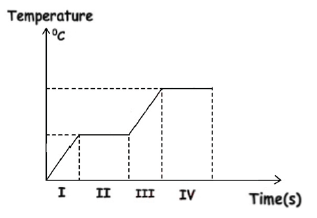
Consider the following temperature-time graph when a solid is heated. which part of the graph involves latent heat of vaporization?
Part I
Part II
Part III
Part IV
What is the correct definition of denstiy?
The amount of mass per area
The weight per unit volume
The amount of matter in an object
The mass per unit volume
Which of the following is the least dense?
Air
Liquid
Aluminium
Copper
In order to find the density of a regular object you must (check all that apply)
Find the volume
Calculate the weight
Measure the mass
Place it in a measuring cylinder
Divide the mass by volume
Which change is state takes place when a solid turns to a liquid?
Melting
Freezing
Boiling
Evaporating
Which change is state takes place when a liquid turns to a solid?
Melting
Freezing
Boiling
Evaporating
Which change is state takes place when a liquid turns to a gas?
Melting
Freezing
Boiling
Evaporating
Which change is state takes place when a liquid turns to a gas at the fastest rate possible?
Melting
Freezing
Boiling
Evaporating
Which change is state takes place when a solid turns to a gas?
Melting
Sublimation
Boiling
Evaporating
Which type of change are changes in state?
Chemical change
Physical change
Which type of change can be reversed?
Chemical change
Physical change
What is internal energy?
The total potential and kinetic energy in a system
The total kinetic energy in a system
The total potential energy in a system
The total potential and chemical energy in a system
Which state of matter has the greatest internal energy?
Solid
Liquid
Gas
Which state of matter has the lowest internal energy?
Solid
Liquid
Gas
How can we describe the particles in materials with high internal energy?
Spread apart
Tightly packed
How can we describe the particles in materials with high internal energy?
Faster movement
Slower movement
What is the definition of specific heat capacity?
The energy required to change the temperature of 1kg of material by 1⁰C
The energy required to change the state of 1kg of a material
The energy required to change the temperature of a material
What is the specific latent heat of fusion?
The energy required to change the state of 1kg of a material from solid to liquid, without a change in temperature
The energy required to change the state of 1kg of a material from liquid to gas, without a change in temperature
The energy required to change the temperature of 1kg of a material by 1⁰C, without a change in state
The energy required to change the temperature of a material without changing state
Which change in state occurs when we add internal energy to a solid?
Melting
Freezing
Evaporating
Condensing
Which state of matter is most dense?
Solid
Liquid
Gas
Which state of matter is least dense?
Solid
Liquid
Gas
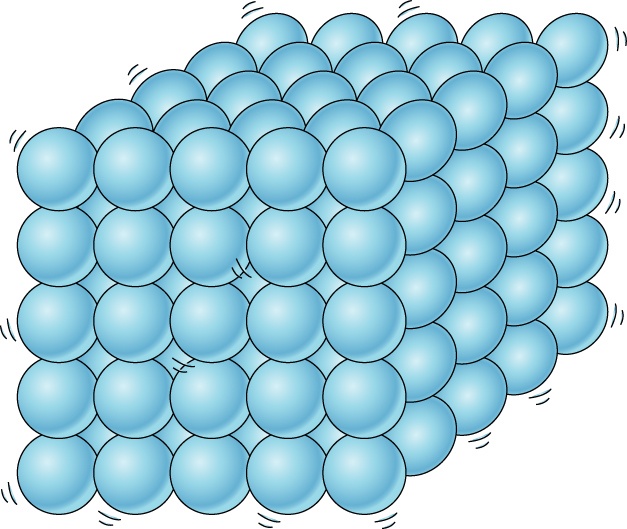
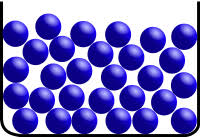
Which description best matches this particle model?
Particles are closely packed, move around each other, strong/medium intermolecular forces
Particles are loosely packed, move around each other, strong/medium intermolecular forces
Particles are closely packed, move randomly around each other and have weak intermolecular forces.
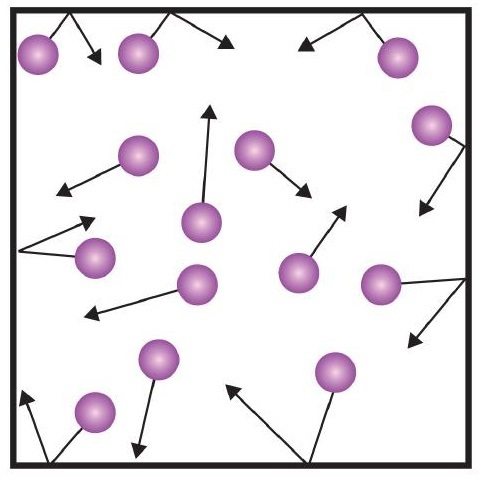
Which description best matches this particle model?
Particles move fast in specific directions, weak intermolecular force
Particles have a lot of space between them and move at different speeds in random directions.
Particles have lots of energy and have a medium intermolecular forces between them.

