wayground logo

Free Printable Worksheets

NEW

Font size

S
M
L
XL
Worksheets

Final Exam 7th

Total questions: 75

Worksheet time: 38mins

Name
Class
Date
1.
A series of steps used by scientists to solve a problem or answer a question. 
a)
scientific method
b)
recipe
c)
data collection
d)
metric system
2.

The information you collect while doing your experiment is called

a)

conclusions

b)

data

c)

hypotheses

d)

procedures

3.

The variable that is being measured or observed is called the _______________. Hint: this is the variable that is the result or effect

a)

independent variable

b)

dependent variable

c)

control variable

4.

What is a constant/control in an experiment?

a)

Things that do not change in a experiment. It's the variable that stays the same. You can have many variables stay the same.

b)

It's the variables that the scientist changes in the experiment

c)

It's the variables that are being measured in an experiment

5.
If I ride my bike to school instead of walking, then I will get to school faster. What is the dependent variable?
a)
True
b)
How fast you get to school
c)
Riding a bike or walking
d)
False
6.
If I study for my scientific method test, then I will have a better test score. What is the dependent variable?
a)
Scientific Method
b)
Studying
c)
Independent variable
d)
Test score
7.

A scientist investigates the effect of carbon dioxide on plant height. The scientist grows plants in several closed containers. All the plants receive the same amounts of water and light, but the air in each container has a different amount of carbon dioxide. What is the independent variable in this experiment?

a)

the amount of carbon dioxide in each container

b)

the number of plants in each container

c)

the amount of water provided to the plants

d)

the height of each plant after a period of time

8.

A meteorologist recorded high temperatures for five days at three locations on land. The data are shown in the table above.

a)

Areas at the beach have the coolest temperatures

b)

Areas farther from the beach always have the warmest temperatures.

c)

Areas at the beach have the most stable temperatures.

d)

Areas farther from the beach always have the same weather as areas at the beach

9.
The summary at the end of an experiment that explains the results. 
a)
conclusion
b)
procedures
c)
materials
d)
responding variable
10.
Something that takes up space and has mass.
a)
volume
b)
matter
c)
mass
d)
density
11.
The amount of space something takes up
a)
density
b)
volume
c)
mass
d)
matter
12.
A watermelon has more matter than a grape, so it has more
a)
mass
b)
eat
c)
solid
d)
greater
13.
You can measure ______ with grams.
a)
mass
b)
volume
c)
conductivity
d)
melting point
14.
__________ are the building blocks of life.
a)
solids
b)
gases
c)
atoms
d)
nutrients
15.
It occurs when a substance combine with another to form a new substance
a)
Physical Change
b)
Chemical Change 
c)
Physical Property
d)
Chemical Property
16.
It can be observed or measured without changing the composition of matter.
a)
Physical Change
b)
Chemical Change
c)
Physical Property
d)
Chemical Property
17.
Which of the following is not an example of Physical Change?
a)
Melting of an ice cream
b)
Water vapor formed as water boils
c)
Frying an egg
d)
Cutting the paper into pieces
18.
Which of the following is a pure substance? 
a)
Water
b)
Salad
c)
Chocolate milk
d)
All of them 
19.
a)

Element

b)

Compound

c)

Homogeneous Mixture

d)

Heterogeneous MIxture

20.

When there is one type of atom

a)

Element

b)

Compound

c)

Homogeneous Mixture

d)

Heterogeneous Mixture

21.

When there is 2 or more atoms combined together

a)

Element

b)

Compound

c)

Homogeneous Mixture

d)

Heterogeneous Mixture

22.
Freezing is...
a)
Solid to gas
b)
Liquid to solid
c)
Gas to solid
d)
Liquid to gas
23.
Molecules move quickest in which state of matter
a)
solid
b)
liquid
c)
gas
d)
solid, liquid and gas
24.
What is labelled "B" on the graph?
a)
solids
b)
liquids
c)
gases
d)
a phase change
25.
Phase change from a liquid to a gas that only happens at the surface.
a)
evaporation
b)
boiling
c)
sublimation
d)
melting
26.
Which form of matter take the shape of a container like this juice?
a)
liquid
b)
solid
c)
glass
d)
gas
27.
Which state of matter do the particles in this picture represent?
a)
solid
b)
liquid
c)
gas
d)
plasma
28.
Which state of matter has the highest kinetic energy? 
a)
solid
b)
liquid 
c)
gas
d)
matter
29.
How much longer is the key than the paper clip?
a)
3 cm
b)
2 cm
c)
4 cm
d)
1 cm
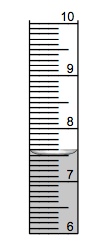
30.
What is the volume of the liquid in this graduated cylinder?
a)
8.5 mL 
b)
7.5 mL 
c)
8 mL 
d)
.1 mL
31.
What is the volume of the liquid in this graduated cylinder?
a)
44 mL 
b)
30.6 mL 
c)
37 mL 
d)
36 mL
32.
Tool used to measure MASS
a)
Metric Ruler
b)
Triple Beam Balance
c)
Graduated Cylinder
d)
Thermometer
33.

Find the mass.

a)

253 g

b)

252.9 g

c)

522.9 g

d)

523.5 g

34.
What is the mass on this triple beam?
a)
220g
b)
222g
c)
20g
35.
Jack has a rock. The rock has a mass of 14g and a volume of 2cm3. What is the density of the rock?
a)
7 mL
b)
7 g/cm3
c)
28 g/cm3
d)
1/7 g/cm3
36.
length=2
width=2
height=3
a)
Volume=12 cubic units
b)
Volume=7 cubic units
c)
Volume=223 cubic units
d)
Volume=18 cubic units
37.
Calculate the Volume
a)
410 cm3
b)
420 cm3
c)
402 cm3
d)
401 cm3
38.

What is the volume of the fish?

a)

40mL

b)

6mL

c)

38mL

d)

8mL

39.
240 cm = ___________ m
a)
2400
b)
24
c)
2.4
d)
0.24
40.
 330 cm = ___________ m
a)
3,300
b)
33
c)
3.3
d)
0.33
41.
32.9 km = ___________ cm
a)
32,900
b)
329,000
c)
3,290,000
d)
32,900,000
42.

A rock formed from fragments of other rocks that accumulate over time is called

a)
Metamorphic Rock
b)
Sedimentary Rock
c)
Extrusive Rock
d)
Igneous Rock
43.
If heat and pressure inside the Earth cause a rock to melt, the material that formed would be
a)
Metamorphic
b)
Magma
c)
Sedimentary
d)
Igneous
44.

Which of the following is formed by tremendous heat and pressure?

a)

Igneous Rock

b)

Sedimentary Rock

c)

Metamorphic Rock

d)

Pimples

45.

What is letter B?

a)

Igneous Rock

b)

Sedimentary Rock

c)

Metamorphic Rock

d)

Minerals

46.
Is the following metamorphic rock foliated or non-foliated?
a)
Foliated
b)
Non-foliated
c)
Neither
47.

The idea that the continents were once joined and then broke apart

a)

seafloor spreading

b)

plate tectonics

c)

continental drift

48.

Wegener's supercontinent was known as

a)

Glossopteris

b)

Eurasia

c)

Pangea

d)

Gondwandaland

49.

Really big mountains form at which boundary?

a)

divergent

b)

convergent

c)

transform

50.

Seafloor spreading occurs at which type of boundary?

a)

divergent

b)

convergent

c)

transform

51.

Plates collide at a ___ boundary.

a)

divergent

b)

convergent

c)

transform

52.

Plates slide past each other at a ____ boundary.

a)

divergent

b)

convergent

c)

transform

53.
Mechanical waves are created when a source of energy causes a medium to...
a)
Move
b)
Expand
c)
Vibrate
d)
Compress
54.
Waves that move the particles of the medium parallel to the direction in which the waves are traveling are called
a)
Surface Waves
b)
Combination Waves
c)
Longitudinal Waves
d)
Transverse Waves
55.
The maximum distance that the particles of a medium move from the rest position is the
a)
Wavelength of the Wave
b)
Frequency of the Wave
c)
Amplitude of the Wave
d)
Speed of the Wave
56.
The distance between two corresponding parts of a wave is the wave’s
a)
Wavelength
b)
Frequency
c)
Amplitude
d)
Speed
57.
Why do you see lightning from a distant storm before you hear thunder?
a)
Your eyes react faster than your ears
b)
Light travels faster than sound
c)
The thunder is produced after the lightening
58.
Transmit
a)
pass through
b)
bounce back
c)
below
d)
transverse
e)
the highest point of a transverse wave
59.
Reflect
a)
bounce back
b)
above
c)
electrons dropping down an energy level(s)
d)
longitudinal
e)
material through which a wave travels
60.

Which wave has the longest wave length?

a)

top wave

b)

bottom wave

61.
What is the measure of how many waves pass a point in a certain amount of time?
a)
frequency
b)
wavelength
c)
midpoint
d)
crest and trough
62.
This is what you get when sound waves are reflected, or bounce back, off of a hard surface.
a)
Amplitude
b)
Pitch
c)
Volume
d)
Echo
63.
When the frequency of a wave increases, what happens to the wavelength?
a)
The wavelength is not directly affected by the frequency of a wave.
b)
The wavelength increases.
c)
The wavelength decreases.
d)
More specific information is needed to form a conclusion about the wavelength.
64.
If you see an object as orange,
a)
it is absorbing orange light and reflecting all other colors. 
b)
it is reflecting all colors. 
c)
it is absorbing all colors. 
d)
it is reflecting orange light and absorbing all other colors. 
65.
This type of material allows most light to pass through but forms a blurry image, like looking through a fogged up window.
a)
opaque
b)
translucent
c)
transparent
d)
echo
66.
Sound intensity is measured in units called ________ named after Alexander Graham Bell.
a)
tones
b)
hertz
c)
amplitudes
d)
decibels
67.

According to the Law of Conservation of Energy, energy cannot be ______ or _______

a)

destroyed, determined

b)

created, nuclear

c)

destroyed, remade

d)

created,destroyed

68.

Gravitational potential energy depends on the______ and ______ of the object.

a)

force, energy

b)

speed, height

c)

mass, speed

d)

height, mass

69.

This tea kettle whistles when the water boils. What energy transformations are taking place?

a)

electrical --> thermal --> sound

b)

chemical --> sound --> thermal

c)

mechanical --> thermal --> sound

70.
The rock on high on the cliff has lots of this kind of energy
a)
kinetic energy
b)
sound energy
c)
potential energy
d)
nuclear energy
71.

People get energy from the food that they eat and transform that energy as they move. Which energy transformations occur as a student rapidly rubs the palms of his hands together?

a)

mechanical to thermal to electrical

b)

chemical to mechanical to thermal

c)

mechanical to chemical to sound

d)

chemical to sound to electrical

72.
Who is the scientist who had the idea of evolution by natural selection?
a)
Pierce
b)
Darwin
c)
Kettlewell
d)
Aristotle
73.
Which of the following is a herbivore?
a)
cricket
b)
frog
c)
hawk
d)
shrew
74.
What is the main energy source for this food chain?
a)
Berries
b)
Squirrel
c)
Bobcat
d)
Sun
75.
Which of the following is NOT a consumer?
a)
Plants
b)
Polar Bear
c)
Oxen
d)
Insects