
 Worksheets
Quarter 4 final revision G8
Total questions: 111
Worksheet time: 3hrs 59mins
The order of elements in the periodic table is based on
the number of protons in the nucleus.
the electric charge of the nucleus.
the number of neutrons in the nucleus.
atomic mass.
In Mendeleev's periodic table, elements in each column had similar
atomic masses.
properties.
atomic numbers.
symbols.
Which of the following elements is an alkali metal?
calcium
magnesium
mercury
sodium
How was Mendeleev's periodic table arranged?
by increasing atomic mass
by decreasing atomic mass
by increasing atomic number
by decreasing atomic number
Mendeleev left gaps in his periodic table because
the table was too small.
protons belonged there.
the table was too full.
no known elements fit there.
Each column of the periodic table is
an element.
a group.
an isotope.
a period.
The three main groups of elements are metals, nonmetals, and
inert gases.
alkali metals.
radioactive isotopes.
semiconductors/metalloids.
Most elements are
metals.
nonmetals.
metalloids.
semiconductors.
The order of elements in the modern periodic table is based on an element's
atomic number.
name.
chemical symbol.
atomic mass.
Which statement about the alkali metals is correct?
They are located in the left-most column of the periodic table.
They are extremely nonreactive.
They are usually gases.
They form negative ions with a 1- charge.
Metals tend to be
gases.
dull.
brittle.
good conductors.
Which of the following is a property of group 18 elements?
malleable
brittleness
high electrical conductivity
unlikely to react with other elements
Based on its location on the periodic table, which of these elements most likely has physical and chemical properties most similar to boron (B)?
magnesium (Mg)
aluminum (Al)
neon (Ne)
chlorine (Cl)
Which of the following elements would most likely be a shiny, gray-colored solid at room temperature, conduct electricity, and dent when hit with a hammer?
argon (Ar)
chlorine (Cl)
sulfur (S)
aluminum (Al)

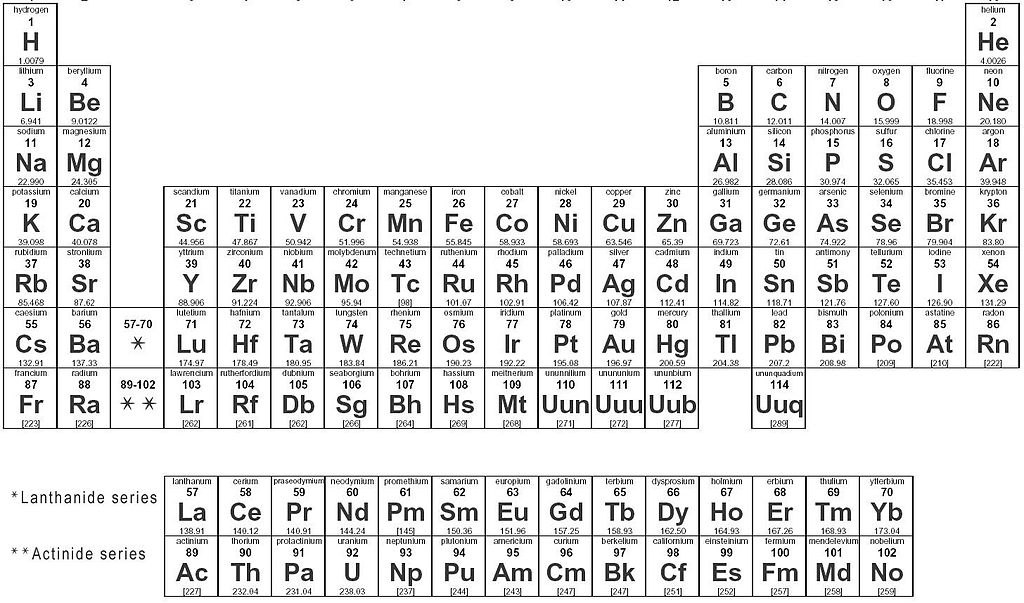
From this element key of Nitrogen, determine the atomic mass of nitrogen
7
7.01
14.01
21.01
Which is NOT a property of metals?
brittleness
conductivity
ductility
luster
What are two properties that make a metal a good choice to use as wire in electronics?
conductivity, malleability
ductility, conductivity
luster, malleability
malleability, high density
Where are most metals on the periodic table?
on the left side only
on the right side only
in the middle only
on the left side and in the middle
Using the periodic table, which element is a metalloid?
carbon
silicon
oxygen
aluminum
Iodine is a nonmetal. What is one property of iodine?
conductivity
dull appearance
malleability
ductility
Where are most nonmetals located on the periodic table?
in the bottom row
on the left side and in the middle
on the right side
in the top row
Which group of elements can act as semiconductors?
halogens
metalloids
metals
noble gases
When an object changes shape when struck by a hammer it is said to be...
luster
malleable
brittle
ductile
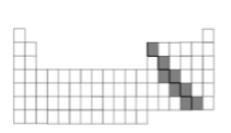
Elements in the shaded area can best be described as -
Shiny and brittle, semiconductors
Insulators
Good conductors
The elements argon, krypton, and xenon are all non-metals.What property would these elements have in common?
Good conductor of thermal energy
Poor conductor of electricity
Shiny, lustrous surface
Soft and malleable
Carbon is dull and brittle. Carbon is a
metal
nonmetal
metalloid
When an object changes shape when struck by a hammer it is said to be...
luster
malleable
brittle
ductile
The chemical elements have been categorized to ease its study
True
False
a unique number for each element that equals the number of protons in an atom of that element
element name
element symbol
atomic number
atomic mass
the mass of an atom, calculated by adding the number of protons and neutrons in the nucleus of the atom
element name
element symbol
atomic number
atomic mass


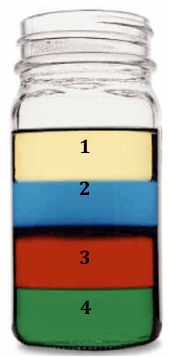
Will an object with a density of 0.9 gm/cm3 sink or float in water?
sink
float
A description of objects that can be measured and observed is
boiling point
chemical properties
physical properties
melting point

Which tool would you use to compare the mass of different objects?
Thermometer
Magnet
Balance Scale
Ruler
Volume is
The amount of "STUFF" in an object
The amount of "SPACE" in an object
The amount of WATER in a cup
The length of something
The force of gravity acting on an object is the object's
mass
matter
weight
friction
...... is the amount of matter an object has
Matter
Volume
Density
Mass
What is the density of object with mass 50 g and volume 15 cm cube?
2 cm cube
3.3 g
5.5 g
3.3 g/ cm cube
Which alkali metal is most reactive out of the following
rubidium
potassium
sodium
lithium
Which alkali metal is the least reactive?
lithium
sodium
potassium
rubidium
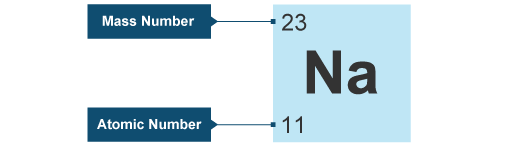
How many protons does a sodium atom have?
11
23
12
Alkali metals are located in column ___ of the periodic table.
1
2
7
8
Alkali metals have ____ density than most metals.
higher
lower
Which metal is NOT an Alkaline Earth Metal?
Calcium
Radon
Strontium
Radium
Where are valence electrons found?
In the first energy level of the electron cloud
In the nucleus
In the outermost energy level in the electron cloud
Which metal is NOT an Alkaline Earth Metal?
Calcium
Radon
Strontium
Radium
Which metal is NOT an Alkaline Earth Metal?
Calcium
Radon
Strontium
Radium
Alkaline Earth Metals are fairly reactive metals because they only have 2 valence electrons and a full shell underneath
True
False
You can find chunks of alkali metals in nature because they do not like to form compounds and are not reactive.
True
False
Alkaline Earth metals conduct heat and electricity
True
False

Which is the most reactive metal in this group?
Sodium
Potassium
Rubidium
Francium
What is the main trend observed in group 2 metals?
Easily decompose
Increases in reactivity downwards
Increases in reactivity upwards
Becomes denser downwards

Which metal is more reactive?
Magnesium
Barium
Strontium
Calcium

Radium
Rd
Ra
Rm
R

Ca
K
Cl
Cm

Ms
Ma
Mn
Mg

St
Sr
Sm
So

Beryllium
Barium
Boron
Bromine

Beryllium
Barium
Boron
Bromine
Which of the following is not a member of the alkaline earth metals, Group 2?
Beryillium
Magnesium
Hydrogen
Calcium
Which are the Alkaline earth metals?
calcium, magnesium, Beryrillium, Strontium, Barium, Radium
Lithium, Sodium Potassium, Ribidium, Cesium, Francium
Nitrogen, Phosphorous, Arsenic, Bismuth
Helium, Neon, Argon, Krypton, Rado, Xenon
Which are more reactive than the alkaline earth metals?
inert gases
Transition metals
Metalloids
alkali metals
Which are the Alkaline earth metals?
calcium, magnesium, Beryrillium, Strontium, Barium, Radium
Lithium, Sodium Potassium, Ribidium, Cesium, Francium
Nitrogen, Phosphorous, Arsenic, Bismuth
Helium, Neon, Argon, Krypton, Rado, Xenon
Which is the most reactive metal in this group?
Sodium
Potassium
Rubidium
Francium
What is the main trend observed in group 2 metals?
Easily decompose
Increases in reactivity downwards
Increases in reactivity upwards
Becomes denser downwards
Beryllium
Barium
Boron
Bromine
Which of the following is not a member of the alkaline earth metals, Group 2?
Beryillium
Magnesium
Hydrogen
Calcium
Which are the Alkaline earth metals?
calcium, magnesium, Beryrillium, Strontium, Barium, Radium
Lithium, Sodium Potassium, Ribidium, Cesium, Francium
Nitrogen, Phosphorous, Arsenic, Bismuth
Helium, Neon, Argon, Krypton, Rado, Xenon
Which are more reactive than the alkaline earth metals?
inert gases
Transition metals
Metalloids
alkali metals
Which of the following is not a transition metals?
sodium
chromium
iron
nickel
When compared to group 1 metals, the transition metals are...
harder
softer
When compared to group 1 metals, the transition metals have...
higher melting points
lower melting points
When compared to group 1 metals, the transition metals are...
less reactive
more reactive
Which of the "Halogens" is found in liquid state at room temperature?
Flourine
Chlorine
Iodine
Bromine
Which of these elements are Halogens?
Fluorine
Helium
Zinc
Bromine
What group are the Halogens?
16.9
17
18
13
As you move down the group, halogens' reactivity...
increases
decreases
doesn't change
shows no trend.
Which halogens are gases?
iodine
fluorine
bromine
chlorine
Which halogen is the most reactive?
iodine
chlorine
bromine
fluorine
Why was this?

