
 Worksheets
400-490
Total questions: 82
Worksheet time: 41mins
A solution of a salt and 100 grams of water that can still dissolve more solute at a given temperature is classified as
unsaturated
supersaturated
saturated
dilute
concentrated
The net ionic equation for the reaction between CaCl2 and Na2CO3 to form calcium carbonate and sodium chloride would include all of the following except:
Ca2+
CO32–
2Na1+
CaCO3
All of the substances above would be in the net ionic equation.
Which solution listed below is going to have the highest boiling point?
1.5 m NaC
1.5 m AgCl
2.0 m C6H12O6
2.0 m CaCl2
1.0 m Al2(SO4)3
Which equation is correctly balanced?
Na + Cl2 → 2NaCl
CH4+3O2 →CO2 +H2O
2KI + Pb(NO3)2 → 2KNO3 + PbI2
H2SO4 + KOH → K2SO4 + H2O
6H12O6 + 6O2 → 6CO2 + H2O
What color does the litmus acquire in the aqueous medium of potassium carbonate?
red
green
blue
colorless
Which of the oxides is amphoteric?
Zn
SiO2
SiO
Na2O
How many ions are formed during the dissociation of the (NH4)2SO4 molecule?
2
9
3
4
What substances form Mn2+ ions during dissociation?
KMnO4
MnCI2
Na2MnO4
MnO2
Covalent coupling is carried out by:
electronic clouds
valence electrons
two common electrons, or an electron pair
electrostatic forces of attraction
What is the number of neutrons in an atom 31 15 P?
31
16
15
46
What is the number of orbitals on the f-sublevel?
1
3
5
7
The chemical concept of "mole" shows:
the number of atoms of the substance
the number of molecules of the substance
the amount of the substance
the molecular weight of the substance
It does not have amphoteric properties:
ZnO
Zn(OH)2
Al2O3
Cu2O
The chemical bond between ions is called:
cationic anion
ionized
ionic
hydrogen
If an atom contains 4 protons, 4 neutrons, and 4 electrons. What is its mass number?
4
8
2
16
A pure substance made of the same type of atoms is called a(n)
atom
molecule
compound
element
A polar molecule, such as the one involved in a hydrogen bond, is sometimes called _____.
a dipole
simply, hydrogen
tripole
a covalent bond
What type of bond occurs between two different molecules due to polarity?
Covalent
Ionic
Hydrogen
Metallic
The reactant in a redox reaction that readily donates electrons is called a/an:
dehydrogenase
redox agent
reducing agent
coenzyme
oxidizing agent
Why does salt dissolve in water?
Water is a weaker ion than sodium.
Salt does not dissolve in water.
Water is a stronger ion than chlorine.
Water is a polar substance.
Water is a non-polar substance.
If a carbon atom has four valence electrons, which of the following statements are TRUE?
I. Carbon can form a triple covalent bond with another carbon atom.
II. A carbon atom CANNOT form two double bonds simultaneously.
III. A carbon atom can form four single covalent bonds simultaneously.
I
I and III
III
I and II
I and III
An ionic bond occurs when a _____ and an _____ come together and form a bond.
Cation: Anion
Proton: Electron
Nucleus: Outer shell
Neutron: Electron
Which of the following statements is true?
I. In an ionic bond, electrons move toward the atom that is more electronegative.
II. A cation is a negatively charged atom.
III. A positively charged atom is called an anion.
IV. Under biological conditions, ionic bonds are stronger than covalent bonds.
I
IV
III and IV
II
III
What are the three particles that make up all atoms?
protons, neutrons, and isotopes.
neutrons, isotopes, and electrons
positive, negative, and neutrals
Protons, neutrons, and electrons
Simple substances include a substance whose formula under normal conditions is:
P4
N
B
CO2
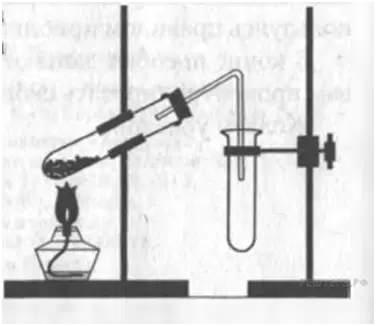
Using the device shown in the figure below, by the method of displacement of air in a test tube, you can collect gas:
hydrogen
methane
carbon monoxide (IV)
ammonia
The composition of all organic substances includes a chemical element:
hydrogen
carbon
silicon
oxygen
Set the correspondence between the element indicated in brackets and its oxidation state: a) -2 b) -3 c) +4 d) +6
1a, 2d, 3c
1b, 2d, 3c
1a, 2c, 3d
1b, 2c, 3a
With the water displacement method, gas can be collected:
hydrogen bromide
ethane
sulfur dioxide
ammonia
Choose the correct statements:
a) among metals there are both s-, p-, d-, f-elements;
b) allotropic modifications form only sulfur and carbon;
c) all non-metals are in a gaseous state of aggregation;
d) iodine and bromine form molecular crystal lattices.
a, c
a, b, d
a, d
b, c
Indicate the number of hydrogen atoms in a sample of zinc acetate dihydate ((CH3COO)2Zn∙2H2O) weighing 131.4 g:
3.612∙1023
1.445∙1024
2.167∙1024
3.612∙1024

Nitrogen in the laboratory with minimal losses can be collected using the device shown in the figure:
A, B, C
A, B, D
A, B
B
The amount (mol) of CO2 that contains the same number of carbon atoms as there are in 1.4 g of CO2 is:
0.025
0.05
0.1
0.15
Using the least-loss water displacement method, you can collect:
hydrogen
hydrogen chloride
ammonia
hydrogen bromide
Which of the following elements can exhibit multiple oxidation states?
Carbon
Nitrogen
Oxygen
Silicon
Sulfur
Which of the following compounds is an example of an ionic compound?
CO2
H2O
NaCl
CH4
What is the name of the process that produces hydrogen gas from coal?
Gasification
Hydrogenation
Pyrolysis
Liquefaction
Which of the following elements is a transition metal?
Calcium
Copper
Potassium
Aluminum
Which of the following is a powerful oxidizing agent?
Nitric acid
Hydrogen peroxide
Chlorine gas
Potassium permanganate
What is the oxidation state of carbon in methane (CH4)?
+1
-1
0
-4
Which compound is commonly used as a desiccant in laboratories?
Calcium carbonate
Silica gel
Magnesium oxide
Sodium bicarbonate
Which of the following is the correct electron configuration for a phosphorus atom?
1s2 2s2 2p6 3s2 3p3
1s2 2s2 2p6 3s2 3p6 4s2 3d10 4p3
1s2 2s2 2p6 3s2 3p6 4s2 3d10 4p6 5s2 4d10 5p3
1s2 2s2 2p6 3s2 3p6 4s2 3d10 4p6 5s2 4d10 5p3 6s2 4f14 5d10 6p3
Which of the following is NOT an allotrope of carbon?
Graphene
Diamond
Silicon carbide
Buckminsterfullerene
What is the coordination number of a central metal atom in a square planar complex?
4
5
6
7
Which of the following compounds is insoluble in water?
NaCl
AgCl
KCl
NH4Cl
What is the molecular shape of ammonia (NH3)?
Linear
Trigonal planar
Tetrahedral
Octahedral
Which of the following compounds is an example of a Lewis acid?
NH3
H2O
BF3
HCl
Which of the following is a paramagnetic species?
O2
N2
CO2
H2O
What is the pH of a solution with a hydronium ion concentration of 1 x 10^-9M?
1
7
9
5
What is the acid-base reaction between hydrochloric acid and sodium hydroxide?
HCl + NaOH -> NaCl + H2O
HCl + NaOH -> H2O + NaCl
NaOH + H2SO4 -> Na2SO4 + H2
HClO4 + NaOH -> NaClO4 + H2O4
Which of the following compounds exhibits paramagnetism?
CO
O2
C6H6
N2
H2O
onsider the compound XCl4, where X represents an element. Which of the following elements could X be?
Sulfur (S)
Chlorine (Cl)
Oxygen (O)
Phosphorus (P)
The compound M3N2 is synthesized by the reaction of metal M with nitrogen gas (N2). If 0.50 moles of M3N2 is produced, how many moles of nitrogen gas were consumed in the reaction?
0.25 moles
1.0 moles
2.0 moles
3.0 moles
Which of the following coordination compounds exhibits geometric isomerism?
[Co(NH3)4Cl2]+
[Co(NH3)4Cl2]2+
[Co(en)2Cl2]2+
[Co(NH3)4(en)]3+
[Co(NH3)4(en)]2+
Which of the following is not a physical process?
distillation
filtration
chromatography
evaporation
none of the above
The mass in grams of 2.6 x 10²² chlorine atoms is:
4.4
11
0.76
1.5
3.2
The valence electron equal to …?
The number of electros in atom
The number of electrons in cation
The number of electrons in anion
The number of electrons in outer shell
The number of electrons in inner shell
The maximum number of electrons that can be accommodated in a sublevel for which l = 3 is:
2
10
6
14
8
An electron dot diagram shows:
protons
electrons
neutron
valence electron
none of them
What is the correct CHEMICAL name for H2O
water
hydrogen oxide
dihydrogen oxide
dihydrogen monoxide
all of them
Neutral oxides:
NO, CO, Na2O
NO, N2O, CO
Na2 O, CO, NO
N2 O3 , NO, CO2
Na2 O, CO, N2 O3
Which is the strongest acid?
HClO4
HClO3
HClO2
HClO
HF
Which molecule is nonpolar?
H2Se
BeH2
PF3
CHCl3
SO2
Calculate Ho for the reaction:
Na2O(s) + SO3(g) Na2SO4(g)
given the following information:
Ho (1) Na(s) + H2O(l) NaOH(s) + 1/2 H2(g) -146 kJ
(2) Na2SO4(s) + H2O(l) 2NaOH(s) + SO3(g) +418 kJ
(3) 2Na2O(s) + 2H2(g) 4Na(s) + 2H2O(l) +259 kJ
+255 kJ
-435 kJ
-581 kJ
+531 kJ
-452 kJ
The Ellingham diagram cannot tell
about the speed of reaction
about the feasibility of a reaction
about which substance is a better reducing agent
about the thermodynamic concept of a reaction
Chromatography is based on the principle of
difference in density
difference in absorption
difference in mass
difference in adsorption
The process of conversion of precipitates into the colloidal solution is called
dialysis
dissolution
peptization
electrophoresis
In Van Arkel method, the metal is heated with
bromine
chlorine
carbon
iodine
Magnesium metal is not used for the reduction of alumina because
it is thermodynamically not feasible
the temperature requirement is high
magnesium is not a good reducing agent
it is evident from Ellingham diagram
Which of the following is the best reducing agent?
Lithium
Sodium
Potassium
Magnesium
Ellingham diagram tells that
how easily a substance can be reduced
how easily a substance can be oxidised
how easily a substance can oxidise other substance
none of the above
What is the process of reduction of alumina using carbon called?
Mond's process
Van Arkel method
Hydrometallurgy
Hall-Heroult process
In Ellingham diagram, the temperature range for the feasibility of a reaction is indicated by
the increase in slope of the curve
the decrease in slope of the curve
the point of intersection of the curves
x-axis of the curve
Free energy charge is
inversely related to rate constant
directly related to rate constant
directly related to negative value of rate constant
directly related to minus log of rate constant
Choose the correct statements:
a) among metals there are both s-, p-, d-, f-elements;
b) allotropic modifications form only sulfur and carbon;
c) all non-metals are in a gaseous state of aggregation;
d) iodine and bromine form molecular crystal lattices.
a, c
a, b, d
a, d
b, c
A polar molecule, such as the one involved in a hydrogen bond, is sometimes called _____.
a dipole
simply, hydrogen
a tripole
a covalent bond
High purity oxygen in used in which of the mentioned cases?
Combustion
Medical purposes
Chemical reactions
Oxidation processes
An Isochore is a graph which is plotted at
constant pressure
constant temperature
constant volume
not any constant parameter
To speed up the process of ultrafiltration
high temperature is required
pressure or suction is applied
high temperature and high pressure is applied
more volume has to be taken
The potential difference between the fixed layer and the diffused layer of opposite charges is called
electrode potential
e.m.f.
zeta potential
reduction potential
The change in slope in the Ellingham diagram indicates
change in phase
ease of reduction
increase in entropy
decrease in free energy
When copper is heated with conc. HNO3 it produces
Cu(NO3)2 and NO2
Cu(NO3)2 and NO
Cu(NO3)2 and NO2,NO
Cu(NO3)2 and N2O

