
 Worksheets
Unit 7: Classification Quiz
Total questions: 56
Worksheet time: 2hrs 52mins
Endosymbiotic Theory is the idea that ______ cells could have evolved from_____cells
prokaryotic, eukaryotic
eukaryotic, animal
prokaryotic, plant
eukaryotic, prokaryotic
Prokaryotic cells do not have
cell wall
nucleus
cytoplasm
ribosomes
Both prokaryote and eukaryotes have a cell membrane
True
False
Only eukaryotes have a membrane
Only prokaryotes have a membrane
How did one type of prokaryote get inside of another type of prokaryote
Acts as a ligand
One engulfed the other
Fused in as a vesicle
snuck in as a retrovirus
Symbiosis means
Feeding off of something
Using something for its ATP
Living in harmony
Producing sugars
Early bacteria that could make its own energy evolved into
Mitochondria
Chloroplast
ATP
ADP
Early bacteria that could perform photosynthesis evolved into
Mitochondria
Chloroplast
ATP
ADP
Eukaryotic cells can have
Only chloroplast
Only mitochondria
both mitochondria and chloroplast
neither chloroplast nor mitochondria
Evidence for endosymbiosis includes
Mitochondria and Chloroplast are the same color
Mitochondria and Chloroplast are the same size
Mitochondria and Chloroplast are the same structure
Mitochondria and Chloroplast have the same pH
Evidence for endosymbiosis includes
Mitochondria and chloroplast have their own Lysosomes
Mitochondria and chloroplast have their own vesicles
Mitochondria and chloroplast have their own RNA
Mitochondria and chloroplast have their own DNA
Mitochondria and Chloroplast are similar to prokaryotic cells like bacteria in what way?
Their DNAs are copies of each other
Their DNAs both have uracil
Their DNAs are circular
Their DNAs both have short lifespans

If two organisms belong to the same order, then they must also belong to the same...
Species
Class
Family
Genus
Reorder the following taxonomic Categories from least related to most related
Class
Order
Family
Genus
Species
Which two taxonomic groups give you the scientific name of an organism?
Class & Family
Domain & Kingdom
The common Name
Genus & Species
Domain, (a) , Phylum, Class, (b) , (c) , Genus, (d)
Mammals belonging to which taxonomic group would be the most closely related?
mammals in the same Order
mammals in the same Genus
mammals in the Class
Mammals in the same Family
The bullfrog, Rana catesbeiana, is most closely related to the
spotted chorus frog, Pseudacris clarki
asian flying frog, Polypedates leucomystax
northern leopard frog, Rana pipiens
african bullfrog, Pyxicephalus adspersus
Which of the following taxonomic groups would contain plants with the greatest amount of variety and differences?
Kingdom
Phylum
Order
Family
Vertebrates are animals that have a backbone. Humans, horses, goldfish, sharks, and dogs are examples of the many types of vertebrates. Which of these groups of vertebrates would contain the most closely related organisms?
Vertebrates of the same Family
Vertebrates of the same Class
Vertebrates of the same Phylum
Vertebrates of the same Order

Which of the two organisms are the most related?
Tiger and Polar Bear
Polar Bear and Mountain Lion
Mountain Lion and Tiger
Zebra and Tiger

Which of the following organisms are the LEAST related?
Zebra and Tiger
Polar Bear and Mountain Lion
Polar Bear and tiger
Mountain Lion and Tiger

Use the dichotomous key to identify Bird X?
Certhidea
Geospiza
Camarhynchus
Platyspiza
Who created the most commonly used system of taxonomy?
Niels Bohr
Watson and Crick
Charles Darwin
Carl Linnaeus
Which is the correct order?
Kingdom Phylum Order Class
Class Order Family Genus
Domain Phylum Kingdom Species
Order Family Species Genus
Identify the one that is NOT an archaea.
Methanogen
Thermophile
Halophile
Virus
You find a species that seems to be unicellular and is eating smaller cells around it. It has organelles and a nucleus. Which kingdom is it MOST likely a part of?
Fungi
Bacteria
Protists
Plants
Which of the following is NOT a unicellular kingdom?
Prokaryotes
Protists
Archaea
Fungi
Which one is NOT a difference between plants and fungi?
Plants use cellulose but fungi use chitin
Plants are autotrophs but fungi are heterotrophs
Plants have cell walls but fungi don't
Plants make their own food and fungi decompose their food
You identify a small living organism that is eating something at your feet. It's visible but pretty tiny, you take it to a lab and find that it has cell walls made of chitin. Which is its domain and kingdom?
Prokaryote, Fungi
Eukaryote, Fungi
Prokaryote, Plant
Eukaryote, Plant
Which is NOT a eukaryote?
Plants
Animals
Archaea
Protists
How are mammals different from all the other classes of vertebrates?
They don't have keratin
They don't have a backbone
They don't lay eggs (except two)
They aren't animals
Which best explains why a sponge is an animal?

All animals breath and sponges breath
Animals live underwater and so do sponges
Animals are multicellular heterotrophs and so are sponges

The modern Biological classification system is based on the pioneering work of:
Carl Linnaeus
Isaac Newton
Charles Darwin
John Meritus
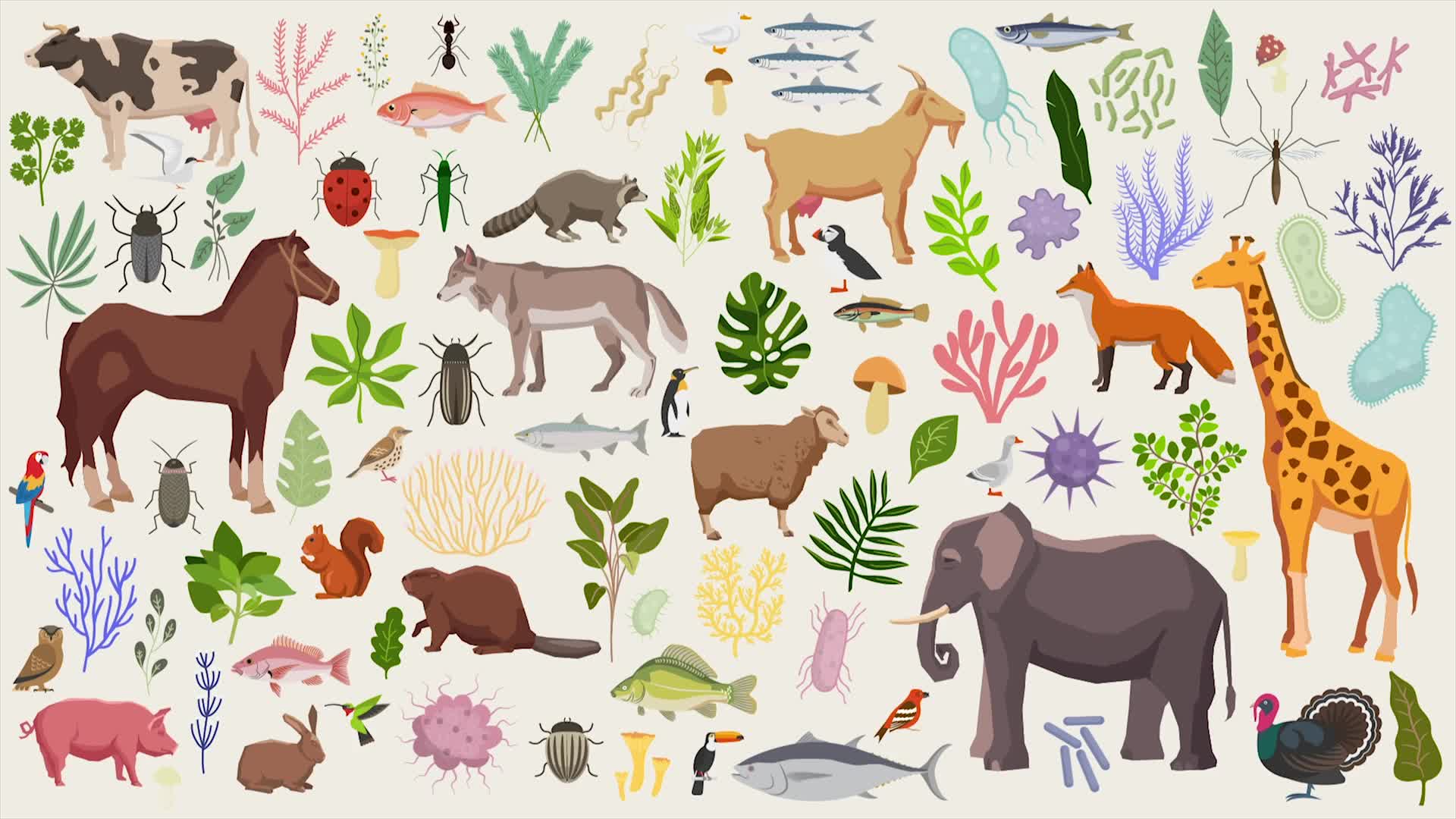

What is taxonomy?
The study of naming and classifying things
Preserving dead organisms
The science of paying your taxes
My cat's name

To what genus does a Banana tree belong to?
Musa
Ficus
paradisicum
Bamboosa
A human is in the domain
Eukarya
Archae
Bacteria
Which group contains a larger amount of organisms?
Phylum
Class
Genus
Order
True or False: “If two organisms are in
the same phylum, they must also be in the same kingdom.”
True
False
Organisms made of one cell are (a) . Organisms made of many cells are (b)
Organisms that have a nucleus are (a)
Organisms with NO nucleus is
Eukaryotic
Unicellular
Prokaryotic
Multicellular
I am prokaryotic
I am found in extreme ecosystems
What kingdom do I belong to?
A cell that does not have a nucleus is a
Multicelular
Prokaryotic
Eukaryotic
Unicellular
Plant cells and animal cells have similar characteristics. What characteristic do they share that classifies them both into the Eukarya domain?
They are both multicellular
They both have a cell wall
They both have a nucleus in the cells
They both produce their own food

The image shows an organism growing on the surface of the bread. Which kingdom would this organism belong to?
Kingdom Fungi
Kingdom Protista
Kingdom Animalia
Kingdom Plantae
Which list of characteristics describes organisms classified as animals?
Unicellular, prokaryotic, autotrophic
Multicellular, eukaryotic, heterotrophic
Unicellular, eukaryotic, heterotrophic
Multicellular, eukaryotic, autotrophic
Which kingdoms are prokaryotes?
Kingdom Eubacteria
Kingdom Archaebacteria
Kingdom Animalia, Kingdom Plantae
Both Eubacteria and Archaebacteria
Which kingdom has organisms that don't really fit into other kingdoms?
Protista
Bacteria
Archebacteria
Plantae
Match the following vocabulary words
Autotrophs
Organisms that can make their own food from their environment.
Heterotrophs
Organisms that cannot make their own food
Prokaryotic
Cells that do not have a nucleus or organelles
Eukaryotic
Cells that have a nuclei and organelles
Unicellular
Organisms that are made of only one cell

