wayground logo

Free Printable Worksheets

Font size

S
M
L
XL
Worksheets

m2 nervous system

Total questions: 60

Worksheet time: 1hrs 2mins

Name
Class
Date
1.
The system of the body that carries information to all parts of the body.
a)
Nervous system
b)
Spinal Cord
c)
Neuron
d)
Brain
2.
A bundle of nerves that runs along the back of a vertebrate within the spinal column.
a)
Dendrites
b)
Stimulus
c)
Brain Stem
d)
Spinal cord
3.

The part of the neuron that receives messages from adjacent neurons

a)

axon

b)

axon terminal

c)

dendrite

d)

neuron

4.
This insulating material forms a layer, around the axon of a neuron.  It enables electrical signals to travel down the axon at higher speeds.
a)
neuron
b)
myelin sheath
c)
dendrite
d)
neurotransmitter
5.
A chemical produced by neurons that carries messages to other neurons
a)
myelin sheath
b)
neurotransmitter
c)
axon
d)
axon terminal
6.
The tiny gap between neurons where nerve impulses are sent from one neuron to another.  It is where communication occurs between an axon and dendrite
a)
synapse
b)
axon terminal
c)
impulse
d)
myelin
7.

Identify #1

a)

axon

b)

cell body

c)

myelin sheath

d)

nucleus

8.

Identify #3

a)

axon

b)

cell body

c)

dendrite

d)

myelin sheath

9.
The correct direction of the neural impulse within one neuron.
a)
Axon Terminal to Dendrite
b)
Dendrite to Axon Terminal
c)
Cell Body to Axon
d)
Axon Terminal to Cell Body
10.
What letter represents the Frontal Lobe?
a)
A
b)
B
c)
C
d)
D
11.
What letter represents the Temporal Lobe?
a)
B
b)
C
c)
D
d)
F
12.
What letter represents the Occipital Lobe?
a)
A
b)
B
c)
C
d)
F
13.
What letter represents the Parietal Lobe?
a)
A
b)
B
c)
C
d)
E
14.
What letter represents the Cerebellum?
a)
A
b)
E
c)
F
d)
D
15.
The Central Nervous System are made up of the _________ and __________.
a)
Brain and Meninges
b)
Meninges and Spinal Cord
c)
Brain and Spinal Cord
d)
Brain and Peripheral Nerves
16.
What is the fluid in the space between the meninges that acts as a shock absorber to the brain and spinal cord called? 
a)
Blood-Brain Barrier
b)
Meninges
c)
Cerebrospinal Fluid
d)
Cerebral Cortex
17.

What protects the brain?

a)

skull

b)

spinal cord

c)

dendrites

d)

cerebellum

18.

The basic unit of structure and function in the nervous system is a nerve cell. Nerve cells are also called-

a)

Osteocytes

b)

Dendrites

c)

Neurons

d)

Spinal Cords

19.

How many pairs of cranial nerves are there?

a)

9

b)

12

c)

21

d)

31

20.

In this picture of a brain, the green section is known as the

a)

thalamus

b)

frontal cortex

c)

cerebellum

d)

cerebrum

21.

What are the 3 functions of the nervous system?

a)

Gathering information

b)

Responding to Stimuli

c)

Maintaining Homeostasis

d)

All of are correct

22.

If you are having trouble with your BALANCE and COORDINATION, which part of your brain should be checked?

a)

cerebrum

b)

cerebellum

c)

brain stem

d)

spinal cord

23.

The CENTRAL nervous system is made up of which two organs?

a)

Brain and Spinal Cord

b)

Spinal Cord and Peripheral Nerves

c)

Peripheral Nerves and Heart

d)

Heart and Lungs

24.

Which color is the CEREBRUM?

a)

PINK

b)

PURPLE

c)

YELLOW

25.
The part of the nervous system that consists of nerves that branch out from the CNS (central nervous system) and connect to other body parts
a)
Sympathetic
b)
Parasympathetic
c)
Autonomic
d)
Peripheral
26.
What is the insulating membrane that surrounds parts of the axon that helps to protect & propagate action potential?
a)
Axon
b)
Dendrites
c)
Node of Ranvier
d)
Myelin Sheath
27.

The major set of large set of nerves running down the spinal column or vertebrae.

a)

axon

b)

spinal cord

c)

dendrite

d)

cell body

28.

The part of the body that integrates the information it receives from all over the body in order to make decisions is called the __________________

a)

peripheral nervous system

b)

sympathetic nervous system

c)

central nervous system

d)

parasympathetic nervous system

29.
Label the Neuron-What does the letter "C" represent?
a)
Dendrite
b)
Axon
c)
Axon Terminal
d)
Cell Body
30.
The part of the neuron that takes information away from the cell body is called a(n) _____________.
a)
dendrite
b)
axon
c)
cell body
d)
Schwann cell
31.
These carry signals from tissues and organs to the brain and spinal cord
a)
Sensory Neurons
b)
Motor Neurons
c)
Efferent Neurons
d)
Glial Cells
32.
The long, fiber like part of a neuron which the cell sends information to receiving neurons
a)
axon 
b)
dendrite
c)
axon terminal
d)
gene
33.

How is a message delivered from the "sending" neuron to the "receiving" axon?

a)

sympathetic nerves

b)

hormones

c)

medulla oblongata

d)

neurotransmitters

34.
Trochlear Nerve
a)
II
b)
IV
c)
V
d)
VIII
35.
Allows you to swallow your food
a)
Trigeminal
b)
Facial
c)
Glossopharyngeal
d)
Hypoglossal
36.
Sense of smell
a)
I
b)
II
c)
III
d)
VII
37.
Shrugs the shoulders
a)
Accessory
b)
Vestibulocochlear
c)
Abducens
d)
Trigeminal
38.
Balance
a)
Optic
b)
Trigeminal
c)
Vestibulocochlear
d)
Vagus
39.
Moves eyes laterally away from the nose
a)
abducens
b)
facial
c)
trigeminal
d)
accessory
40.
Taste sensation on the anterior 2/3 of the tongue
a)

Facial

b)

Trigeminal

c)

Glossopharngeal

d)

Hypoglossal

41.
A loss of hearing could be associated with which cranial nerve?
a)
Olfactory
b)
Trigeminal
c)
Vestibulocochlear
d)
Accessory
42.
Moves the tongue
a)
Trigeminal
b)
Facial
c)
Hypoglossal
d)
Accessory
43.
Sight
a)
I
b)
II
c)
III
d)
IV
44.

Which of the following does not effect the eyes

a)

Optic

b)

Trochlear

c)

Vagus

d)

Abducens

45.

Which of the following cranial nerve controls the movement of the eyeball, the opening of the eyelid, pupillary dilation, and lens accommodation?

a)

Optic

b)

Oculomotor

c)

Vagus

d)

Trigeminal

46.

Which of the following does not effect the eyes

a)

Optic

b)

Trochlear

c)

Vagus

d)

Abducens

47.

What is the function of the nerve cells?

a)

They are responsable of your defense mechanism.

b)

They transmit signals or messages to other neurons, organs or glands.

c)

They transmit substances to your endocrine system to produce hormones.

48.

What are the Neurons?

a)

Units that constitute the nervous system.

b)

Units that constitute the brain tissue.

c)

Blocks of tissue that constitute the endocrine system.

d)

Blocks or tissues that constitute the organs of the body system.
49.

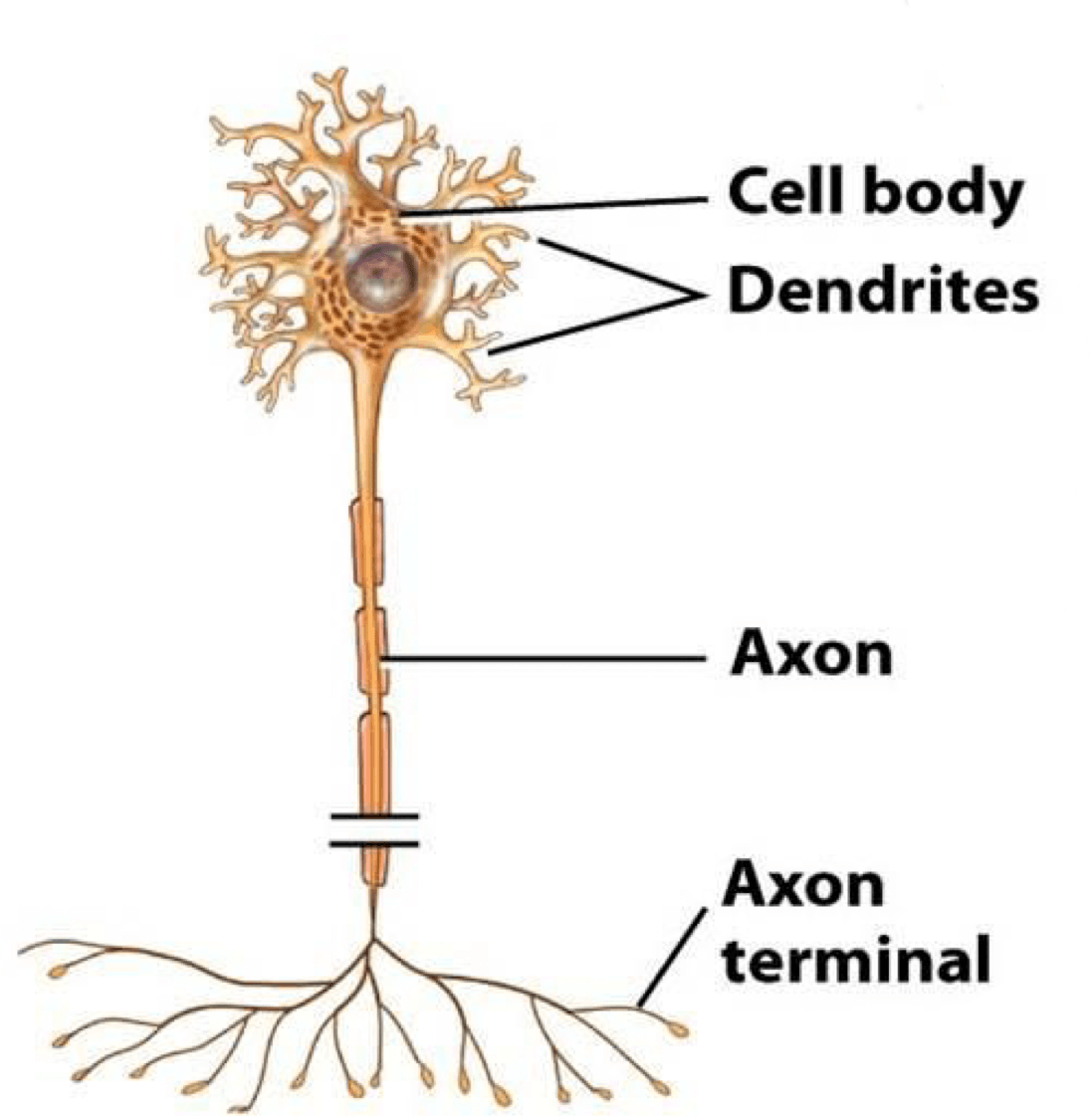
What type of neuron is represented on the image?

a)

Motor Neuron

b)

Interneuron

c)

Sensory Neuron

50.

What type of neuron is represented on the image?

a)

Motor Neuron

b)

Interneuron

c)

Sensory Neuron

51.

What type of neuron is represented on the image?

a)

Motor Neuron

b)

Interneuron

c)

Sensory Neuron

52.

Type of neuron that perceive information about your environment.

a)

Motor Neuron

b)

Interneuron

c)

Sensory Neuron

53.

Type of neuron located only in the brain and spinal cord that pass impulses from one neuron to another.

a)

Motor Neuron

b)

Interneuron

c)

Sensory Neuron

54.

Type of neuron that sends nerve impulses to muscles and gland, by the command of other neurons.

a)

Motor Neurons

b)

Interneurons

c)

Sensory Neurons

55.

The ______________ is the largest part of the brain

a)

cerebrum

b)

cerebellum

c)

thalamus

d)

hypothalamus

56.

This part of the brain coordinates movement and balance.

a)

Cerebrum

b)

Cerebellum

c)

Brain stem

d)

Spinal Cord

57.

The function of the thalamus is ______.

a)

a balance center

b)

a thermostat

c)

a relay station to other brain parts

d)

to regulate sleep

58.

This structure allows the left and right hemisphere of the brain to communicate.

a)

thalamus

b)

cerebral cortex

c)

hypothalamus

d)

corpus callosum

59.
What part of the brain is Letter C pointing to?
a)
Frontal Lobe
b)
Parietal Lobe
c)
Occipital Lobe
d)
Temporal Lobe
60.
What part of the brain is Letter A pointing to?
a)
Temporal Lobe
b)
Parietal Lobe
c)
Occipital Lobe
d)
Frontal Lobe