
NEW
Font size
 Worksheets
Unit 8 Evolution Review
Total questions: 56
Worksheet time: 34mins
Which of these is NOT one of the things that Darwin proposed was necessary for evolution to occur?
imperfection
struggle for survival
variation and adaptation
suvival of the fittest
This term describes how well an organism can survive and reproduce in its given environment
strength
adaptability
fitness
aptitude
This is the process by which organisms with variations more suited to their local environment survive and leave more offspring:
artificial selection
selective breeding
common descent
natural selection
These homologous structures are remnants of evolution that are no longer actively being used by the organism that inherits them
fossils
embryos
vestigial structures
unwanted leftovers
This person gets almost all of the credit for developing the theory of evolution:
Charles Darwin
Alfred Russel Wallace
Neil Shubin
Jennifer Doudna
This is NOT a piece of evidence that serves to support evolution:
common embryology
homologous genes and structures
vestigial structures
variety of traits
Which of these is a vestigial structure?
flippers on a dolphin
hair on a human
legs on a horse
hip bones in a whale
A category of body structures that are formed in similar ways during embryonic development and share similar patterns of bone structure.
Homologous structures
Analogous structures
Vestigial structures
Bone structures

What type of structure does this image illustrate?
Analogous structures
Homologous structures
Vestigial structures
For an organism's traits to be naturally selected for, which of these is it most important for it to be able to do?
The organism needs to be able to acquire more food
The organism needs to be able to fight off predators
The organism needs to be able to reproduce
The organism needs to be able to do photosynthesis
Speciation
structures that no longer function/serve a purpose
The accumulation of differences between species or populations
The hypothesis that evolution of a species occurs in periods of rapid
change separated by periods of little change.
The process by which new species form
Which of the following is evidence of a common ancestor?
Vestigial structures
Fossil record
Similarities in the embryo
All of these
Which of the following is one of Charles Darwin’s theories about evolution and natural selection?
The environment in which a species lives is unrelated to natural selection
New species that appear in the fossil record are actually descendants of older species
Natural selection is caused by human intervention
Changes to an organism occur rapidly
Which of the following statements best describes what the word 'fittest' means in the phrase "Survival of the fittest".
The organism that survives in their environment to produce more offspring is the fittest.
The organism that collects the most resources is the fittest
The organism that becomes the strongest individual is the fittest
The organism that lives the longest is the fittest.
In science, the inheritance of a structure that results from natural selection and by which the organism becomes better able to survive and reproduce is called
mutation
advantage
adaptation
evolution
How do fossils support evolution?
The fossil record provides evidence that organisms have changed over time.
Individual species disappear and reappear in the fossil record over time.
The fossil record provides evidence that all organisms developed at the same time.
Organisms in the fossil record are identical to living organisms.
What is the term for a feature that allows an organism to survive better in its environemtn?
variation
adaptation
homologous structure
vestigial structure

Process when breeders select individuals that have desirable traits that can be inherited by offspring
natural selection
artificial selection
adaptation
embryonic development
Which of the following is not evidence for evolution:
binary fission
embryonic development
homologous structures
biochemistry and DNA
fossils
Refers to changes in the genes of populations:
microevolution
macroevolution
convergent evolution
coevolution

What is the most likely cause for the change in the mice population over time?
hawks eat more dark mice because they taste better
hawks eat more white mice because they are easier to see
hawks eat more dark mice because they are easier to see
hawks eat more white mice because they reproduce better
The same species lives in the same area and have different appearances. What term can be used to describe this?
overpopulation
population
extinction
variation
Which statement best explains adaptations in context of the Theory of Evolution.
adaptations are critical to the survival of a species by providing ways to adjust
adaptations allow a single surviving organism to choose its traits and then reproduce
adaptations are when an organism changes is environment to make it easier to live
adaptations allow organisms to learn how to survive in any environment


Birds are eating all the green beetles. Because the brown beetles are surviving they reproduce more and make more brown beetles. This is called ___________
Artificial Selection
The Theory on the Origin of Species
Natural Selection
Mutation
Darwin wrote that the organisms best suited to their environments will .....
Increase in Number
Go Extinct
Mutate More often

Why were the beaks on Darwin's finches so Important?
They showed the finches always existed as Darwin found them.
They showed that the finches could mutate their beaks whenever they want.
They showed variability in the finches species. All finches were equally adaptable to all islands.
They show that the finches adapted to their environments. Their beak shape matched the food available on each island.

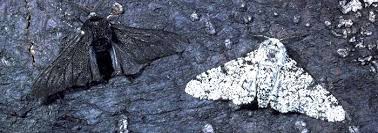
4. When the industrial revolution started, the trees have been covered in soot from coal factories. Which moth will be more successful in this environment?
White Moth
Dark Moth
Both are Equally Successful in this Environment
The large-scale events of speciation are called...
macroevolution
simplification
adaptation
microevolution
Microevolution happens in
species
individuals
populations
households
Natural selection requires ______________ to happen in a population.
hundreds of years
variation
low genetic fitness
high genetic fitness

