Wayground logo

Free Printable Worksheets

Font size

S
M
L
XL
Worksheets

Grade 8 Quiz Review

Total questions: 114

Worksheet time: 1hrs 26mins

Name
Class
Date
1.
Ice melting
a)
Chemical Change
b)
Physical Change
2.
Water freezing
a)
Chemical Change
b)
Physical Change
3.
Wood burned in a fireplace
a)
Chemical Change
b)
Physical Change
4.
Cake batter baked in an oven
a)
Chemical Change
b)
Physical Change
5.
Blue liquid and yellow liquid mixed to make a green liquid
a)
Chemical Change
b)
Physical Change
6.
Baking soda and vinegar combine to make carbon dioxide
a)
Chemical Change
b)
Physical Change
7.
Light used to produce food in plants
a)
Chemical Change
b)
Physical Change
8.
Glass bottle that is shattered
a)
Chemical Change
b)
Physical Change
9.
Copper roof changing color
a)
Chemical Change
b)
Physical Change
10.
Shredding a piece of paper
a)
Chemical Change
b)
Physical Change
11.
Rust on an iron fence
a)
Chemical Change
b)
Physical Change
12.
Boiling water
a)
Chemical Change
b)
Physical Change
13.
Burning coal
a)
Chemical Change
b)
Physical Change
14.

The property of metals by which they can be beaten in to thin sheets is called

a)

Sonority

b)

Malleability

c)

Ductility

d)

None of the above

15.

The property of metals by which it can be drawn into wires is

a)

Malleability

b)

Sonority

c)

Lustrous

d)

Ductility

16.

Metals are

a)

Hard

b)

Lustrous

c)

Sonorous

d)

Non ductile

17.

Which of the following beaten in to thin sheets

a)

Phosphorus

b)

Zinc

c)

Sulphur

d)

Oxygen

18.

Metals are good conductor of

a)

Only heat

b)

Only electricity

c)

Heat and electricity both

d)

None of the above

19.

Which nonmetal is very essential for our life is

a)

Iodine

b)

Oxygen

c)

Nitrogen

d)

Chlorine

20.

Non-metal used in water purification process

a)

Oxygen

b)

Nitrogen

c)

Chlorine

d)

Iodine

21.

Non-metal used in purple colour solutions which is applied on wounds as an antiseptic

a)

Iodine

b)

Oxygen

c)

Sulphur

d)

Phosphorus

22.

Red litmus paper turns blue when it is dipped in

a)

Acidic solution

b)

Basic solution

c)

Neutral solution

d)

None of the above

23.
Which of these is a property of metals?
a)
It's malleable
b)
It can't conduct electricity
c)
They are used in food
d)
It's very brittle
24.

Which type of chemical reaction has two or more reactants to make one product?

a)

combustion

b)

single displacement

c)

double displacement

d)

synthesis

e)

decomposition

25.

Identify the following chemical reaction.

2 NaBr + 1 Ca(OH)2 ----> 1 CaBr2 + 2 NaOH

a)

Synthesis (or combination)

b)

Decomposition

c)

Single displacement

d)

Double displacement

26.

Identify the following chemical reaction.

3 HBr + 1 Al(OH)3 ----> 3 H­2O + 1 AlBr3

a)

Synthesis (or combination)

b)

Decomposition

c)

Single displacement

d)

Double displacement

27.

Identify the following chemical reaction.

Pb + FeSO4 ----> PbSO4 + Fe

a)

Synthesis (or combination)

b)

Decomposition

c)

Single displacement

d)

Double displacement

28.

What reaction has the following general formula:

AB --> A + B

a)

Synthesis

b)

Decomposition

c)

Single Replacement

d)

Double Replacement

e)

Combustion

29.

What reaction has the following general formula:

A + CD --> C + AD

a)

Synthesis

b)

Decomposition

c)

Single Replacement

d)

Double Replacement

e)

Combustion

30.

What reaction has the following general formula:

AB + CD --> CB + AD

a)

Synthesis

b)

Decomposition

c)

Single Replacement

d)

Double Replacement

e)

Combustion

31.

What reaction has the following general formula:

A + B --> AB

a)

Synthesis

b)

Decomposition

c)

Single Replacement

d)

Double Replacement

e)

Combustion

32.

Which chemical reaction always starts with a hydrocarbon that reacts with oxygen and produces carbon dioxide and water?

a)

Decomposition

b)

Synthesis

c)

Combustion

d)

Single Replacement

33.

Which phrase describes what happens to atoms in a chemical reaction?

a)

never lost or gained, just rearranged

b)

sometimes lost, never rearranged

c)

sometimes lost, gained, or rearranged

d)

lost or gained, never rearranged

34.
In a chemical reaction, everything to the right of the arrow is called ______________.
a)
Products
b)
Yields
c)
Molecules
d)
Reactants
35.
Coal contains carbon and other elements. Carbon dioxide forms when coal burns in the presence of oxygen. Which of these is the best evidence that a chemical reaction occurs when coal burns?
a)
The shape of the coal changes
b)
Oxygen is present
c)
A new substance is produced
d)
Coal is made up of more than one element
36.
At the end of chemical reactions, what is the total mass of the reactants compared to the total mass of the products?
a)
the product is doubled
b)
the product is half the mass of the reactants
c)
the mass is the same
d)
the mass changes depending on the reaction
37.

Which of the following is a compound?

a)

zinc (Zn)

b)

magnesium (Mg)

c)

sodium chloride (NaCl)

d)

potassium (K)

38.

Which of the following is an element?

a)

potassium chloride (KCl)

b)

water (H2O)

c)

carbon (C)

d)

calcium carbonate (CaCO3)

39.

In this reactivity series, which of the following is the most reactive element?

a)

Gold

b)

Calcium

c)

Zinc

d)

Potassium

40.

In this reactivity series, which of the following is the least reactive element?

a)

Gold

b)

Calcium

c)

Zinc

d)

Potassium

41.

True or False:

Magnesium is more reactive than silver.

a)

True

b)

False

42.

True or False:

Lead is more reactive than iron.

a)

True

b)

False

43.

What type of reaction is shown by this word equation?

lead nitrate + sodium → sodium nitrate + lead

a)

Decomposition

b)

Thermite

c)

Displacement

d)

Neutralisation

44.

In a displacement reaction, it is the ____________ reactive metal that is displaced from a compound.

a)

Heaviest

b)

Least

c)

Most

d)

Worst

45.

In the following reaction, which metal has been displaced?

copper sulfate + magnesium → magnesium sulfate + copper

a)

magnesium

b)

copper

c)

sulfate

46.

Complete the word equation:

lithium + silver nitrate →

a)

lithium + silver nitrate

b)

lithium + silver nitrite

c)

silver + lithium nitrate

d)

silver + lithium nitrite

47.

Complete the word equation:

lead + calcium sulfate →

a)

lead + calcium sulfate

b)

lead + calcium sulfide

c)

calcium + lead sulfate

d)

calcium + lead sulfide

48.

Use the following observations to select the correct reactivity series (highest to lowest).


calcium + water: slow

sodium + water: fast

calcium + dilute acid: very fast

gold + dilute acid: no reaction

aluminium + dilute acid: fast

a)

calcium, sodium, aluminium, gold

b)

sodium, calcium, aluminium, gold

c)

sodium, aluminium, calcium, gold

d)

gold, aluminium, calcium, sodium

49.

Which chemical tastes bitter?

a)

Acid

b)

Base

50.

Which chemical tastes sour?

a)

Acid

b)

Base

51.

Which chemical feels slippery on the skin?

a)

Acid

b)

Base

52.

Acid mixed with a base will __________ the mixture.

a)

nullify

b)

neutralize

c)

balance

d)

naturalize

53.

Which pH number below reflects a weak acid?

a)

1

b)

6

c)

8

d)

13

54.

Which pH number below reflects a weak base?

a)

1

b)

6

c)

8

d)

13

55.

Pure water is _______ on the pH scale.

a)

Acid

b)

Base

c)

Neutral

56.

Which is the stronger acid?

a)

pH 1

b)

pH 4

c)

pH 8

d)

pH 13

57.
Which of the following substances is basic?
a)
Apple juice
b)
Ginger ale
c)
Baking soda
d)
Distilled water
58.

True or false: bases are sometimes called alkaline.

a)

True

b)

False

59.

A neutralisation reaction produces...

a)

Acids

b)

Bases

c)

neutral water

d)

pH > 7

60.

The reaction between an acid and an alkali

produces salt and water. This reaction is called

a)

acidication

b)

neutralisation

c)

alkalisation

61.

Hydrochloric acid reacts with Sodium hydroxide and forms water and

a)

sodium Hydrokside

b)

sodium chloride

62.

Soft drinks could contain

a)

Acetic acid

b)

Carbonic acid

63.

Complete the word equation below:

Acid + alkali --> ............... + water

a)

water

b)

salt

c)

gold

d)

metal

64.

Sulphuric acid + potassium hydroxide --> ........................ + water

a)

potassium sulphate

b)

potassium sulphurate

c)

potassium nitrate

d)

magnesium hydroxide

65.

Toothpaste contain .................. that neutralize acid formed by bacteria.

a)

alkali

b)

acid

c)

antacid

d)

slaked lime

66.
What method is used to study the neutralisation reaction between an acid and an alkali?
a)
Evaporation
b)
Titration
c)
Sublimation
d)
Electrolisis
67.
In a neutralisation reaction, what is the function of the indicator?
a)
To indicate that the mixture is neutral
b)
To indicate that hot water should be added
c)
To indicate that the flask should be shaken
d)
To indicate that a precipitate is formed
68.
In a neutralisation reaction, dilute hydrochloric acid is slowly added to a sodium hydroxide solution. What is the colour change at the end point if the indicator used is phenolphthalein?
a)
From colourless to pink
b)
From blue to green
c)
From pink to colourless
d)
From green to blue
69.
What is the salt formed when nitric acid is added to potassium hydroxide?
a)
Sodium chloride
b)
Potassium nitrate
c)
Sodium nitrate
d)
Potassium chloride
70.
products of a neutralisation reaction are always
a)
an acid and a base
b)
an acid and a salt
c)
salt and water
d)
salt and base
71.

If this product is detergent, most probably it is

a)

acid

b)

neutral

c)

Alkali

72.
Which subatomic particle has a positive (+) charge?
a)
Neutron
b)
Proton
c)
Electron
73.
Which subatomic particle has a negative (-) charge?
a)
Proton
b)
Electron
c)
Neutron
74.
Which subatomic particle has a neutral or no charge?
a)
Proton
b)
Electron
c)
Neutron
75.
Where is the nucleus located in an atom?
a)
Near the electron shells/levels
b)
Near the center of an atom
76.
Where are the Electrons found in the structure of an atom?
a)
In the nucleus
b)
In spaces around the nucleus
77.
The subatomic particles in green are...
a)
Protons
b)
Neutrons
c)
Electrons
78.
In this picture, the Electrons are found in which color?
a)
Blue
b)
Red
c)
Green
79.

The Atomic number is known as the _______

a)

Number of electrons in an atom

b)

Number of Protons in an atom

c)

Number of neutrons in an atom

d)

Number of Protons and electrons in an atom

80.

What charge do protons have?

a)

Positive

b)

Negative

c)

Neutral

81.

What is the Atomic Mass Number of the element mentioned above

a)

12

b)

6

c)

C

d)

16

82.
What does the 1.00794 stand for?
a)
Hydrogen
b)
atomic number
c)
atomic mass
d)
atomic explosion
83.
The blue atoms are called 
a)
metals
b)
nonmetals
c)
metalloids
d)
noble gases
84.
Each column in the periodic table is called a 
a)
period
b)
group
c)
cluster
d)
unit
85.
The atomic number tells you what?
a)
number of electrons
b)
number of protons
c)
number of neutrons
d)
both electrons and protons in an atom.
86.
Elements which are shiny, conduct electricity and heat are called
a)
metal
b)
nonmetal
c)
metalloid
d)
nonexistent
87.
The atoms along the staircase are called 
a)
metals
b)
nonmetals
c)
metalloids
d)
noble gases
88.
Which is a halogen?
a)
Helium
b)
Chlorine
c)
Oxygen
d)
Neptune
89.
Which is an alkali metal?
a)
Magnesium
b)
Iron
c)
Sodium
d)
Europium
90.
In the modern periodic table elements are arranged by:
a)
atomic mass
b)
atomic number
c)
valence electrons
d)
number of isotopes
91.

Which element is a metalloid?

a)

H

b)

Re

c)

Ne

d)

B

92.
Two or more substances that are mixed together but not chemically combined is a ___
a)
compound
b)
mixture
c)
keratin
d)
chromatography
93.
Two or more substances that are chemically combined is a ___
a)
compound
b)
mixture
c)
solvent
d)
solute
94.

Ink can be separated by a method of -----------------------------------------------

a)

distillation

b)

filtration

c)

chromatography

d)

sedimentation

95.
chromatography separates the mixture of dyes on the basis of their ----------------------------
a)
density
b)
solubility
c)
gravity
d)
boiling point
96.
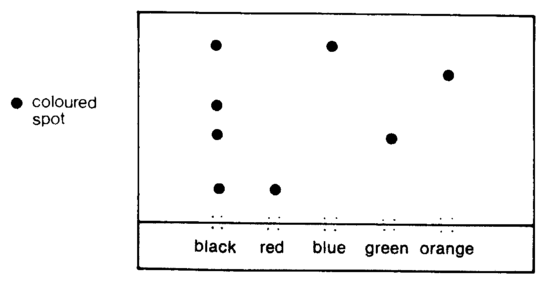
On the chromatogram given -------------- is mixture.
a)
red
b)
orange
c)
green
d)
black
97.

A pure substance shows ------------------ spot on chromatogram

a)

0

b)

1

c)

2

d)

3

98.
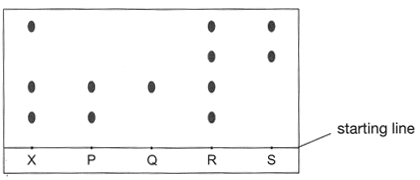
The diagram below shows a chromatogram obtained when a sample X was analysed together with four other known dyes P, Q, R and S. Dye Q was known to cause cancer. Which of the following dye(s) is/are safe for use?
a)
P only
b)
S only
c)
P and S
d)
P and X
99.
_________________ utilizes a stationary and a mobile phase to separate mixtures based on their affinity for each phase.
a)
filtration
b)
chromatography
c)
distillation
d)
osmosis
100.
The mobile phase in paper chromatography is typically a
a)
plasma
b)
solid
c)
gas
d)
liquid
101.
The substance in the mixture that has the greatest affinity for the stationary phase will travel
a)
fastest
b)
slowest
102.
The substance in the mixture that has the greatest affinity for the mobile phase will travel
a)
fastest
b)
slowest
103.
The retention factor is used
a)
to zero the chromatography scale
b)
to identify unknown compounds in a sample
c)
to retain solvent
d)
as a starting tool for chromatography
104.
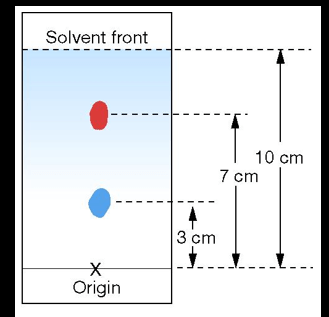
The Rf value  for the blue component is 
a)
0.3
b)
0.7
c)
10
d)
3
105.
The Rf value  for the red component is 
a)
0.3
b)
0.7
c)
10
d)
7
106.

A substance is soluble if it can be dissolved.


In paper chromatography, the most soluble solute _____________________ .

a)

does not move from the start point

b)

stays closest to the start point

c)

travels furthest away from the start point

d)

can be found in the middle of the chromatogram

107.

What is the correct image of paper chromatography???

a)
b)
c)
108.

In the image, which dye is the most soluble?

a)

Red

b)

Blue

c)

Purple

109.

In the image, which dye has the largest retention factor (Rf)?

a)

Red

b)

Blue

c)

Purple

110.

In the image, which dye has the smallest retention factor (Rf)?

a)

Red

b)

Blue

c)

Purple

111.

What is the Rf value of the purple dye?

a)

0.6

b)

0.2

c)

0.4

d)

0.8

e)

1.0

112.

What is the Rf value of the blue dye?

a)

0.6

b)

0.2

c)

0.4

d)

0.8

e)

1.0

113.

What is the Rf value of the red dye?

a)

0.6

b)

0.2

c)

0.4

d)

0.8

e)

1.0

114.
Which plant species has plant pigments most similar to those in A?
a)
B
b)
C
c)
D