
 Worksheets
Specific Heat Capacity Practice
Total questions: 65
Worksheet time: 2hrs 16mins

Which will heat up faster?
copper
granite
iron
basalt

Which will heat up slower?
water
lead
granite
iron
Which of the following best explains why the sand at the beach is hotter than the water?
Sand has a higher specific heat than water.
Sand has a lower specific heat than water.
There is more water than sand at the beach.
There is more sand than water at the beach.
The amount of energy required to raise the temperature 1ºC for every gram is called____?
Thermal Energy
Specific Heat
Temperature
Kinetic Energy
The specific heat of platinum is 0.133 J/g°C. How much heat(Q) is released when a 10 g piece of platinum cools from 100°C to 50°C?
66.5 J
665 J
0.0266 J
0.665 J

What would be the effect on the particles if more heat is supplied to the system? (a)

Water has a specific heat of 4184 J/KgºC. Wood has a specific heat of 1760 J/KgºC. What material needs more energy to raise the temperature 1ºC (a)
it requires more energy to change temperature
it requires less energy to change temperature
You heat up 2 pans of water; one has 100 mL in it, and the other has 1000 mL. Which one heats up the fastest?
100 mL
1000 mL
They both heat up at the same speed
Which will heat up the fastest? (a)
Rank the materials in order of slowest to heat up to fastest to heat up.
water
1
lead
2
granite
3
iron
4
Which of the following best explains why the sand at the beach is hotter than the water?
Sand has a higher specific heat than water.
Sand has a lower specific heat than water.
Sand has a greater mass than water.
Water has a greater mass than sand.
(a) is the amount of energy required to raise the temperature of 1 kg of mass by 1 oC

Copper, Stainless Steel, Carbon Steel, and Zinc were all heated using the same amount of thermal energy. What material would be the coolest after being heated?
Copper
Carbon Steel
Zinc
Stainless Steel
Object A, it has a lower specific heat
Object B, it has a lower specific heat
Object A, it has a higher specific heat
Object B, it has a higher specific heat
Which one will have the SMALLEST change in temperature?
Heat will always transfer from the ___________ object to the ________ object.
The hottest object to the coolest object.
The coolest object to the hottest object.
The solid object to the liquid object.
The liquid object to the solid object.

Thermal energy
Temperature
Heat
Convection
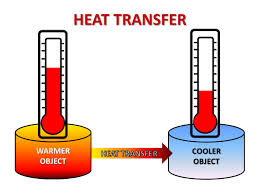
Heat flows from an area of (a) temperature to an area of (b) temperature.
Car A has their AC set to 72oF. Car B has their AC set to 67oF. If it is 98oF outside, which car will heat flow into faster?
Car A
Car B
Heat will flow into the cars at the same rate.
The sun heats up the sand and sea water at the same period of time. Which is the correct observation from the situation given?
sand gets hot slowly and sea water gets hot quickly
sand gets hot quickly and sea water gets hot slowly
both gets hot in a same time.
"When 100 J of heat is supplied to objects X and Y, object X experiences a rise in temperature of 1°C and object Y 2°C. "
Based on the statement above, which objects have higher heat capacity?
X
Y
When 100 J of heat is supplied to objects X and Y, object X experiences a rise in temperature of 1°C and object Y 2°C. This is due to object have different heat capacity. Based on below, which of the best assumptions on "object X have high heat capacity"
Rise of temperature in object X is bigger.
Rise of temperature in object X is smaller
When 100 J of heat is supplied to objects W, X , Y and Z, object W experiences a rise in temperature of 4°C , object X =1°C, object Y = 3 °C and Z = 2°C. Arrange the object in ascending order according to their heat capacity.
W, X, Y, Z
Z, W, Y, X
Y, X, W, Z
X, Z, Y, V
When 500 J of heat is supplied to objects M, N and O, object M experiences a rise in temperature of 5°C, object N= 3°C and object O = 7 °C. Which object has higher heat capacity?
M
N
O
When 500 J of heat is supplied to objects M, N and O, object M experiences a rise in temperature of 5°C, object N= 3°C and object O = 7 °C. Which object has smaller heat capacity?
M
N
O

If the water in beaker A and beaker B is heated for 5 minutes using the same Bunsen burner, which water in the beaker will show higher temperature?
A
B
What does the specific heat capacity of water mean?
=4200 J kg-1°C-1
4200 J heat required by 1 kg of water to raise the temperature by 2 ° C
4200 J heat required by 2 kg of water to raise the temperature by 1 ° C
4200 J heat required by 1 kg of water to raise the temperature by 1 ° C
What are the units for specific heat capacity?
Kg/JºC
J/KgºC
N/mºC
Watts
Determine the heat energy needed to heat the water in the pot to boiling.

Which material heats up slowest?
Aluminium
Concrete
Diamond
Glass
Water

10 kg of aluminium is heated from 120C to 220C. How much energy is needed?
8 970 000 J
897 J
8970 J
89 700 J
897 000J
20 g of water. specific heat of water is 4.18 J/g°C. temperature changes from 25° C to 20° C, how much heat energy (E) moves from the water to the surroundings?
418 J
209 J
83 J
4.18 J
E=mc∆t
E=mc
E= ½mv
m=EC
A 15.75-g piece of iron absorbs 1086.75 joules of heat energy, and its temperature changes from 25°C to 175°C. Calculate the specific heat capacity of iron.
0.46 J/goC
1.654 J/goC
2,567,446.875 J/goC
How many joules of heat are needed to raise the temperature of 10.0 g of aluminum from 22.0°C to 55.0°C, if the specific heat of aluminum is 0.903 J/g°C?
298 Joules
0.003 Joules
297 J/g°C
0.003 J/g°C
A 300.0 g piece of copper is heated and fashioned into a bracelet. The amount of energy transferred by heat to the copper is 66,300 J. If the specific heat of copper is 0.3845 J/g 0C, what is the change of the copper's temperature?
641 °C
7,650,000 Joules
The specific heat of aluminum is 0.9025 J/g°C. How much heat(Q) is released when a 10.0 g piece of aluminum foil is taken out of the oven and cools from 100.0° to 50.0°?
451 J
45.1 J
400 J
20.0 g of water. specific heat of water is 4.184 J/g°C. temperature changes from 25.0° C to 20.0° C, how much heat energy (Q) moves from the water to the surroundings?
418 Joules
209 J
83 J
4.18 J
∆t= 66
∆t=124
∆t=100
∆t=76
The specific heat(c) of copper is 0.38 J/g °C. What is the temperature change(∆t) when 100.0 Joules of heat(E) is added to 20.0 grams?
13 °C
13.2°C
13.16 °C


