
 Worksheets
Spring Final Review
Total questions: 84
Worksheet time: 2hrs 2mins
Select the consequences of climate change.
Ocean levels rising
more severe storms
Less greenhouse gases
More severe droughts
more solar radiation
Select evidences for climate change.
ocean level rising
less arctic ice sheets
more earthquakes
longer summers
less food production
Which of the following atmospheric gasses are considered greenhouse gasses? Select ALL that apply.
Water (H2O)
Carbon Dioxide (CO2)
Oxygen (O2)
Methane (CH4)
Nitrogen (N2)
The warming of a planet due to trapped radiation.
The cooling of Earth due to air pollution.
The heating of a solid, such as a rock.
Which of these is a reason that carbon dioxide is increasing?
Photosynthesis
Dissolving in oceans
Burning fossil fuels
Trapped in sedimentary rocks
Identify different types of climate feedback. Select all that apply.
Albedo
Methane Hydrates
Severe weather
Increased Evaporation
Melting Glaciers
180 g/mol
150 g/mol
220 g/mol
105 g/mol
Using the following equation: Fe2O3 + 3H2 → 2Fe + 3H2O
How many moles of iron can be made from 6 moles H2?
4 moles Fe
6 moles Fe
9 moles Fe
2 moles Fe
How many moles of water can be produced if 8 moles H2 are used?
4 moles
8 moles
16 moles
2 moles
How many grams of aluminum sulfate would be formed if 250g H2SO4 completely reacted with aluminum?
Which of the following is a diatomic element?
NaF
CO2
N2
H2O
What type of reaction is this?
2 C6H14 + 19 O2 → 12 CO2 + 14 H2O
Single Replacement
Double Replacement
Combustion
Decomposition
Predict the products for the this Single Replacement reaction:
K + HCl →
KCl + H2
KHCl
KH + Cl2
HCl + K2
What type of reaction occurs between an element and a compound?
Zn + 2HCl --> ZnCl2 + H2
Synthesis
Decomposition
Single Replacement
Double Replacement
According to the law of conservation of mass, matter cannot be created or (a)
Al + O2 --> 2Al2O3
Mg + __HCl ---> MgCl2 + H2
Identify the following chemical reaction.
2 NaBr + 1 Ca(OH)2 ----> 1 CaBr2 + 2 NaOH
Synthesis (or combination)
Decomposition
Single displacement
Double displacement
Identify the following chemical reaction.
Pb + FeSO4 ----> PbSO4 + Fe
Synthesis (or combination)
Decomposition
Single displacement
Double displacement
What reaction has the following general formula:
AB --> A + B
Synthesis
Decomposition
Single Replacement
Double Replacement
Combustion
What reaction has the following general formula:
A + CD --> C + AD
Synthesis
Decomposition
Single Replacement
Double Replacement
Combustion
What reaction has the following general formula:
AB + CD --> CB + AD
Synthesis
Decomposition
Single Replacement
Double Replacement
Combustion
What reaction has the following general formula:
A + B --> AB
Synthesis
Decomposition
Single Replacement
Double Replacement
Combustion
Which chemical reaction always starts with a hydrocarbon that reacts with oxygen and produces carbon dioxide and water?
Decomposition
Synthesis
Combustion
Single Replacement
48.86 g of cobalt is equal to how many moles of cobalt?
2879 moles
8.291 moles
.8291 moles
.829 moles
How many molecules of water are in a 821.3 g sample?
45.58 molecules
8.232 x 1025 molecules
8.909 x 1027 molecules
2.744 x 1025 molecules
Transition from a liquid to a gas
Condensation
Freezing
Evaporation
Melting
Gas condenses to a liquid
Evaporation
Melting
Freezing
Condensation
What happens to molecules when their kinetic energy increases?
The molecules move slower
The molecules move faster
The molecules get heavier
It depends on the type of molecule
When you boil water in a pot, some of the water escapes as steam. Which of the following choices explains what is happening with the water molecules in this scenario?
The molecules slow down as the kinetic energy increases and move farther apart from one another.
The molecules slow down as the kinetic energy decreases and move closer together.
The molecules speed up as the kinetic energy increases and the molecules move farther apart from one another.
The molecules speed up as the kinetic energy decreases and the molecules move closer together.
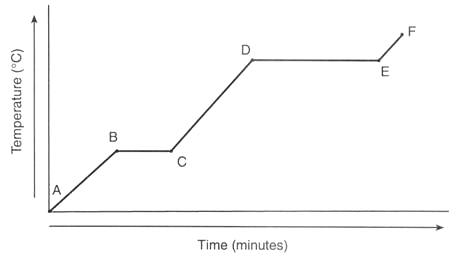
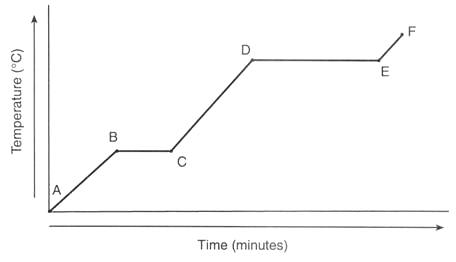
Is the substance gaining or losing energy?
Gaining
Losing
What state/phase is the object likely from points A to B?
Solid
Liquid
Gas
What is happening to the particles in the substance between points A and B?
Melting
Freezing
Speeding Up
Slowing Down
What is happening to the particles in the substance between points D and E?
Melting
Freezing
Vaporizing
Sublimating

Where on the graph are phase changes taking place?
1
2
3
4
5

How many moles of KNO3 must be dissolved in water to make 1.5 L of a 2.0 M solution?
1.3 mol KNO3
.75 mol KNO3
1 mol KNO3
3 mol KNO3
What is the molarity of 2.0 L of an aqueous solution that contains 0.5 mole of potassium iodide
1.0 M
4.0 M
0.25 M
1.5 M
Bases have a pH of
7
Less than 7
More than 7
Which molecule makes water acidic?
Carbonate Ions
Carbon Dioxide
What do some marine creatures do with the carbonate ion?
use it as a food source
use it as a defense mechanism
use it to build shells and exoskeletons
use it to cool body temperatures
How many moles of hydrogen are needed to react with 2 moles of nitrogen?
6 mol H
2 mol H
3 mol H
1 mol H
What is the name of Li3P?
Trilithium phosphide
Lithium (III) phosphide
Lithium phosphate
Lithium phosphide
What is the name for Na2S?
Sodium sulfide
Sodium sulfate
Sodium sulfite
Disodium sulfide
What is the formula for Zinc (II) fluoride?
ZnF2
ZnF
Zn2F
Zn2F4
Predict the products for the this Double Replacement reaction:
AgNO3 + KCl →
AgCl + KNO3
AgK + ClNO3
KAg + NO3Cl
AgCl + 3 KNO
According to the law of conservation of mass, matter cannot be created or (a)
Use the following BALANCED chemical equation to determine the ratio:
2HgO → 2Hg + O2
What is the ratio of HgO to Hg
2:2
1:1
2:1
1:2
Use the following BALANCED chemical equation to determine the ratio:
4NH3+6NO → 5N2+6H2O
What is the ratio of NH3 to NO
4:5
1:1
2:3
4:6
How many molecules of water are in a 821.3 g sample?
45.58 molecules
8.232 x 1025 molecules
8.909 x 1027 molecules
2.744 x 1025 molecules
How many moles of sodium chloride are in a 321.8 g sample?
18810 moles
3.315 x 1024 moles
5.507 moles
4.767 moles
What is the greenhouse effect?
Gases in the atmosphere trap the heat from the sun.
Gases cannot escape the atmosphere.
Gases in pollution damage trees.
Gases in the atmosphere make plants grow faster.
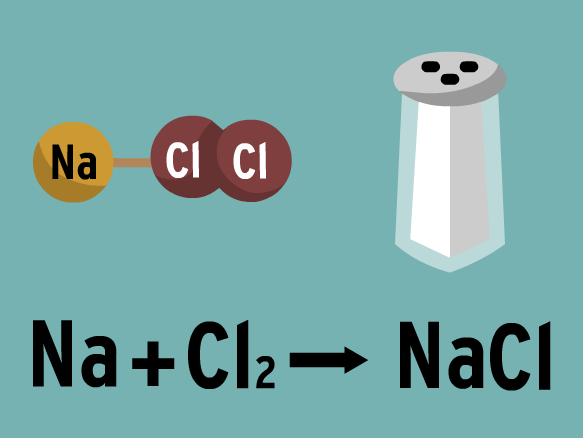
In a chemical reaction, 4 grams of sodium must combine with how many grams of chlorine to produce 10 grams of table salt?
4 grams
6 grams
8 grams
10 grams

22.7 grams of Phosphorous reacts with oxygen to form 28.5 grams of Phosphorous Pentoxide. How much oxygen was used in this reaction?
(a)
B2H6 + 3O2 -->2 HBO2 + 2 H2O
What mass of O2 will be needed to burn 20.0 g of B2H6 ?

How many moles of water are in this equation?
0
1
2
can't be determined
What happens to molecules when their kinetic energy increases?
The molecules move slower
The molecules move faster
The molecules get heavier
It depends on the type of molecule

Three containers with the same amount of the same material are shown below. Which container has the substance with the highest amount of energy?
The container on the left
The middle container
The container on the right
All have an equal amount of energy
When you boil water in a pot, some of the water escapes as steam. Which of the following choices explains what is happening with the water molecules in this scenario?
The molecules slow down as the kinetic energy increases and move farther apart from one another.
The molecules slow down as the kinetic energy decreases and move closer together.
The molecules speed up as the kinetic energy increases and the molecules move farther apart from one another.
The molecules speed up as the kinetic energy decreases and the molecules move closer together.
A student inflates a balloon with helium then places it in the freezer. The student should expect
the balloon's volume to increase
the balloon's volume to decrease
the balloon's moles to increase
the balloon's moles to decrease
A student is preparing solutions for a laboratory experiment by dissolving solid solutes in liquid solvents. Which actions will increase the rate of solubility? Select all that apply
Increase the temperature of the solution
stirring the solute in the solution
Decrease the particle size of the solute
increasing the particle size of the solute
How do the particles move in a solid? Select all that apply.
rotation
translation
vibration
limited translation
How do the particles move in a liquid? Select all that apply.
rotation
translation
vibration
limited translation
How do the particles move in a gas? Select all that apply.
rotation
translation
vibration
limited translation
How much energy is required to heat 23g of ice at -46°C to O°C?
2,116 J
7,685.7 J
9,623.2 J
50,738 J
How much heat energy is required to melt 23g of ice at 0°C?
2,116 J
7,659 J
9,623.2 J
418.14 J
How much energy is required to convert 100g of liquid water at 20°C completely to steam at 100°C?
254,072 J
70,581.04 J
587,236 J
258,168 j
How much energy is required to change 23g of liquid water at 100°C to steam at 109°C?
104,546 J
42,520 J
51,156.1 J
89,544 J
Neutral solutions have a pH of:
0
1
7
14
Which is true?
pH of less than 7 is basic; pH of more than 7 is acidic
pH of less than 7 is acidic; pH of more than 7 is basic
pH is the measure of the concentration of ______.
Acids
H+ ion
OH- ion
Bases

