
 Worksheets
Year 9 End of Year Quiz
Total questions: 93
Worksheet time: 49mins
Which type of microbe is not a living thing?
Bacteria
Viruses
Fungi
Protists
Which type of microbe is the smallest?
Bacteria
Viruses
Fungi
Protists
Which type of microbe is prokaryotic?
Bacteria
Viruses
Fungi
Protists
Which type of microbe is eukaryotic? (Select all)
Bacteria
Viruses
Fungi
Protists
Which type of microbe reproduces by binary fission?
Bacteria
Viruses
Fungi
Protists
Which type of microbe reproduces by causing a host cell to make more copies of it?
Bacteria
Viruses
Fungi
Protists
Which type of microbe can be prevented with vaccines?
Bacteria
Viruses
Fungi
Protists
Which type of microbe can be treated with antibiotics?
Bacteria
Viruses
Fungi
Protists
Which type of microbe is sometimes called "parasites"?
Bacteria
Viruses
Fungi
Protists
Which of the following is a virus?
Influenza
Malaria
Strep throat
Athlete's Foot
Which of the following is not a vector?
Bacteria
Rat
Tick
Mosquito
Why should people wash their hands?
To protect harmless bacteria
To change viral and bacterial nucleic acids
To release mutated cells from pores
To remove viruses and bacteria from the skin

Which type of pathogen is this?
Virus
Bacterium
Parasite
Fungus
Absorbs energy
Endothermic
Exothermic
Burning and combustion
Endothermic
Exothermic
Evaporation of sweat
Endothermic
Exothermic
Feels warm or hot
Endothermic
Exothermic
Feels cold
Endothermic
Exothermic
Heat pack
Endothermic
Exothermic

Endothermic
Exothermic

Endothermic
Exothermic
Cellular Respiration
Endothermic
Exothermic
Energy is being taken in
Endothermic
Exothermic
Photosynthesis
Endothermic
Exothermic
Energy or heat is a product
Endothermic
Exothermic
Cold Pack
Endothermic
Exothermic
Releases energy
Endothermic
Exothermic
Most of the mass of an atom is found in the ______.
nucleus
proton
electron cloud
isotope
The smallest particle with characteristics of an element is known as the
Periodic Table
Atom
Proton
Electron


Is H2O2 an element or a compound?
element
compound
An atom that gains or loses an electron becomes
an isotope
a new element
an ion
a molecule
When an atom gains an electron it becomes
negatively charged
positively charged
neurtal
Which type of bonds create compounds?
covalent bonds
ionic bonds
metallic bonds
all type of bonds
Which type of bond occurs between non metals?
covalent bonds
ionic bonds
metallic bonds
all types of bonds
How many different elements are in the C6H12O6
3
6
12
24
How many total atoms are in C6H1206
3
6
12
24
What type of bond forms CaF2
covalent bond
ionic bond
metallic bond
all answers are correct
If two fluorine atoms bond they will make a _____ bond.
ionic
covalent
metallic

What type of bonding does this picture show?
Ionic
Covalent

What type of bonding does this picture show?
Ionic
Covalent
Generally, atoms form bonds so that _______________.
Each atom loses its electrons
Each atom has a stable electron configuration
Each atom has an unstable electron configuration
Each atom gains electrons
Poor electrical conductivity
Ionic compounds
Covalent compounds
Conducts electricity well when melted or dissolved
Ionic compounds
Covalent compounds
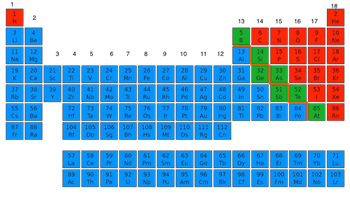
The chemical bond between a non-metal and another non-metal will be a ________ bond.
metal
ionic
covalent
polar
The chemical bond between a metal and a non-metal will be a _____ bond.
metal
ionic
covalent
polar
Sodium and Bromine will make a _____ bond.
ionic
covalent
metallic
Carbon and Oxygen will make a ___________ bond.
ionic
covalent
metallic
What kind of energy is stored in moving objects?
kinetic energy
thermal energy
chemical energy
magnetic energy
What kind of energy is stored in hot objects?
Chemical energy
Thermal energy
Magnetic energy
Gravitational energy
What kind of energy is stored in materials that generate a magnetic field?
Electrical energy
Thermal energy
Magnetic energy
Gravitational energy
What kind of energy is stored objects that are high up and have the potential to fall.
Elastic Potential Energy
Chemical Energy
Magnetic energy
Gravitational Potential energy
What kind of energy is stored objects that can be stretched or squashed?
Elastic Potential Energy
Chemical Energy
Magnetic energy
Thermal Energy
The energy in which store decreases as a candle burns?
Chemical energy store
Kinetic energy store
Nuclear energy store
A car moves faster? Which energy store increases?
Gravitational Potential Energy
Kinetic Energy
Thermal Energy
Kinetic Energy
Energy is transferred _______________ due to charge flowing around a circuit.
Electrically
Kinetic
Mechanically
By radiation
________ is when energy is transferred between areas that have different temperatures.
By radiation
By heating
Mechanically
Nuclear
When you eat fruits and vegetables, the energy is stored as ...
a. thermal energy
b. food energy
c. electrical energy
d. chemical energy

Food, fuels and batteries have energy in this energy store
Chemical
Thermal
Gravitational Potential
Elastic
A ____ converts chemical energy into kinetic energy?


Where does MOST of the digestion process occur?
Small intestine
Mouth
Stomach
Large Intestine
Colon

The physical & chemical breakdown of food is called?
Digestion
Absorption
Swallowing
Excretion

Pick the correct order of digestion
Mouth,stomach,esophagus,large intestine,small intestine
Mouth,esophagus,stomach,small intestine, large intestine
Mouth, esophagus, stomach, large intestine, small intestine, colon
Mouth, stomach, esophagus, small intestine, large intestine

Where is Bile produced?
Liver
Stomach
Pancreas
Colon

What does the Gall Bladder store?
Bile
Fat
Carbohydrates
Insulin

What organ produces Insulin?
Liver
Stomach
Appendix
Pancreas
HCl is present
mouth
stomach
small intestine
esophagus
What are proteins made of?
amino acids
minerals
sugars
vitamins
What is the main source of energy for your body?
proteins
carbohydrates
fats
mineral
What fluid produced in the mouth has digestive enzymes?
chyme
bile
blood
saliva
The tendency for a material to oppose the flow of electrons is _____.
current
resistance
conductor
voltage
Items with opposite charges _____ each other.
attract
repel
move
none of the above
Items with like charges _____ each other.
attract
repel
move
none of the above
An instrument used to measure potential difference is a(n) _____.
Voltmeter
Generator
Ammeter
Transformer
Resistance is measured in a unit called _____.
ampere
ohm
volt
coulomb
Potential difference is measured in a unit called _____.
ampere
ohm
volt
coulomb
Electric current is measured in a unit called _____.
ampere
ohm
volt
coulomb
An instrument used to measure electric current is a(n) _____.
Voltmeter
Generator
Ammeter
Transformer

Is the symbol for _____.
Light bulb
Resistor
Battery
Switch

Is the symbol for _____.
Light bulb
Resistor
Battery
Switch
A good conductor is a material that does not allow electricity to flow through it.
True
False
A battery is a source of alternating current.
True
False
In a series circuit, all parts of the circuit are connected in a single path.
True
False
Which of the following are examples of conductors?
Copper
Plastic
Glass
Aluminum foil
Pencil lead
Electricity that flows in only one direction is called _____.
Alternating current (AC)
Direct current (DC)
Electricity that changes direction as it flows is called _____.
Alternating current (AC)
Direct current (DC)

