
 Worksheets
Unit 3 Topic 1
Total questions: 75
Worksheet time: 1hrs 25mins
Linnaeus based his system of classification on:
structures
size
habitat
genetics
Which one of the following categories includes the greatest number of different types of organisms?
genus
family
phylum
class
Scientists of all nations use binomial nomenclature because these names are:
different in all languages
the same in all languages
accurate descriptions of organisms
written in Latin
An amateur birdwatcher sighted two robins that were both black, red and white in colour, but one had red head feathers and the other had black head feathers. One robin was male and the other was female. The bird watcher was unsure whether or not they belonged to the same species. In order to be certain, he would need to:
determine whether the two robins would mate under natural conditions
refer to a catalogue of type specimens of robins
determine whether the offspring produced by mating these two robins were fertile
refer to preserved specimens of robins that had been collected and labelled by experts
Shrubs seldom grow successfully on the floor of a dense forest. Which of the following factors mainly accounts for this phenomenon?
They fail to compete with the extensive root system of the trees to obtain sufficient water and mineral salts.
They fail to compete with the tall trees to obtain CO2 from the atmosphere to support photosynthesis.
They fail to compete with the extensive canopy of the trees to receive sufficient sunlight.
They easily suffocate because most of the oxygen in the atmosphere has been absorbed by the leaves of the trees.
A factor that distinguishes a community from an ecosystem is:
time
space
the biotic environment
the abiotic environment
The interaction between a particular kind of organism and its environment is described by the term:
community
population
niche
ecosystem
The organisms living in and on a decaying log can be described as:
a community
a population
an ecosystem
a society
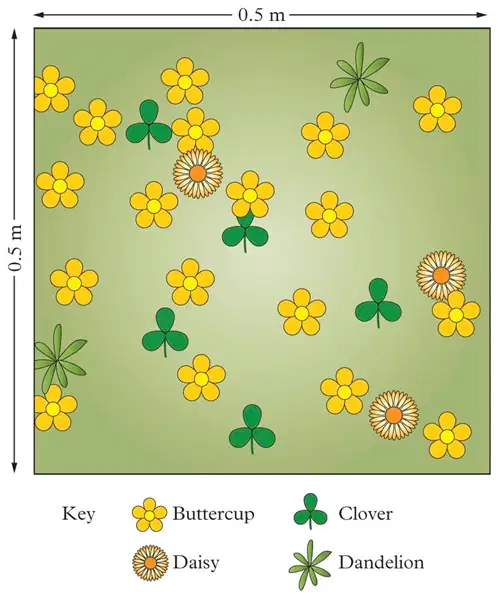
A student throws a 0.25 m quadrat onto the school lawn. Figure 3 shows what was found.
Based on this quadrat, determine the number of dandelions in 1m.
6
7
8
9
10
Biodiversity:
Only refers to the ecosystems in which particular organisms are found
Results from the loss of some genes and gain of other genes in a range of different organisms
Refers to the types of organisms found on Earth
Refers to the variety of organisms, their genetic makeup and the ecosystems in which they are found
With reference to dogs, the poodle and the sausage dog are:
Subspecies
Races
Varieties
Hybrids
An abiotic factor related to the climate of an area would be:
water currents
pH
temperature
topography
Identify which one of the following is a biotic factor.
Light intensity
Wind and air currents
Predators
Temperature
Identify which one of the following species is more closely related to Eucalyptus alba.
Ardea cineria
Ardea alba
Eucalyptus regnans
Quercus alba
Identify which of the following statements is true for r-strategists.
Their population densities are as high as the ecosystem will allow.
They have the ability to produce large numbers of offspring with little parental involvement.
They have a long life expectancy.
They tend live in more stable environments.

A field study was conducted on two areas of a forest. The following samples were collected, and the number of individuals of species W, X, Y and Z were recorded in the table below. Species W, X, Y and Z are the same species in both areas.
Calculate the species richness for Area A using the formula
30
40
50
60
A place where an organism lives is called its:
Niche
Habitat
Community
Environment

The image represents a gridded quadrat of 20cm x 20cm squares used in a plant survey. The calculate cover for a species, the surveyor identified each plant species and then counted the number of squares in which the species appeared.
What is the approximate percentage cover of Species A?
22%
44%
53%
58%
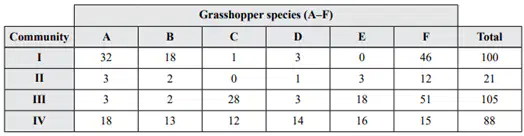
A survey of grasshopper species was conducted across four eucalypt communities. Counts were conducted and the average abundance per 400 m2 recorded.
Which community has both the highest species richness and highest evenness for grasshoppers?
I
II
III
IV
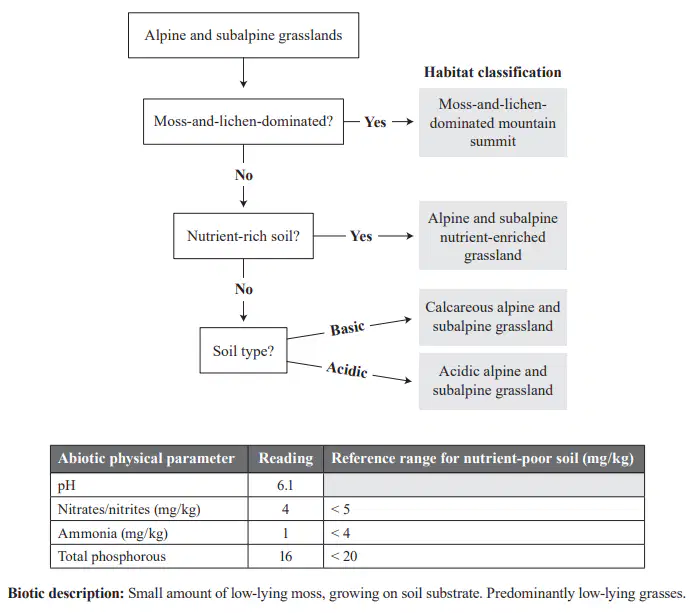
The following information includes:
· a key that is used to classify the types of alpine and subalpine grassland habitats
· a table of abiotic and biotic data obtained from a habitat survey.
Using the data in the table and the key, this alpine and subalpine grassland would be classified as:
A moss-and-lichen dominated mountain summit
An alpine and subalpine nutrient-enriched grassland
A calcaerous alpine and subalpine grassland
An acidic alpine and subalpine grassland
Students used quadrats to investigate biodiversity in a grassland community with scattered distribution of plant species. The students agreed on a counting criteria for each quadrat to
reduce the time taken to count the different species.
minimise statistical uncertainty.
ensure all strata were sampled.
minimise bias
The scientific (and common) names of three animals are: Canis familiaris (dog), Canis lupis (wolf) and Vulpes vulpes (fox). These three animals all belong to the same:
Class but different species
Genus but different classes
Genus but different species
Species but different genus
The concept of a species as a clear group whose members are descended from a common ancestor and who all possess a combination of certain defining, or derived, traits.
Phylogenetic Species Concept
Biological Species Concept
Evolutionary Species Concept
The concept of a species as a clear group of organisms that can interbreed to produce fertile offspring.
Phylogenetic Species Concept
Biological Species Concept
Evolutionary Species Concept
The concept of a species as a series of ancestor descendent populations passing through time and space independent of other populations
Phylogenetic Species Concept
Biological Species Concept
Evolutionary Species Concept
The maximum number of organisms an ecosystem can support is called the -
biotic factor
limiting factor.
carrying capacity.
abiotic factor
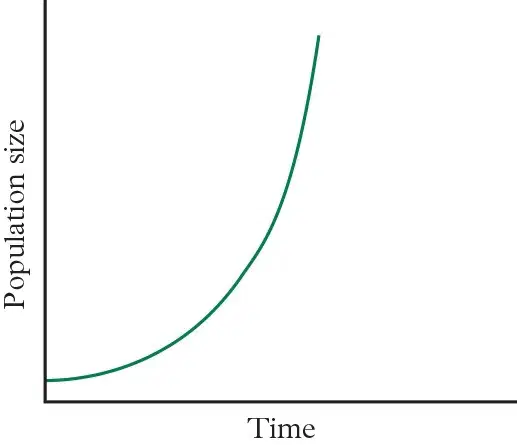
The graph below shows a population size over time. Identify which of the following conclusions is correct.
This population is an example of an S-curve growth rate.
This is an example of a logistic growth rate.
This population is unlikely to have any environmentally limiting factors affecting its survival.
This population has reached carrying capacity.
A population of 3000 rescued orangutans was recorded in the rehabilitation forest in Borneo in 2018. During the year, 1000 of these orangutans died, 50 orangutans were born, 100 orangutans moved to a nearby forest and an additional 75 orangutans were added to the forest as they were rescued throughout the year.
Infer the type of change that is likely to be seen in this population.
The population will increase and will continue to grow in numbers exponentially.
The population will neither increase or decrease but will remain constant.
The population will decrease and is unlikely to survive.
The population has reached carrying capacity.
Select which of the following situations describes a population that is increasing in size.
B = birth
D = death
I - immigration
E = emigration
(B+D) > (I+E)
(B+E) > (D+I)
(B+E) < (D+I)
(D+E) < (B+I)
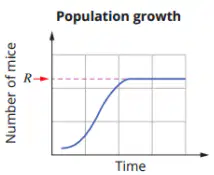
Identify the term that correctly describes the number of mice indicated by R
Plateau number
Peak population
Carrying capacity
Population maximum
Without any limiting factors, growth of a population will be exponential. Limiting factors can be density dependent or density independent.
Identify the example of a density independent factor.
Crowding
Predation
Natural disasters
Competition for resources
Without any limiting factors, growth of a population will be exponential. Limiting factors can be density dependent or density independent. Identify the example of a density independent factor.
Competition for resources
Natural disasters
Predation
Crowding
A particular country has negligible immigration and emigration. In 2017 its population size increased from 50 million to 51 million. If the birth rate was 30 individuals per thousand, then the death rate (per thousand) in 2017 was:
10
20
30
40
An organism is small in size and has a short life span. It is fast maturing and produces many offspring at a young age. The young stay with the mother for only a short period of time. It is likely that this organism is:
A K-strategist
An r- strategist
Initially an r-strategist and becomes a K-strategist at maturity
Intermediate between an r- and K-strategist
The largest number of individuals that an environment can support long term is...
Carrying capacity
Emigration
Immigration
Population density
Something that regulates the size of a population is called...
A limiting measure
A limiting factor
Carrying capacity
Biodiversity

What is the carrying capacity of the graph?
Approximately 500
More than 800
Less than 300
Approximately 700
Which of the following would INCREASE the carrying capacity of an ecosystem?
Increase in predators
Disease
Increase in available food
Drought
Which limiting factor would increase due to the number of individuals in a population (aka; density-dependent)?
Unusual weather
Natural disaster
Disease
Which limiting factor is density independent?
Competition
Disease
Natural disasters
Mice produce a large number of offspring all year long, yet the number of mice within a given population changes very little from year to year. The stability of the population size is most likely the result of
mice continuing to reproduce when its population is large
the survival of more female mice than male mice
the development of mutations in young mice
limiting factors that keep the population in check
The capture–recapture method of measuring a population would be most likely be used for measuring the population of:
Wedge-tailed eagles
Soil bacteria
Eucalyptus maculata
Dairy cattle
Exponential population growth can be described as
growth when resources are limited
a j-shaped curve
a s-shaped curve
growth that reaches carrying capacity
Logistic population growth can be described as
growth when resources are limited
a s-shaped curve
reaching carrying capacity
all of the above
none of the above
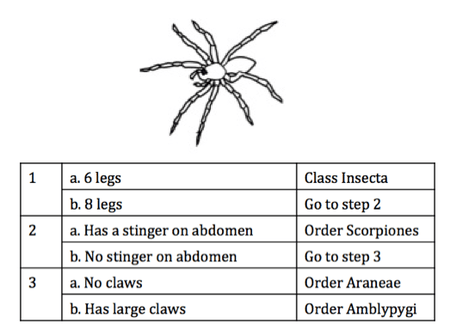
following observations of the plant’s characteristics would be useful in determining its identity with a dichotomous key?

The school librarian wants to determine how many students use the library on a regular basis. What type of sampling method would she use if she chose to select every 3rd student who enters the library on Tuesday.
Random
Stratified
Simple
Systematic
Woodcrest SC wants to survey its teachers. The sample size was chosen at random from every department. What sampling technique is evident?
Simple
Stratified
Cluster
Quota

Ecologists are comparing the number of species in two woodland areas every month for a year. Based on the graph below how many samples should be taken for further studies in this area?
4
8
3
9
There are three main sampling techniques that can be used in ecology. Which of the following is not one of them?
Random
Systematic
Stratified
Clustered
Which of the following statements describes stratified sampling?
Stratified sampling is used when the population has known strata
Stratified sampling is used when every item has the same chance of being selected.
Stratified sampling is where samples are chosen in a regular way.
All of the statements describe an aspect of stratified sampling.

Which type of sampling is this an evaluation of?
Random
Systematic
Stratified
Clustered
This sampling method is used to estimate the size of a population where it is not practical to catch all the individuals within it. This is a live trap technique where the individuals are trapped and then marked harmlessly. The area is then sampled later and those species have been caught before are easily identified.
capture-mark-recapture
The more data you collect, the more (a) your experiment will be
Some of the limitations of sampling are......
Bias, lack of skill identifying species, and cost of fuel
Bias, lack of skill identifying species, and cost of buying a new wetsuit
Bias, lack of skill identifying species, going surfing instead of working,
Bias, lack of skill identifying species, and cost of working in the field.
Which of the following is a quadrat?

Jaguar Quad Quads....DUUUUVAL!

4 fin surfboard

Weird net thing laying in the grass

Nerd stuff, so fun!
How do you ensure that the quadrat is placed randomly?
Throw the quadrat into the field.
Place the quadrat near where you are standing.
Divide the area into a grid and choose the coordinates.
Divide the area into a grid and use a random number generator to select coordinates.

What can this type of sampling be used for? Multiple answers.
estimated percent of coverage
number of different species
number of individuals of a specific species
number of individual plants
A type of probability sampling where every member of the population has an equal chance of being selected. Your sampling frame should include the whole population.
random sampling
systematic sampling
stratified sampling
cluster sampling
A type of probability sampling that allows the researcher to draw more precise conclusions by ensuring that every subgroup is properly represented in the sample
simple random sampling
systematic sampling
stratified sampling
cluster sampling
The technique which ecologists use to quantify the biodiversity of area is called?
Sampling
Documentation
Recording
Observation
Why is it that the higher the biodiversity the healthier the ecosystem?
Healthy ecosystem has more insects that feed everything else
Healthy ecosystem tends to make bigger animals
High biodiversity of an ecosystem allows it to more resilient to changes
High diversity means the area is looked after people

Why are quadrats placed randomly?
To ensure repeatability
To improve accuracy
To avoid bias
To ensure validity of results
If a field has an area of 40m2 , a quadrat has an area of 1m2 , and the average number of daisies in each quadrat is 2, what is the estimated number of daisies in the field?
8
80
800
8000
What method would you use to monitor the change in distribution of species due to changes in environmental conditions?
Random quadrats
Line transect
Capture-recapture
There are three main sampling techniques that can be used in ecology. Which of the following is not one of them?
Random
Systematic
Stratified
Clustered
Relative representation of a species in a particular ecosystem , best describes?
abundance
distribution
individual count
percentage cover
Where a species of an organism is found in the environment and how it is organised , best describes?
abundance
distribution
individual count
percentage cover
What is the name of the survey used to assess changing biotic data across ecosystem profiles?
Line transect
Quadrat survey
Belt transect
Linear sampling
What type of population would you ESTIMATE using a quadrat?


Limpets were found in 25 out of 50 quadrats. What percentage of quadrats contained limpets?
100%
25%
50%
75%
Why do scientists use sampling techniques to gather population data rather than counting everything?
scientists are lazy
sampling is more efficient and achievable
sampling is more accurate
scientists prefer estimations
sampling is cheaper
What do we call a sample that is drawn from a number of separate strata of the population, rather than at random from the whole population, in order that it should be representative?
Systematic Sample
Stratified Sample
Simple Random Sample
Convenience Sample

