
 Worksheets
Xii A
Total questions: 126
Worksheet time: 1hrs 16mins
The hydrocarbon which can react with sodium in liquid ammonia is
(1) CH3CH2C ≡ CCH2CH3
(2) CH3CH2CH2C ≡ CCH2CH2CH3
(3) CH3CH2C ≡ CH
(4) CH3CH ≡ CHCH3
1
2
3
4
Which one of the following is reduced with zinc and hydrochloric acid to give the corresponding hydrocarbon?
(1) Ethyl acetate
(2) Acetic acid
(3) Acetamide
(4) Butan-2-one
1
2
3
4
Polysubstitution is a major drawback in
(a) Reimer-Tiemann reaction
(b) Friedel-Crafts acylation
(c) Friedel-Crafts alkylation
(d) Acetylation of aniline.
1
2
3
4
In the presence of peroxide, HCl and HI do not give anti-Markovnikov’s addition to alkenes because
(1) All the steps are exothermic in HCl and HI
(2) One of the steps is endothermic in HCl and HI
(3) HCl is oxidizing and the HI is reducing
(4) Both HCl and HI are strong acids
1
2
3
4

The reagent needed for converting
is
H2 / lindlar Cat.
Catalytic Hydrogenation
LiAlH4
Li/ NH3
The gas evolved on heating CH3MgBr in methanol is
(1) methane
(2) ethane
(3) propane
(4) HBr
1
2
3
4
Which one of the following has the minimum boiling point?
(1) n-Butane
(2) 1-Butyne
(3) 1-Butene
(4) Isobutene
1
2
3
4
In the hydroboration – oxidation reaction of propene with diborane, H2O2 and NaOH, the organic compound formed is :
(1) CH3CH2CH2OH
( 2) (CH3)3COH
(3) CH3CHOHCH3
(4) CH3CH2OH
1
2
3
4
The number and type of bonds in C22- ion in CaC2 are:
(1) Two σ bonds and one π – bond
(2) Two σ bonds and two π – bonds
(3) One σ bond and two π – bonds
(4) One σ bond and one π bond
1
2
3
4

In the given transformation, which of the following is the most appropriate reagent?
NaBH4
NH2-NH2, OH
Zn – Hg / HCl
Na, Liq.NH3
Ozonolysis of an organic compound gives formaldehyde as one of the products. This confirms the presence of:-
(1) an isopropyl group
(2) an acetylenic triple bond
(3) two ethylenic double bonds
(4) a vinyl group
1
2
3
4
Which branched chain isomer of the hydrocarbon with molecular mass 72 u gives only one isomer of mono substituted alkyl halide?
(1) Neopentane
(2) Isohexane
(3) Neohexane
(4) Tertiary butyl chloride
1
2
3
4
One mole of a symmetrical alkene on ozonolysis gives two moles of an aldehyde having a molecular mass of 44 u. The alkene is:-
(1) Ethene
(2) Propene
(3) 1-Butene
(4) 2-Butene
1
2
3
4
Which one of the following classes of compounds is obtained by polymerization of acetylene?
(1) Poly-ene
(2) Poly-yne
(3) Poly-amide
(4) Poly-ester
1
2
3
4
The gas liberated by the electrolysis of Dipotassium succinate solution is :
(1) Ethyne
(2) Ethene
(3) Propene
(4) Ethane
1
2
3
4
CH3 – CH = CH2 is __________.
aliphatic saturated
aliphatic unsaturated
alicyclic saturated
alicyclic unsaturated

is __________.
aliphatic
aromatic
alicyclic
None of these
CH3 – CH2 – CH2 – CH3 is __________.
aliphatic
aromatic
alicyclic
None of these
This prefix means 7
but
hept
hex
non
propyl is a....
three carbon chain
three carbon side chain
triple bond

How many methyl groups are on the following molecule?
1
2
3
4

How many carbons are in the longest chain?
7
8
9
10

What group(s) is/are found on the following molecule?
methyl
ethyl
butyl
methyl and butyl
all of the above
What is wrong with the name 2,4-methylhexane
inappropriate use of commas
inappropriate use of dashes
a prefix is missing
a space is missing
What is wrong with the name 1-methyl-3-cyclohexene
prefixes
numbering
commas
dashes
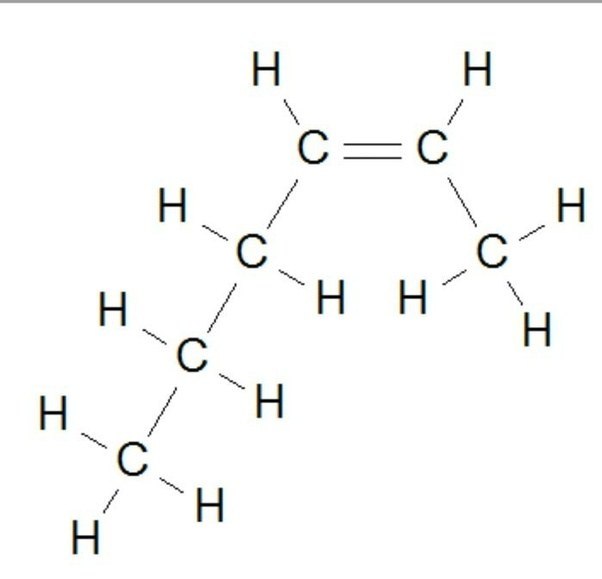
Name the following hydrocarbon
cis-4-hexene
trans-4-hexene
trans-2-hexene
cis-2-hexene
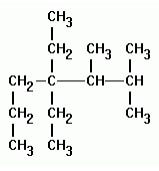

4-ethyl-6-methylnonane
3-propyl-5-methyloctane
2,4-dipropylhexane
4-ethyl-2-propylheptane

What is the correct name for the following compound?
3,4-dimethylheptane
4-methyl-5-ethylhexane
3-methyl-4-propylpentane
4,5-dimethylheptane

What is the correct name for the alkyne shown?
butyne
1-butyne
2-butyne
1-methyl-1-propyne

WHICH of the following is not an isomer of C7H16
2,3 dimethyl pentane
2,2,3 trimethylbutane
3-isopropyl pentane
3-methylhexane
which of the following has highest boiling point
n-pentane
isopentane
neopentane
all have same

correct IUPAC name of following is
5-Methyl 3,4 di isopropyl heptane
3,4 Di isopropyl 5-methyl heptane
3-Methyl 4,5 di isopropyl heptane
3-Ethyl 2,5dimethyl 4-isopropyl heptane
what is the product formed when hex-2 yne undergoes hydrogenation in presence of palladium
cyclohexane
hexane
hex-3-yne
hexan -2-ol
A on reaction with sodium in presence of dry ether gives 2,3 dimethyl butane. what is A?
2,3 dimethyl 1-chloro butane
propanoic acid
isopropyl chloride
t-butyl chloride
X + NaOH --CaO-------- benzene
what is X
sodium phenoxide
sodium benzoate
sodium propanoate
chlorobenzene
product when sodium butanoate undergoes kolbe electrolysis
hexane
octane
butane
propane
which of the halogen reacts fastest during halogenation of alkane
Cl2
F2
Br2
l2
halogenation of alkane proceed via which type of mechanism?
carbocation formation
carbanion formation
free radical formation
transition state
which of the following shows propagation step
Cl2---- 2Cl.
Cl.+Cl.------ Cl2
Cl.+ CH4---CH3.+HCl
Cl.+CH3.-------CH3Cl
combustion reactions are
always exothermic
always endothermic
some times exothermic and some times endothermic
no heat involved
CH4+O2--Mo2O3----heat-----
what is the product
methanol
methanoic acid
ethane
methanal
n hexane--Cr2O3, 773 K, 10atm----
find the product
hexanol
hexene and hydrogen
2-methyl pentane
benzene
Pick out the most reactive alkyl halide for an SN1 reaction.


Which of the following alkyl halides will undergo SN1 reaction most readily?
(CH3)3C-F
(CH3)3C-Cl
(CH3)3C-Br
(CH3)3C-I
Which of the following statement(s) is/are true for SN1 reaction?
I. The rate of SN1 reaction depends on concentration of alkyl halide
II. The rate of SN1 reaction depends on concentration of nucleophile
III. SN1 reactions of alkyl halides are favoured by non-polar solvents
Only I
Only II
Only III
Both I and III


What is the type of reaction in chemical reactions where dehydration occurs?
Addition
Substitution
Rearrangement
Elimination
Toluene reacts with a halogen in the presence of iron (III) chloride giving ortho and para halo compounds. The reaction is
Electrophilic elimination reaction
Electrophilic substitution reaction
Free radical addition reaction
Nucleophilic substitution reaction
Which reagent will you use for the following reaction? CH3CH2CH2CH3 ⎯⎯→ CH3CH2CH2CH2Cl + CH3CH2CHClCH3
Cl2/UV light
NaCl + H2SO4
Cl2 gas in dark
Cl2 gas in the presence of iron in dark
Which of the following is an example of vic-dihalide?
Dichloromethane
1,2-dichloroethane
Ethylidene chloride
Allyl chloride
The position of –Br in the compound in CH3CH=CHC(Br)(CH3)2 can be classified as ____________.
Allyl
Aryl
Vinyl
Secondary
Chlorobenzene is formed by reaction of chlorine with benzene in the presence of AlCl3. Which of the following species attacks the benzene ring in this reaction?
Cl–
Cl+
AlCl3
[AlCl4]–
Ethylidene chloride is a/an ______________.
vic-dihalide
gem-dihalide
allylic halide
vinylic halide
A primary alkyl halide would prefer to undergo _____________.
SN1 reaction
SN2 reaction
α–Elimination
Racemisation
Which of the following alkyl halides will undergo SN1 reaction most readily?
(CH3)3C—F
(CH3)3C—Cl
(CH3)3C—Br
(CH3)3C—I
Which is the correct IUPAC name for CH3-CH(C2H5) -CH2-Br?
1-Bromo-2-ethylpropane
1-Bromo-2-ethyl-2-methylethane
1-Bromo-2-methylbutane
2-Methyl-1-bromobutane
What should be the correct IUPAC name for diethylbromomethane?
1-Bromo-1,1-diethylmethane
3-Bromopentane
1-Bromo-1-ethylpropane
1-Bromopentane
Which is the correct increasing order of boiling points of the following compounds? 1-Iodobutane, 1-Bromobutane, 1-Chlorobutane, Butane
Butane < 1-Chlorobutane < 1-Bromobutane < 1-Iodobutane
1-Iodobutane < 1-Bromobutane < 1-Chlorobutane < Butane
Butane < 1-Iodobutane < 1-Bromobutane < 1-Chlorobutane
Butane < 1-Chlorobutane < 1-Iodobutane < 1-Bromobutane
Which is the correct increasing order of boiling points of the following compounds?
1-Bromoethane, 1-Bromopropane, 1-Bromobutane, Bromobenzene
Bromobenzene < 1-Bromobutane < 1-Bromopropane < 1-Bromoethane
Bromobenzene < 1-Bromoethane < 1-Bromopropane < 1-Bromobutane
1-Bromopropane < 1-Bromobutane < 1-Bromoethane < Bromobenzene
1-Bromoethane < 1-Bromopropane < 1-Bromobutane < Bromobenzene

Arrange the above compounds in the increasing order of their densities
(a) < (b) < (c) < (d)
(a) < (c) < (d) < (b)
(d) < (c) < (b) < (a)
(b) < (d) < (c) < (a)

In which of the above molecules carbon atom marked with asterisk (*) is asymmetric?
(a), (b), (c), (d)
(a), (b), (c)
(b), (c), (d)
(a), (c), (d)

What is ‘A’ in the reaction?


Which of the carbon atoms present in the molecule given below are asymmetric?
a, b, c, d
b, c
a, d
a, b, c

Which of the statements are correct about above reaction?
(a) and (e) both are nucleophiles.
In (c) carbon atom is sp3 hybridised.
In (c) carbon atom is sp2 hybridised.
(a) and (e) both are electrophiles.

Which of the following statements are correct about the reaction intermediate?.
Intermediate (c) is unstable because in this carbon is attached to 5 atoms.
Intermediate (c) is unstable because carbon atom is sp2 hybridised.
Intermediate (c) is stable because carbon atom is sp2 hybridised
Intermediate (c) is less stable than the reactant (b).
Haloalkanes contain halogen atom (s) attached to the sp3 hybridised carbon atom of an alkyl group. Identify haloalkane from the following compounds.
2-Bromopentane
Vinyl chloride (chloroethene)
2-chloroacetophenone
Trichloromethane
Alkyl halides are prepared from alcohols by treating with
HCl + ZnCl2
Red P + Br2
H2SO4 + KI
All the above
For which of the following transformations does the reactive carbon undergo a change in hybridization?
methane to chloromethane
methanol to methanal
methanal to methanoic acid
chloromethane to methanol
Which molecule does not act as a nucleophile in a reaction with a halogenoalkane?
Water
Ethanol
Hydroxide ion
Ammonium ion
Which compounds reacts fastest with water?
(CH3)3CBr
(CH3)3CCl
CH3CH2CH2CH2Br
CH3CH2CH2CH2Cl
The reaction between 2-chloro-2-methylpropane, (CH3)3CCl, and aqueous sodium hydroxide is an example of
Unimolecular nucleophilic addition
Bimolecular nucleophilic addition
Unimolecular nucleophilic substitution
Bimolecular nucleophilic substitution
Which statement about the reactions of halogenoalkanes with aqueous sodium hydroxide is correct?
Primary halogenoalkanes react mainly by SN1 mechanism.
Chloroalkanes react faster than iodoalkanes.
Tertiary halogenoalkanes react faster than primary halogenoalkanes.
The rate of an SN1 reaction depends on the concentration of aqueous hydroxide.
Which one of the following carbonium ions (carbocations) is most stable?


Which is correct about the order and rate of hydrolysis (relative to 1-iodobutane) for 2-iodo-2-methylpropane, (CH3)3Cl?
A
B
C
D
Which of the chloroalkanes below will hydrolyse most rapidly?
CH3CH2CH2CH2Cl
CH3CH(CH3)CH2Cl
CH3CH2CHClCH3
(CH3)2CClCH2Cl
Which substance(s) is(are) most likely to react with hydroxide ions by means of a SN2 mechanism?
I. C6H5Cl
II. (CH3)3CCl
III. (CH3)2CHCH2Cl
IV. CH3CH2CH2CH2Cl
I and III
I and IV
III and IV
I, III and IV
Which statement is incorrect regarding the reaction of ammonia with alkyl halides?
This is a Lewis acid base reaction
Ammonia acts as a nucleophile and forms dative bond with the carbon
The product of the reaction is an amine
The hybridisation of the carbon atom that receives the ammonia molecule changes from sp3 to sp2
In SN1 reaction, racemisation occurs if the reaction occurs at a stereogenic centre, however, 50:50 mixture of enantiomers are rarely obtained, why?
Usually one enantiomer is more stable than other
Retention of configuration is always favoured in reaction
Hydroxylic solvent favour retention of configuration
There is steric hindrance to the approach of nucleophile from the front side as some of the leaving group are not departed completely which favour inversion of configuration
Pick out the most reactive alkyl halide for an SN1 reaction.
Pick out the compound which reacts fastest in the presence of AgNO3.
(CH3)3CCI
(CH3)2CHCH2CI
(CH3)2CHCI
CH3CH2CI

From the following, pick out the explanation for why molecule Y hydrolyses faster than molecule Z.
Less steric hindrance
Neighbouring group participation
Greater carbocation stability
Better solvent
Which of the following statement(s) is/are true for SN1 reaction?
I. The rate of SN1 reaction depends on concentration of alkyl halide
II. The rate of SN1 reaction depends on concentration of nucleophile
III. SN1 reactions of alkyl halides are favoured by non-polar solvents
Only I
Only II
Only III
Both I and III
From the following, pick out the potential energy profile for a SN1 reaction.


The most and least reactive electrophiles respectively in a SN1 reaction are
I and II respectively
II and III respectively
I and III respectively
III and IV respectively
Pick out the following factor(s) which promote a SN1 reaction :
I. Temperature
II. Concentration of nucleophile
III. Concentration of alkyl halide
IV. Aprotic solvents
Both I and II
Both II and III
Both III and IV
Both I and III
Which of the following is true regarding a SN1 reaction?
It would be faster at 25°C than at 50°C
it would be faster in ethanol than in pentane
Keeping the moles of reactants constant but doubling the quantity of solvent would decrease the rate by a factor of 4
Stereochemical inversion occurs exclusively

Rank the following molecules increasing in order of relative rate of SN1 solvolysis with methanol and heat.
Ill < II < IV < V < I
II < III < IV < I < V
V < IV < III < II < I
II < III < IV < V < I

Which is the most likely product when the following iodide is heated with water?


When the reactants shown undergo substitution, which of the products will form?
This question has four choices (a), (b), (c) and (d), out of which ONE or MORE THAN ONE are correct.


Which is the correct increasing order of boiling points of the following compounds? 1-Iodobutane, 1-Bromobutane, 1-Chlorobutane, Butane
Butane < 1-Chlorobutane < 1-Bromobutane < 1-Iodobutane
1-Iodobutane < 1-Bromobutane < 1-Chlorobutane < Butane
Butane < 1-Iodobutane < 1-Bromobutane < 1-Chlorobutane
Butane < 1-Chlorobutane < 1-Iodobutane < 1-Bromobutane
Assertion (A): Phosphorus chlorides (tri and penta) are preferred over thionyl chloride for the preparation of alkyl chlorides from alcohols.
Reason (R): Phosphorus chlorides give pure alkyl halides.
Assertion and Reason both are correct and Reason is the correct explanation of Assertion.
Assertion and Reason both are correct statements but Reason is not the correct explanation of Assertion.
Assertion is correct but Reason is wrong.
Assertion and Reason both are wrong statements
Assertion: Electron withdrawing groups in aryl halides increases the reactivity towards nucleophilic substitution.
Reason: 2, 4-Dinitrochlorobenzene is more reactive than chlorobenzene.
Both assertion and reason are true and the reason is the correct explanation of the assertion.
Both assertion and reason are true but reason is not the correct explanation of the assertion
Assertion is true but reason is false
Assertion is false but reason is true.
Assertion: Halogen acids react with alcohols to form haloalkanes.
Reason: Order of reactivity of halogen acids HCl>HBr>HI
Both assertion and reason are true and the reason is the correct explanation of the assertion.
Both assertion and reason are true but reason is not the correct explanation of the assertion.
Assertion is true but reason is false.
Assertion is false but reason is true.
Which of the following is a chiral molecule?
CH2BrI
CH3CBr2Cl
(CH3)2CHCl
CH3CHBrCH2CH3
Ambident nucleophile is
CN
H2O
Cl
NH2
Which of the following undergoes nucleophilic substitution exclusively by SN1 mechanism?
Ethyl chloride
Isopropyl chloride
Choro benzene
Benzyl chloride
When excess chlorine is used in electrophilic substitution of toluene, which of the following dichloroarenes are formed?
Ortho and meta
Ortho and para
Meta and para
Ortho, meta and para
complete the following reaction
R-OH + X → RCl + SO2 + HCl
SO2
SOCl3
SOCl2
SOCl
Complete the following reaction
R-OH + PCl5 → RCl + X + HCl
X is
PCl3
PCl5
POCl3
POBr3
Ethylidene chloride is a/an ______________.
vic-dihalide
gem-dihalide
allylic halide
vinylic halide
Which reagent will you use for the following reaction?
CH3CH2CH2CH3 → CH3CH2CH2CH2Cl + CH3CH2CHClCH3
Cl2 /UV light
NaCl + H2SO4
Cl2 gas in dark
Cl2 gas in the presence of iron in dark
In organic chemistry, commas separate....
numbers
names from numbers


Name the following molecule:
3,3-dimethyl-1-butanol
3,3-methyl-1-butanol
2,2-dimethyl-4-butanol
3,3,3-trimethyl-1-propanol
Which is the structures with IUPAC nomenclature
2,2,4-trimethylpentane
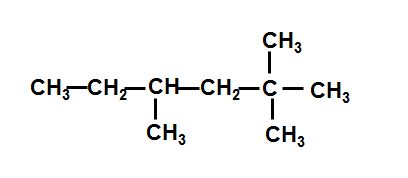
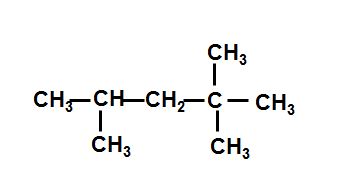
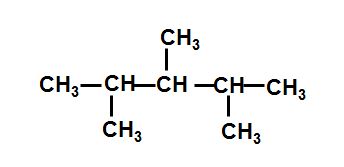
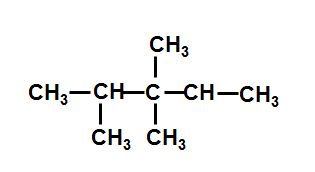
How many structural isomers does C5H12 have?
2
3
5
9
Which is the name of this compound?
3-ethyl-2,2-dimethylhex-3-yne
4-ethyl-5,5-methylhex-2-yne
4-butylhex-2-yne
4-ethyl-5,5-dimethylhex-2-yne
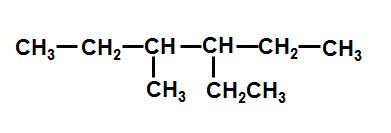
Give the IUPAC name for this compound
3-methyl-4-ethylhexane
3-ethyl-4-methylhexane
3-methyl-4-ethylheptane
3-ethyl-4-methylheptane
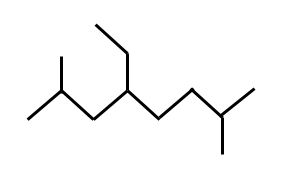
Give IUPAC nomenclature for this compound
2,7-dimethyl-5-ethyloctane
5-ethyl-2,7-dimethyloctane
2,7-dimethyl-3-ethyloctane
4-ethyl-2,7-dimethyloctane

Name this molecule
2-methyl-but-1-yne-3-ene
1-methyl-but-1-yne-3-ene
2-methyl-but-1-ene-3-yne
1-methyl-but-1-ene-3-yne


