
 Worksheets
Classification of Matter Test Review
Total questions: 125
Worksheet time: 4hrs 10mins
------------
2 x 10⁶
Convert this number into scientific notation: 0.068
6.9 x 10⁶
6.8 x 10⁻⁹
6.8 x 10⁻²
None of the above
Convert this number into scientific notation: 950,000
9.5 x 10⁵
9.5 x 10⁻⁹
9.5 x 10²
None of the above
.000457
6.34 x 10⁻⁹
____________
2.1 x 10⁸

What is the correct reading of the water level in the image?
40 mL
39.0 mL
38.5 mL
38.0 mL
(6.9 x 10⁷) / (2.3 x 10⁻³)
7.3 x 10⁵ + 3.7 x 105 =
5 x 10⁸ - 3.4 x 108 =

What is the result of 1345.567 divided by 23.56? (Use significant figures!)
57.11
58.11
56.75
83.49
Calculate 1.23 m x 0.89 m and give your answer with the appropriate number of significant figures.
1.0 m2
1.1 m2
1.0947 m2
1.09 m2
Calculate 12.34 + 1.234 + 0.1234. Use only sig fig in your answer
13.6974
13.697
13.70
13.7
Convert 4.2 seconds to hours
0.00117 hours
252.0 hours
0.05 hours
1.2 hours
Convert 354 grams to kg
0.354 kg
3.54 kg
35400 kg
3540 kg
Convert 26.2 m/s to km/hr
94.32 km/hr
3.41 km/hr
2.64 km/hr
0.98 km/hr
Frank has a paper clip. It has a mass of 9g and a volume of 3cm3. What is its density?
3 g/cm3
0.33 g/cm3
27 g/cm3
39 g/cm3
A mechanical pencil has the density of 3.0 g/mL. The volume of the pencil is 15.8 mL. What is the mass of the pencil?
47.4 g
50 g
0.190 g
5.27 g
A screwdriver has the density of 5.5 g/mL. It has a mass of 2.3 g. What is the screwdriver’s volume?
2.4 mL
0.42 mL
12.65 mL
0.42 g
A student has a rectangular block. It is 2 cm wide, 3 cm tall, and 25 cm long. It has a mass of 601 g. What is the density of the block? (V = L x W x H)
150 cm3
4 g/cm3
0.25 g/cm3
150 g/cm3
Which unit of measurement is used for density?
g
cm3
g/cm3
mL
Object B floats in water. The object is broken into 5 pieces and one of those pieces is placed into the water. What will the object do?
sink
float
sink at first and then float
float at first and then sink
The volume of water in a graduated cylinder is 50 mL. A marble is placed in the cylinder and the volume goes up to 52 mL. What is the density if the mass of the marble is 1 gram?
1.0 g/mL
1.04 g/mL
2 g/mL
.5 g/mL

Which box has a higher density?
A
B
They both have the same density.

Which substance has a density greater than water (1.0 g/ml)?
Substance A
Substance B
Neither
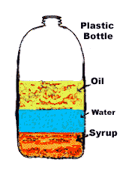
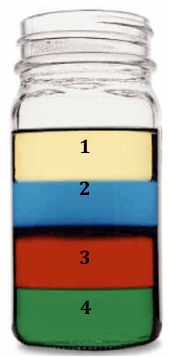
If both of these substances were placed in the same container, which one would float as the top layer?
Substance A
Substance B
Neither
If both of these substances were placed in the same container, which one would float as the top layer?
Substance A
Substance B
Neither

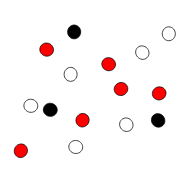
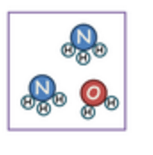
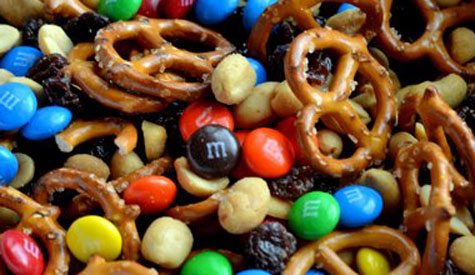
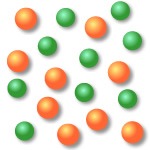
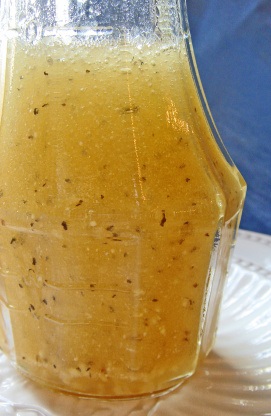

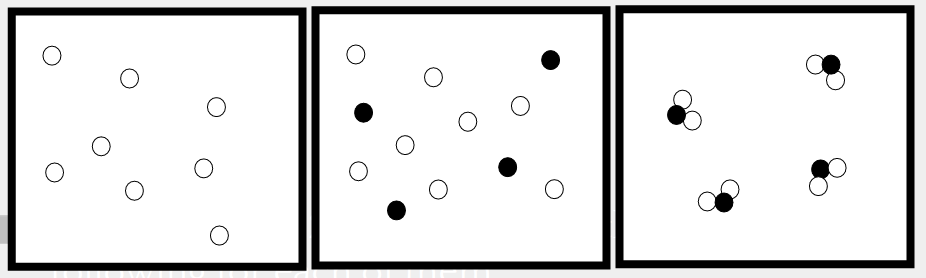

Classify the matter pictured
Element
Compound
Mixture of elements
Mixture of compounds
Mixture of elements and compounds
Which of the following are NOT considered matter. (Check 2 of them)
Solid
Sound
Gas
Light
Liquid
Which of the following are evidences of a chemical change? (select all)
sudden change of color
Change of shape by tearing
Change of size by pounding flat
release of odor
Which of the following are physical changes? (Select all)
Cutting your hair
Fruit rotting
Water boiling
Dropping an alka-seltzer in water
Which of the following are examples of chemical changes? (Select all)
Burning paper
Cutting paper
Iron rusting
Writing on paper
Matter is anything that.....
Has mass and takes up space
Has mass and is visible
Takes up space and has energy
Has energy and is visible
What is an example of a chemical change?
Tearing paper
Dissolving salt in water
Melting ice
Burning wood
What is an example of a physical property?
Silver is shiny
Alcohols are flammable
Alkali metals are reactive with water
Acids are sometimes corrosive
Matter can be classified as either a __________ or a _____________.
Element or a Compound
Compound or a Solid
Pure Substance or a Mixture
Mixture or a Solid
Ammonia, or NH3 is a:
Mixture
Element
Compound
Particle
A substance with a variable and inconsistent composition made of two or more different substances physically mixed together that can be separated by physical means.
Homogeneous
Heterogeneous
Homogeneous and heterogeneous
None
What is an example of a physical property?
Silver is shiny
Alcohols are flammable
Alkali metals are reactive with water
Acids are sometimes corrosive
What is the best classification of this substance? H2SO4
An element
A compound
A mixture
What is a physical property?
A property that describes how something changes over time
An observable property that describes the state of a system
A property that describes how reactive something is

Physical change
change of one substance into a new substance
any change in size, shape, or state of matter in which the identity of the substance remains the same.
any characteristic of a material, such as size or shape, that can be observed without changing the identity of the material.
any characteristic of a substance, such as flammability, that can be observed that produces a new substance.
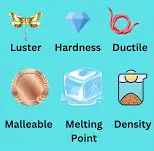
Physical property
change of one substance into a new substance
any change in size, shape, or state of matter in which the identity of the substance remains the same.
any characteristic of a material, such as size or shape, that can be observed without changing the identity of the material.
any characteristic of a substance, such as flammability, that can be observed that produces a new substance.

Distillation
process that can separate two substances in a mixture by evaporating a liquid and re-condensing its vapor.
law that states that the mass of all substances present before a chemical change equals the mass of all the substances remaining after the change.
any characteristic of a substance, such as flammability, that can be observed that produces a new substance.
tendency for a beam of light to scatter as it passes through a colloid.

Chemical Property
any characteristic of a material, such as size or shape, that can be observed without changing the identity of the material.
any characteristic of a substance, such as flammability, that can be observed that produces a new substance.
any change in size, shape, or state of matter in which the identity of the substance remains the same.
change of one substance into a new substance

Chemical Change
change of one substance into a new substance
any change in size, shape, or state of matter in which the identity of the substance remains the same.
any characteristic of a material, such as size or shape, that can be observed without changing the identity of the material.
any characteristic of a substance, such as flammability, that can be observed that produces a new substance.
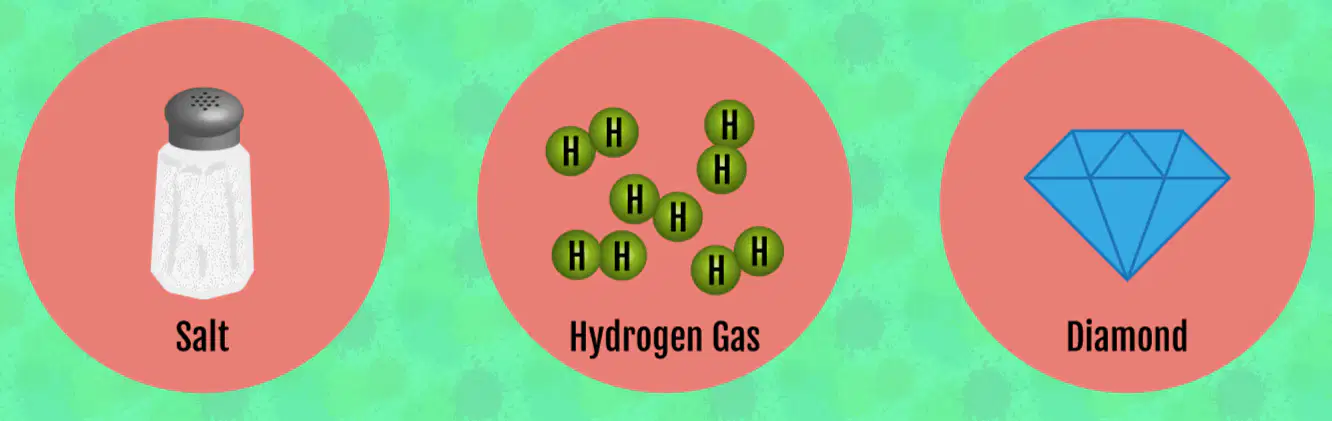
Pure Substance
element or compound that cannot be broken down into simpler components without losing the properties of the original substance.
substance in which the atoms of two or more elements are combined CHEMICALLY and in fixed proportions.
substance containing two or more components that are blended/mixed uniformly so that individual components are indistinguishable with a microscope; like soda
substance in which its different components are easily distinguished; like trail mix

Solution
homogeneous mixture, remains constant and uniformly mixed and has particles that are so small they cannot be seen with a microscope.
heterogenous mixture containing a liquid , and in which visible particles slowly settle due to gravity; ex. yoohoo or muddy water
heterogeneous mixture whose particles never settle; like FOG

Homogeneous mixture
element or compound that cannot be broken down into simpler components without losing the properties of the original substance.
substance containing two or more components that are blended/mixed uniformly so that individual components are indistinguishable with a microscope; like soda
substance which atoms that are all alike; Gold, oxygen
substance in which its different components are easily distinguished; like trail mix

Heterogeneous mixture
element or compound that cannot be broken down into simpler components without losing the properties of the original substance.
substance containing two or more components that are blended/mixed uniformly so that individual components are indistinguishable with a microscope; like soda
substance which atoms that are all alike; Gold, oxygen
substance in which its different components are easily distinguished; like trail mix
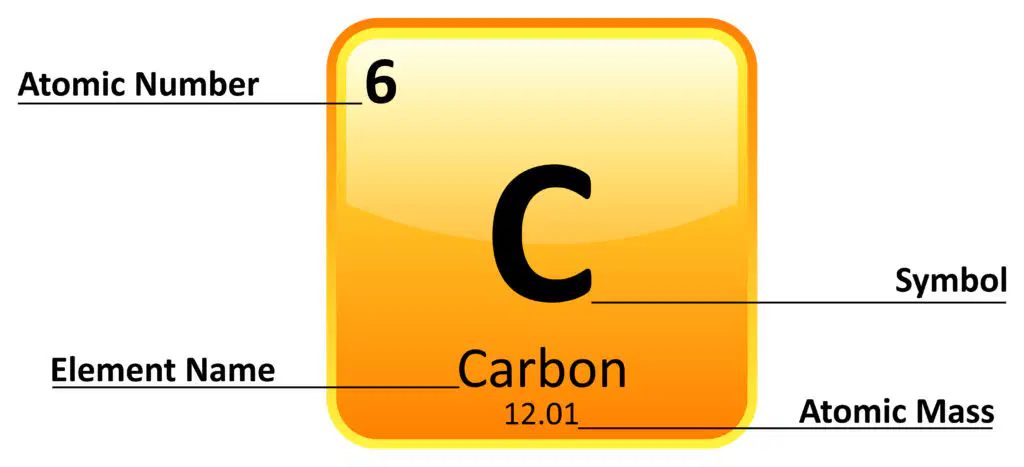
Element
substance which atoms that are all alike; Gold, oxygen
heterogeneous mixture whose particles never settle; like FOG
substance in which its different components are easily distinguished; like trail mix
substance in which the atoms of two or more elements are combined CHEMICALLY and in fixed proportions.

Compound
substance in which its different components are easily distinguished; like trail mix
substance containing two or more components that are blended/mixed uniformly so that individual components are indistinguishable with a microscope; like soda
substance in which the atoms of two or more elements are bonded together in fixed proportions.
element or compound that cannot be broken down into simpler components without losing the properties of the original substance.


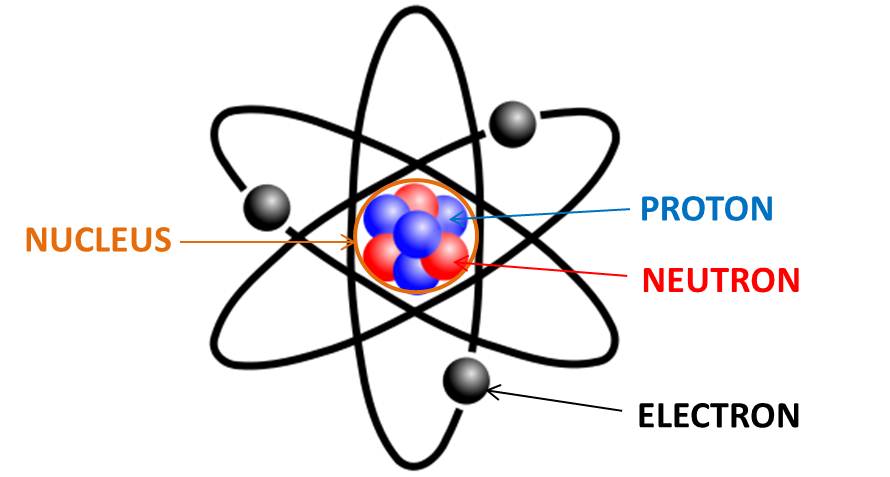
Blood is a fluid found in the bodies of humans and other animals. It can be physically separated into plasma, red blood cells and white blood cells. Blood is a ___________________
pure substance
mixture
Chemical or Physical:
Mass, volume, or density of an object is a _______________ property of that object.
Chemical
Physical
Chemical or Physical:
The ability to cook, burn, rust, tarnish, or explode is an example of a ___________ property.
Chemical
Physical


Round 5.67498 to 1 s.f.
(a)
Round 0.04102 to 3 s.f.
(a)
Round 2.998 to 2 s.f.
(a)
Round 26,384 to 2 s.f.
(a)
Round 0.006008 to 3 s.f.
(a)

Distillation method
Sieving method
Filtration method
Sedimentation method

Sedimentation method
Distillation method
Filtration method
Sieving method
Which mixture can be separated using a filtration method?
oil and water
sand and iron powder
sand and water
water and ethanol
Paper clips and glass fragments can be separated by using a ________
magnet
filter paper
flotation method
distillation method
Which of these is a mixture?
oxygen
copper sulfate
air
quartz
If I know the components of a mixture and the boiling points of the components, which is a possible way to isolate the components in the mixture?
makes use of magnetic attraction
make use of evaporation
make use of distillation
make use of paper chromatography
Homogeneous Mixture is a Synonym of...
Solution
Pure substance
Mixture
Compound
There are two types of mixture
Magnetic and separation
Decantation and filtration
Heterogeneous and homogeneous
Heteregeous and evaporation
True or False: Elements and compounds are pure substances.
True
False
Baking soda combines with vinegar to create bubbles of carbon dioxide gas.
physical change
chemical change

