
 Worksheets
H Chem Tri B Final Exam Review
Total questions: 127
Worksheet time: 5hrs 10mins
What coefficients are needed to balance the reaction?
What coefficient goes in front of H2?
The equation for Percent Yield:
(theoretical/experimental) X 100
(experimental/theoretical) X 100
(experimental - theoretical)/ Predicted X 100
What is a Limiting Reagent?
speeds up a reaction
reactant consumed first
reactant in excess
slows down a reaction
What is a Excess Reagent?
amount you end with
reactant consumed first
reactant in excess
reactant you start with
How many moles of oxygen are produced when 6.7 moles of KClO3 decompose completely?
How many grams of hydrogen are produced if 120 g of Na are available?
What is the measured amount of a product obtained from a chemical reaction?
mole ratio
theoretical yield
percentage yield
actual/experimental yield
How many grams of potassium chloride can be produced from 356 g of chlorine and 356 g of potassium bromide?
In the experiment above, 7.62 g of Fe are allowed to react with 8.67 g of S.
How much FeS is formed?

Percent yield=(________)÷(________)×100%


Actual yield = 62g
Calculate the percent yield.
What is the percent by mass of a solution made by dissolving 20.0 g of NaCl into 180.0 g of water?
10.0 %
11.1 %
80.0 %
20.0 %
Find the percentage composition of Mg in Mg3(PO4)2.
27.48% Mg
43.11% Mg
16.00% Mg
12.63% Mg
What is the mass percentage of Carbon in Carbon dioxide (CO2)?
27.27%
42.86%
72.73%
72.72%


You are given a small beaker of solution at room temp. You add a bit of solute to the solution and it dissolves. The solution was:
saturated
unsaturated
concentrated
warm
An electrolyte is...
The rapid, random movement of particles in colloidal dispersion.
A substance that dissociates/ionizes into ions in water and conducts electric current.
A substance that dissolves in water and does not conduct electric current.
The solution process when water is the solvent.


solution. Which amount would you need to change to solve for molarity?
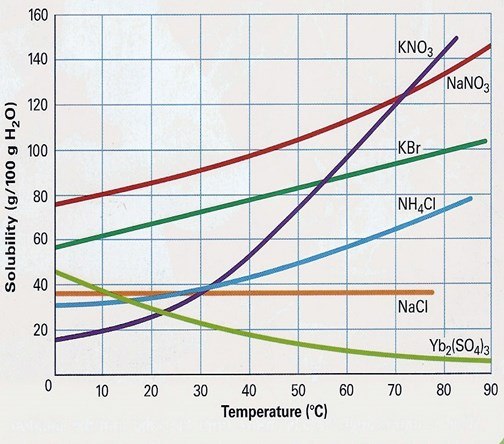
Identify if the following solution would be saturated, unsaturated, or supersaturated: 103 g KBr at 70'C.
Unsaturated
Saturated
Supersaturated
How could you change a saturated solution to an unsaturated solution?
Add solvent
Add solute
A ______________ solution contains more dissolved solute than a saturated solution at the same temperature.
saturated
supersaturated
suspended
unsaturated
An aqueous solution is:
any liquid with another compound dissolved in it.
an ionic compound with water dissolved in it.
water with another compound dissolved in it.
none of the above
Which of the following compounds is SOLUBLE?
copper carbonate
calcium carbonate
potassium carbonate
strontium carbonate
In writing the chemical equation for a precipitation reaction, what abbreviation of the physical state must appear with one of the products?
(s)
(g)
(l)
(w)
What would be the formula of the precipitate that forms when Pb(NO3)2 (aq) and K2SO4 (aq) are mixed?
K(NO3)2
PbSO4
PbK2
H2O
Considering the following precipitation reaction:
Pb(NO3)2(aq) + 2KI(aq) → PbI2(s) + 2KNO3(aq)
What is the correct complete ionic equation?
Pb2+ + (NO3)2- + 2K+ + 2I- → PbI2(s) + 2K+ + 2NO3-
Pb2+ + 2NO3- +2K+ + I- → PbI2(s) + 2K+ + NO3-
Pb2+ + 2NO3- + 2K+ + 2I- → PbI2(s) + 2K+ + 2NO3-
Pb2+ + 2NO3- + 2K+ + 2I- → Pb2+ + 2I- + 2K+ + 2NO3-
Which of the following statements about writing molecular, complete and net ionic equations is FALSE?
A molecular equation is a chemical equation showing the complete, neutral formulas for every compound in a reaction
A complete ionic equation is a chemical equation showing all of the species as they are actually present in solution.
A net ionic equation is an equation showing only the species that actually participate in the reaction.
A spectator ion remains unchanged in the reaction and appears on both sides of the equation.
All of the statements are true
Which of the following compounds is INSOLUBLE?
magnesium phosphate
magnesium sulfate
magnesium iodide
magnesium nitrate
none of the above
What is the net ionic equation for the precipitation reaction between BaCl2 and Na2SO4?
BaCl2(aq) + Na2SO4(aq) --> BaSO4(s) + 2NaCl(aq)
Na+(aq) + Cl-(aq) --> NaCl(s)
Ba2+(aq) + SO42-(aq) --> BaSO4(s)
Ba2+(aq) + 2Cl-(aq) + 2 Na+(aq) + SO42-(aq) --> BaSO4(s) + 2Cl-(aq) + 2Na+(aq)
When solutions of two ionic compounds are combined and a solid forms, the process is called
hydration
solvation
dissociation
precipitation
Which of the following pairs of solutions produces a precipitate when combined?
Cu(NO3)2 and NaCl
Fe(NO3)3 and MgCl2
Cu(NO3)2 and K2CO3
CaCl2 and NaNO3
Identify the spectator ion(s) in the equation: 2Ag+(aq) + 2NO3–(aq) + 2Na+(aq) + S2–(aq) --> Ag2S(s) + 2Na+(aq) + 2NO3–(aq)
2Ag+(aq) + 2NO3–(aq)
2Na+(aq) + 2NO3–
2Na+(aq) + S2–(aq)
Ag2S(s) + 2Na+(aq
Zn(OH)2 + HNO3 ---> H2O + Zn(NO3)2
Which of the following is NOT a property of bases.
Bitter
Makes OH- in solution.
pH below 7
pH above 7
Which of the following are NOT properties of acids?
sour
bitter
pH below 7
creates H3O+ ions in a solution.
What range of values on the pH scale represent solutions with a higher ratio of hydronium (H3O+) ions?
0-14
below 7
7
above 7
When found in food, acids often taste ________.
Sour
Bitter
Salty
Slippery
Pure water (H2O) has a pH of 7 and would be classified as...
a base
a neutral substance
both an acid and a base
an acid

The reactants in a neutralization reaction are always...
salt and water
an acid and a base
a neutral solution
carbon dioxide and oxygen
Acids are __________, which means they "eat away" at other materials.
transitional metal
alkaline
flammable
corrosive
(HINT...be careful! Acidity and basicity are determined by the point measured on the pH scale. And don't forget [H+] = 10-pH)
(HINT...pH + pOH = 14 and
[OH-] = 10-pOH)
(HINT...use the calculator...
pH = -log [H+] )
Identify the acid listed below:
KOH
H2O
H2SO4
NaCl
If a solution has a [H+] of 1.0 x 10 -5, what is the [OH-]?
1.0 x 10 -9
1.0 x 10 -5
1.0 x 10 -14
1.0 x 10 -7
If HF and KOH react, which salt would be produced?
KF
HOH
FOH
HK
During a titration, 20. mL of 0.50 M HF is used to neutralize 10. mL of NaOH. What is the concentration of the base?
1.0 M NaOH
0.25 M NaOH
400 M NaOH
10 M NaOH
A student collects the following data during a titration. Calculate the concentration of acid:
Volume of Acid: 20. mL HCl
Concentration of NaOH: 1.0 M NaOH
Initial Buret Reading of NaOH: 1.70 mL
Final Buret Reading: 32.20 mL
1.6 M HCl
1.5 M HCl
0.085 M HCl
0.66 M HCl
You need a pH of 6.2; you have a pH of 5.1. Do you need to add an acid or a base?
A base.
An acid.
You need a pH of 7; you have a pH of 11.2. What should you add?
A base.
An acid.
Which chemical is a proton donor?
Acid
Base
After a chemical reaction, the beaker feels cold to the touch. This is likely a ____________ reaction.
negative
positive
endothermic
exothermic
This type of reaction releases thermal energy to its surroundings.
endothermic
exothermic
decomposition
synthesis
When the pH of a solution changes from 6 to 4, the solution becomes
2 times less acidic
2 times more acidic
100 times less acidic
100 times more acidic
What reaction has the following general formula:
CxHy + O2 −>CO2 + H2O
Combination
Decomposition
Single Replacement
Double Replacement
Combustion
What type of reaction is the following:
2KI −> 2K + I2
Combination
Decomposition
Single Replacement
Double Replacement
Combustion
What type of reaction is the following:
C11H24+17O2−> 11CO2 + 12H2O
Combination
Decomposition
Single Replacement
Double Replacement
Combustion
What type of reaction is the following:
2C4H10 +13O2 −> 8CO2+10H2O
Combination
Decomposition
Single Replacement
Double Replacement
Combustion
MgCl2 + Li2CO3 ----> MgCO3 + 2 LiCl
Synthesis
Neutralization
Single displacement
Precipitation
No Reaction
All chemical equations must be balanced because of the Law of Conservation of Mass. This law states.....
that matter exists in all states and reacts the same
that matter can only be changed into new substances by introducing a catalyst
that matter exists in the same state throughout any chemical change
that matter cannot be created or destroyed and that the mass of the products must equal the mass of the reactants
The following reaction is classified as:
Zn(OH)2 + HNO3 ---> H2O + Zn(NO3)2
Synthesis
Single Replacement
Precipitation
Neutralization
No Reaction
Which process involves the transfer of electrons?
double replacement
neutralization
oxidation-reduction
sublimation
During an oxidation-reduction reaction, the number of electrons gained is
equal to the number of electrons lost
equal to the number of protons gained
less than the number of electrons lost
less than the number of protons gained
In a redox reaction, there is a conservation of
mass, only
charge, only
both mass and charge
neither mass nor charge
During which process does an atom gain one or more electrons?
transmutation
reduction
oxidation
neutralization
When a lithium atom forms an Li+ ion, the lithium atom
gains a proton
gains an electron
loses a proton
loses an electron
Defined as the loss of electrons.
oxidation
reduction
redox
OIL RIG
Defined as the gain of electrons.
oxidation
redox
reduction
LEO GER




A sample of gas at a constant pressure with a volume of 30.0 mL at 25.0oC is heated to 50.0oC. What is the new volume of the gas?
60.0 mL
15.0 mL
27.5 mL
32.5 mL



