wayground logo

Free Printable Worksheets

Font size

S
M
L
XL
Worksheets

Practice Final Exam Chemistry Honors

Total questions: 125

Worksheet time: 4hrs 10mins
Name
Class
Date
1.
You need to measure the volume of a liquid. Which piece of equipment should you use? Untitled Question
a)
Beaker
b)
Graduated Cylinder
c)
Test tube
d)
Flask
2.
A metal pole with a solid base, used to hold or clamp glassware and other equipment in place
a)
Pole clamp
b)
Metal spatula
c)
Ring stand
d)
Graduated cylinder
3.
When gathering glassware and equipment for an experiment, you should
a)
read all directions carefully to know what equipment is necessary.
b)
examine all glassware to check for chips or cracks.
c)
clean any glassware that appears dirty.
d)
All of the above.
4.
You broke a test tube. What should be your next steps?
a)
Pick it up with your bare hands. Don't inform the teacher.
b)
Inform the teacher. And then use the broom/dustpan and place it into the broken glass container.
c)
Walk away from it. Don't Inform the teacher.
d)
Inform the teacher. And then use the broom/dustpan and place it into a common trash can.
5.
A series of steps used by scientists to solve a problem or answer a question.
a)
scientific method
b)
recipe
c)
data collection
d)
metric system
6.
Which type of data involves numbers that are obtained by counting or measuring?
a)
quantitative
b)
qualitative
7.
An experiment was carried out to determine whether drinking caffeinated soda increases pulse rate. The pulse rates of two groups of people at rest were measured. Group A was then given caffeinated soda and group B was given caffeine-free soda. One hour after drinking the soda, the pulse rates were measured. The participants in the experiment were all the same age, and they were all given the same amount of soda. The dependent variable in this experiment is the
a)
type of soda given to each group
b)
amount of soda given to each group
c)
pulse rate of each group
d)
age of participants in each group
8.
The SI unit for volume is the __________.
a)
liter
b)
meter
c)
ounce
d)
gram
e)
gallon
9.
The metric prefix kilo- means
a)
1000
b)
100
c)
0.001 or 1/1000
d)
0.01 or 1/100
10.
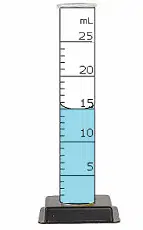
What is the correct volume of the liquid?
a)
15.1 ml
b)
15 ml
c)
16 ml
d)
14.9 ml
11.
Which is a correct measurement reading for the length of the screw?
a)
5.1 cm
b)
5.10 cm
c)
5.100 cm
d)
5.01 cm
12.
In the measurement 0.503 L, which digit is the estimated digit?
a)
5
b)
the 0 immediately to the left of the 3
c)
3
d)
the 0 to the left of the decimal point
13.
Three different people weigh a standard mass of 2.00 g on the same balance. Each person obtains a reading of 7.32 g for the mass of the standard. These results imply that the balance that was used is ____.
a)
accurate
b)
precise
c)
accurate and precise
d)
neither accurate nor precise
14.

How are cm3 and mL related?

a)

cm3 is a unit of measure of volume and mL is a unit of measure for mass

b)

mL is a unit of measure of volume and cm3 is a unit of measure for mass

c)

they are equivalent units of measure for volume

d)

they aren’t related at all

15.
If you change the shape or state of a substance what physical property doesn’t change?
a)
mass
b)
volume
c)
length
d)
area
16.
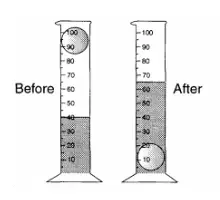
The sphere is dropped into the graduated cylinder as shown on picture. What is the volume of the sphere?
a)
15 mL
b)
25 mL
c)
40 mL
d)
65 mL
17.
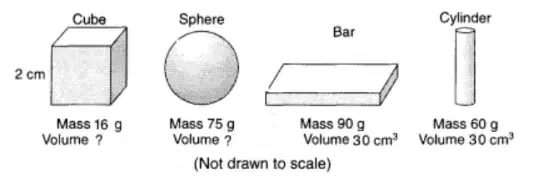
What is the density of the cube?
a)

8.0 g/cm3

b)

2.0 g/cm3

c)

32.0 g/cm3

d)

3.0 g/cm3

18.

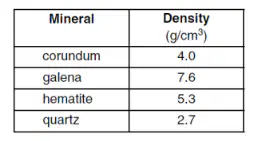
The data table below shows the density of four different mineral samples. A student accurately measured the mass of a sample of one of the four minerals to be 249.6 grams at its volume to be 47.1 cm3. Which sample of mineral did the student measure?

a)

Corundum

b)

Hematite

c)

Galena

d)

Quartz

19.
When a sample of gas is heated, its thermal energy ______ and the particles move_____.
a)
Increases; slower
b)
Decreases; slower
c)
Increases; faster
d)
Decreases; faster
20.
The pressure exerted by a gas on the container depends on….
a)
The space between the particles
b)
The instrument used to measure the pressure
c)
The number of collisions between gas particles and other gas particles
d)
The number of collisions between gas particles and the walls of the container
21.
As the temperature of a liquid substance increases the average energy of the particles _________ and the space between the particles ____________.
a)
stays the same; increases
b)
increases; decreases
c)
increases; increases
d)
increases; stays the same
22.
Why can’t we use the Celsius temperature scale to solve gas law problems?
a)
The Celsius scale doesn’t go low enough
b)
The Celsius scale includes zero and negative numbers
c)
The Celsius scale has degrees that are too large
d)
The Celsius scale has reference points of the boiling and freezing point of water so it is not an absolute scale.
23.
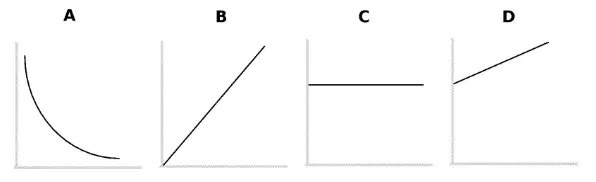
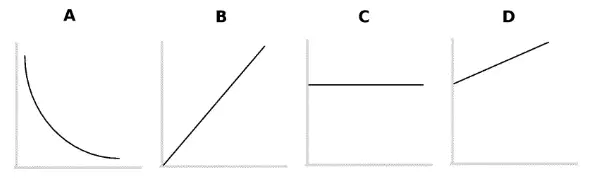
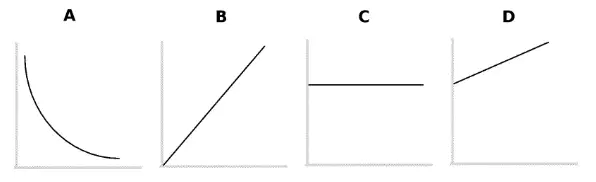
Which graph represents the relationship between the pressure of a gas and the absolute temperature?
a)
A
b)
B
c)
C
d)
D
24.
Which graph represents the relationship between the pressure of a gas and its number of particles?
a)
A
b)
B
c)
C
d)
D
25.
Which graph represents the relationship between the pressure of a gas and its volume?
a)
A
b)
B
c)
C
d)
D
26.
Isotopes of Carbon (Carbon-12 and Carbon-14) have the same number of _______ but a different number of ________ .
a)
protons, neutrons
b)
protons, electrons
c)
neutrons, protons
d)
electrons, protons
27.
What would be the correct nuclear notation for an atom with 7 neutrons and 8 protons?
a)
Option 1
b)
Option 2
c)
Option 3
d)
Option 4
28.
What would be the correct number of each subatomic particle in an atom of
a)
30 protons, 37 neutrons, 28 electrons
b)
32 protons, 37 neutrons, 30 electrons
c)
30 protons, 37 neutrons, 32 electrons
d)
28 protons, 37 neutrons, 30 electrons
29.
X has two isotopes: X-12 (20.0%) and X-13 (80.0%). The average mass is:
a)
12.2
b)
12.5
c)
12.8
d)
13.0
30.
A sample originally contains 20 atoms. After 16 days, 5 atoms remain. What is the half-life?
a)
4 days
b)
8 days
c)
12 days
d)
16 days
31.
How many energy levels of electrons are occupied in a phosphorus atom?
a)
1
b)
4
c)
2
d)
3
32.
All elements in the same family or group have similar numbers of:
a)
total electrons
b)
inner electrons
c)
valence electrons
d)
protons
33.
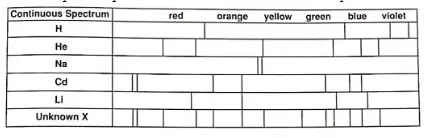
Use the emission spectra presented below to answer the question. Which two elements are in unknown X?
a)
hydrogen and cadmium
b)
helium and cadmium
c)
lithium and helium
d)
sodium and lithium
34.
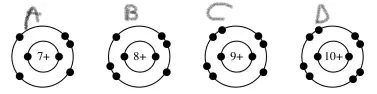
Oxygen is a gas important for life and represents about 21% of Earth’s atmosphere. Which of the following illustrations below best represents a Bohr diagram of an oxygen atom?
a)
A
b)
B
c)
C
d)
D
35.
Which is an electron configuration of a fluorine atom in the excited state?
a)
Option 1
b)
Option 2
c)
Option 3
d)
Option 4
36.
Which is the correct electron dot representation of an atom of sulfur in the ground state?
a)
A
b)
B
c)
C
d)
D
37.
As you move down a group of the periodic table, the atomic radii of the elements
a)
increase
b)
decrease
c)
remain constant
d)
show no pattern
38.
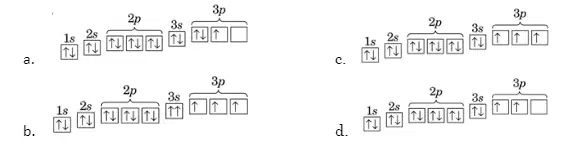
Which of the following orbital filling diagrams for phosphorus is correct?
a)
A
b)
B
c)
C
d)
D
39.
Based on the image below, which circle would best represent phosphorus?
a)
A
b)
B
c)
C
d)
D
40.
Based on the periodic table, which group tends to have the highest ionization energy? The lowest?
a)
halogens; alkaline earth metals
b)
alkali metals; noble gases
c)
alkaline earth metals; halogens
d)
noble gases; alkali metals
41.
Which of the following has the largest electronegativity value?
a)
Sulfur, S
b)
Chlorine, Cl
c)
Barium, Ba
d)
Rubidium, Rb
42.
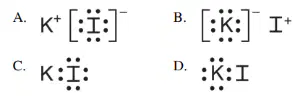
Which Lewis electron dot diagram represents the bonding in potassium iodide?
a)
A
b)
B
c)
C
d)
D
43.
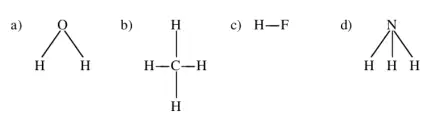
Which structural formula represents a nonpolar symmetrical molecule?
a)
A
b)
B
c)
C
d)
D
44.
Which substance contains a polar covalent bond?
a)
A
b)
B
c)
C
d)
D
45.
The relatively high boiling point of water is primarily due to the presence of
a)
Hydrogen bonds
b)
London dispersion forces
c)
Molecule-ion attractions
d)
Ion-ion attraction
46.
a)
Polar covalent
b)
Metallic
c)
Nonpolar covalent
d)
Ionic
47.
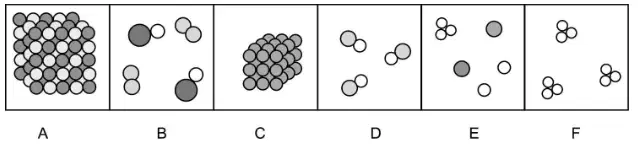
A mixture of elements
a)
E
b)
A
c)
B
d)
C
e)
D
48.
Which particle model diagram represents a chemical change?
a)
Option 1
b)
Option 2
c)
Option 3
d)
Option 4
49.
Which of the following is an example of a physical change?
a)
sugar and oxygen reacting to produce water and carbon dioxide
b)
honey dissolving in tea
c)
a raw egg being cooked
d)
metal rusting after being left out in the rain
50.
Student wants to separate a mixture of many tiny beads that are all the same size. Some of the beads are made from pine wood and some of the beads are metal. What would be the easiest way for her to separate the mixture?
a)
Add water and the wooden beads will dissolve.
b)
Pick out all the wooden beads by hand.
c)
Add water and the wooden beads will float.
d)
Sift the beads and the wooden ones will stay on top.
51.
The compound sodium chloride is placed in water and separates into ions. What are the correct names for these ions?
a)
The chloride and sodium ions are both cations.
b)
The chloride and sodium ions are both anions.
c)
The sodium ion is the anion, and the chloride ion is the cation
d)
The sodium ion is the cation, and the chloride ion is the anion.
52.
What are two properties of most nonmetals?
a)
Low/no conductivity, low melting point
b)
Low/no conductivity, high melting point
c)
High conductivity, high melting point
d)
High conductivity, low melting point
53.
Test results on two white crystalline solids are shown in the table below. Based on the information in the table, what can be concluded?
a)
Both solids contain only ionic bonds.
b)
Both solids contain only covalent bonds.
c)
Solid X contains only covalent bonds, and Solid Y contains only ionic bonds.
d)
Solid X contains only ionic bonds, and Solid Y contains only covalent bonds.
54.
Theobromine is a compound within dark chocolate that gives it a bitter flavor. Theobromine contains 46.66% C, 4.48% H, 31.11% N, and 17.76% O by mass. In a 75 g sample of theobromine, how many grams of N would you expect to find?
a)
31.11 g N
b)
23.33 g N
c)
2.41 g N
d)
52.45 g N
55.

An unknown metal, X, combines with nitrogen to form the compound XN. Metal X also combines with oxygen to produce X2O3. Metal X is most likely which of the following elements?

a)

Lithium, Li

b)

Magnesium, Mg

c)

Tin, Sn

d)

Gallium, Ga

56.
The substances listed on the right side of a chemical equation are the
a)
Yields
b)
Reactants
c)
Products
d)
Precipitates
57.
In balancing chemical equations, we change
a)
Coefficients
b)
Subscripts
c)
Both can be changed
d)
None can be changed
58.
a)
1 mol
b)
2 mol
c)
3 mol
d)
6 mol
59.
a)
a
b)
b
c)
c
d)
d
60.
a)
Synthesis
b)
Decomposition
c)
Single replacement
d)
Combustion
61.
In what type of reaction do two or more substances come together to form a single product?
a)
Synthesis
b)
Decomposition
c)
Single replacement
d)
Combustion
62.
a)
a
b)
b
c)
c
d)
d
63.
a)
a
b)
b
c)
c
d)
d
64.
a)
a
b)
b
c)
c
d)
d
65.
The activity series measures a substance’s (metal or halogen) tendency to form
a)
Cations for metals & anions for nonmetals
b)
Cations for nonmetals & anions for metals
c)
Solids at room temperature for nonmetals
d)
Multiple covalently bonded compounds
66.
A precipitate is defined as
a)
A solid that forms from two covalently bonded compounds
b)
A solid that forms from the combination of two aqueous ionic compounds
c)
A substance that is created during a single replacement reaction
d)
A substance that is soluble in water but may become insoluble with time
67.
a)
a
b)
b
c)
c
d)
d
68.
How can you identify the spectator ions in a chemical reaction equation between two aqueous substances?
a)
They are changed over the course of the chemical reaction and form a solid.
b)
They are changed over the course of the chemical reaction and form a gas.
c)
They are unchanged over the course of the chemical reaction and remain aqueous.
d)
They are unchanged over the course of the chemical reaction and remain solid.
69.
a)
a
b)
b
c)
c
d)
d
70.
a)
a
b)
b
c)
c
d)
d
71.
a)
a
b)
b
c)
c
d)
d
72.
What is the total mass, in grams of 0.75 mole sulfur dioxide?
a)
16 g
b)
24 g
c)
32 g
d)
48 g
73.
a)
a
b)
b
c)
c
d)
d
74.
a)
a
b)
b
c)
c
d)
d
75.
a)
a
b)
b
c)
c
d)
d
76.
The limiting reactant in a chemical reaction is one that
a)
Always has the smallest molar mass
b)
Always has the least amount of moles
c)
Limits the amount of product that is formed and is completely consumed
d)
Is leftover at the end of the chemical reaction
77.
a)
a
b)
b
c)
c
d)
d
78.
a)
a
b)
b
c)
c
d)
d
79.
a)
a
b)
b
c)
C
d)
d
80.
a)
a
b)
b
c)
c
d)
d
81.
a)
a
b)
b
c)
c
d)
d
82.
a)
a
b)
b
c)
c
d)
d
83.
a)
a
b)
b
c)
c
d)
d
84.
a)
a
b)
b
c)
c
d)
d
85.
a)
a
b)
b
c)
c
d)
d
86.
Which of the following word pairs correctly completes the sentence below? _______ are corrosive substances characterized as having a strong smell, a sour taste, and a _______.
a)
Acids; pH less than 7
b)
Acids; pH greater than 7
c)
Bases; pH greater than 7
d)
Bases; pH less than 7
87.
Which of the following is a base?
a)
orange juice
b)
water
c)
vinegar
d)
dishwashing detergent
88.
On the pH scale what number(s) are acids?
a)
7-14
b)
0-7
c)
7
d)
1
89.
The pH scale measures...
a)
...the strength of an acid.
b)
...the strength of hydrogen ions.
c)
...the concentration of hydrogen ions.
d)
...the concentration of an acid.
90.
When an equal strength acid and base are mixed, what kind of chemical reaction occurs?
a)
Neutralization
b)
Combustion
c)
Oxidation
d)
Decomposition
91.
Holly has an unknown substance in a beaker. She wants to determine the relative pH of the unknown substance. She places a piece of blue litmus paper into the substance, and the litmus paper stays blue. The substance in the beaker
a)
is a base
b)
is an acid
c)
have neutral pH
d)
doesn't have pH
92.
What is the gas produced when acid reacts with carbonate?
a)
hydrogen
b)
carbon dioxide
c)
ammonia
d)
oxygen
93.
Which shows a balanced chemical equation for the reaction between sulfuric acid and sodium hydroxide?
a)
Option 1
b)
Option 2
c)
Option 3
d)
Option 4
94.
What is a "homogeneous mixture of two or more substances in a single phase"?
a)
Solution
b)
Solvent
c)
Solute
d)
Solubility
95.
Which of the following is a solution?
a)
sand
b)
hydrogen gas
c)
seawater
d)
chocolate chip cookie
96.
When you have added as much solute as can dissolve in the solvent, the solution is called:
a)
concentrated
b)
supersaturated
c)
saturated
d)
unsaturated
97.
You make a Kool Aid drink using Kool Aid powder, sugar, & water & you notice your drink still has too much powder sitting at the bottom. What will happen if you add more water to the drink?
a)
decrease the solubility
b)
decrease the solubility rate
c)
increase the solubility rate
d)
increase the solubility
98.
Solutions that conduct an electric current are called ____________ and usually are made from ___________ compounds.
a)
electrolytes; ionic
b)
nonelectrolytes; ionic
c)
nonelectrolytes; covalent
d)
electrolytes; covalent
99.
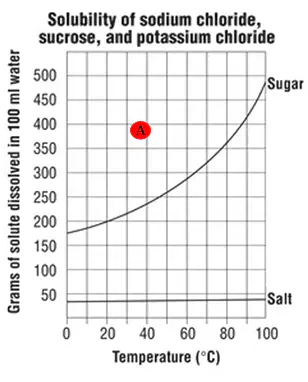
The sugar solution “A” would be considered
a)
Unsaturated
b)
Supersaturated
c)
Saturated
d)
Undefined
100.
Which substance is MOST soluble at 0 ºC?
a)
Option 1
b)
Option 2
c)
Option 3
d)
Option 4
101.
When 30 grams of potassium chloride, KCl, is dissolved in 100 grams of water at 50 ºC, the solution can be correctly described as:
a)
supersaturated
b)
unsaturated
c)
saturated
d)
Not a solution at all
102.

A solution of potassium chlorate, KClO3, has 20 grams of salt dissolved in 100 grams of water at 70 ºC. Approximately how many more grams of salt can be added until the solution becomes saturated?

a)

10 grams

b)

30 grams

c)

80 grams

d)

60 grams

103.
The molarity of a solution is
a)
The number of grams of solute divided by the liters of solute
b)
The number of moles of solute divided by the liters of solvent
c)
The number of moles of solute divided by the liters of solution
d)
The number of grams of solute divided by the liters of solution
104.
If 0.50 liter of a 12 M solution is diluted to 1 L, the molarity of the new solution is
a)
2.4 M
b)
6.0 M
c)
12.0 M
d)
24.0 M
105.
What is the total number of moles of solute contained in 0.50 liter of 3.0 M HCl?
a)
1.00 moles
b)
1.50 moles
c)
3.00 moles
d)
3.50 moles
106.
How many liters of 0.2 M NaOH solution would contain 0.4 mole of NaOH?
a)
1 L
b)
2 L
c)
0.5 L
d)
4 L
107.
What is the main purpose of acid-base titrations?
a)
To test if reactants react.
b)
To calculate the concentration of unknown analyte.
c)
To calculate the concentration of known analyte.
d)
To test the quality of reactants.
108.
What is the role of an indicator in an acid-base titration?
a)
To help reactants react successfully.
b)
To bind to the analyte to form products.
c)
To show when the reaction has reached or past the equivalence point.
d)
To provide a surface for the reaction to occur.
109.
What is an equivalence point in an acid-base titration?
a)
It is the point when enough analyte has been added.
b)
It is the point when the amount of added titrant is equal to the amount of analyte in the solution.
c)
It is the point when the volume of titrant is equivalent to the volume of analyte.
d)
It is the point when the concentration of titrant added is equivalent to the volume of analyte.
110.
a)
0.5 M
b)
50 M
c)
2.0 M
d)
1.0 M
111.
What is the rate of reaction?
a)
How much energy is needed for a reaction to occur.
b)
The energy required to break a bond.
c)
The time it takes for a reaction to occur.
d)
Collision Theory
112.
Collision theory states that....
a)
reaction rate increases when particles collide more
b)
reaction rate is not affected by collisions
c)
reaction rate increases as there are fewer collisions
d)
there is no relationship between collisions and reaction rate.
113.
How does temperature affect reaction rate?
a)
Increasing temperature= more collisions= increased reaction rate
b)
Decreasing temperature= fewer collisions= increased reaction rate
c)
Temperature has no effect on reaction rate.
d)
Decreasing temperature= more collisions= increased reaction rate
114.
When surface area is decreased the rate of reaction...
a)
Decreases, because there are LESS possible sites for correct collisions
b)
Increases, because there are LESS possible sites for correct collisions
c)
Decreases, because there are MORE possible sites for correct collisions
d)
Increases, because there are MORE possible sites for correct collisions
115.
Why does a higher concentration increase the rate of reaction?
a)
it increases the amount of reactants
b)
it lowers the activation energy
c)
it increases the energy of particle collisions
d)
it increases the frequency of particle collisions
116.
How does a catalyst work in speeding up a reaction?
a)
by lowering the activation energy or reaction
b)
by giving more energy to the particles
c)
by making particles more available
117.
The rate of a reaction increases as temperature__________________.
a)
Decreases
b)
Increases
c)
Stays the Same
118.
Products will form faster if____________
a)
the particle size of the reactants are larger.
b)
the temperature is decreased.
c)
concentration of the reactants are increased.
d)
the reagents are not stirred.
119.
A ______________ is a substance that increases the rate of a reaction without being used up during the reaction.
a)
catalyst
b)
product
c)
reactant
d)
solute
120.
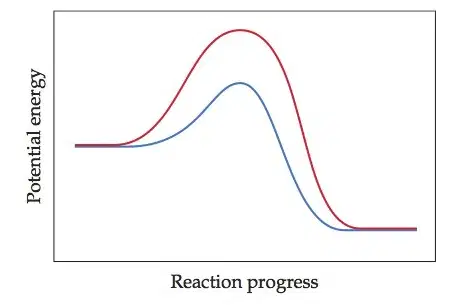
The following graph shows two different reaction pathways for the same overall reaction at the same temperature. Which pathway is slower and why?
a)
Red, because the activation energy is larger
b)
Blue, because the activation energy is lower
c)
both reaction progress at the same rate
121.
What are the two factors to look for when determining if the reaction is at equilibrium?
a)
Forward reaction rate is faster than the reverse and concentrations are equal
b)
Forward and reverse reaction rates are equal and concentration is constant
c)
Forward and reverse reaction rates are equal and concentration is equal
d)
Forward reaction rate is faster than the reverse and concentration is equal
122.
a)
left
b)
right
c)
left and right
d)
neither left nor right
123.
a)
Option 1
b)
Option 2
c)
Option 3
d)
Option 4
124.
a)
shift equilibrium right
b)
shift equilibrium left
c)
increase pressure
d)
have no change
125.
a)
to the left
b)
to the right
c)
to the left and right
d)
neither left nor right