
NEW
Font size
 Worksheets
Lesson 1: From Republic to Empire
Total questions: 52
Worksheet time: 2hrs 56mins
Which of the following did Rome do during the first period of expansion, before 264 B.C.E.?
surrender to Etruscans
conquer most of Europe
expand into North Africa
take over the Italian peninsula
A city conquered by Rome might become a Roman ally. What was a disadvantage for the conquered city?
It had to pay Roman taxes.
Its citizens were taken to Rome.
Its people became Roman citizens.
It was allowed to trade with Rome.
Why did most of the city of Rome burn down in 390 B.C.E.?
It was set on fire during a civil war.
It was attacked by Gauls.
Romans destroyed it to unite the Latins.
Hill tribes threw flaming torches into it.
During the Punic Wars in Rome’s second period of expansion, Rome’s main enemy was
mainland Greece.
the Egyptian pharaoh.
a city-state in North Africa.
a nomadic tribe in Europe.
Which issue first led to war between Rome and Carthage?
the ability to get wheat from Egypt
the right to start colonies in Spain
the use of chariots in warfare
control of trade in the Mediterranean
How did the Romans build a strong navy?
They drew on ancient Latin traditions.
They copied ship designs from Carthage.
They were influenced by Etruscan culture.
They adopted ideas from Greek settlers in Italy.
How did the general Hannibal surprise the Romans?
He burned their city to the ground.
He crossed the Alps with elephants.
He attacked their ships in the harbor.
He hired spies to pretend to be citizens.
How did the enslavement of prisoners lead to unemployment?
Roman citizens were prohibited from enslaving people.
People who supported revolts by enslaved people lost their jobs.
Landowners enslaved people instead of paying free workers.
Soldiers who enslaved people were released from the army.
How did expansion make civil wars larger and more harmful?
Rome adopted other cultures.
New technology was invented.
Romans moved to distant lands.
Powerful generals led big armies.
What was one cause of the end of the Roman Republic?
Rome built long roads.
Cesar Augustus came to power
Spartacus freed enslaved people.
Rome established new colonies.
How did Octavian become Rome’s first emperor, Caesar Augustus?
He was crowned by Julius Caesar.
He was elected by the people.
He defeated his rivals in battle.
He married Cleopatra of Egypt.
How did the Praetorian Guard cause problems for the emperors?
Although they took part in parades, they had few military skills.
Although its members were farmers, they also liked to fight.
Although they were stationed in Spain, they sometimes marched into Italy.
Although their job was to protect the emperor, sometimes they plotted against him.
Who is Caesar Augustus?
A. a member of the Senate
B. Rome's first Emperor
C. Julius Caesar's brother
D. a farmer that started a revolution
What is a civil war?
A. a war that happens between two countries
C. a war that only happens over sea
D. a war between groups in the same country
What is a dictator?
A. a ruler with absolute power
B. a member of the Senate that shared the power with the emperor
C. a farmer that stole back his land
D. a slave that was upset and wanted to start a revolution
What did Julius Caesar create for thousands of Romans?
A. gladiator contests
B. new roads
C. public buildings
D. all of the above
What was the 200 year of peace called?
A. the first expansion
B. Pax Romana
C. Peace for Romans
D. none of the above
The Punic Wars were a series of wars fought between Rome and Carthage for control of the Mediterranean.
A. True
B. False
During what expansion does the Roman Republic collapse?
A. the first period of expansion
B. the second period of expansion
C. the third period of expansion
D. the fourth period of expansion
Which of the following methods was commonly used to choose a new Roman emperor?
selection by philosophers
fighting among private armies
secret ballot by the Senate
voice vote by Roman citizens
In the later empire, why did large numbers of Roman farmers move to the cities?
They were able to sell more food by moving closer to the markets.
They knew jobs were available for all who wanted to work.
They were unable to compete with large landowners who enslaved people.
They felt that cities were safer and more secure.
Which of these made the empire harder to defend as it grew?
slow communication
diminishing resources
variety of conflicting laws
revolts by prosperous colonies
What protected the borders of the Roman Empire?
treaties
soldiers
wild lions
wood fences
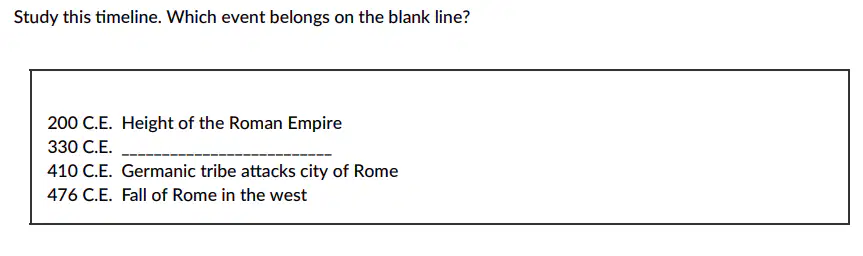
Study this timeline. Which event belongs on the blank line?
The Roman capital moves to Byzantium.
The Praetorian Guard is dissolved.
The Romans develop the alphabet.
The Romans conquer Gaul.
Whose action reduced the importance of the city of Rome within the Roman Empire?
Caesar Augustus
the Praetorian Guard
Constantine
Marcus Aurelius
What event marked the fall of Rome in 476 C.E.?
The eastern half of the empire won control over the western half.
Workers in the cities demanded a voice in government.
Wealthy families turned their estates into private kingdoms.
Germanic tribes overthrew the last emperor in the west.
What type of Roman sculpture inspired some American artists?
lifelike statues of famous people
abstract statues of fanciful beasts
large statues of horses in action
humorous statues of children playing
Which term describes Roman artwork made from small pieces of tile, glass, or colored stone?
cameo
fresco
mosaic
mural
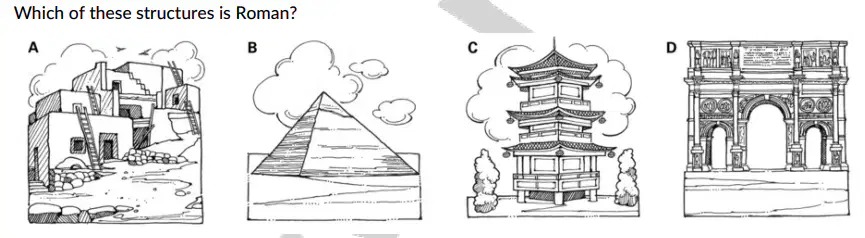
Which of these structures is Roman?
A
B
C
D
The Romans built aqueducts to carry
armies.
merchants.
ships.
water.
Which engineering feat connected the city of Rome with territory throughout the empire?
canals
roads
ships
runners
Which languages are most closely related to Latin?
Greek and Turkish
Polish and Russian
French and Spanish
German and Danish
Which of the following describes how Latin most influences modern English?
prefixes and roots
numeral style
sentence structure
alphabet style
Which of these traits did the Stoics value most?
courage and self-control
imagination and creativity
personal ambition and wealth
emotions and pleasure
Which feature of American democracy comes from the Romans?
All people are born equal.
Leaders are elected directly by the people.
Government is based on a written constitution.
Citizens have certain rights and responsibilities.

