wayground logo

Free Printable Worksheets

Font size

S
M
L
XL
Worksheets

GRADE 9 IGCSE Periodic Table

Total questions: 48

Worksheet time: 33mins
Name
Class
Date
1.
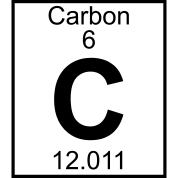
What does the 6 represent?
a)
atomic mass
b)
atomic number
c)
element name
d)
chemical symbol 
2.
What does 12.011 represent?
a)
atomic mass
b)
atomic number
c)
element name
d)
chemical symbol 
3.
What does the C represent?
a)
atomic mass
b)
atomic number
c)
element name
d)
chemical symbol 
4.
These are found on the Periodic Table.
a)
Compounds
b)
Elements
c)
Mixtures
5.

the basic structural unit of matter

a)

atom

b)

matter

c)

element

d)

nucleus

6.

a collection of atoms of one type that cannot be broken down into simpler substances by ordinary chemical or physical means

a)

element

b)

subatomic particle

c)

electron

d)

matter

7.

the positively charged subatomic particle contained in the nucleus of an atom

a)

proton

b)

neutron

c)

electron

d)

matter

8.

a subatomic particle, contained in the nucleus of an atom, having the same mass as a proton but no electrical charge

a)

proton

b)

neutron

c)

electron

d)

matter

9.

a negatively charged subatomic particle that orbits the nucleus of an atom

a)

proton

b)

neutron

c)

electron

d)

matter

10.

a unique number for each element that equals the number of protons in an atom of that element

a)

element name

b)

element symbol

c)

atomic number

d)

atomic mass

11.

the mass of an atom, calculated by adding the number of protons and neutrons in the nucleus of the atom

a)

element name

b)

element symbol

c)

atomic number

d)

atomic mass

12.
The atomic number of this pictured element is
a)
28
b)
58.6934
c)
Ni
d)
Nickel
13.
What is the atomic mass of Neon?
a)
10
b)
30
c)
10.18
d)
20.18
14.
How many protons are in this element?
a)
79
b)
196
c)
117
d)
Cannot be determined
15.
How many neutrons are in a Gold atom?
a)
79
b)
196
c)
118
d)
275
16.
a)
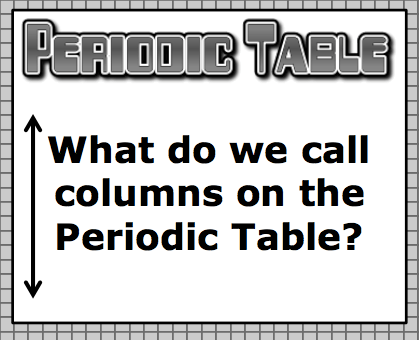
Periods
b)
Groups
17.
a)
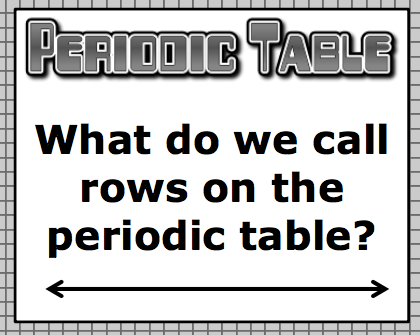
Periods
b)
Groups
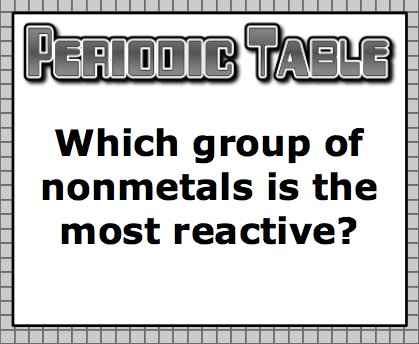
18.
a)
Group 1
b)
Group 17
c)
Group 2
d)
Group 18
19.
a)
Group 1
b)
Group 17
c)
Group 18
d)
Group 2
20.
a)
Group 1
b)
Group 17
c)
Group 18
d)
Group 2
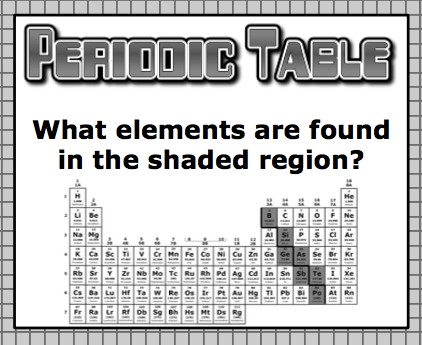
21.
a)
Metals
b)
Nonmetals
c)
Metalloids
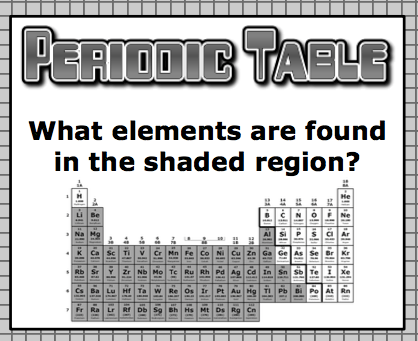
22.
a)
Metals
b)
Nonmetals
c)
Metalloids
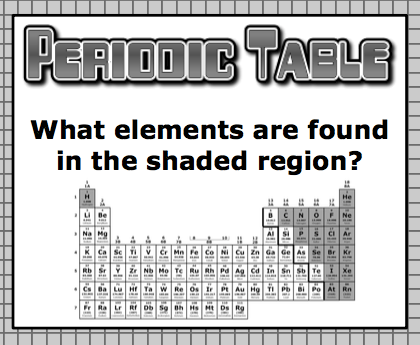
23.
a)
Metals
b)
Nonmetals
c)
Metalloids
24.
How did Mendeleev arrange the elements?
a)
alphabetical 
b)
density
c)
melting point
d)
atomic mass
25.
The number at the bottom of each square on the periodic table is the ...
a)
atomic number
b)
atomic mass
c)
chemical symbol
d)
element name
26.
The number at the top of each square on the periodic table is the ...
a)
atomic number
b)
atomic mass
c)
Chemical Symbol
d)
Element Name
27.
Which group of the periodic table is composed of inert (not reactive)  gases?
a)
alkali metals
b)
alkaline earth metals
c)
halogens
d)
noble gases
28.
Which is a halogen?
a)
Helium
b)
Chlorine
c)
Oxygen
d)
Neptune
29.
Which is an alkali metal?
a)
Magnesium
b)
Iron
c)
Sodium
d)
Europium
30.
In the modern periodic table elements are arranged by:
a)
atomic mass
b)
atomic number
c)
valence electrons
d)
number of isotopes
31.

Xenon is an example of

a)

Alkali Metal

b)

Alkali Earth Metal

c)

Halogen

d)

Noble Gase

32.

Flourine has similar chemical properties to . . .

a)

Bromine

b)

Calcium

c)

Magnesium

d)

Oxygen

33.

Which element is this?

a)

H

b)

He

c)

Li

d)

B

34.

What element is this?

a)

Sulfur

b)

Aluminum

c)

Argon

d)

Silicon

35.

What is the force that holds atoms together?

a)

Chemical Bonds

b)

Physical Bonds

c)

Newtonians

d)

Chemical Changes

36.

What is the octet rule?

a)

Atoms wanting a full shell of 8 electrons to become stable.

b)

Atoms having 8 shells.

c)

Atoms with 8 electrons.

d)

Atoms losing 8 electrons.

37.
A proton is....
a)
A negatively charged subatomic particle
b)
A positively charged subatomic particle
c)
A neutrally charged subatomic particle
d)
The only subatomic particle located in the nucleus
38.

What are valence electrons?

a)

Any of an atom's electrons

b)

Electrons located on the first energy level

c)

Electrons not attached to any atom

d)

electrons located on the outer energy level

39.

What are valence electrons?

a)

Any of an atom's electrons

b)

Electrons located on the first energy level

c)

Electrons not attached to any atom

d)

electrons located on the outer energy level

40.

What period is Lead (Pb) in?

a)

6

b)

4

c)

Metals

d)

4A

41.

What category is silicon (Si) a part of?

a)

Metal

b)

Nonmetal

c)

Metalloid

d)

Halogens

42.

What is the ionic charge of Phosphorus (P)?

a)

+5

b)

-3

c)

+3

d)

-5

43.
How did Mendeleev arrange the elements?
a)
alphabetical 
b)
density
c)
melting point
d)
atomic mass
44.
The horizontal row on the periodic table is called a
a)
group
b)
family
c)
period
d)
atomic number
45.
Dimitri found that there was a pattern of properties that repeated every ____ elements.
a)
2
b)
4
c)
5
d)
7
46.
The number at the bottom of each square on the periodic table is the ...
a)
atomic number
b)
atomic mass
c)
chemical symbol
d)
element name
47.
A proton is....
a)
A negatively charged subatomic particle
b)
A positively charged subatomic particle
c)
A neutrally charged subatomic particle
d)
The only subatomic particle located in the nucleus
48.

What family is silicon (Si) a part of?

a)

Metal

b)

Nonmetal

c)

Metalloid

d)

Halogens