
 Worksheets
CET Section IV
Total questions: 75
Worksheet time: 38mins
The ripple frequency of a full-wave rectifier circuit in a 60 Hertz power system would be:
60 Hz
120 Hz
400 Hz
800 Hz
Which of the following is true?
Shorting the base to the emitter is almost sure to destroy the transistor if it is in a Class A amplifier circuit
Shorting the base to the collector is almost sure to destroy the transistor
Which of the following statements is correct?
The forward bias current for a transistor that is operating Class B will be greater than the forward bias on a transistor that is operating Class A
The forward bias current for a transistor that is operating Class A will be greater than the forward bias on a transistor that is operating Class B
In the normal operation of a transistor, which junction is forward biased?
The collector-base junction.
The emitter-base junction.
Which of the following is not correct for AC beta?
hfe=
hFE=
Another name for a Darlington connection is:
alpha squared
beta squared
gamma squared
delta squared
omega squared

For the amplifier shown in Figure 20, the output signal
in phase with the input signal
180 degrees out of phase with the input signal
A ferrite bead behaves like:
an inductor
a temperature-sensing register
The emitter resistor in a bipolar transistor circuit is used for:
reducing amplifier noise
increasing the gain of the stage
biasing the transistor
stabilizing the stage against the effects of temperature change and against thermal runaway
positive feedback
Removing the capacitor across an emitter resistor in a transistor amplifier will:
increase the gain of the amplifier
increase the amplifier frequency response
Which amplifier configuration can be used to match a high impedance to a low impedance?
Grounded base
Conventional
Emitter follower
Common Source
Grounded Gate
Which amplifier configuration will introduce a 180 degree phase shift to the signal?
Common drain
Cathode filter
Grounded grid
Common Source
Common Base
When the base of a transistor is the same voltage as the emitter, the transistor is:
saturated
operating normally
cut-off
Which of the following is not one of these standard busses of all micrpprocessors?
Address bus
Data bus
Control bus
Register bus
An internal short-term memory in a microprocessor might be called:
a CPU
an address
a latch
a register
a decoder
Which of the following memories is classified as volatile?
PROM
EPROM
RAM
ROM
EEROM
The output of a Tri-state buffer depends upon the:
signal on 1 lead
signal on 2 leads
An ALU will:
distribute data to many inputs
distribute data to many outputs
do math, logic and data manipulation on binary numbers
do math, logic and data manipulation on decimal numbers
convert a decimal value to an ASCII code
An advantage of parallel data handling is:
speed
less circuitry required
Which of the following counters is faster?
Synchronous
Asynchronous
Which of the following can be used for a CMOS supply?
+5V regulated
-5V regulated
+15V regulated
+5V to +15V
-5V to -15V

After three input pulses at the S terminal in Figure 17, the output of the flip-flop will be:
high
low
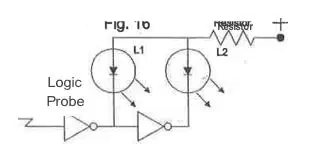
When there is a logic 1 delivered to the input of the logic probe as in Figure 16, the LED marked L2 is:
glowing
not glowing
The greater demand on a power supply occurs with a:
ripple counter
synchronous counter
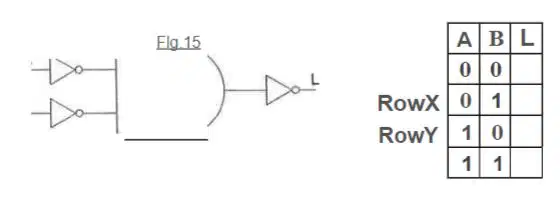
The circuit in Figure 15 is equivalent to:
a NAND
a NOR
an invertor
an OR
an AND
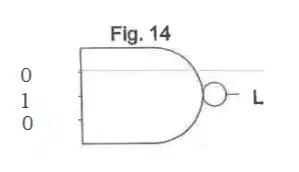
When the input to the gate is 010 as shown in Figure 14, the output at L will be:
logic 1
logic 0
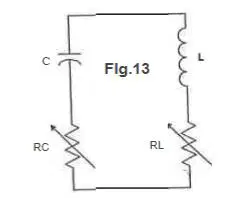
For the circuit in Figure 13, the resonant frequency:
can be adjusted with Re or RL
cannot be adjusted with Re or RL
The voltage on the collector of an NPN transistor audio amplifier is positive and the voltage on the base is negative with respect to the emitter. Which of the following is true?
The polarity of the voltage on the collector is wrong.
The polarity of the voltage on the base is wrong.
The polarities of both voltages are wrong.
This is normal.
To forward bias a semi-conductor diode:
its anode is made positive with respect to the cathode
its anode is made negative with respect to the cathode
Which of the following is a bipolar transistor?
NPN
Diac
MOSFET
JFET
To stop an SCR from conducting:
drive the gate voltage negative with a pulse.
make the anode and cathode voltages equal.
Which of the following would be grounded in a source-follower?
Drain
Collector
Gate
Source
The polarity of voltage on the gate with respect to the drain of an N-channel JFET is normally:
positive
negative
A P-channel FET should have a gate/cutoff voltage that is:
positive with respect to the voltage on the source.
negative with respect to the voltage on the source.
The base collector junction of a transistor is normally:
always some form of hot carrier construction.
reverse biased.
forward biased.
always passivated.
If there is a small amount of negative voltage in the gate of an SCR it will:
decrease the leakage current.
prolong the life of the SCR.
decrease the breakover voltage.
increase the breakover voltage.
Which of the following conducts in either of two directions?
NPN transistors
Triacs
SCRs
Bipolar transistors
A Class A amplifier might be made with:
a Triac.
a UJT
a MOSFET
an SCR
A transistor that does not have a collector is the:
unijunction transistor
junction transistor
MADT
PEP transistor
Current gain in a common-emitter with a PNP transistor circuit is called:
the alpha
the impedance transfer
the gain-bandwidth product
the beta
A certain resistor changes its resistance value in accordance with the amount of voltage across its terminals. It is called:
a VDR
a VER
a VIR
an EDR
If the collector current of a transistor flows all of the time, the transistor is being operated:
Class A
Class B
Class C
The bias voltage of an NPN transistor is:
positive with respect to the collector voltage.
negative with respect to the collector voltage.
Which is the most efficient class of amplifier?
Class A
Class AB
Class B
Class C
Electron current flows in a PNP transistor:
from emitter to collector
from collector to emitter
The capacity of a capacitor is not affected by:
the type of material used for the dielectric
the area of the plates facing
the type of material used for the plates
the distance between the plates
The capacity of a 4 microfarad capacitor in series with a 6 microfarad capacitor is:
2.4 microfarads
3.1 microfarads
10 microfarads
24 microfarads
To stabilize against temperature changes a circuitry may use:
a thermistor
an LDR
a ferrite bead
a varistor
When two capacitors are placed in parallel, the breakdown-voltage rating of the combination is equal to:
the smaller of the two breakdown-voltage ratings.
the total of the breakdown-voltage ratings of each capacitor.
A certain resistor is color-coded orange, orange, orange, gold. By actual measurement its resistance 34.8K.
The resistor is out of tolerance.
The resistor is in tolerance.
Two 5 microfarad capacitors are connected in series. Their combined capacity is:
2.5 microfarads
3.3 microfarads
5 microfarads
10 microfarads
The inductance of a coil does not depend upon:
the number of turns in the coil.
the current flowing through the coil.
the distance between the turns of the coil.
the shape of the coil.
Diodes are connected in series to get a greater:
PIV rating.
current-carrying ability.
To increase the capacity of a voltage-variable capacitor:
decrease the reverse bias voltage.
increase the reverse bias voltage.
Select the proper color code for a 100 ohm resistor.
Brown, black, brown
Brown, black, black
Brown, black, gold
Brown, black, silver
The voltage drop across a glowing LED is usually about:
0.7 volts
1.6 volts
A capacitor with a temperature co-efficient marking of P75D has:
a permanent temperature co-efficient
a positive temperature co-efficient
Which of the following operates with a reverse current?
A varactor diode
A zener diode
Both choices are correct
In order to show that a resistor has a tolerance of± 10 percent:
the third band is silver
the fourth band is gold
the fourth band is silver
there is no color in the fourth band
The most common uses of resistors in electronics circuits are to:
limit current
introduce a voltage drop
generate heat
All of the above
Numbers 1 and 2 are correct
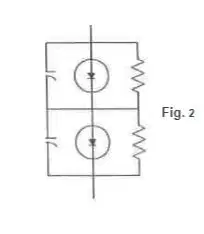
The diodes in Figure 2 are connected in series, their peak inverse voltages (PIV):
will be equal to the lowest PIV
will multiply by the number of diodes in series
will not change
will add together
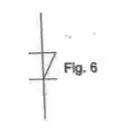
A four layer diode, Figure 6, is also known
Shockley diode
Schottky diode
Hot-carrier diode
Both B and C are correct
When increasing the reverse voltage on a varactor diode:
the capacitor dielectric will evaporate
the capacitance will increase
the capacitance will decrease
the diode will conduct like a rectifier
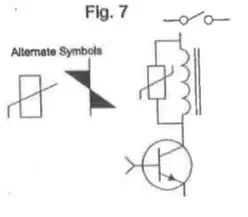
Why is the VDR connected across the relay coil in the circuit of Figure 7?
To reduce the time required for relay contact closure.
To protect the transistor.
Squeezing the turns of a coil closer together will:
decrease the inductance
increase the inductance
not affect the inductance
Which of the following is the result of this expression?
X=l / 2 x PI x F x C where F is 49MHz and C is 0.47 uFD
.0069 ohms
6.9 ohms
69 ohms
690 ohms
What will test good out of circuit but bad in circuit?
Diode
Switch
Power on Light
Fuse
What symptom would be observed if the feedback resistor in a non-inverting Op Amp circuit opens?
No symptom
Reduced output
Output only at positive and negative saturation
An over heated Op Amp chip
When measuring a fuse that is good, you will measure:
infinite
0
high one way, low the other
Depends on the fuse
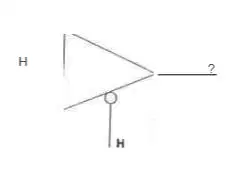
With two highs on the input, what is the, output?
High output
Low output
No output
High Z
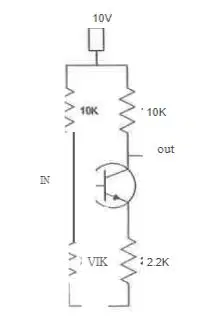
If .5V P-P is applied to the input of the amplifier to the right, what is the approximate output voltage?
2.27 Vpp
4.55 Vpp
10.0 Vpp
Cannot be determined without transistor data.
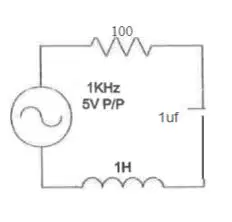
What is the resonant frequency of this circuit?
159 Hz
1000 Hz
6000 Hz
7400 Hz
A Triac:
is not susceptible to off-state voltage tum on as long as the peak voltage does not exceed the voltage breakover point.
is a 3 terminal devcse with a main terminal 1, main terminal 2 and base.
can be fired with a positive trigger pulse only when the main terminal 1 is positive in respect to the main terminal 2.
can be fired with a + or - trigger pulse when main terminal 1 is in respect to main terminal 2.
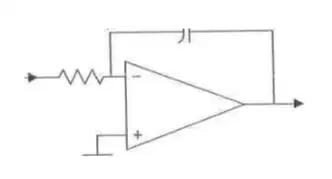
This circuit represents a:
Oscillator
Differentiator
Integrator
Schmitt Trigger
Which of the following is most true of an SCR?
Once fired the gate current must be interrupted to stop conduction.
Once fired the only way to stop conduction is to reverse the polarity on the gate.
An SCR is a bi-directional device which can be fired by high transients on the supply lead.
An SCR can be turned on by exceeding the forward breakover voltage.

