
 Worksheets
Physical Properties, Density, Weight VS Mass Review!
Total questions: 56
Worksheet time: 1hrs 3mins

The temperature at which a substance changes from a liquid to a gas
Melting point
Boiling point
Freezing point
Condensation point
What is the state of matter that has a fixed volume but not a fixed shape?
Solid
Liquid
Gas
The ability of a substance to conduct heat, sound, or electricity.
malleability
magnetism
color
conductivity
The ability of a substance to attract iron.
malleability
conductivity
hardness
magnetism
The temperature at which a substance changes from a solid to a liquid.
melting point
boiling point
ductility
buoyancy
True or false? Physical properties are things that can be observed about matter.
true
false

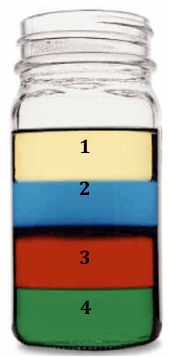
What is the least dense liquid in this container?
Honey
vegetable oil
lamp oil
water
Anything that has mass and takes up space
Matter
weight
volume
mass
amount of mass in a given volume of a substance or object; found by dividing the mass of the object by its volume
Density
Luster
Matter
Volume


Claire has a liquid. It has a mass of 9g and a volume of 3mL. What is its density?
3 g/mL
.33 g/mL
27 g/mL
39 g/mL


A student performs an experiment with an irregular shaped object. How would the student measure the density of the irregular shaped object?
Water Displacement
Scale
Thermometer
Lenth X Width X Height
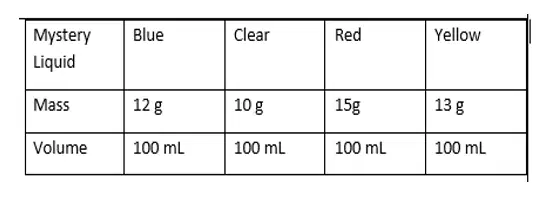
Kiara measures the mass and volume of mystery liquids and pours them into a beaker. The liquids separate into different layers. According to Kiara’s data above, which liquid would make up the bottom layer of the beaker?
Blue
Clear
Red
Yellow
What is the definition of weight?
a measure of how much matter an object has
a measure of force of gravity on an object
the force an objects pushes on the ground
the force on an object due to its size
The mass of an object decreases as it moves away from Earth.
True
False
What do you use to measure the mass of an object?


What physical property do rocks, lollipops and mirrors all have in common?
They all have matter.
They are all have conductivity.
Their Density is the same.
They are soluble.
Which of the following is a physical property
Density
Mass
Color
All of the above
Mary added a powder chemical to a solution and started mixing it, after several minutes she couldn’t see the particles of the powder in the solution as it dissolved. If the teacher asked her to classify this powder, how she will classify it?
Insoluble
Soluble
Aqueous
Diluted
Which of the following is the most appropriate definition for magnetism?
the force of attraction or repulsion of magnetic materials
the force of attraction only of magnetic materials
the force of repulsion only of magnetic materials
none of the above
If I threw a penny into a pond and it sinks to the bottom, what would help to explain why?
The mass of the penny is more than the mass of the water
The density of the penny is more than the density of the water
The volume of the penny is more than the volume of the water
The temperature of the penny is more than the temperature of the water

What units are used to measure mass?
grams
milliliters
cubic centimeters
g/cm3

When a Hoberman Sphere expands (opens up), how does the volume (space) change?
It Decreases
It Increases
It Doesn't Change

In this image, the DENSITY of A is _____ the density of B
equal to
greater than
less than
In this image, the VOLUME of A is _____ the volume of B
equal to
greater than
less than

amount of matter in an object
density
volume
weight
mass
A student has a toy car that is green, made of iron (metal) and weighs 52 grams. If the student drops the car in a grassy field, how could the student find his toy car?
Use a magnifier lens to find the car by its color
Place a magnet over the area to attract the car
Weigh samples of the area to find a sample that is 52g
Place a sample of the field in water to find out its density
Which of the following is a physical property of matter that is always the same regardless of size or amount?
Mass
Density
Volume
Solubility
Your friend tells you the weight of a particular sample of chalk is 17.85 grams. Is there anything wrong with your friend's statement?
No, because grams are the right units for weight
No, because mass and weight are the same thing
Yes, because mass and weight are measured in different units
Yes, because your friend should have reported the mass in Newtons
A 500 gram piece of metal has a volume of 2.75 cm3 . What is its density?
181.8 g/cm3
24 g/cm3
0.0055 g/cm3
A cube measures 5 cm on each side and has a mass of 300g. What is the density of the cube?
2.4 g/cm3
60 g/cm3
20 g/cm3
The piece of jewelry occupies a space of 76 mL. If the mass of the piece of jewelry is 122 grams, what is its density?
1.6 g/mL
0.62 g/mL
9272 g/mL
A sample of seawater has a mass of 158 g and a volume of 156 mL. What is the density?
1.01 g/mL
0.99 g/mL
24,648 g/mL

