
 Worksheets
7th Final Fall 2023
Total questions: 58
Worksheet time: 47mins
You are managing a large lot of cattle. A pharmaceutical company wants you to try a new antibiotic to treat Shipping Fever in newly arrived cattle. The company claims that it is less expensive and more effective than the current antibiotic you are using. You will measure the temperature of the cattle to see whether or not it works. WHAT IS THE INDEPENDENT VARIABLE (IV)?
Type of cow
Antibiotic
No Antibiotic
Temperature of Cattle
You are managing a large lot of cattle. A pharmaceutical company wants you to try a new antibiotic to treat Shipping Fever in newly arrived cattle. The company claims that it is less expensive and more effective than the current antibiotic you are using. You will measure the temperature of the cattle to see whether or not it works. WHAT IS THE DEPENDENT VARIABLE (DV)?
Type of cow
Antibiotic
No Antibiotic
Temperature of Cattle
You are managing a large lot of cattle. A pharmaceutical company wants you to try a new antibiotic to treat Shipping Fever in newly arrived cattle. The company claims that it is less expensive and more effective than the current antibiotic you are using. You will measure the temperature of the cattle to see whether or not it works. WHAT IS A CONTROLLED VARIABLE (CONSTANT)?
Type of cow
Antibiotic
No Antibiotic
Temperature of Cattle
You are managing a large lot of cattle. A pharmaceutical company wants you to try a new antibiotic to treat Shipping Fever in newly arrived cattle. The company claims that it is less expensive and more effective than the current antibiotic you are using. You will measure the temperature of the cattle to see whether or not it works. WHAT WOULD BE THE CONTROL GROUP, THE GROUP USED FOR COMPARISON?
Type of cow
Antibiotic
No Antibiotic
Temperature of Cattle
This variable in an experiment is the one being changed by the scientist.
dependent variable
independent variable
constants
control group

Minion is working in the Lab, what is he doing incorrectly?
Nothing he looks prepared
Put on gloves
Ties back hair
Wearing improper lab clothes

Minion is in the lab, what should he not be doing?
Wearing goggles
Wearing gloves
Drinking in the lab
Nothing, all behaviours are fine

These minions are working on a lab, what should they NOT be doing?
wearing gloves
wearing goggles
Horse playing
nothing

If you saw these minions in the lab, what would you say they are doing incorrectly?
Nothing
Eating in the lab
Wearing goggles
No hair tied back

What should minions do before entering the lab?
Nothing, he looks ready
have science notebook
not be tardy
Put on goggles

Approved eye protection devices (such as goggles) are worn in the laboratory
to avoid eye strain.
to improve your vision
only if you don’t have corrective glasses
any time chemicals, heat or glassware are used.

When gathering glassware and equipment for an experiment, you should
read all directions to know what equipment is necessary
Check glassware for chips and cracks
clean any glassware that appears dirty
a and b only
All of the above
What is the symbol for the prefix kilo-?
L
m
k
kg
The SI units of science are based on the __________ system
Emperical
Standard
Metric
Science
When measuring the volume of soda in a large bottle, what unit of measure should be used?
L
mL
kL
Gallons

The mass of an elephant is best shown using which unit?
g
mg
hg
kg
Which options shows the correct conversion between grams and milligrams?
85g = 8500mg
85g = 8.5mg
85g = .85mg
85g = 85000mg
If an SI unit is not to the correct scale of what is being measured. How do we make the unit match the scale?
Ignoring it
Adding/changing the prefix
Adding or subtracting units
Ask the teacher why this is important

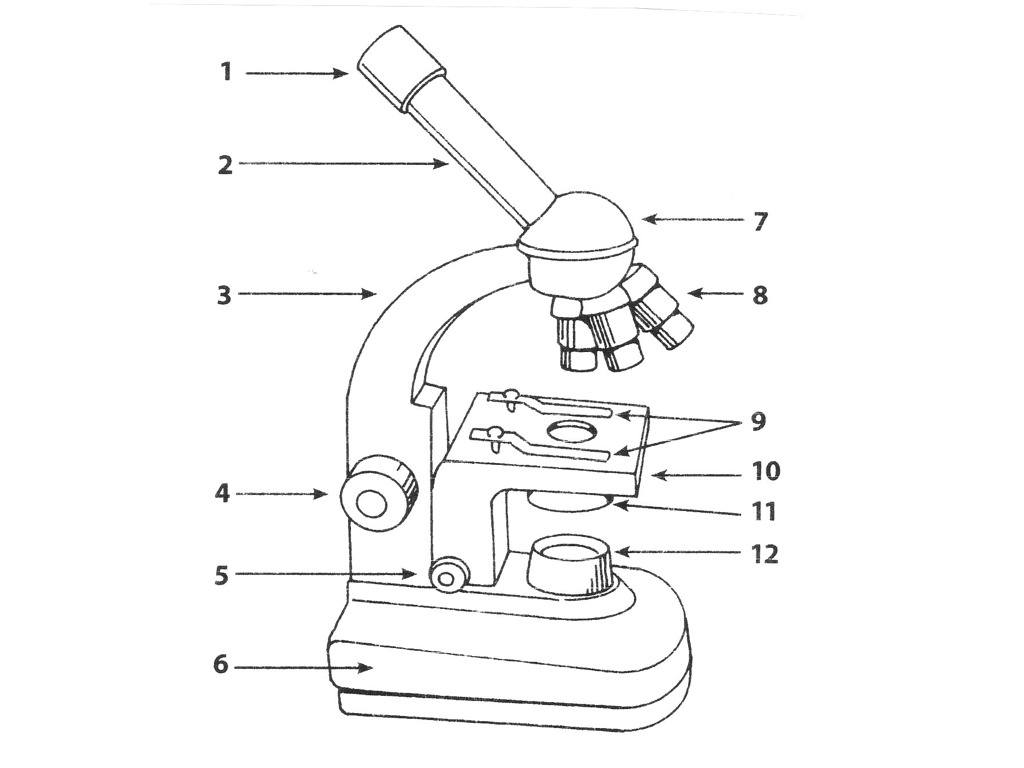
Letter A is the _______
stage
slide clip
coarse adjustment knob
eye piece
objective lens

The letter B is the ________
fine adjustment knob
eye piece
stage
slide clip
objective lens

The letter C is the_________
eye piece
slide clip
stage
objective lense
fine adjustment knob

The letter D represents the__________
eye piece
slide clip
stage
coarse adjustment knob
fine adjustment knob

The letter E represents the _________
fine adjustment knob
stage
objective lens
eye piece
slide clip

The letter F represents the________
fine adjustment knob
stage
eye piece
objective lens
coarse adjustment knob
____________________________________: Three separate lenses to magnify the image (4X, 10X, and 40X). The one in use is the one above the object being viewed.
objective lens
eye piece
stage
slide clip
coarse adjustment knob
_________________________________: A slower, more precise control used to fine focus the image.
eye piece
slide clip
stage
coarse adjustment knob
fine adjustment knob
____________________________________: A rapid control which allows for quick focusing by moving the stage up and down. This is used for initial focusing.
coarse adjustment knob
fine adjustmet knob
eye piece
objective lens
stage
____________________________________: something to hold the slide on.
eye piece
stage
slide clip
objective lens
coarse adjustment knob
____________________________________: a platform for the slide.
eye piece
slide clip
stage
coarse adjustment knob
fine adjustment knob
____________________________________: magnifies the image by 10x. This is where you put your eyes.
eye piece
stage
fine adjustment knob
objective lens
slide clip
Objects under the microscope will be come______
smaller
blurry
inverted
blue


How does a concave lens differ from a convex lens?
A convex lens is another way to describe a plane mirror; a concave lens is curved
A concave lens is curved inward on both sides; a convex lens is on only one side
A convex lens has a thick center and thin edges, a concave lens has a thin center and thicker edges
A convex lens has a thin center and thick edges. a concave lens has a thick center and thinner edges
What does the Golgi Body do?
Packages and distributes materials to other parts of the cells
Breaks down molecules to recycle
Produces energy
Directs the activities of the cell
These are passageways in the cell that carry materials from one part of the cell to the other
Mitochondria
Lysosome
Endoplasmic Reticulum
Vacuole
This is the thick, gel-like fluid that keeps the organelles in place and holds salts, proteins, and water.
Chloroplast
Cytoskeleton
Lysosome
Cytoplasm
This cell is irregularly shaped, has many small vacuoles, but does not have a cell wall or chloroplasts
Prokaryotic Cell
Plant Cell
Animal Cell
Bacteria Cell
The part of the plant cell that contains chlorophyll and makes food from light energy
Cytoplasm
Lysosome
Cell Wall
Chloroplast
This is the part of the cell that controls what comes in and out of the cell
Nucleus
Cytoplasm
Cell membrane
Endoplasmic Reticulum
This controls the activities of the cell
Nucleus
Vacuole
Ribosome
Chloroplast
This produces the energy needed for the cell to do everything it needs to do to survive
Cytoplasm
Mitochondria
Vacuole
Endoplasmic Reticulum
This is the rigid outer structure found in some cells
Cell Wall
Cell Membrane
Cytoskeleton
Cytoplasm
This stores food, water and sometimes wastes
Vacuole
Cytoplasm
Nucleus
Ribosome
This type of cell is usually larger than the others, is geometric in shape, and has a cell wall and chloroplasts
Prokaryotic Cell
Animal Cell
Plant Cell
Fungi Cell
Draw and label to the best of your ability, a plant cell

Write out the 7 steps of the scientific method. For each step, explain what is done during that step. Take your time and be very descriptive!

