
 Worksheets
Biochem FINAL: Replication/transcription/translation
Total questions: 101
Worksheet time: 52mins
Mitosis must be regulated.
True
False
Nucleosomes disassembled as replication begins and proteins form
S phase
M phase
G phase
Breakdown of nuclear membrane, spindle fibers appear, chromosomes condense
Prophase
Metaphase
Anaphase
Telophase
Spindle fibers attach to chromosomes and chromosomes condense
Prophase
Metaphase
Anaphase
Prometaphase
Centromeres divide and sister chromatids move to opposite sides of the cell
Prophase
Metaphase
Anaphase
Telophase
When does the spindle fiber dissapear?
Prophase
Metaphase
Anaphase
Telophase
Colchicine (Colcrys) keeps spindle fibers from forming
True
False
Spindle fibers are also known as
microtubules
not this
Packed nucleosomes condensed during mitosis
nucleosome
chromosome
ds helix
ds helix wrapped around an octamer of histones
chromatin
ds DNA chain
nucleosome
ds helix wraps up around histone
nucleosome
chromatin
coiling of ds chain
dsDNA chain
nucleosome
ds helix
2 complete chaines H-bonded in antiparallel orientation
ds helix
dsDNA chain
nucleosome
polymers of nucleotides
nucleoside
oligonucleotide
nucleoside + 3 phosphates
nucleotide
nucleoside
base + sugar
nucleotide
nucleoside
Deoxyribose is a ___ carbon sugar molecule
6
5
8
Where does phosphate group of DNA attach?
C7
C3
C5
Adenine and Guanine
purines
pyrimidines
Thymine and Cytosine
purines
pyrimidines
Ribose-5-phosphate is formed in
glycolysis
PPP
citric acid cycle
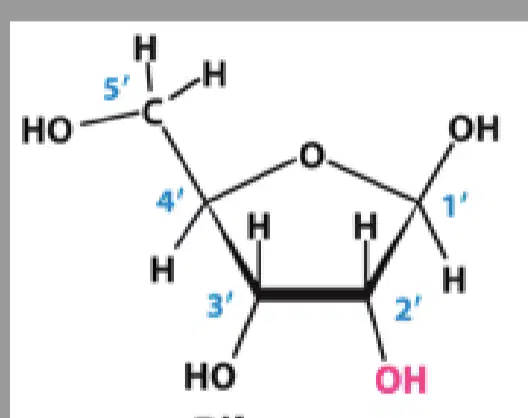
which one?
Ribose
Deoxyribose
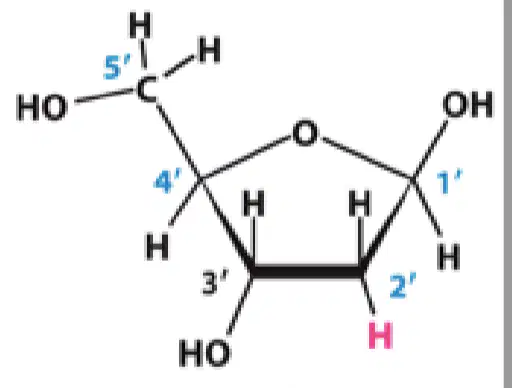
Which one?
Ribose
Deoxyribose
Which ones are 2 ring structures?
Purines
Pyrimidines
Which ones are one ring structures?
Purines
Pyrimidines
What is the only difference in thymine and uracil?
the methyl group
not this
Select the features of nitrogenous bases.
planar to allow for pi pi stacking
good H-bond acceptors and donors
neutral at pH of 7
C and N atoms ont eh base numbered cyclically
DNA is neutral at pH of 7.
True
False
beta-glycosidic linkages link the pentose sugar and the
phosphate
nitrogenous base
B-glycosidic linkages form on C1 of sugar and ____ in purines.
N1
N9
B-glycosidic linkages form between C1 of sugar and ___ of pyrimidines.
N1
N9
All sugars are oriented in the same direction on both DNA strands.
True
False
2 ester bonds being formed using phosphoric acid
phosphodiester linkage
B-glycosidic linkage
phosphodiester linkages repeat in the ___ direction
3' --> 5'
5' --> 3'
Adenine with Thymine
2 H bonds
3 H bonds
Cytosine with Guanine
2 H bonds
3 H bonds
Which part of DNA is exposed to the solvent?
nitrogenous bases
sugar/phosphate backbone
Which part of DNA is NOT exposed to the solvent?
nitrogenous bases
sugar/phosphate backbone
hydrophobic part of DNA
nitrogenous bases
sugar/phosphate backbone
After every ___ basepairs there is a twist.
5
10
base pairs in the core of the helix have e's that interact with one another to generate
hydrophilic stacking
hydrophobic stacking
pi-pi stacking stabilizes the helix.
True
False
site of DNA replication in prokaryotes
nucleus
cytosol
How many sites of origin to prokaryotes have?
1
many
how many sites of origin are in eukaryotes?
1
many
For each origin, there are 2 replication forks.
True
False
DNA has a "bubble appearance" at the replication forks
True
False
Prokaryotes have ___ DNA than eukaryotes
more
less
unwinds DNA
lipase
topoisomerase
helicase
Prevent the two unwound DNA strands from coming back together during replication
topoisomerase
single-stranded binding proteins (SSBs)
helicase
Cuts both strands and helps with the strain that is placed on the DNA helix.
topoisomerase II
helicase
SSBs
Topoisomerase requires energy and prevents supercoiling.
True
False
Topoisomerase I cuts
1 strand
2 strands
Topoisomerase II cuts
1 strand
2 strands
Enzyme that adds nucleotides to growing DNA strand
topoisomerse
helicase
DNA polymerase
DNA polymerase needs an RNA primer before it can start.
True
False
RNA primers added by primase during DNA replication get replaced with DNA later in the process
True
False
ATP, UTP, GTP and CTP are
RNA triphosphates
DNA triphosphates
dTTP, dATP, dGTP, and dCTP are
RNA triphosphates for primase
DNA triphosphates for primase
Mg is cofactor for DNA polymerase
True
False
made discontinuoulsy away from the replication fork
leading strand
lagging strand
made continuously as replication fork advances
leading strand
lagging strand
joins Okazaki fragments together
ligase
primase
Where are errors more likely due to Okazaki fragments?
leading strand
lagging strand
DNA polymerase can proofread and repair as well as it adds bases
True
False
permanent change in cell's DNA
mutations
not this
3 main DNA repair mechanisms
Base-excision repair
Nucleotide-excision repair
mismatch repair
Mutagens that form a lesion by altering DNA bases
nitrosamines
nitrites
nitrates
Replaces C with U
spontaneous deamination
mutagen-induced
replaces C with U, A with hypoxantine, and G with xanthine
mutagen-induced
spontaneous deamination
removes abnormally modified bases by glycosylases and replaces them with right ones. Uses ligase to seal it up.
NER
BER
Lesion formed due to bulky DNA adducts (most often thymines)
NER
BER
Removes entire region of DNA on either side of the lesion and uses DNA polymerase to fill it and ligase to seal it
BER
NER
Used to fix any insertions or deletions
BER
NER
mismatch repair
double strand breaks in DNA are lethal to the cell.
True
False
Transcription does NOT need a primer
True
False
three phases of transcription
initiation
elongation
termination
Uses Acetyl CoA to add acetate to lysine residue to suppress positive charge of the histone so DNA can dissociate
histone acetyl transferases (HATs)
HDACs
Removes the acetate from histone to restore positive charge
HATs
HDACs
Before transcription can begin, HATs must remove DNA from histones.
True
False
1 gene codes for 1 protein
True
False
Transcription factors control what genes get transcribed.
True
False
RNA polymerase II
single subunit
multiple subunits and large
RNA polymerase II binds to promoter region to start RNA synthesis
True
False
Stop point for RNA polymerase
promoter
terminator
Like DNA polymerase, RNA polymerase can proofread
True
False
Where are error rates higher?
DNA replication
transcription
mRNA is synthesized by RNA polymerase II
True
False
RNA polymerase requires 2 cofactors
Mg
Ca
Zn
Fe
For mRNA synthesis, DNA must unwind over a short distance forming a transcription bubble
True
False
Form BEHIND RNA polymerase
positive supercoils
negative supercoils
Form AHEAD of RNA polymerase
positive supercoils
negative super coils
the Pre-mRNA molecule contains a 5' cap and a poly A tail
True
False
the 5' cap is
adenine
guanine
What is the coding part of DNA?
introns
exons
Part of DNA that does not code for anything
exon
intron
Which one gets spliced out?
introns
exons
Form mature RNA
exons
introns
Translation requires ATP?
True
False
synthesized in the nucleus and binds to its complementary mRNA which lead to silencing and ultimately to degredation of the mRNA in the lysosome.
tRNA
siRNA
study slides 47-60
yes
no

