
 Worksheets
Ohm's Law Review
Total questions: 58
Worksheet time: 2hrs 34mins
Who developed Ohm's Law?
Georg Ohm
Andre Ampere
Paul
Einstein
What is the relationship between voltage and current?
Directly proportional
Inversely proportional
No relationship
Random relationship
What is the formula for calculating voltage?
V = I * R
V = I / R
V = R / I
V = E / R
What is the unit of current?
Ampere
Volt
Ohm
Coulomb
What happens to the current when resistance is doubled?
Current halves
Current doubles
Current remains the same
Current becomes zero
What is the formula for calculating current?
I = V * R
I = V / R
I = R / V
I = E / R
What is the relationship between current and resistance?
Directly proportional
Inversely proportional
No relationship
Random relationship
What is the formula for calculating resistance?
R = V * I
R = V / I
R = I / V
R = E / I
What is the resistance of a lamp with a current of 0.5 Amps and a voltage of 12 volts?
6 Ohms
24 Ohms
0.5 Ohms
2.4 Ohms
What will be the current when a 240 Ohm lamp is plugged into a 120 volt outlet in the US?
0.5 Amps
1 Amp
2 Amps
4 Amps
What is the name for the pressure that forces electrons to flow through a circuit?
Voltage
Capacitance
Resistance
Current
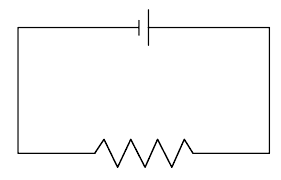
If the battery produced 12.6 Volts what would be the current flow for a 6 Ohm resistor?
2.1 Amps
2.4 Amps
1.71 Amps
15 Amps

In the model, what does the lightbulb represent?
electricity
current
voltage
resistance

In the model, what does the battery represent?
voltage
current
circuit
resistance

Based on this model, what change should be made in order to increase the current?
Close the switch
Add another battery
Add another lamp
Remove a wire

If a charger for a tablet offers a voltage of 120V and has 240Ω of resistance, what is the amperage?
0.5A
2A
14,400A
28,800A

If a computer has 10.0A of current and 11Ω of resistance, what is its voltage?
0.9V
1.1V
55V
110V
If the current through a resistor is 2A and the voltage across it is 12V, what is the resistance
12Ω
6Ω
24Ω
0.167Ω


Simple, Series, or Parallel?
Simple
Series Circuit
Parallel Circuit
Which best describes a parallel circuit?
Electricity flows along one pathway.
The flow of electricity comes from one source.
Electricity flows along more than one pathway.
The flow of electricity comes from more than one source.

What is the voltage of a circuit with 4 ohms of resistance and 3 amps of current?
12 V
21 V
4/3 V
3/4 V
If a series circuit of three bulbs is rearranged into a parallel circuit, what will happen to the brightness of three bulbs
The bulbs will turn off due to an incomplete supply of electricity.
All three bulbs will have the same amount of luminosity once rearranged into a parallel circuit but will be dimmer than in parallel.
All three bulbs will have the same amount of luminosity once rearranged into a parallel circuit but will be brighter than in series.
The bulb next to the battery will be brightest and each bulb will be dimmer than the one before.
Johnny and Sam are working on a physics lab together. In their lab, they are to create both a series circuit and a parallel circuit using identical materials. Johnny constructs the series circuit while Sam makes the parallel circuit. After observing the two circuits, Sam argues that his circuit contains more resistance than Johnny's circuit. Johnny says that Sam is wrong, and that his circuit has more resistance. Who is correct?
Sam is correct, the parallel circuit has more paths for the electricity to travel, making the resistance greater.
Sam is correct, the parallel circuit's light(s) is brighter, meaning there is more resistance.
Johnny is correct, parallel circuits have LESS resistance because the current is greater.
Johnny is correct, parallel circuits have LESS resistance because their resistors add inversely, while the resistors in series circuits add normally.
For which circuit do you have to inverse the resistors to find the equivalent resistance?
series circuit
parallel circuit
both series and parallel circuits
neither series and parallel circuits
Which of the following circuit diagrams is a parallel circuit?


Which of the following circuit diagrams would short circuit due to lack of resistance?

Solve for the total resistance of the circuit shown
50 V
1970 ohms
705 K ohms
20 Amps
Voltage drop stands for what?
the voltage applied to a circuit
the voltage flowing through a resistor
the voltage used by a load
What is the total circuit resistance of the following five resistors connected in series?
R1 = 27 ohms
R2 = 33 ohms
R3 = 51 ohms
R4 = 1.2 kohms
R5 = 240 ohms
Rt = __________ Ohms
353.2
1551
1.9 K

If more bulbs were added to this circuit, each bulb would get ___.
brighter
dimmer
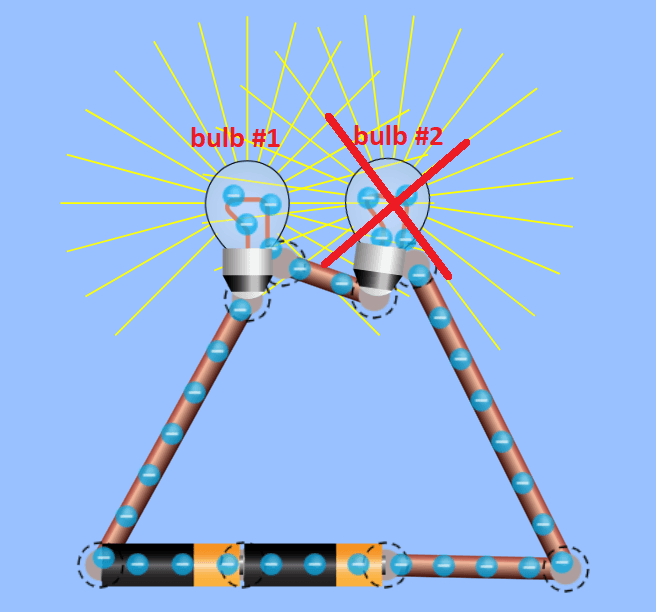
If bulb #2 in this series circuit broke, bulb #1 would
stay on
go off

Homes, school and factories ___ wired in series.
are
are not

In a series circuit, when you add more appliances, each appliance gets ___ power/electrical pressure.
more
less

Students constructed a circuit using different-colored lightbulbs. What will happen if Switch 3 is closed and the other switches are left open?
Only the white bulb will operate
None of the bulbs will operate
Only the white and yellow bulbs will operate
Only the red and blue bulbs will operate


Which of the following is true?
The voltage will be equal at R1, R2 and R3
Current at 1 is equal to 2
Total resistance is
1/18 ohms
Voltage is greatest through R1

