
 Worksheets
Physical Science Test - Chapter 5: Dynamics
Total questions: 65
Worksheet time: 1hrs 9mins
IF AN OBJECT REMAINS AT CONSTANT SPEED IN THE SAME DIRECTION, THAN THE FORCES ARE KNOWN TO BE:
BALANCED
UNBALANCED
INCREASING
DECREASING


Who developed mathematical equations describing how forces affect motion?
Aristotle
Archimedes
Galileo
Newton
Forces are scalar quantities because they have size and direction.
True
False
Contact forces cause all observed changes in motion.
True
False
Field forces grow stronger with distance from the source, but contact forces do not change with distance.
True
False
Balanced forces cause an object, if it is in motion, to maintain its motion.
True
False
How can you tell when the forces acting on a system are balanced?
There is no motion.
There is no displacement.
There is no acceleration.
A microscopic organism like a protozoan can exert a gravitational force.
True
False
Which of the following is the result of a contact force?
A ball thrown into the air falls down to the ground.
Two magnetic compass needles repel each other.
A hammer drives a nail into a piece of wood.
Your hair stands on end, when you are touching a Van de Graaff generator.
Which of the following fundamental forces is comparatively the weakest?
the strong nuclear force
the weak nuclear force
the electromagnetic force
the gravitational force
Which of the following is the result of a force field?
An apple press squeezes out apple cider.
An airplane is jostled around because of wind shear.
Girls win against boys in tug-of-war.
When you jump into the air, you land on the ground.
A piano suspended from a rope that goes through a pulley begins to fall. What is the largest force acting on the piano?
pull of the rope
pull of gravity
the forces are equal
none of these
Balanced forces cause an object, if it is in motion, to maintain its motion.
True
False
According to Newton’s first law, only external forces acting on an object can cause it to accelerate.
True
False
If the mass of a system is constant, its acceleration will change when the force exerted on it changes.
True
False
Newton’s third law applies to all objects regardless of their condition of motion.
True
False
Friction acts only on objects in motion
True
False
Static and kinetic friction are directly proportional to the force pressing the systems into contact.
True
False

Which letter represents "friction" on the diagram?
A
B
C
D
E
In which case are all the forces acting on a system balanced? (Systems are underlined.)
a baseball hit into left field
a forklift lifting a pallet
a meteorite that is falling through the earth's atmosphere and has reached its terminal velocity
a baker stirring a bowl of chocolate cookie dough
Which object has the most inertia?
a falcon
an airplane
a single bar of gold
the planet Jupiter
A wrecking ball strikes a brick wall. Which of the following would increase the force of the ball?
increasing the mass of the wrecking ball
slowing down the wrecking ball
decreasing the mass of the wrecking ball
decreasing the thickness of the brick wall
Why are hot air balloons floating at a constant altitude not in free fall?
The balloons are light enough that the gravitational force is zero.
Forces on the balloons are balanced.
The balloons are far enough from the earth to be unaffected by gravity.
The balloons are not subject to air resistance.
The tendency of matter to resist a change in motion until acted on by an external force is known as ______________.
static
kinetic
inertia
mass
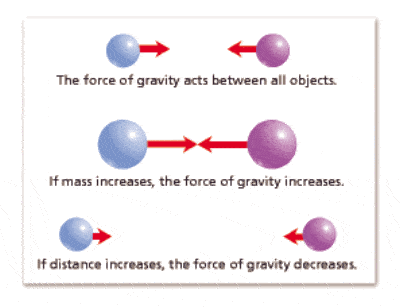
The gravitational force between the sun and the earth is dependent on the square of the distance between their surfaces.
True
False

Which letter on the diagram is "weight"?
A
B
C
D
E

What happened at time 0.0 s?
The object hits the ground.
The object is dropped.
Velocity increases.
Velocity decreases
0.10 seconds

What happens to the object's speed as it falls?
The object hits the ground
The object is dropped
Velocity increases
Velocity decreases
0.10 seconds

What happens at time 3.34 s?
The object hits the ground.
The object is dropped.
Velocity increases.
Velocity decreases.
0.10 seconds

Tru or False, use the image to answer the question
True
False

Which letter represents "air resistance" on the diagram?
A
B
C
D
E
Air resistance is a form of friction known as ______________.
drag
rolling
kinetic
static
If all objects exert gravitational attraction on each other, then why doesn’t all matter clump together?
Gravitational attraction cannot overcome friction and other forces.
The distances between objects are too small.
Most matter is too cold.
Most matter is moving too quickly.
An object’s weight is directly proportional to its ______________ and gravitational acceleration.
drag
inertia
mass
Air resistance on a falling object increases with increasing __________ of the object.
weight
surface area
altitude
mass
A mountain climber falters on a steep slope and slides down until his safety harness catches, pulling his rope taut. Why does he stop sliding?
There is lower gravity due to higher altitude
The tension on the rope is greater than gravity.
The cold temperature slows his fall.
Why are hot air balloons floating at a constant altitude not in free fall?
The balloons are light enough that the gravitational force is zero.
Forces on the balloons are balanced.
The balloons are far enough from the earth to be unaffected by gravity.
The balloons are not subject to air resistance.
Which of the following are not directly proportional?
weight and mass
speed and distance traveled
distance and gravitational attraction
mass and gravitational attraction

Use the image to answer the question
3.8 N
5.4 N
4.3 N
2.2 N

Use the image to answer the question. Multiple answers may be selected
Mass of object 1
Mass of object 2
distance between their centers
None of these are true

A soccer ball is sitting in the middle of a field. The ball will remain at rest until an outside force like a players foot or the wind acts upon it. Which of Newton's laws is represented by this?
1st
2nd
3rd
Think about pushing a shopping cart and a car. If you apply the same amount of force to both, the shopping cart will travel fast, but the car will hardly move. To move the car yo would need a larger force. Which of Newton's laws is being represented?
1st
2nd
3rd
Sally jumps on her trampoline. She exerts a force on the trampoline and the trampoline exerts an equal but opposite force back on Sally. This represents
Law 1
Law 3
Law 2


All objects in free fall (and ignoring air resistance) accelerate towards the earth at 9.8 m/s/s.
true
false
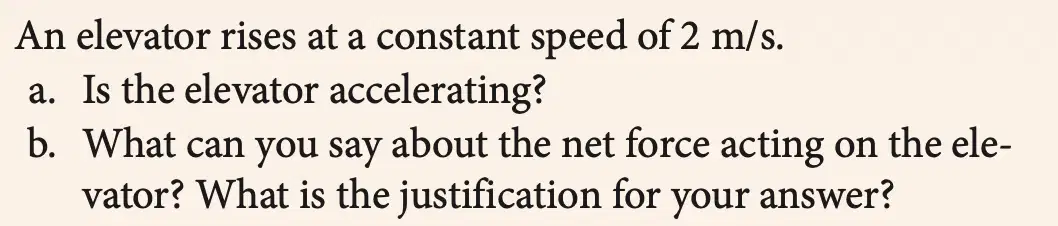
Please answer the question in the image.

Use the image to answer the question

