Wayground logo

Free Printable Worksheets

Font size

S
M
L
XL
Worksheets

Chapter 2 Review

Total questions: 87

Worksheet time: 1hrs 27mins

Name
Class
Date
1.
the tendency of an object to resist a change in its motion
a)
acceleration
b)
inertia
c)
mass
d)
frame of reference
2.

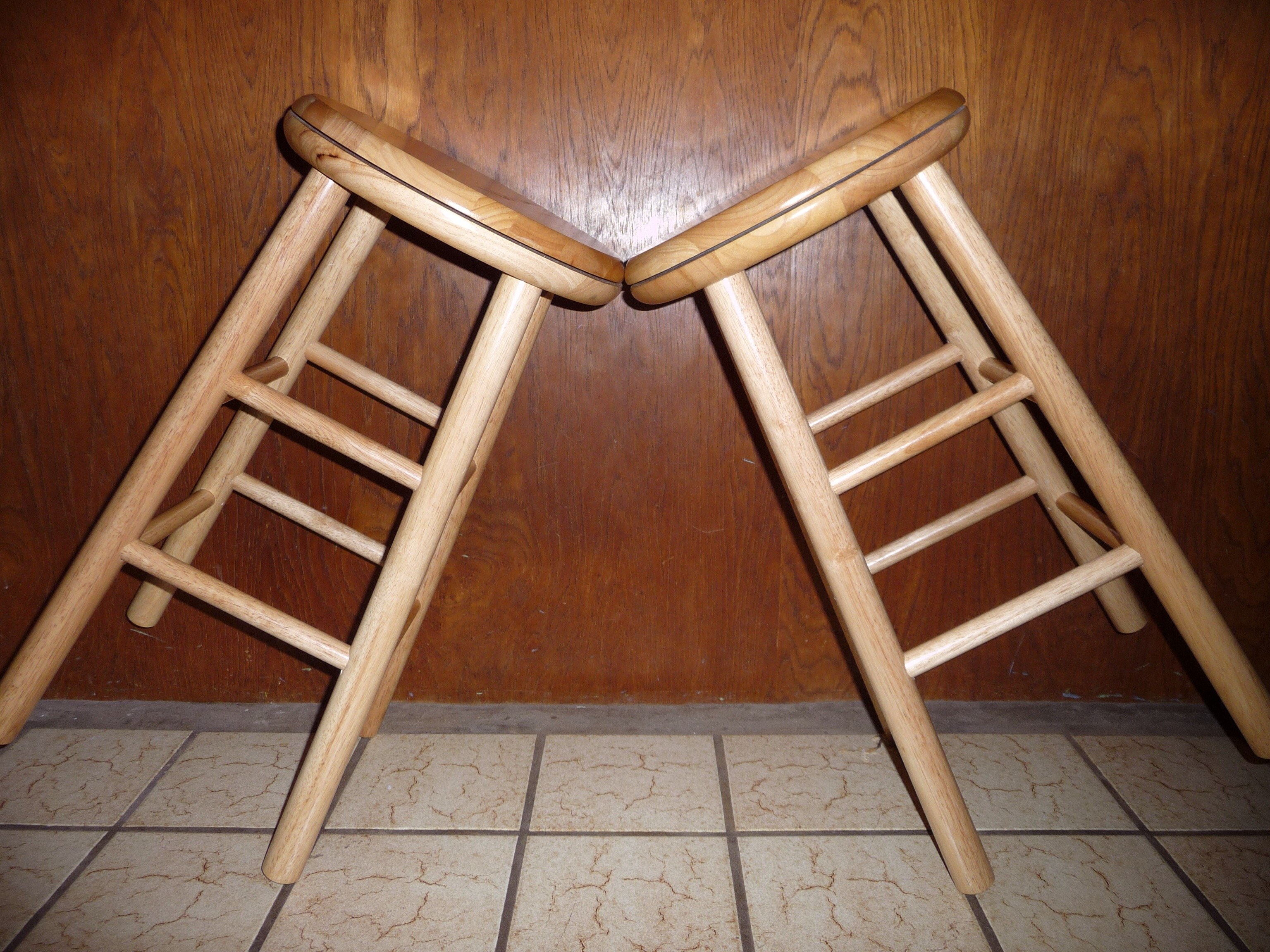
Which has the MOST inertia?

a)
b)
c)
d)
3.

Objects with greater _________ also have greater inertia.

a)

speed

b)

mass

c)

force

d)

friction

4.
Because of inertia, a resting object will remain at ________.
a)
rest
b)
a constant speed
c)
school
d)
inertia 
5.
What kind(s) of objects have inertia?
a)
all objects with mass
b)
only objects at rest
c)
only objects in motion
d)
only objects whose motion is being changed
6.
You push on a car and it does not move.  What is true about the inertia?
a)
The inertia is changing
b)
The inertia of the car is too great 
c)
The inertia of the person is equal to the car
d)
There is not inertia because of no movement
7.
a force that opposes motion between any surfaces that are touching
a)
velocity
b)
friction
c)
inertia
d)
position
8.

Which one has the LEAST inertia?

a)
b)
c)
d)
9.

Inertia refers to ___________

(select all the apply)

a)

the tendency of moving objects to remain in motion

b)

the force which keeps moving objects in motion with a constant velocity

c)

the force that keeps stationary objects at rest

d)

the tendency of stationary objects to remain at rest

10.

A skateboard rolls down a hill, reaches the level surface and eventually comes to a stop. The fact that the skateboard ultimately stops is best explained by ________.

a)

the skateboard needs an additional unbalanced force to continue its motion

b)

the presence of an unbalanced force can cause a moving object to stop

c)

the presence of inertia causes it to stop

d)

the natural tendency of any object is to stop at some point

11.

Newton's 1st Law is also called the Law of ...

a)

Friction

b)

Inertia

c)

Unbalanced forces

d)

Newtons

12.
An object in motion tends to stay in motion unless an ___ force acts on it.
a)
unbalanced
b)
balanced
13.
What type of friction acts on an object that is not yet moving?
a)
Static
b)
Dynamic
c)
kinetic
d)
Rolling
14.
As the child moves down the slide, they mostly experience the effect of ___________.
a)
Rolling Friction
b)
Sliding Friction
c)
Fluid Friction
d)
Static Friction
15.
The wheels on a moving skateboard most likely experience ____________.
a)
Rolling Friction
b)
Sliding Friction
c)
Fluid Friction
d)
Static Friction
16.
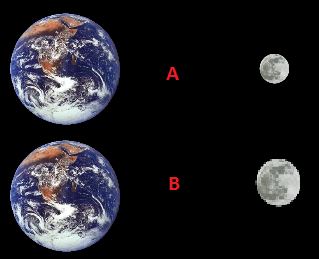
Which model has greater gravitational attraction (if any)
a)
Model A
b)
Model B
c)
Both Model A and Model B (same gravity)
17.
Which system has the greater gravitational attraction between the two objects (if any)?
a)
System A
b)
System B
c)
Same gravitational attraction fro System A and System B
18.
The force of gravity acting on an object is the object's ______.
a)
mass
b)
matter
c)
weight 
d)
friction 
19.
Which of the following never changes no matter where in the universe?
a)
weight
b)
force
c)
mass
d)
pounds
20.
The amount of matter in an object is 
a)
pressure
b)
weight
c)
mass
d)
force
21.
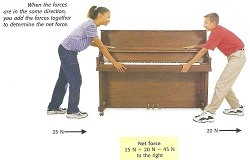
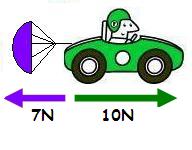
What is the net force?
a)
5 N
b)
45 N to the left
c)
5 N to the right
d)
45 N to the right
22.
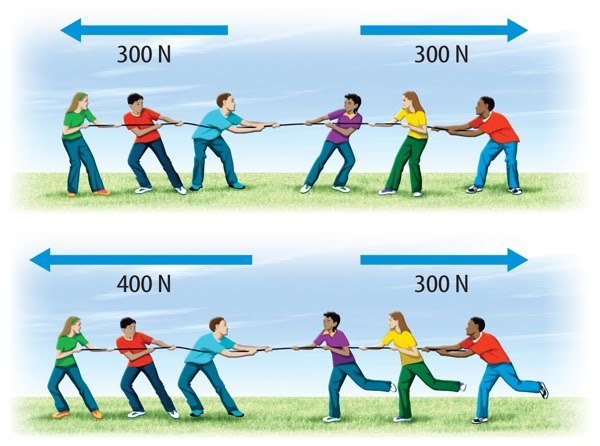
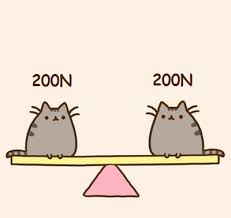
Which one is balanced?
a)
top
b)
bottom
c)
both
23.
Is it BALANCED? 
a)
Yes
b)
No
24.
What is the FORCE? 
a)
5 N
b)
10 N
c)
400 N
d)
0 N
25.
What is the unit for FORCE? 
a)
N (Newtons)
b)
lbs (pounds)
c)
g (grams)
d)
m/s (meters per second)
26.
If there are two forces going in the SAME direction, you would ...?
a)
(-) Subtract the forces
b)
(+) Add the forces
c)
Neither
d)
(x) Multiply
27.
Forces that have a force of Zero (0).
a)
Balanced force
b)
Unbalanced force
28.
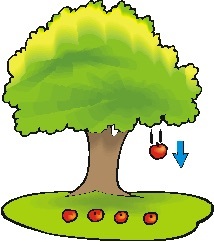
The FORCE that PULLS things down or back to EARTH.
a)
Speed
b)
Gravity
29.
If the net force is 0 the object will ... 
a)
CHANGES motion
b)
STAY the SAME, NOT Move
30.
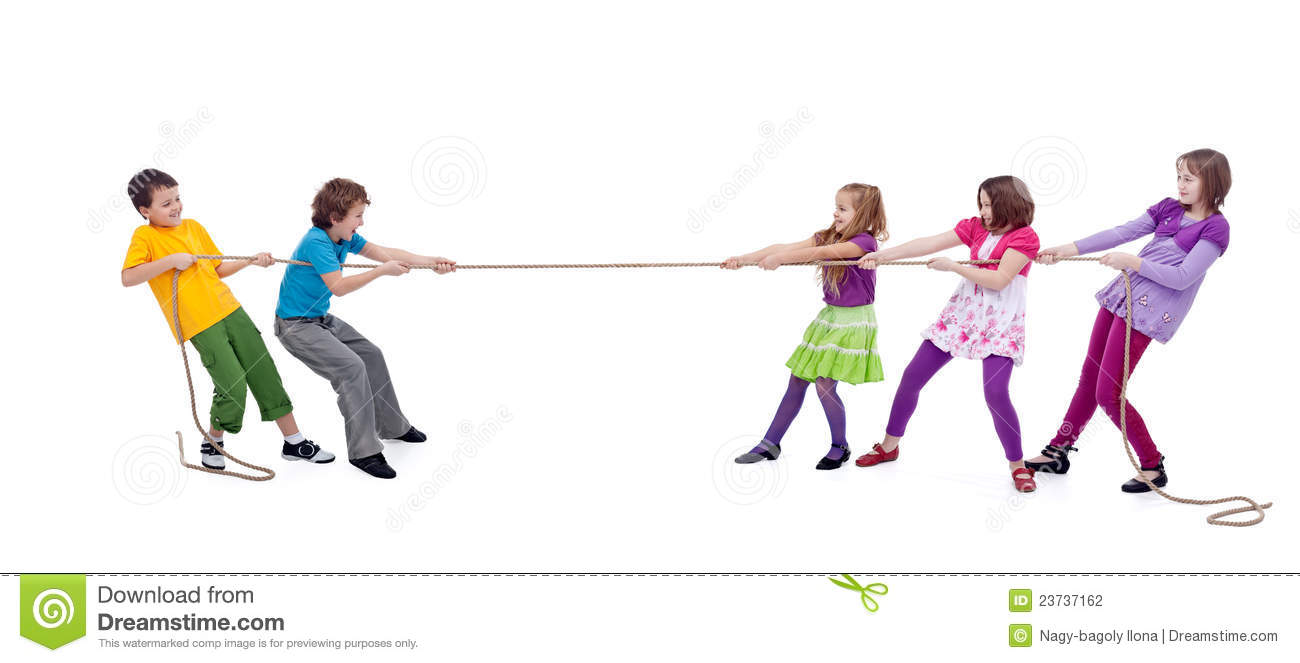
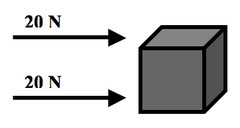
This is an example of what kind of force?
a)
Balanced Force
b)
Pushing Force
c)
Gravity Force
d)
Unbalanced Force
31.
What is the net force?
a)
17 N Right
b)
3 N Right
c)
3 N Left
d)
17 N Left
32.
What is the net force?
a)
65 N left
b)
65 N right
c)
35 N left
d)
35 N right
33.
What is the net force?
a)
4.2 N left
b)
4.2 N right
c)
2.2 N left
d)
2.2 N right
34.
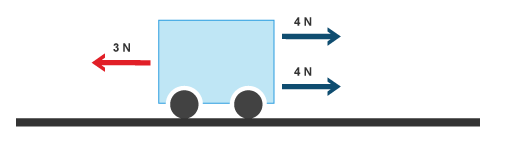
What is the net force?
a)
5.5 N left
b)
5.5 N right
c)
2.5 N left
d)
2.5 N right
35.
What is the net force?
a)
11 N left
b)
11 N right
c)
3 N left
d)
3 N right
36.
What is the net force?
a)
3 N left
b)
3 N right
c)
7 N left
d)
7 N right
37.
What is the net force?
a)
1.3 N left
b)
1.3 N right
c)
3.7 N left
d)
3.7 N right
38.
A toy car was used in an investigation about forces. During which of the following scenarios was the car experiencing balanced forces?
a)
The toy car speeds up as it rolls down a ramp.
b)
The toy car travels forward at a constant speed.
c)
The toy car slows down as it rolls up a hill.
d)
The toy car changes direction at a constant speed.
39.
The diagram below shows a skateboarder pushing himself forward with a force of 25 N while the wind pushes back with a force of 5 N. How will the skateboarder be affected if the force of the wind increases to 8 N?
a)
The speed of the skateboarder will increase.
b)
The speed of the skateboarder will remain constant.
c)
The speed of the skateboarder will decrease.
d)
The skateboarder will come to a stop.
40.

True or False: Newtons Second Law is also called the Law of Inertia

a)

True

b)

False

41.

Which of the following is NOT included in Newtons Second Law

a)

Mass

b)

Acceleration

c)

Speed

d)

Force

42.

If we want to find FORCE which formula would we use?

a)

F = Ka

b)

F = N

c)

F = ma

d)

F = mc2 

43.

What formula would be used to find MASS for Newtons Second Law?

a)

F = ma

b)

m = F/a

c)

a = F/m

d)

m = DQ

44.

What formula would we use to calculate acceleration for Newtons Second Law

a)

a = F/m

b)

m = F/a

c)

F = ma

45.

According to Newton's Second Law HOW would an increase in the acceleration change the FORCE of an object?

a)

The Force would INCREASE

b)

The Force will DECREASE

c)

The Force would STAY THE SAME

d)

The Force would DISAPPEAR

46.
How much force is needed to accelerate a 2 kg physics book to an acceleration of 6 m/s/s?
a)
36 N
b)
12 N
c)
3 N
d)
0.33 N
47.
You pull horizontally on a 50-kg crate with a force of 500 N, and the friction force on the crate is 250 N. The acceleration of the crate is (find net force, use formula)
a)
zero
b)

2 m/s2

c)

4 m/s2

d)

5 m/s2

48.
A 20 kg bike accelerates at 10 m/s2.  what was the force
a)
25 Newtons
b)
20 Newtons
c)
200 Newtons
d)
10 Newtons
49.
What is the net force?
a)
40 N left
b)
0 N Balalnced
c)
400 N right
d)
40 N right
50.
What Unit do we Measure Force in? 
a)
Newtons
b)
Joules
c)
Force
d)
Don't know
51.

An object of mass 10 kg is accelerated upward at 2 m/s2.  What force is required? 

a)
20 N
b)
2 N
c)
5 N
d)
0 N
52.
20 N is the
a)
mass
b)
weight
c)
force
d)
acceleration 
53.
45 m/s2 is the... 
a)
Mass
b)
Force 
c)
Acceleration
d)
weight
54.

If 20 N go to the left and 50 N go to the right the sum of the forces is:

a)

30 N to the left

b)

30 N to the right

c)

80 N to the left

d)

80 N to the right

55.

A 10kg object is at rest, it accelerates because a 50N force is applied. What is the velocity after 4 seconds.

a)

16 m/s

b)

20 m/s

c)

40 m/s

d)

50 m/s

56.

A 5 kg object is at rest. If a 15N force is applied find the velocity after 3 seconds.

a)

9 m/s

b)

12 m/s

c)

15 m/s

d)

75 m/s

57.

A 5 kg object has no velocity. It has 40 N pushing to the left and 30 N pushing to the right. What is the velocity after 4 seconds

a)

8 m/s to the left

b)

8 m/s to the right

c)

10 m/s to the left

d)

10 m/s to the right

58.
Calculate the acceleration of a 150 kg object that is moved with a force of 300N. 
a)
2
b)
150
c)
.5
d)
450
59.

A10 kg bowling ball would require what force to accelerate down an alleyway at a rate of 3 m/s2? 

a)
13
b)
3.3333333
c)
30
d)
7
60.
Newton's Third Law States...
a)
Objects in motion stay in motion and objects at rest stay at rest
b)
Force is equal to mass times acceleration
c)
For each action there is an equal and opposite reaction
61.
A player hits a ball with a bat. The action force is the impact of the bat against the ball. The reaction force is...
a)
The grip of the player's hands on the ball
b)
the air resistance of the ball
c)
the force of the ball against the bat
62.
A baseball player bats a ball with a force of 1,000 N. The ball exerts a reaction force (without any additional forces action on it) against the bat of...
a)
Less than 1, 000 N
b)
1,000 N
c)
More than 1,000 N
63.
A rocket pushes exhaust 10, 000 N. Without any other forces acting on the rocket, how much force does the rocket go forward?
a)
15,000 N
b)
1,000 N
c)
10, 000 N
64.
What is the reaction force to a foot pushing down on the floor?
a)
The foot going through the floor
b)
The floor pushing back against the foot
c)
The floor breaking to the foot
65.
According to Newton's third law forces come in pairs?
a)
True
b)
False
66.
Momentum is a ____________________ quantity
a)
science
b)
scalar
c)
vector
d)
energy
67.

The momentum of an object depends upon the object's ___________&_____________.

a)

size and shape

b)

mass and speed

c)

mass and veloctiy

d)

mass and energy

68.
Determine the momentum of 1000-kg car moving northward at 20 m/s......... 
a)
20000 N
b)
20000 Joules
c)
20000 Kg * m/s
d)
20000 kg * m/s north
69.
The definition of momentum is
a)
Mass in Motion
b)
The size of an object
c)
The velocity of an object
d)
A comparison between two objects
70.
The equation to calculate momentum is
a)
p=mv
b)
p=1/2mv2
c)
p=mgh
d)
p=mg
71.
In any collision (crash) the ______ is ALWAYS constant
a)
Total Momentum
b)
total speed
c)
total Velocity
d)
Energy
72.
A 0.250 kg cart moving at 0.400 m/s has how much momentum?
a)
0.1 kg-m/s
b)
1 kg-m/s
c)
10 kg-m/s
d)
100 kg-m/s
73.
A 2 kg cart has a momentum of 16 kg m/s. What is its velocity?
a)
8 m/s
b)
32 m/s
c)
0.125 m/s
d)
18 m/s
74.
The total momentum before a collision is _________ the total momentum after a collision.
a)
equal to 
b)
less than 
c)
more than
d)
It depends on the type of collision
75.
Which of the following images has more momentum?
a)
Object A
b)
Object B 
c)
They are the same
76.
If two objects have the same mass, then the faster moving object has ____________ momentum.
a)
more 
b)
less
c)
the same
77.

10 m = _____ mm

a)

10,000 mm

b)

100 mm

c)

1 mm

d)

1,000 mm

78.

987 mm = _____ cm

a)

98.7 cm

b)

9,870 cm

c)

9.87 cm

d)

0.987 cm

79.

4.5 m = _____ cm

a)

45 cm

b)

450 cm

c)

0.45 cm

d)

4,500 cm

80.

2.7 L = _____ mL

a)

0.27 mL

b)

270 mL

c)

2,700 mL

d)

27 mL

81.

18 kg = _____ g

a)

180 g

b)

1,800 g

c)

1.8 g

d)

18,000 g

82.

345 cm = _____ m

a)

3.45 m

b)

0.345 m

c)

34.5 m

d)

3,450 m

83.

2.76 kg = _____ g

a)

0.276 g

b)

276 g

c)

2,760 g

d)

27,600 g

84.

Ed fills his sports bottle with 1 liter of water. After his bike ride, he drinks 200 milliliters of the water. How much water is left in Ed's sports bottle?

a)
800 mm
b)
8000 ml
c)
80 ml
d)
800 ml
85.

7,000 g = ____ kg

a)
70
b)
7000
c)
7
d)
0.07
86.
Is 20 g greater than, less than, or equal to 2 kg?
a)
greater than
b)
less than
c)
equal to
87.
490,000 g =____ kg
a)
490
b)
49
c)
4,900
d)
0.49