
 Worksheets
Quiz 2
Total questions: 59
Worksheet time: 1hrs 29mins
The crucial problem of economics is
Establishing a fair tax system.
Providing social goods and services
Developing a price mechanism that reflects the relative scarcities of products and resources.
Allocating scarce productive resources to satisfy wants
Enacting a set of laws that protects resources from overuse.
When one decision is made, the next best alternative not selected is called
economic resources
opportunity cost
scarcity
comparative disadvantage
production
Which of the following is true of the concept of increasing opportunity costs?
It is unimportant in command economies because of central planning.
It suggests that the use of resources to produce a set of goods and services means that as more of one is produced, some of the other must be sacrificed.
It is irrelevant if the production possibilities curve is convex to the origin
It suggests that unlimited wants can be fulfilled.
It means that resources are plentiful and opportunities to produce greater amounts of goods and services are unlimited.
In the circular flow diagram, which of the following is true?
Businesses pay wages, rent, interest, and profits to households in return for use of factors of production.
Businesses purchase goods and services from households in return for money payments.
Households pay wages, rent, interest, and profits to businesses in return for use of factors of production.
The relationship between households and businesses exist only in a traditional society.
The relationship between households and businesses exists only in command economy.
Which of the following goods would be considered scarce?
I. Education
II. Gold
III. Time
I only
II only
III only
I and II only
I, II and III
In which way does a straight-line production possibilities curve differ from a concave production possibilities curve?
A straight-line production possibilities curve has a decreasing opportunity cost.
A straight-line production possibilities curve has a constant opportunity cost.
A straight-line production possibilities curve has an increasing opportunity cost.
A straight-line production possibilities curve does not show opportunity cost
Upward-sloping production possibilities curve.
The law of increasing opportunity cost is reflected in the shape of the
Production possibilities curve concave to the origin (“bowed-out”)
Production possibilities curve convex to the origin (“bowed-in”)
Horizontal production possibilities curve
Straight-line production possibilities curve
Upward-sloping production possibilities curve
Which of the following would cause an inward shift of the production possibilities curve?
An increase in unemployment
An increase in inflation
An increase in capital equipment
A decrease in consumer demand
A decrease in the population
Which of the following would cause an outward shift in the production possibilities curve?
An increase in unemployment
An increase in inflation
An increase in capital equipment
A decrease in natural resources
A decrease in the number of workers

What is the opportunity cost of moving from point B to C on the curve?
30 tons of wheat
30 tons of steel
5 tons of wheat
5 tons of steel
75 tons of wheat
Ford can produce 200 Mustangs or 400 Escapes in their factory. What is the opportunity cost of making each Mustang?
1/2 Escape
1/2 Mustang
2 Escapes
2 Mustangs
400 Escapes

What is the opportunity cost of increasing production of french fries from 11 to 18 orders?
11 French Fries
7 Chicken Nuggets
7 French Fries
48 Chicken Nuggets
18 French Fries
When a point lies inside of the PPC it can be said that
Resources are under employed
Resources are fully utilized
Production is beyond the resource potential
Opportunity cost of production is constant
Allocative efficiency is achieved
In a market economy, ___________ are relied upon to ration output.
Firms
Consumers
Prices
Supply
Governments
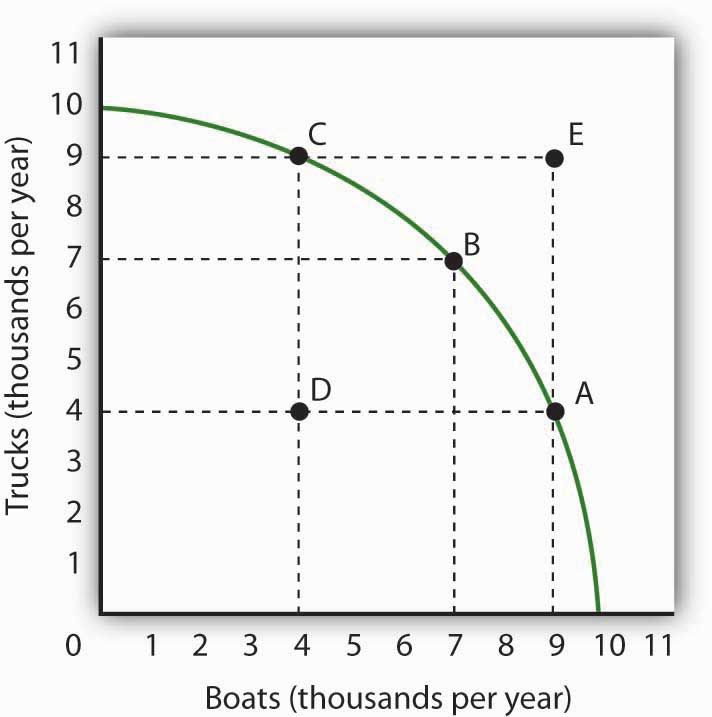
The opportunity cost of increasing production from 7 to 9 trucks is
0 boats
2 boats
2 trucks
3 boats
7 trucks
What can cause a production possibilities curve to move to the right?
thousands of people move out of the country
a drought destroys many crops
new technology
the population is growing increasingly old
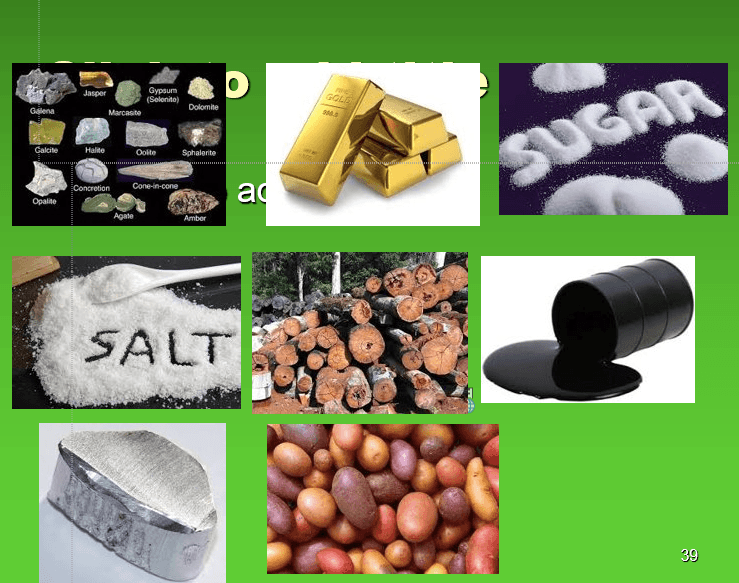
Which factor of production is this?
capital
entrepreneur
land
labor

Command economies are usually dominated by:
Free market enterprise
Traditions, customs, and beliefs
State-owned enterprise
All of the above
Which of the following is the best definition of the word "marginal?"
Additional
Abstract
Econometric
Complicated
Which economic system provides private ownership of property and resources?
Traditional Economy
Free Market Capitalism
Communism
Command Economy
The Invisible Hand concept explains
consumers and producers working together with no one directing them
businesses taking advantage of customers
helping those who are disadvantaged
economic planning and direction by experts
WHAT IS LABOR?
work people do for wages to produce good and services
actions people do for other people
any physical object
The money people get for inheritance


Moana's village would be an example of a ___________ economy.
Traditional
Planned/command
Mixed
Free-market
An example of a public good provided by the government would be:
Cars
Interstate highway
Phones
Internet
_______________ would be an example of a modern mixed economy. (select all that apply!)
Germany
The United States
North Korea
Brazil
__________ is an example of a planned/command economy.
Capitalism
Traditional
Uniited States of America
Communism
The closest thing to a planned/command economy today exists in:
Soviet Union
Czechoslovakia
North Korea
South Korea
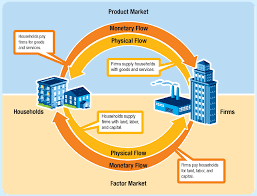
This diagram is called a:
Production Possibilities Curve
Supply and Demand Curve
Circular Flow Model
Circular Motion Equation
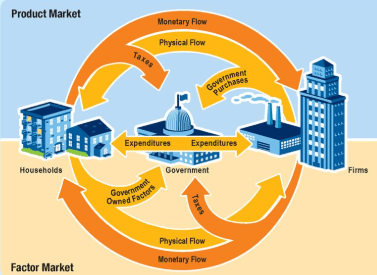
This circular flow model would be for a __________ economy
Traditional
Planned/Command
Free Market
Mixed Economy
This circular flow model would be for a __________ economy
Traditional
Planned/Command
Free Market
Mixed Economy
Define traditional market
A market based on cultural rituals
Relies on government to make all the decision.
Consumer decisions choose how industries and financial markets work
None of the above

KYLIAN PLAYS FOR .....
REAL MADRID
INTER
BARCELONA
PSG
Where is mbappe


Where is Messi from?
Brazil
Chile
Argentina
Peru

who's better?
Ronadlo
Messi
Mbappe

