
 Worksheets
Muscular System Review
Total questions: 55
Worksheet time: 55mins
What muscle makes up the heart?
involuntary muscle
smooth muscle
cardiac muscle
voluntary muscle
Point of origin refers to .......
the place where the muscles attach to the bone, but no movement occurs
the place where the muscles attach the and movement occurs
where a muscle attaches to another muscle
the membrane the covers and supports muscles
Which is NOT a kind of muscle in the human body?
exoskeletal
smooth
skeletal
cardiac
Muscles are working in your body even when you are asleep and still.
True
False

The space between two Z lines constitutes the?
sarcoplasm
sarcophagus
sarcolemma
sarcomere
The energy needed to perform a muscle contraction comes directly from
ATP
Oxygen
Glucose
Calcium

Do the lengths of the thick and thin filaments change during contraction?
Yes
No
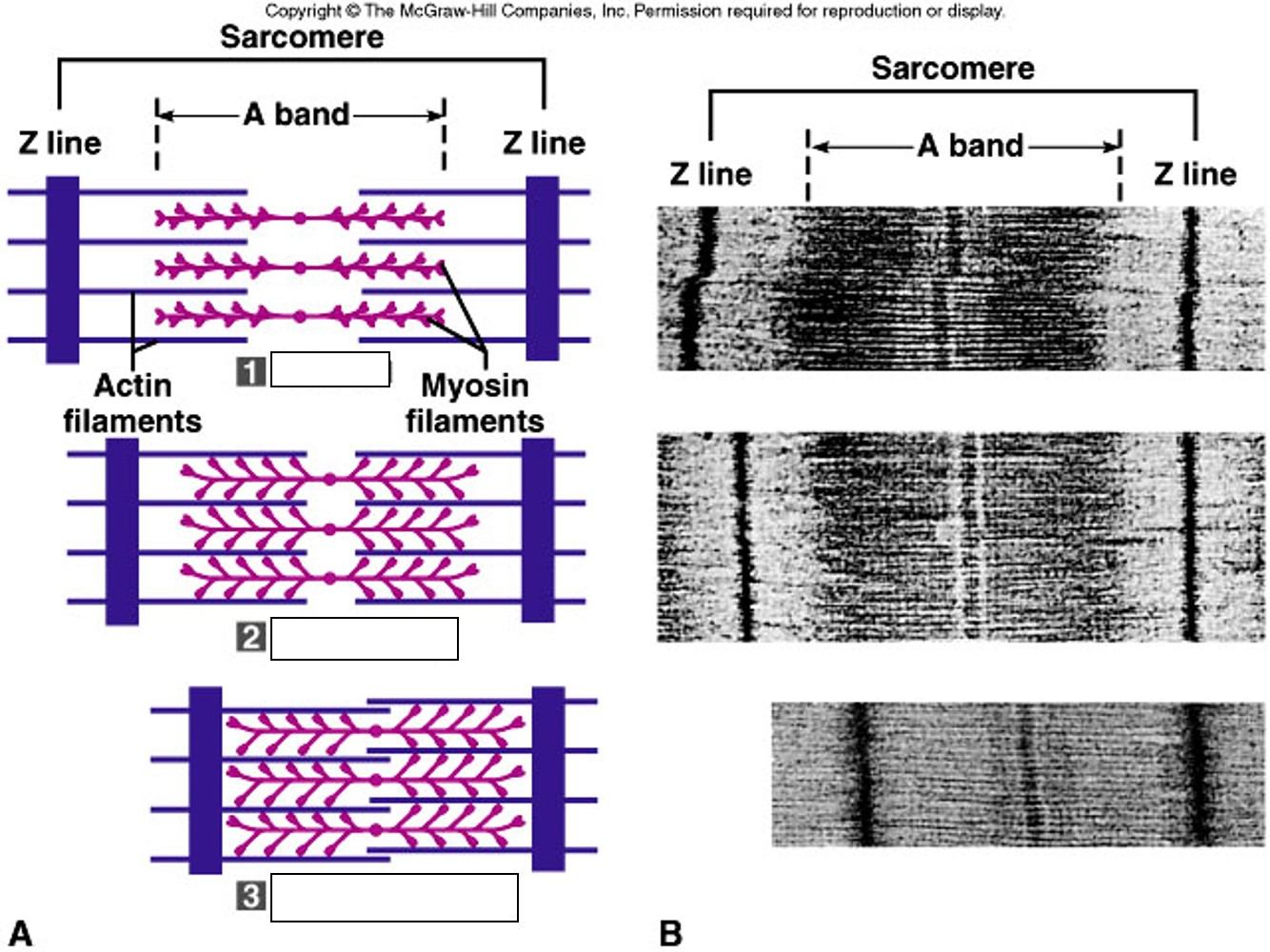
Partially Contracted
Partially Contracted

What muscle type is this?
cardiac
skeletal
smooth
Which muscle type is striated?
cardiac
skeletal
smooth
cardiac and skeletal
What type of muscle lines the inside of the stomach?
cardiac
skeletal
smooth
What type of muscle is/are voluntary?
smooth and cardiac
smooth
skeletal and smooth
skeletal
What type of muscle(s) is involuntary?
skeletal and smooth
cardiac and skeletal
smooth and cardiac
skeletal

What type of muscle tissue is this?
cardiac
skeletal
smooth
Calf raises primarily strengthen which muscle found in your lower leg?
Gastrocnemius
Pectoralis
Obliques
Glutes

The dark area on a myofibril where the actin and myosin filaments overlap is the
H-band
I-band
A-band
Z-line

The light area of a sarcomere that contains only thin filaments is the
H-band
I-band
A-band
Z-line


Label #3
Deltoid
Rectus Abdominis
Abdominals
Trapezius

Label #4
Soleus
Tibialis Anterior
Gastocnemius
Triceps Surae

Label #5
Pectoralis Major
Serratus Anterior
Pectoralis Minor
Deltoid
Label #6
Triceps Brachii
Brachioradialis
Biceps Brachii
Deltoid

Label #10
Rectus Femoris
Hamstrings
Quadriceps
Biceps Femoris

Label #11
Tibialis Anterior
Tibialis Posterior
Gastrocnemius
Soleus
Label #12
Tibialis Anterior
Tibialis Posterior
Gastrocnemius
Soleus

Label #13
Deltoid
Latissimus Dorsi
Trapezius
Rhomboids
Label #15
Deltoid
Latissimus Dorsi
Trapezius
Triceps Brachii
Label #17
Gluteus Minimus
Gluteus Maximus
Piriformis
Gluteus Medius

What is the muscle labeled 13?
Pectoralis
Latissimus Dorsi
Rhomboids
Trapezius
Muscles can only __________, they never ___________.
push, pull
pull, push
Another name for the prime mover is
antagonist
agonist
synergist
fixator
A muscle that helps the prime mover is called a
antagonist
agonist
synergist
fixator

In the picture, the biceps are the
antagonist
agonist
fixator
synergist
In the picture, the triceps muscles are the
antagonist
agonist
fixator
synergist
The place where a tendon attaches the muscle to the moveable end of the bone is known as
the origin
the insertion
a joint
an articulation
When the agonist contracts, the antagonist:
also contracts
relaxes
A muscle that opposes (or creates the opposite action of an agonist) is known as:
Prime mover
Insertion
Origin
Antagonist
What are the two proteins responsible for muscle contraction?
troponin and tropomyosin
actin and myosin
adenine and guanine
Tom and Jerry
When the antagonist relaxes, the agonist:
contracts
relaxes

What are muscles called that help the agonist preform an action?
Prime movers
Synergists
A muscle can be a synergist for one action and an antagonist for another action.
true
false
What is the name of the connective tissue sheath that surrounds each muscle fiber?
Endomysium
Epimysium
Perimysium
Which membrane covers several fibers to form a fascicle?
Endomysium
Epimysium
Perimysium
Which membrane binds many fascicles together and covers the entire muscle?
Endomysium
Epimysium
Perimysium

Which label is pointing to the perimysium?
A
B
C
D
Which label is pointing to the epimysium?
A
B
C
D
Which label is pointing to the endomysium?
A
B
C
D

