
 Worksheets
AP Review
Total questions: 102
Worksheet time: 5hrs 21mins


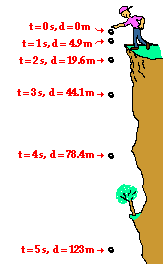
completely described by a magnitude with a direction.

What is the average velocity of the object between 0 and 10 seconds?
6.0 m/s
1.5 m/s
-4 m/s
0 m/s

What is the average velocity of the object between 10 and 15 seconds?
6 m/s
1.5 m/s
-4 m/s
0 m/s

What is the average velocity of the object between 15 and 40 seconds?
6.0 m/s
1.5 m/s
-4 m/s
0 m/s

What is the rate of acceleration of the object between 0 and 4 seconds?
1 m/s
0 m/s2
-1 m/s2
1 m/s2

What is the velocity of the object between 4 and 5 seconds?
0 m/s
5 m/s
1 m/s
2 m/s

Which graph(s) represents a constant velocity?
a and c
b and c
c
a and b

At what point is vy= 0 m/s?
A
B
C
D
None of these points
At what point is vx= 0 m/s?
A
B
C
D
None of these points
Which vector pair (arrow pair) correctly represents the acceleration and velocity at point P?


Who do you agree with?
Anita: “A projectile’s vx changes because of gravity, and its vy remains constant.”
Barry: “Both vx and vy are constant.”
Chris: “A projectile has no acceleration in the vertical dimension but it does accelerate horizontally.”
Dave: “A projectile has vertical acceleration and a constant horizontal velocity”

Suppose Lemming A runs off the edge of the cliff at 2 m/s and Lemming B runs off the edge at 1 m/s. Which will hit the ground first?
A
B
Both at the same time
Suppose Lemming A runs off the edge of the cliff at 2 m/s and Lemming B runs off the edge at 1 m/s. Which will hit the ground farther from the base of the cliff?
A
B
Both at the same distance
A ball is thrown into the air at some angle, with initial velocities vx (horizontal) and vy (vertical). At the very top of the ball’s path:
What is its velocity in the horizontal direction?
vx
Greater than vx
Zero
A ball is thrown into the air at some angle, with initial velocities vx (horizontal) and vy (vertical). At the very top of the ball’s path:
What is its velocity in the vertical direction?
vy
Greater than vy
Zero

A package is dropped from an airplane, where will the package hit the ground?
A
B
C

If you throw a baseball straight up, what is its acceleration at the highest point?
about 10 m/s2
about 10 m/s
0 m/s2
0 m/s

If you throw a baseball straight up, what is its velocity at the highest point?
about 10 m/s2
about 10 m/s
0 m/s2
0 m/s
A frog jumps vertically straight up. Which of the following is true?
gravity gives the frog a vertical speed of -10 m/s
gravity gives the frog a vertical acceleration of -10 m/s2
the frog has a horizontal speed of -10 m/s
the frog has a horizontal acceleration of -10 m/s2
An object is thrown horizontally from a cliff. The time it takes to hit the ground is
more than if it was just dropped
less than if it was just dropped
the same amount of time than if it was just dropped
impossible to determine

A projectile is launched with a horizontal speed of 54 m/s. Ignoring air resistance, after 2 seconds it's horizontal speed is...
34 m/s
54 m/s

Two objects of the same mass are launched from the ground. Object A has a launch angle of 45, while Object B has a launch angle of 65. Which object has the greatest maximum height height?
A
B
Both objects reach the same height
unable to determine with the given information

A skateboarder rolls off a bridge into the river as shown. If the skateboarder was originally moving at 7.0 m/s, how much time did the skateboarder spend in the air?
1.3 s
0.79 s
38.5 s
0.70 s
Not enough information given.

What is the horizontal acceleration of a projectile in real life?
0 m/s2
9.8 m/s2

What is the vertical acceleration of a projectile in real life?
0 m/s2
9.8 m/s2

In the diagram, which letter represents the vertical displacement dy ?
A
B
C
D
In the diagram, which letter represents the horizontal displacement dx ?
A
B
C
D
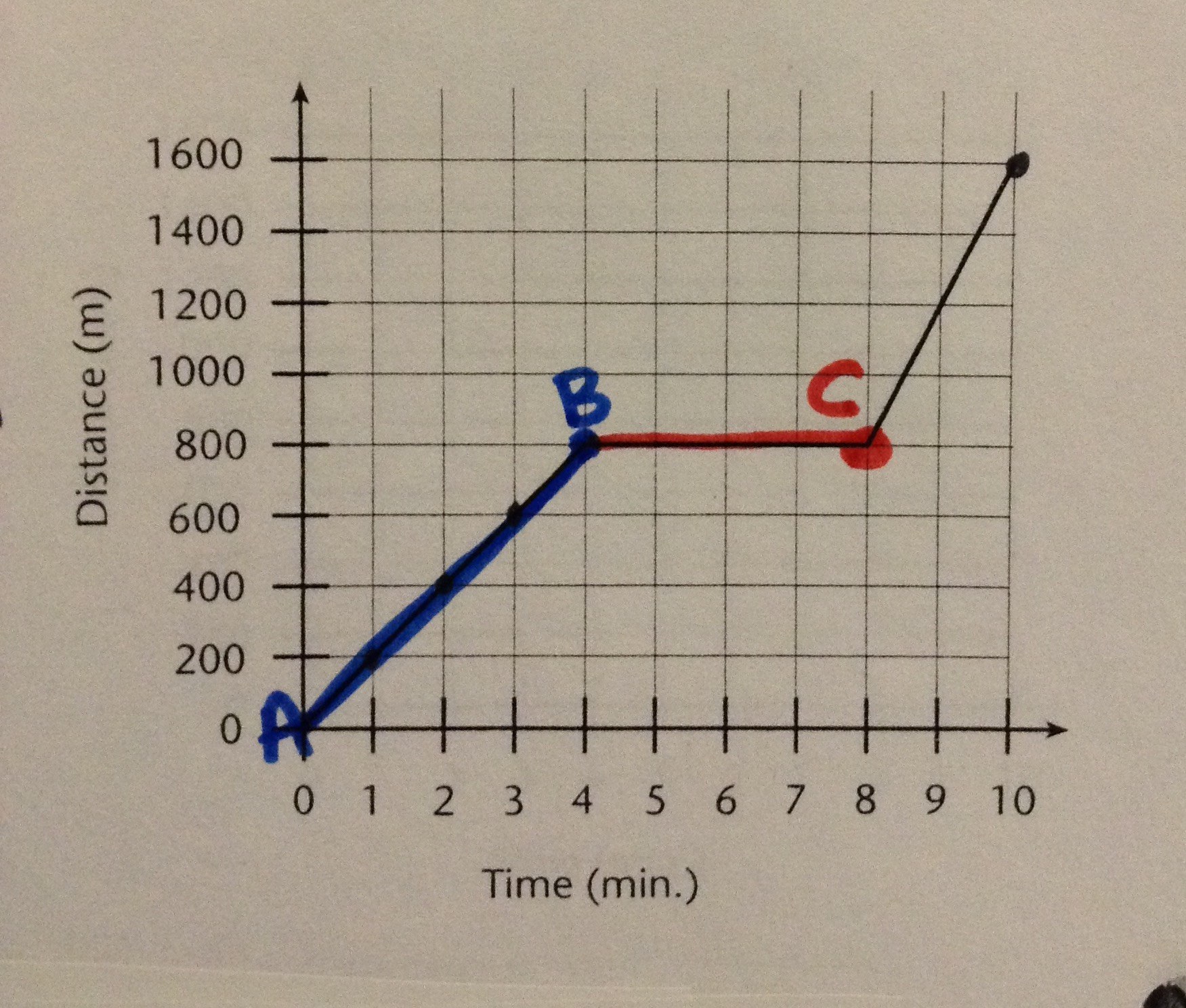
What is occurring from point A to point B?
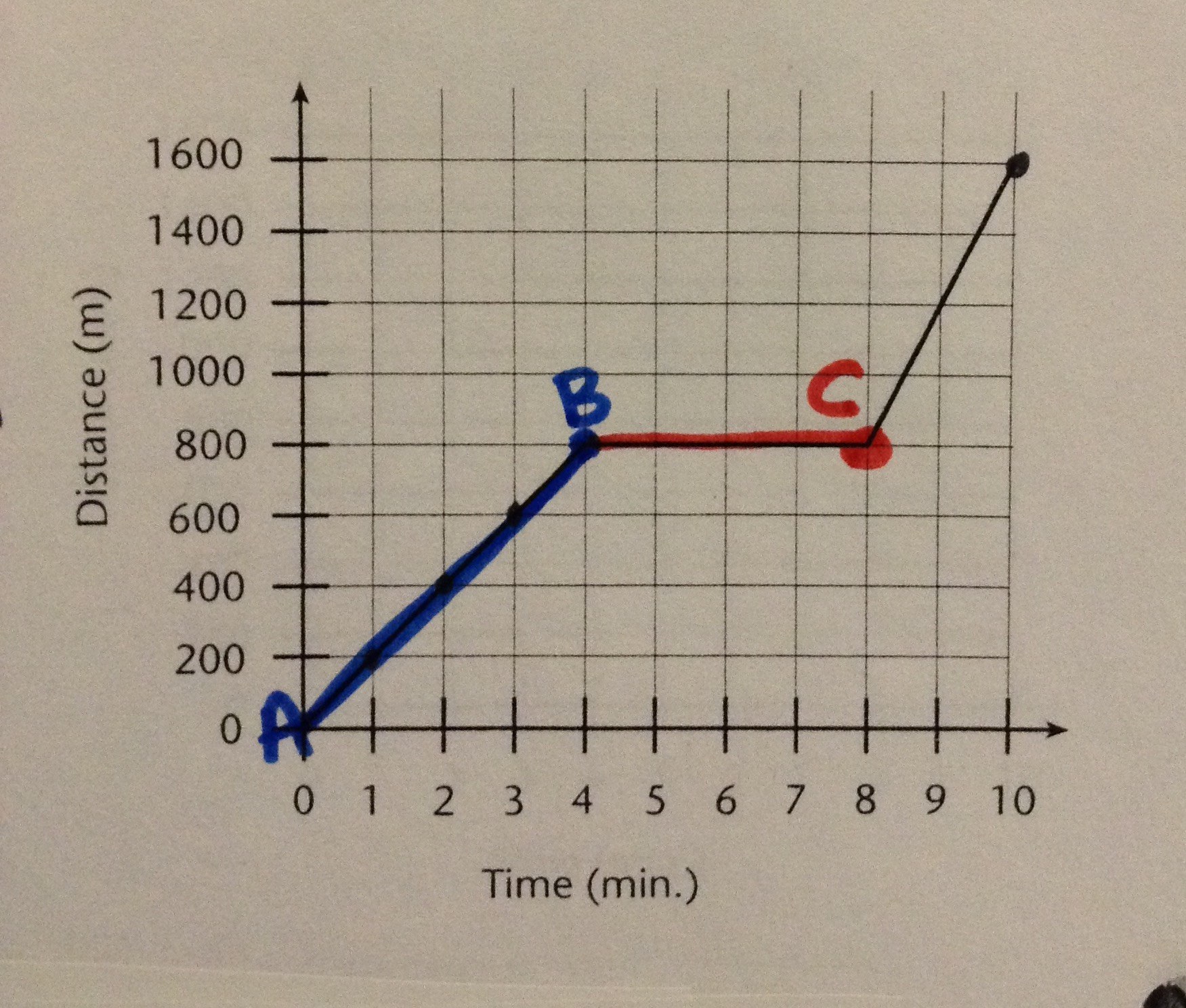
What was occurring from point B to point C?
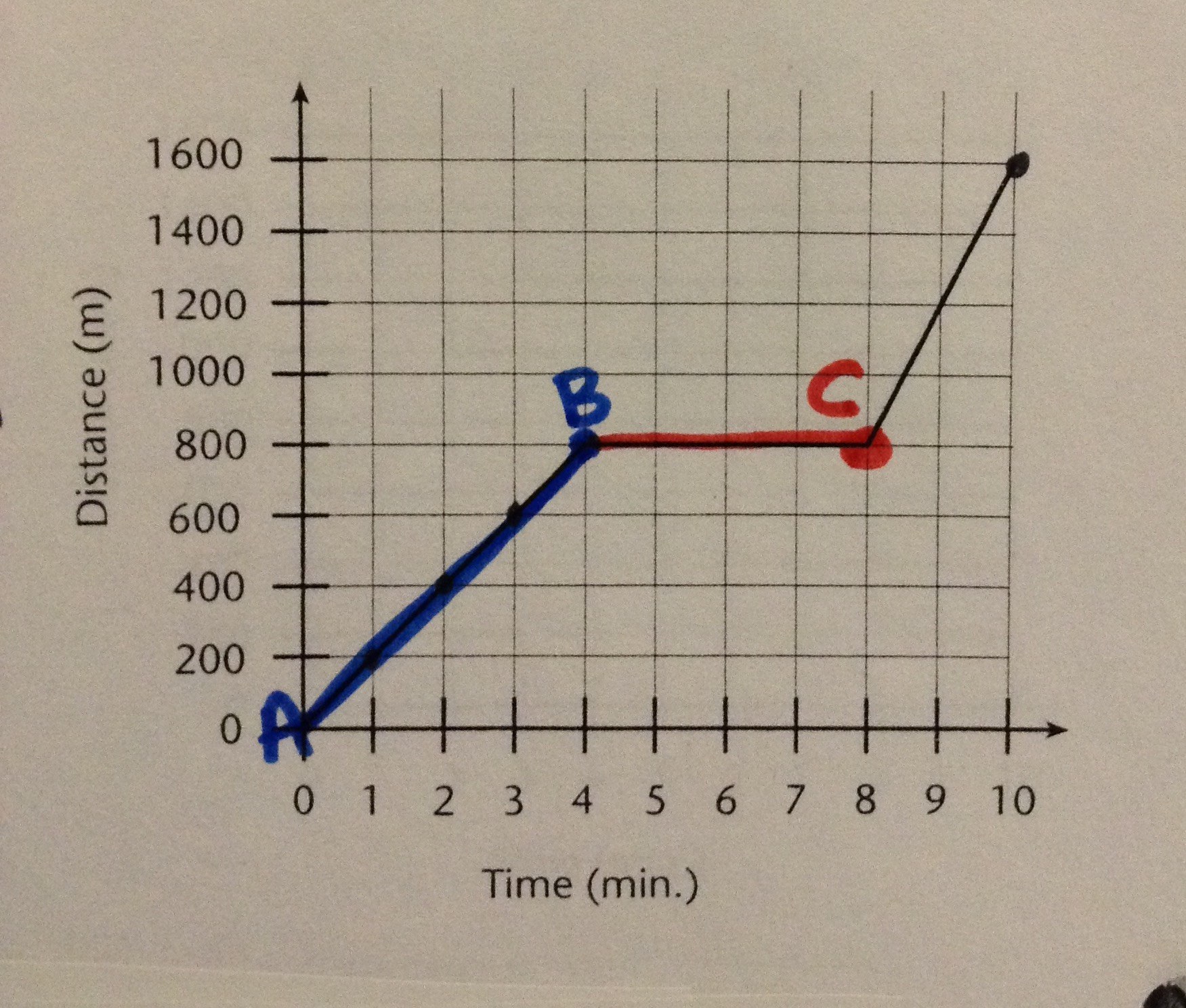
What was her average speed for the ENTIRE trip?


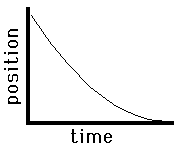

Given this x-t graph, what will the v-t graph look like?
Sloped line
Parabola
Flat line
Flat line at 0

Given the following a-t graph, what would the v-t graph look like?
Sloped line
Parabola
Flat line
Flat line at 0


What is happening between 4 and 5 seconds?
The object is slowing down in a negative direction (opposite direction).
The object is slowing down in a positive direction.
The object is slowing down in a negative direction (opposite direction).
The object is speeding up in a negative direction (opposite direction).


Find the total displacement in the 7 seconds of motion.
1 centimeter
0 centimeters
9 centimeters
12 centimeters


What is happening during point C to D?
not moving
increasing speed at a constant rate
moving at a constant speed
moving at 0 m/s2 acceleration

What is happening during point A to B?
not moving
increasing speed at a constant rate
moving at a constant speed
moving at 10 m/s2 acceleration

What is the graph showing?
Slowing down moving toward start
Speeding up moving toward start
Slowing down moving away from start
Speed up moving away from start

What is the graph showing?
Speeding up moving away from start
Speeding up moving towards start
Slowing down moving towards start
Slowing down moving away from start

What is the graph showing?
Constant speed towards start
Constant speed away from start
Acceleration away from start
Acceleration towards start

Along line segment B, the object is:
Not moving
Moving at a constant velocity
Changing direction
Experiencing acceleration
What is the rate of acceleration of the object between 0 and 4 seconds?
1 m/s
0 m/s2
-1 m/s2
1 m/s2


Vertical 7.2
Vertical 18.9
Vertical 9.6
Vertical 15.2
A potato cannon fires a potato horizontally off of a 6 m high hill with a velocity of 10 m/s. How far from the base of the cliff did it land?
For this question, what variable are you trying to solve for?
ay
vfy
dx
vx
dy
A potato cannon fires a potato horizontally off of a 6 m high hill with a velocity of 10 m/s. How far from the base of the cliff did it land?
For this question, check all of the below that are currently knowns.
viy
vx
ay
dy
dx
A potato cannon fires a potato horizontally off of a 6 m high hill with a velocity of 10 m/s. How far from the base of the cliff did it land?
For the problem above, using only the information listed, which formula would allow you use to solve for the "time it took to fall" without needing any other formula?
v=ΔtΔd
a=Δtvf−vi
d=viΔt + 21aΔt2
d=21(vf+vi)Δt
A potato cannon fires a potato horizontally off of a 6 m high hill with a velocity of 10 m/s. How far from the base of the cliff did it land?
Solve the problem.
12.24 m
11.06 m
9.09 m
732.23 m
1176 m
A toy car drives right off of a table. The car hits the ground in 0.75 seconds and lands 3.5 m away from the table. What was the initial velocity of the car?
For the problem above what formula would you use?
v=ΔtΔd
a=2Δdvf 2−vi2
a=Δtvf−vi
d=viΔt+21aΔt2
A toy car drives right off of a table. The car hits the ground in 0.75 seconds and lands 3.5 m away from the table. What was the initial velocity of the car?
Solve the problem.
0.21 m/s
2.63 m/s
3.91 m/s
4.67 m/s
6.09 m/s
A toy car drives right off of a table. The car hits the ground in 0.75 seconds and lands 3.5 m away from the table. How high was the table?
In the problem above what variable are you trying to solve for?
vy
dx
ax
vx
dy
A toy car drives right off of a table. The car hits the ground in 0.75 seconds and lands 3.5 m away from the table. How high was the table?
In the problem above what formula would you use to solve for how high the table is?
v=ΔtΔd
a=Δtvf−vi
d=viΔt+21aΔt2
ac=rvt2
A toy car drives right off of a table. The car hits the ground in 0.75 seconds and lands 3.5 m away from the table. How high was the table?
Solve the problem.
2.63 m
4.19 m
3.68 m
2.76 m
A small ball is thrown straight up and reaches a height of 7.97 m in 1.25 seconds. What is the velocity at impact when it returns to the same height it was released from?
In the problem above, what variable is the unknown that we are trying to solve for?
dx
dy
vfx
vfy
viy
A small ball is thrown straight up and reaches a height of 7.97m in 1.25 seconds. What is the velocity at impact when it returns to the same height it was released from?
In the problem above, what variables are known. Mark all that apply.
Δt
dx
dy
ay
m
A small ball is thrown straight up and reaches a height of 7.97m in 1.25 seconds. What is the velocity at impact when it returns to the same height it was released from?
In the problem above, what formula(s) below could you use to solve the problem? Mark all that apply.
v=ΔtΔd
a=2Δdvf2−vi2
a=Δtvf−vi
d=21(vf +vi)Δt
A small ball is thrown straight up and reaches a height of 7.97m in 1.25 seconds. What is the velocity at impact when it returns to the same height it was released from?
Solve the problem.
-12.25 m/s
-14.13 m/s
-6.37 m/s
-17.42 m/s
A small ball is thrown straight up and reaches a height of 7.97m in 1.25 seconds. What was the total time it was in the air?
1.25 s
2.50 s
3.75 s
4.50 s
An object is kicked at an angle with a velocity of 40 m/s. The initial horizontal velocity component is 25 m/s. What is the vertical velocity component when the object returns to ground?
-25 m/s
-40 m/s
-37.93 m/s
-29.75 m/s
-31.22 m/s
An object is kicked at an angle with a velocity of 40 m/s. The initial horizontal velocity component is 25 m/s. What is the time it takes to reach the top of its arc?
Solve the problem.
1.6 s
2.55 s
3.19 s
4.08 s
5.79 s

Two identical balls, X and Y, are projected horizontally from the edge of a cliff. The path of each ball is shown in the picture. Which of the following statements are true (mark all that apply)?
They have the same initial horizontal speed
They have the same vertical acceleration
They have the same initial vertical velocity
They take the same amount of time to reach the water
What is the only force acting on a projectile?
air resistance
gravity
launch force
launch speed
A dog is running at 10 m/s at angle of 27 degrees. Find the x velocity of the dog.
8.9 m/s
4.5 m/s
4.6 m/s
26.6 m/s

A soccer ball is kicked and follows the path as shown. At which point is the vertical acceleration equal to - 9.80 s2m ?
X
Y
Both X and Y
Neither X nor Y

When an object is undergoing projectile motion, which of the following are constant? Check all that apply.
vy
vx
ax
ay
A Macaque monkey sitting 12 m up in a tree throws a nut horizontally at 11 m/s. How long will it take the nut to hit the ground?
2.45 s
4.32 s
1.56 s
not enough information

